Most outsourced facility management contracts are won on the proposal and lost in the first quarter. Service requests slip through the gap between the outgoing team and the incoming provider, preventive maintenance quietly stops, and nobody can say which assets were last inspected. A structured 90-day transition keeps buildings running while responsibility moves across. It covers knowledge transfer, tool transfer, technology transition, and a controlled service level ramp, and it needs one shared record of assets and work orders such as the one in Oxmaint CMMS.
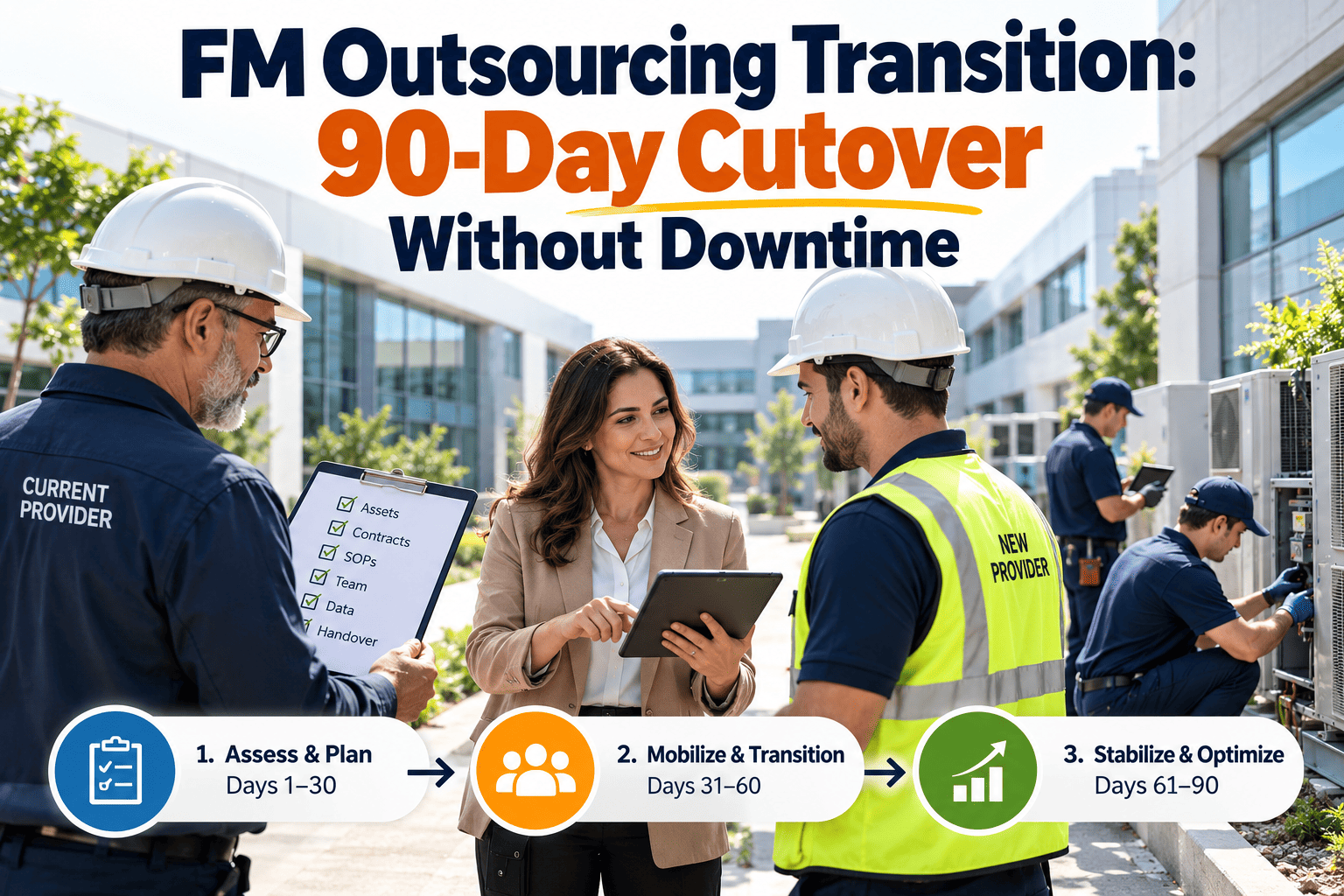
FM Outsourcing Transition: 90-Day Cutover Without Downtime
A phased plan for moving facility services to a new provider while keeping response times, compliance, and tenant confidence intact.
Day 0Day 30Day 60Day 90
Discover and baseline
Shadow and transfer
Cutover and hypercare
SLA ramp and review
Why transitions break service
Hidden knowledge
Incumbent technicians know which boiler trips in cold weather and which tenant needs a call before access. None of it is written down.
Incomplete asset data
Asset lists in spreadsheets omit locations, serial numbers, warranties, and statutory inspection dates.
Unclear accountability
During the handover window, both teams assume the other is covering urgent calls and routine rounds.
Industry transition guidance, including methods promoted by IAOP, consistently treats transition as its own project with governance, risk tracking, and defined exit criteria rather than a side task for the first month of service.
The four workstreams
1
Knowledge transfer
Capture site history, procedures, contacts, and unwritten rules from the outgoing team and the client.
2
Tool transfer
Move keys, access cards, vehicles, test equipment, spares, and consumables with a signed inventory.
3
Technology transition
Migrate asset registers, PM schedules, open work orders, and reports into the system the new provider will use.
4
SLA ramp
Agree how service levels, reporting, and any service credits phase in as the provider takes over.
Days 1 to 30: discover and baseline
The first month is about learning what actually exists. Resist the urge to fix everything yet, because a bad baseline poisons every later metric.
Core activities
- Form a joint transition team with named leads from client, incumbent, and new provider.
- Walk the site to verify the asset register against what is physically installed.
- List statutory and contractual inspections, with dates, certificates, and responsible persons.
- Review open work orders, backlog, and repeat faults from the last twelve months where records allow.
- Log risks, such as critical equipment without service history, in a shared register with owners.
Gate 1 criteria: verified asset list, agreed transition plan, risk register approved, and communication plan sent to occupants.
Knowledge transfer: what to capture
| Knowledge area | Examples to document | Best capture method |
|---|---|---|
| Building systems | Plant room layouts, isolation points, control sequences, known faults | Guided walkthroughs with photos and annotated drawings |
| Procedures | Start-up, shutdown, emergency response, permit to work | Written method statements with sign-off |
| Stakeholders | Tenant contacts, escalation paths, out-of-hours rules | Contact matrix reviewed with the client |
| Vendors and warranties | Specialist contractors, contract terms, warranty expiry | Vendor register linked to assets |
| Compliance | Certificates, inspection results, outstanding findings | Document repository with dates and owners |
| History | Chronic failures, workarounds, past incidents | Interviews with incumbent technicians |
Record interviews and walkthroughs while the incumbent team is still engaged. Goodwill drops quickly once notice periods end.
Days 31 to 60: shadow, transfer, and prepare
Outgoing team leads
- Runs daily operations and urgent calls.
- Coaches new technicians on site-specific tasks.
- Answers questions logged by the incoming team.
Shift in responsibility
Incoming team leads
- Observes, then performs tasks under supervision.
- Takes over PM rounds in agreed areas first.
- Records every request and response in the new system.
Tool transfer checklist
- Keys, fobs, and access rights issued, tested, and logged by individual.
- Vehicles, ladders, test instruments, and calibrated tools counted and conditioned.
- Spare parts, filters, belts, and consumables counted and priced into inventory.
- Calibration certificates and safety inspection records for tools handed over.
- Safety data sheets, permits, and site induction records updated for new staff.
Put the transition on one shared record
Load verified assets, schedules, and open jobs so both teams work from the same list. You can review a transition setup with the Oxmaint team.
Technology transition: moving data without losing history
Extract
Pull assets, PM plans, work orders, vendors, and documents from the old system or spreadsheets.
Clean
Remove duplicates, standardize names, and add locations and criticality ratings.
Map
Match each asset to its PM tasks, frequencies, and compliance requirements.
Load
Import into the CMMS in batches, starting with critical systems.
Verify
Sample records on site and confirm schedules generate correctly.
Accept that old data will not be perfect. Mark uncertain records for field verification instead of delaying go-live for a flawless register.
What the CMMS needs on cutover day
| Need | Oxmaint capability | Cutover benefit |
|---|---|---|
| Single asset record | Asset management with location, documents, and history | New technicians find equipment details fast |
| Uninterrupted PM | Preventive maintenance scheduling | Recurring tasks continue without a gap |
| Request intake | Work order creation and dispatch | One place for tenant and staff requests |
| Field execution | Mobile workflows and inspections | Checklists and photos captured at the point of work |
| Parts control | Inventory management | Handed-over stock is visible and tracked |
| Client reporting | Dashboards and reports | Backlog, completion, and response measured from day one |
Days 61 to 90: cutover, hypercare, and SLA ramp
Stage 1: Reporting only
Measure response and completion times without penalties while data and processes settle.
Stage 2: Critical SLAs live
Emergency response, life safety, and statutory compliance measured against contract terms.
Stage 3: Full SLA regime
Routine requests, PM completion, and reporting quality assessed with agreed service credits, if the contract provides them.
Hypercare in the first weeks after cutover
- Daily stand-ups with client, provider, and incumbent contacts if they remain involved.
- Extra supervision on night and weekend coverage until response patterns are proven.
- Rapid fixes to PM schedules, access issues, and data errors found in the field.
- Weekly review of open risks and escalations with named owners.
People and change: the part spreadsheets miss
Technicians who know the building are the most valuable asset in any transition. Whether they stay or leave, how they are treated shapes the quality of knowledge you receive.
If staff transfer to the new provider
- Confirm roles, reporting lines, and pay arrangements before the first shift.
- Run a short orientation on new procedures and the mobile CMMS.
- Pair them with new supervisors early to build trust.
If staff leave or stay with the incumbent
- Schedule knowledge sessions before final working dates.
- Agree what the incumbent must deliver, such as records, keys, and training time.
- Keep a contact route for questions after exit, as the contract allows.
Be honest with occupants and client staff about what will change. Short, regular updates reduce rumor and repeated service calls.
Transition risk register: typical entries
| Risk | Likely cause | Mitigation | Owner |
|---|---|---|---|
| Missed statutory inspection | Dates held in personal calendars | Load certificates and due dates into the CMMS during week two | Compliance lead |
| Delayed emergency response | Unclear call-out route | Test the after-hours process with a drill | Operations manager |
| Critical asset failure | No spares or service history | Identify critical assets and stock key parts | Technical lead |
| Data errors at go-live | Duplicate or mislabeled assets | Field verify critical systems before import | Data lead |
| Loss of key staff | Uncertainty about roles | Communicate early and secure knowledge sessions | HR and site manager |
| Vendor disruption | Contractors unsure who authorizes work | Issue updated purchase and approval rules | Procurement lead |
Defining service levels before you measure them
Disputes in month three usually trace back to definitions that were never agreed. Fix the vocabulary during the first 30 days.
Response time
Starts when the request is logged and ends when a technician arrives or acknowledges, as the contract states.
Resolution time
Ends when the fault is fixed or made safe, with rules for parts and third-party waits.
Priority levels
Emergency, urgent, and routine categories with examples agreed by both sides.
PM completion
Tasks closed with completed checklists inside the agreed tolerance window.
Baseline backlog
Open work at handover, recorded and excluded or phased so the new provider is not unfairly measured.
Communication plan by audience
| Audience | What they need to know | Channel and timing |
|---|---|---|
| Tenants and occupants | New contact numbers, request method, and start date | Notices and email before each phase, plus reminders at cutover |
| Client leadership | Progress against gates, risks, and decisions needed | Weekly summary and gate reviews |
| Site technicians | Roles, schedules, procedures, and tools | Briefings, toolbox talks, and mobile app training |
| Contractors and vendors | Authorization rules, access, and invoicing contacts | Written notice and vendor register update |
| Regulators or insurers, where relevant | Responsible persons and compliance records | Direct contact as required by local rules |
Adjusting the plan for different portfolios
Single large site
Deep knowledge capture and a single go-live. Use a pilot area first if systems are complex.
Multi-site portfolio
Wave the cutover site by site, starting with a representative building to refine the process.
Regulated environments
Hospitals, labs, and data centers need tighter change control, documented competence, and compliance sign-off.
Warning signs during transition
Response times drift
Urgent requests are acknowledged, but no one can show who attended and when.
PM backlog grows
Scheduled tasks fall behind because the old plan was never loaded or reassigned.
Compliance dates unclear
Nobody can confirm the next fire system, lift, or pressure vessel inspection.
Tenant complaints rise
Requests are repeated across phone, email, and chat because no one owns the queue.
Staff uncertainty
Transferring technicians are unsure of roles, which affects morale and handover quality.
Governance that keeps both sides honest
Daily
Short stand-up on open requests, risks, and access issues.
Weekly
Transition steering review of milestones, data quality, and staffing.
Per gate
Formal sign-off at day 30, day 60, and day 90 against agreed criteria.
Day 90
Close-out report with lessons learned and the baseline for ongoing contract reviews.
Labor transfer rules, notice periods, and employee consultation requirements differ by country and contract. Involve legal and HR advisers early, and keep the transition plan consistent with those obligations.
Metrics to prove the transition worked
Emergency response time
Time from request to attendance for urgent faults.
PM completion rate
Scheduled tasks completed on time compared with the baseline.
Backlog trend
Open corrective work orders by age band.
Statutory compliance
Inspections and certificates current and documented.
Tenant satisfaction
Feedback from occupants and the client team.
Data accuracy
Share of asset records verified in the field.
Data migration mistakes that cost weeks
What goes wrong
- Importing every legacy asset, including retired equipment, which clutters schedules.
- Copying old PM tasks without checking frequency against manufacturer or statutory needs.
- Leaving open work orders in the old system with no owner.
- Skipping location hierarchy, so technicians cannot find assets quickly.
What to do instead
- Tag assets as active, retired, or unverified before loading.
- Review PM plans by criticality and keep only tasks that serve a purpose.
- Convert open jobs into new work orders with clear priorities and owners.
- Build a simple building, floor, and room structure first.
After day 90: turning transition into continuous improvement
Cutover ends the project, not the work. Use the baseline you built to move from handover mode into steady performance management.
Review
Compare actual results with the transition plan and capture lessons learned.
Optimize
Adjust PM frequencies, spares levels, and staffing from real work order data.
Plan ahead
Move toward condition-based work and capital planning using asset history and repair trends.
Questions to ask at each gate
- Can the team show who is responsible for every critical system today?
- Are all statutory inspections scheduled, with evidence stored where auditors can find it?
- Do technicians record work in the system as it happens, not days later?
- Has the client seen real data on response times and backlog, not only verbal assurances?
- Are open risks owned by named people with due dates, and are overdue items escalated?
Day 1 readiness checklist
Emergency contact list issued to all occupants and staff
After-hours call-out route tested end to end
Critical assets listed with isolation procedures and spares
Statutory inspection calendar loaded and assigned
All technicians trained on mobile work order use
Access, permits, and induction completed for each person
Reporting format and review dates agreed with the client
Escalation matrix signed off by both parties
FM transition questions
How long should an FM outsourcing transition take?
Many plans use around 90 days, though complex sites may need longer. Scope, staffing, and data quality decide the real timeline.
What is the biggest risk in an FM cutover?
Lost site knowledge and missed preventive or statutory tasks. A shared CMMS record reduces both.
Should SLAs apply from day one?
Many contracts phase them in, starting with critical services. Agree the ramp in writing before cutover.
Can we migrate spreadsheets into a CMMS?
Yes, after cleaning and mapping them. Start a trial workspace to test an import.
How does Oxmaint help during transition?
It keeps assets, PM schedules, work orders, and reports in one place. Book a demo to see the workflow.
Make the handover invisible to occupants
Keep every request, inspection, and schedule on one platform from day one of the new contract through the full SLA ramp.