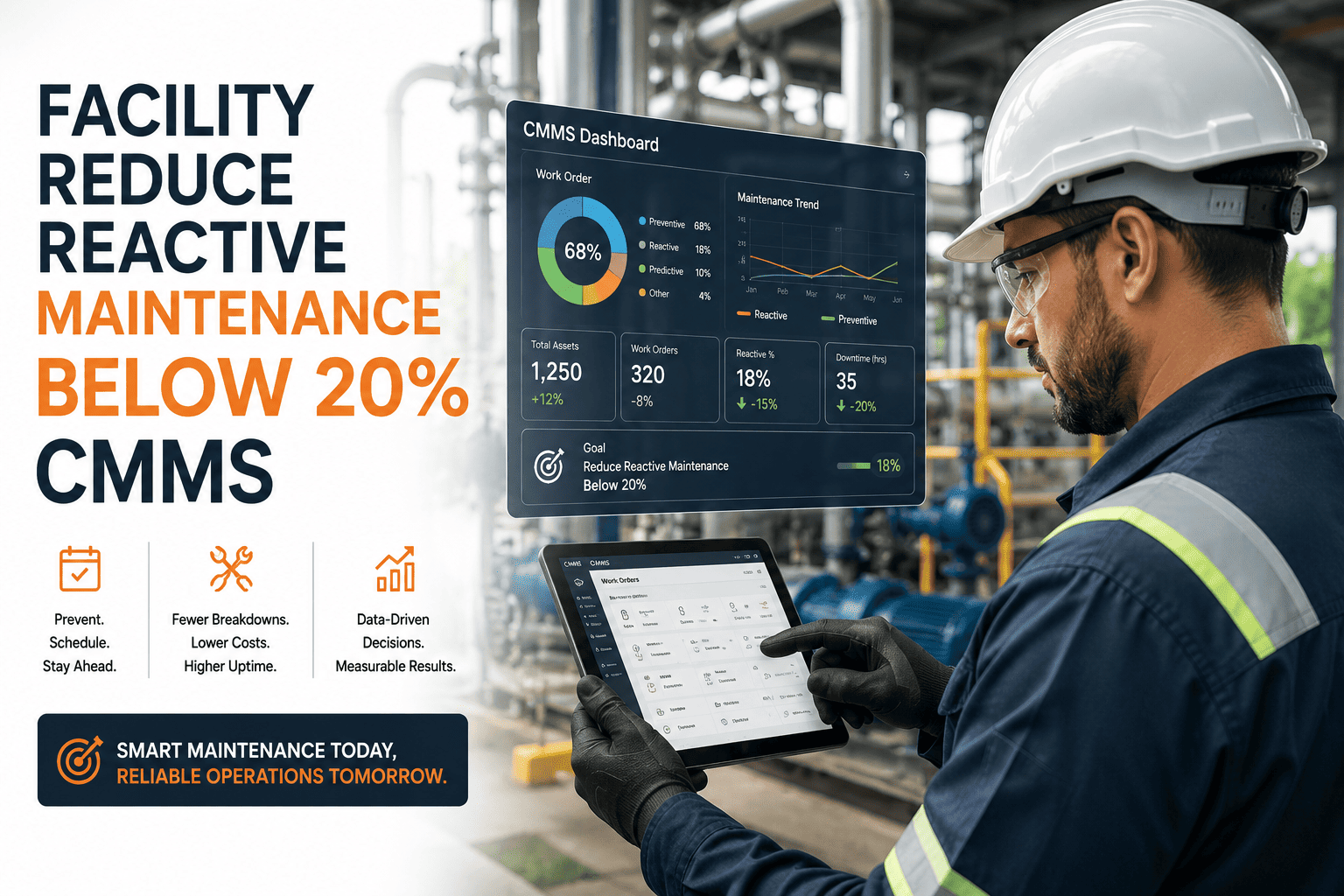
The average facility operating in reactive maintenance mode spends 3 to 4 times more per repair than the same facility running a structured preventive programme — because emergency repairs cost more, unplanned downtime costs more, and the secondary damage from deferred maintenance costs more. OxMaint's Preventive Maintenance module is the operational backbone of this transition — giving maintenance teams the work order structure, PM scheduling, and KPI visibility they need to stop firefighting and start managing. Book a 15-minute demo to see how OxMaint turns a reactive maintenance team into a proactive one within 90 days.
How to Transition from Reactive to Proactive Facility Maintenance
A step-by-step guide covering the mindset shift, CMMS adoption, PM scheduling, planned maintenance ratio targets, and the team habits that make the change stick.
Why Reactive Maintenance Costs More Than It Saves
Four Maintenance Maturity Stages — Where You Are and Where You Are Going
Book a Demo — See How OxMaint Moves Your Facility From Reactive to Proactive in 90 Days.
Most facilities reach Stage 2 (Planned) within their first 30 days in OxMaint and Stage 3 (Proactive) within 90 days — with live KPI data proving the shift to management throughout.
How to Make the Shift — Five Steps That Work in Any Facility
Reactive vs Proactive — The Operational Difference
| Dimension | Reactive Facility | Proactive Facility |
|---|---|---|
| Maintenance trigger | Equipment failure — usually at the worst possible time | Scheduled PM or condition-based alert — at a planned time |
| Emergency repair frequency | Multiple per week — constant firefighting | Fewer than 2 per month — exception rather than norm |
| Repair cost per event | 3–4× higher due to emergency labour and secondary damage | Planned rate with scheduled parts and available technicians |
| Downtime per event | 4–8 hours average — waiting for diagnosis, parts, contractors | Under 2 hours — planned window, parts staged, procedure ready |
| KPI visibility | None or manual — managers learn about failures after they happen | Live dashboard — MTBF, MTTR, PM compliance updated in real time |
| Equipment lifespan | 30–50% shorter than designed life — run-to-failure degrades assets | At or exceeding design life — maintenance extends longevity |
| Technician experience | Constant stress — reactive culture burns out skilled people | Structured work — technicians build competence, reduce turnover |
| Planned maintenance ratio | Below 40% — less than half of maintenance work is planned | 65–85%+ within 12 months of structured programme adoption |
What Maintenance Management Leaders Say About the Transition
The transition from reactive to proactive maintenance is not a technology project. It is a behaviour change project that happens to use technology. The CMMS does not make a team proactive — the habit of opening a work order before starting a job, closing it with real data afterwards, and reviewing what the data says every week makes a team proactive. The CMMS just makes those habits easy and the data visible. Facilities that implement CMMS without changing the weekly review habit achieve nothing. Facilities that change the habit first — even with basic software — achieve significant improvement within 90 days.
How OxMaint Supports Every Stage of the Transition
Questions About the Reactive-to-Proactive Transition
How long does it realistically take to move from reactive to proactive maintenance?
Most facilities reach Stage 2 (planned) — with CMMS in use and basic PM schedules active — within 30 days of structured implementation. Stage 3 (proactive) typically takes 6–12 months as PM interval data accumulates and root cause analysis becomes a regular practice. The speed depends almost entirely on management commitment to the weekly review habit, not on the software. Sign in to start your transition with OxMaint today.
What is the planned maintenance ratio and what should we target?
Planned maintenance ratio is the percentage of total maintenance labour hours spent on planned work (PMs, scheduled repairs) versus reactive work (emergency callouts, breakdown repairs). A reactive facility typically sits at 20–40%. Stage 2 targets 60–65%. World-class is 85–90%. OxMaint calculates your ratio automatically from work order data — the first step is knowing your current number. Book a demo to see planned maintenance ratio tracking in OxMaint.
How do we convince our maintenance team to change when they are used to reactive culture?
Do not frame the change as cultural transformation — frame it as reducing the stress of constant emergencies. Reactive maintenance is exhausting: 2 AM callouts, incomplete diagnoses, emergency parts hunts, and the pressure of being responsible for failures nobody saw coming. Proactive maintenance means working fewer weekends, having parts available, and knowing what is coming next week. Make the weekly review meeting feel like intelligence, not reporting. Sign in to see how OxMaint makes proactive maintenance easier for technicians, not just managers.
How does OxMaint help prove the value of proactive maintenance to senior management?
OxMaint's management report compares planned maintenance ratio, emergency repair frequency, and average MTTR before and after CMMS adoption — using your own work order data. Within 90 days, most facilities have measurable improvement in all three metrics that can be presented with documented evidence. The cost avoidance calculation — emergency labour saved, downtime avoided, secondary damage prevented — is generated directly from OxMaint data without manual compilation. Book a demo to see OxMaint's management reporting for proactive maintenance programmes.
Book a Demo — See OxMaint Taking Your Facility From Reactive to Proactive.
Live planned maintenance ratio · PM template library · Overdue PM visibility · Failure code analysis · Root cause tracking · Management reporting. The tools and structure to end the firefighting — in 90 days, with your own data as proof.