In 2022, bulk R-410A sold for around $4 per pound at distribution. In 2026, contractors are paying $11 to $14 per pound — and the next sharp step-down arrives in 2029, dropping the AIM Act production allowance from 60% of baseline to 30%. The refrigerant powering most of the commercial cooling equipment in operation today is being phased out economically before it is ever phased out legally. Facility teams that wait for the regulatory deadline to act will pay 3 to 4 times current refrigerant prices, scramble for limited certified technician capacity, and face emergency procurement costs that dwarf the cost of planned transition. OxMaint's asset lifecycle management platform turns this into a controlled multi-year programme — modelling cost trajectories per asset, scheduling retrofit and replacement work, and tracking the compliance evidence that follows every refrigerant decision. This guide walks through how to build a defensible transition plan asset by asset, with the timeline, the decision framework, and the technician workflows that actually work in the field.
HVAC Compliance · AIM Act Transition · Asset Lifecycle Planning
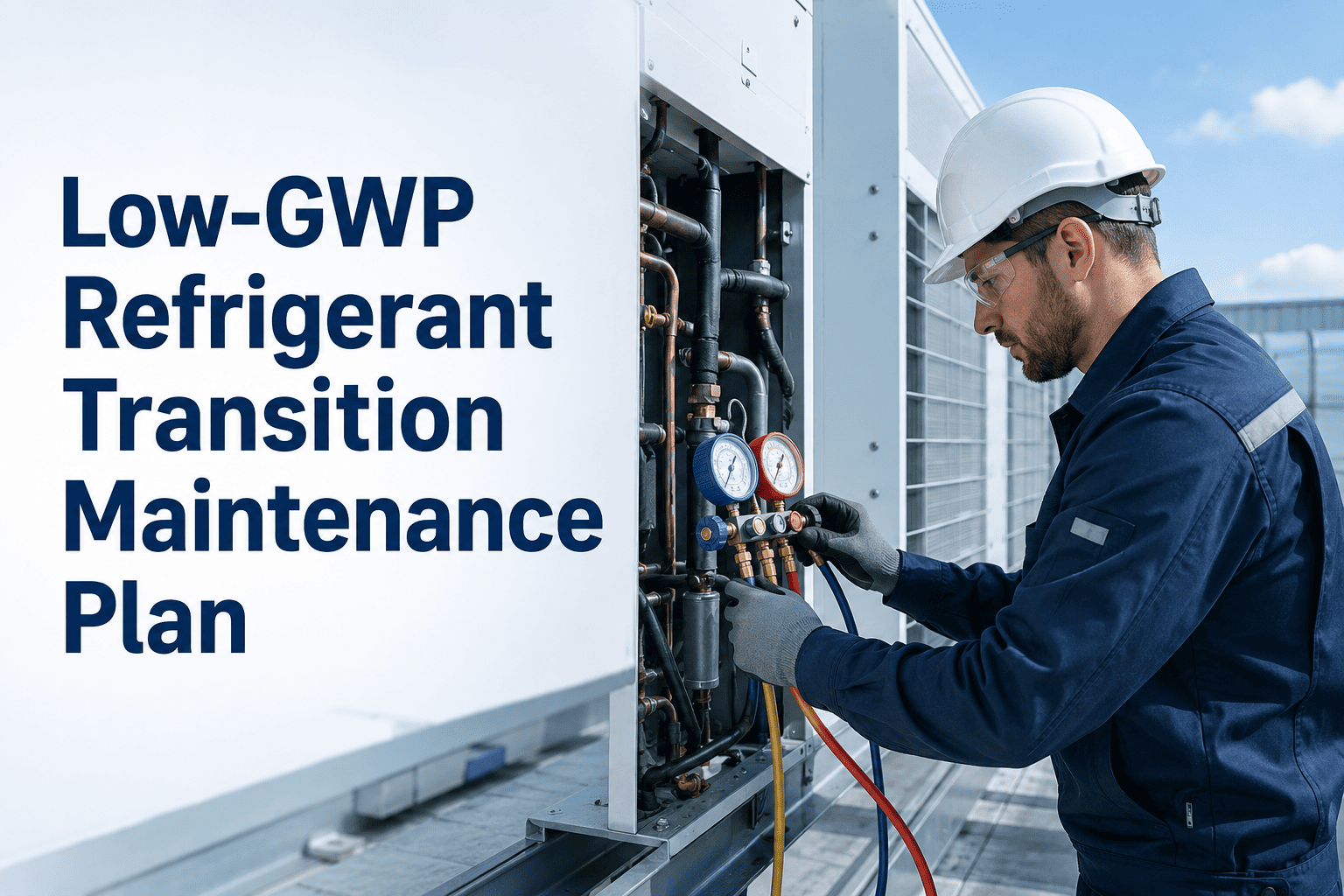
Low-GWP Refrigerant Transition Maintenance Plan
A practical, asset-by-asset framework for facility HVAC teams managing the AIM Act phasedown — covering timeline modelling, retrofit vs replacement decisions, A2L safety protocols, technician readiness, and compliance documentation.
2,088
GWP of R-410A — the legacy refrigerant being phased down
466
GWP of R-454B — primary replacement in new commercial equipment
85%
AIM Act final HFC reduction target by 2036 vs baseline
3 to 4x
Projected R-410A service price increase by 2028 as supply tightens
The AIM Act Phasedown Schedule — Mapped to the Decisions You Must Make
The AIM Act creates obligations at the supply chain level, not directly at the facility level. Facility managers are not required to replace equipment on a regulatory deadline — but the production phasedown of high-GWP HFCs makes the economic case for transition stronger every year. The schedule below is what drives every refrigerant procurement contract, every capital plan, and every maintenance decision for the next decade.
2022
90% baseline
First HFC production cap under AIM Act. R-410A bulk prices begin rising from late 2021 baseline.
2024
60% baseline
Sharpest early step-down. Bulk R-410A prices climb 40–70% from 2022. OEMs transition residential lines.
2025
Tech Transition
New residential and light commercial systems must use refrigerant with GWP under 700. R-454B and R-32 become primary new-equipment refrigerants.
2029
30% baseline
Steepest single step in phasedown schedule. R-410A reclaim-only supply expected. Service costs peak for facilities without a transition plan.
2034
20% baseline
Late-cycle reduction. Most pre-2025 R-410A equipment expected to be retired or retrofitted by this point in well-managed portfolios.
2036
15% baseline
Final AIM Act target — 85% reduction in HFC production from 2011–2013 baseline. Legacy HFC service supply effectively exhausted.
The Three-Path Decision Framework — Retrofit, Replace, or Run-Out
For every R-410A asset in the portfolio, only three viable paths exist. The right choice for each asset depends on equipment age, condition, refrigerant charge size, leak history, and remaining useful life. The decision must be modelled per asset before the cost curve peaks.CMMS-based transition planning turns this from a one-off capital exercise into a continuous lifecycle workflow.
Path A
Retrofit Conversion
Best For Equipment under 10 years old, in good mechanical condition, with low leak history
Convert compatible systems to a lower-GWP refrigerant compatible with the existing hardware. Requires component verification (compressor oil compatibility, expansion valve sizing, sensor compatibility), certified technician work, and updated safety documentation if shifting from A1 to A2L.
Capital costLow to moderate
Downtime1–3 days per asset
RiskCompatibility verification critical
Best For Equipment over 12–15 years old, equipment with chronic leak issues, or end-of-life capital cycle
Replace with new R-454B or R-32 compliant system. Higher upfront cost but eliminates ongoing refrigerant supply risk, improves energy efficiency by 10–25%, and resets the full maintenance cycle. New equipment ships factory-charged with low-GWP refrigerant and includes A2L safety features.
Capital costHigh
Downtime3–7 days per asset
RiskCapital approval timing
Best For Equipment with under 5 years of expected useful life, low refrigerant charge, low leak history
Continue servicing existing equipment using reclaimed R-410A through end of useful life, then replace with low-GWP equipment at retirement. Requires rigorous leak control, low annual leak rate verification, and a documented decommissioning plan. Best when supply availability and reclaim pricing remain manageable for the planned remaining life.
Capital costDeferred
DowntimeNone until retirement
RiskService supply availability post-2029
Refrigerant Comparison — What You Are Transitioning To
R-454B is the primary replacement refrigerant in new commercial equipment from most major OEMs, with R-32 used widely in mini-split and VRF systems. Both are A2L-classified (low toxicity, mildly flammable) and require updated safety protocols, technician training, and tool inventories that differ meaningfully from A1 refrigerant handling.
Property
R-410A · Legacy
R-454B · Primary Replacement
R-32 · Mini-split / VRF
Safety Class
A1 · Non-flammable
A2L · Mildly flammable
A2L · Mildly flammable
Drop-in Compatible
N/A
No · requires verification
No · requires verification
2026 Status
Reclaim supply only for new equipment
Standard in new commercial equipment
Standard in mini-split & VRF
Tools Required
Standard A1 toolkit
A2L-rated recovery, gauges, leak detection
A2L-rated recovery, gauges, leak detection
Tech Certification
Section 608 Type II / Universal
Section 608 + A2L safety training
Section 608 + A2L safety training
Model the Cost of Every Refrigerant Decision Before You Commit Capital
OxMaint's asset lifecycle module projects refrigerant cost trajectories, retrofit vs replacement scenarios, and total cost of ownership per asset across the AIM Act phasedown window. Real numbers, asset by asset.
Asset Readiness Scoring — Build the Decision in the CMMS
Every refrigerant-dependent asset in the portfolio needs a transition score that drives the Retrofit / Replace / Run-Out decision. The scoring framework below is the foundation of a defensible multi-year plan — and the data feeds into capital planning, maintenance prioritisation, and refrigerant procurement contracts.
01
Age & Remaining Life
Years in service vs design life. Equipment less than 5 years remaining favours Run-Out; 5–10 years favours Retrofit evaluation; over 10 years remaining justifies Replacement modelling.
02
Leak History
Annual leak rate trend over last 3 years. Assets exceeding 10% comfort cooling threshold repeatedly are high-risk for Run-Out. Chronic leakers should be prioritised for Replacement.
03
Refrigerant Charge Size
Pounds of refrigerant per asset. Large charges (200+ lb) mean larger procurement exposure as prices rise. Small charges (under 50 lb) can absorb price increases longer in Run-Out.
04
Mechanical Condition
Compressor health, coil condition, control system age. Retrofits require sound underlying hardware. Equipment with deferred maintenance debt is rarely a good retrofit candidate.
05
Criticality of Service
Mission-critical loads (data centre, healthcare, lab) tolerate less downtime risk and benefit from Replacement during planned outages. Comfort-cooling tolerates longer Run-Out.
06
Energy Efficiency Gap
Existing SEER vs current equipment. Older R-410A units running well below modern efficiency benefit most from Replacement — energy savings can offset 20–40% of capital cost.
A2L Safety Protocol Changes Technicians Must Adopt
The shift from A1 to A2L refrigerants is not a chemistry footnote. It changes ASHRAE 15 charge limits per room, alters local fire code applicability, requires updated leak detection equipment, and demands technician retraining on hot work, recovery, and storage. Maintenance organisations that treat A2L like A1 are operating outside the safety envelope.
01
A2L-Rated Recovery Equipment
Recovery machines, gauge sets, and hoses must be specifically rated for A2L refrigerants. Spark suppression and ignition source controls become part of routine service workflow. Equipment used on R-410A is not automatically certified for R-454B service.
02
Charge Limits by Room
ASHRAE 15 sets maximum refrigerant charge per occupied space for A2L systems based on room volume. Equipment installation locations must be re-evaluated. Mechanical room ventilation, refrigerant detection sensors, and emergency shutdown wiring may all be affected.
03
Hot Work & Ignition Source Controls
Brazing, soldering, and any open-flame work near A2L systems requires ventilation, charge isolation, and ignition source elimination protocols documented in the work permit. Permit-to-work systems should incorporate A2L flags for affected assets.
04
Storage & Transport
A2L cylinders require segregated storage from A1 cylinders, ventilated storage areas, and updated transport documentation. Mechanical room cylinder storage near ignition sources is no longer acceptable practice.
05
Leak Detection Sensor Updates
A2L refrigerant leak detectors require updated sensor technology compatible with R-454B and R-32 specifically. Sensors calibrated for R-410A may not detect A2L leaks at compliant sensitivity. Sensor calibration certificates must be updated per refrigerant type.
06
Technician Certification Documentation
Section 608 remains the federal certification baseline. A2L-specific manufacturer training, ASHRAE 15 awareness, and local fire code training should be documented per technician with renewal cycles tracked in the CMMS.
Building a Five-Year Transition Roadmap
A defensible transition programme is not a project. It is a multi-year roadmap that runs continuously alongside normal maintenance operations. The roadmap below is the structure many facility portfolios follow once asset readiness scoring is complete. Asset lifecycle management for HVAC facilities integrates this into the broader capital and maintenance planning process.
Year 1
Inventory, Score, Model
Complete refrigerant asset inventory. Score every asset across the six readiness factors. Model retrofit vs replacement vs run-out economics per asset under current and projected refrigerant prices. Approve year 1 capital list.
Year 2
Replace the Worst Offenders
Execute Year 1 replacements on highest-risk assets — chronic leakers, end-of-life equipment, mission-critical systems. Pilot retrofits on 2–3 candidate assets to validate technician workflow and downtime estimates.
Year 3
Scale Retrofits, Continue Replacements
Roll out retrofits across qualifying mid-life equipment. Continue planned replacements on remaining end-of-life assets. Update A2L technician certifications across the maintenance team. Establish A2L-rated tool inventory across all shifts.
Year 4
Manage Run-Out Assets Tightly
Tighten leak inspection frequency on remaining R-410A run-out assets. Lock in reclaim refrigerant supply contracts. Update annual refrigerant cost projections. Plan terminal-year replacements before 2029 step-down hits.
Year 5
Closeout & Documentation
Decommission remaining legacy assets. Recover and reclaim all remaining R-410A charge. Document full transition history per asset for portfolio sustainability reporting and any future regulatory verification.
Expert Review
"
After twenty-three years across the commercial HVAC industry — sixteen on the contractor side managing major retrofit programmes, and seven now advising Fortune 500 facility portfolios on AIM Act transition — the most consistent failure mode I see is treating the phasedown as a future problem. It is not. The 2029 step-down from 60% to 30% of baseline is the steepest cliff in the entire AIM Act schedule, and facilities that have not made their retrofit-or-replace decisions by 2027 will be making them under emergency conditions at peak refrigerant pricing with limited certified technician availability. The right approach is the opposite: build a five-year roadmap now, model the economics per asset in your CMMS, lock in your A2L technician training, and execute deliberately. The facilities I work with that started this in 2024 are spending 30–40% less per asset on the transition than those who waited. Asset lifecycle management is not a CMMS feature — it is the controlling discipline that determines whether the transition costs you nothing extra or costs you a generation of capital budget.
Marcus DeAngelis, CEM, BEAP, LEED AP
Certified Energy Manager · Building Energy Assessment Professional · LEED Accredited Professional · 23 years commercial HVAC · Former VP Operations at national mechanical contractor · Senior advisor on AIM Act transition planning for Fortune 500 facility portfolios · Author of two industry guidance documents on HFC phasedown economics
Frequently Asked Questions
Q01
Is R-454B a drop-in replacement for R-410A in existing equipment?
No. R-454B is not a drop-in for existing R-410A equipment. The two refrigerants have different operating pressures, compressor oil compatibility requirements, and safety classifications (A1 vs A2L). Retrofit conversion requires component verification, certified technician work, and updated safety documentation. Treat any retrofit as an engineered conversion, not a refrigerant swap.
Q02
Can existing R-410A equipment continue running after 2025?
Yes. The AIM Act restricts production of new high-GWP refrigerants but does not require facilities to retire existing R-410A equipment on any deadline. Servicing continues using reclaimed R-410A. Well-maintained, low-leak R-410A systems can realistically operate through 2030–2033. The economic case for early replacement strengthens as reclaim prices rise.
Q03
What is the AIM Act 2029 step-down and why does it matter?
The 2029 reduction from 60% to 30% of baseline HFC production is the steepest single step in the AIM Act phasedown schedule. Its effect on R-410A and other high-GWP refrigerant pricing is expected to be dramatic — virgin production drops by half overnight while installed equipment base remains largely unchanged. Facilities without a transition plan in place by 2027 will face peak procurement costs and reduced technician availability.
Book a demo to model the 2029 cost impact on your portfolio.
Q04
Do A2L refrigerants require new tools and technician training?
Yes. A2L refrigerants (R-454B, R-32) are mildly flammable and require A2L-rated recovery machines, gauge sets, hoses, and leak detection sensors. Section 608 certification remains the federal baseline, but A2L-specific manufacturer training, ASHRAE 15 charge limit awareness, and local fire code training should be documented per technician with renewal cycles tracked.
Q05
How does OxMaint help model the retrofit vs replacement decision per asset?
OxMaint's asset lifecycle module loads each refrigerant-dependent asset with age, condition, charge size, leak history, and energy performance data, then projects total cost of ownership across Retrofit / Replace / Run-Out scenarios using current and projected refrigerant pricing inputs. The output is a per-asset recommendation with capital cost, operating cost projection, and risk-weighted score.
Sign in to OxMaint to load your portfolio or
book a demo to walk through the model.
The Refrigerant Transition Is a Multi-Year Programme. Run It Like One.
OxMaint turns the AIM Act transition into a controlled asset lifecycle workflow — inventory, score, model, schedule, execute, document. Every refrigerant decision evidenced. Every retrofit tracked. Every replacement modelled. Across every site in your portfolio.