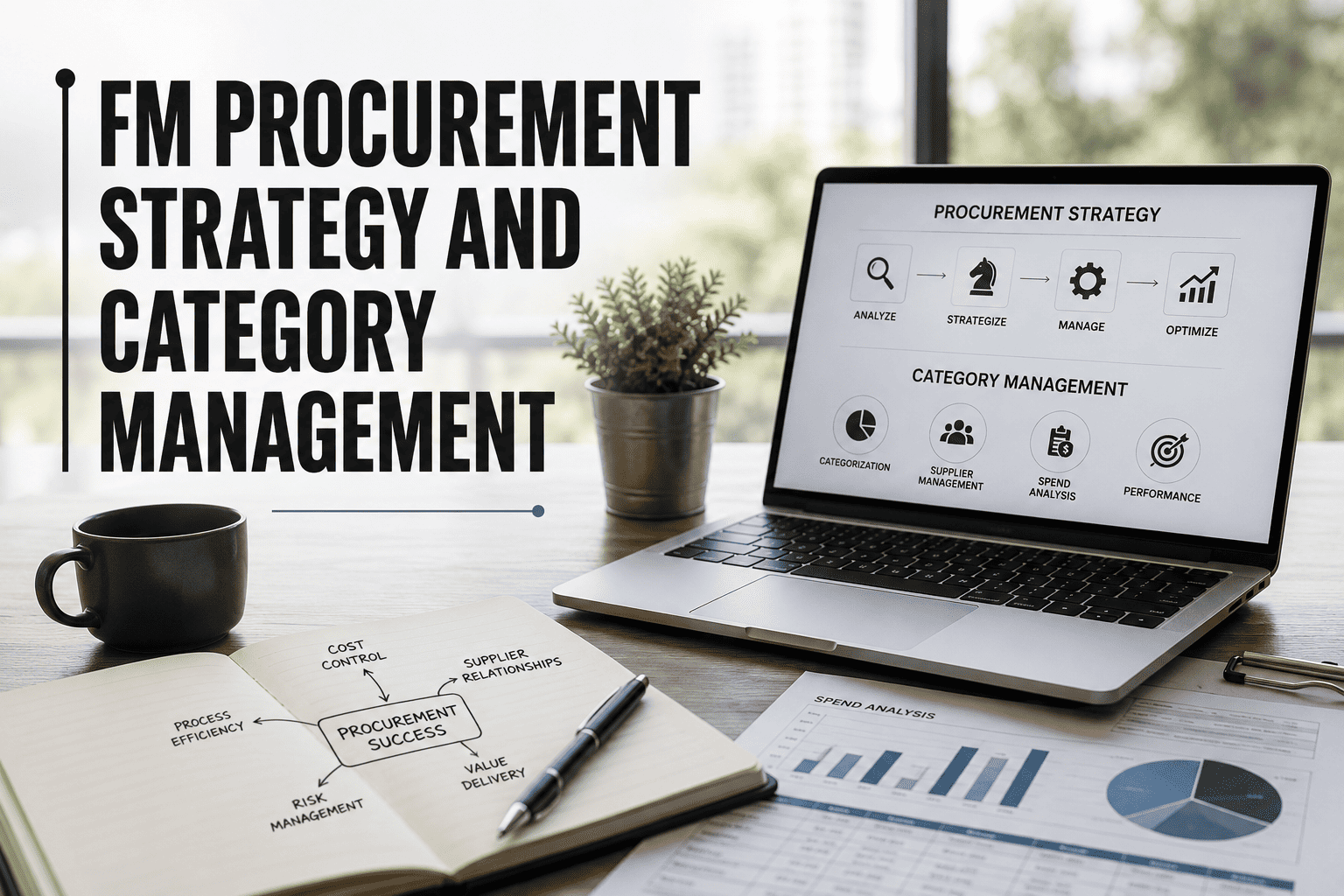
Facility management procurement strategy is where portfolio buying power either compounds into measurable savings or gets scattered across dozens of uncoordinated, reactive purchases. When nobody owns the total FM spend, vendors duplicate, contracts drift past renewal dates, and category management becomes an afterthought. An effective FM procurement strategy aligns facility sourcing strategy with asset lifecycles, consolidates spend visibility, and structures purchasing into logical facility procurement categories. By treating maintenance, parts, and contracted services as strategic categories rather than overhead, organizations can tighten spend management and directly improve uptime. Ready to align your maintenance procurement with real-time asset data? Start Free Trial and see the difference.
Are uncoordinated vendor purchases silently inflating your facility spend?
Fragmented facility management procurement locks teams into higher costs, redundant vendor overlap, and emergency purchasing. Category management brings structure, consolidation, and strategy to FM sourcing — driving down costs while increasing service reliability.
Why FM spend category management fails without ownership
In most multi-site portfolios, FM procurement strategy is handled locally — site managers buy parts, approve service calls, and sign local maintenance contracts independently. The result is a sprawling vendor list, duplicated effort, and zero leverage.
How to build a facility procurement category that maximizes leverage
A strong facility category strategy groups related spend into distinct, manageable portfolios. This allows procurement teams to apply specific sourcing strategies, negotiate volume discounts, and align vendor performance with maintenance KPIs like OEE and MTBF.
Maintenance, Repair & Operations (MRO)
Aggregate spare parts, lubricants, and consumables into a single FM procurement category. Standardizing SKU lists across sites reduces inventory carrying costs by up to 15% and eliminates duplicate local purchasing.
Contracted Maintenance Services
Consolidate HVAC, fire safety, elevator, and janitorial contracts. A facility sourcing strategy that bundles these across a portfolio forces vendors to compete on total value rather than per-site urgency.
Capital Equipment & Replacements
Align capital expenditure with asset lifecycle data. Tying facility procurement planning to predictive maintenance insights ensures replacements happen before catastrophic failure, optimizing the total cost of ownership.
Emergency & Reactive Spend
The most expensive FM spend category. By analyzing historical work orders, facility spend management shifts purchases from costly reactive emergencies to planned, budgeted preventive maintenance.
FM sourcing strategy: From fragmented buying to portfolio power
Consolidating facility management procurement requires visibility into every work order, purchase order, and vendor invoice. When data is siloed in spreadsheets, category managers cannot see what they are spending or who they are spending it with.
Worked Example: A 180-asset manufacturing plant spending $42K/yr on fragmented, reactive MRO parts consolidated their facility procurement category into a single tracked dashboard. By shifting 70% of purchases to planned, bulk-buy preventive cycles, they saved $11.2K in year one — a 26% reduction in total parts spend.
How OxMaint powers data-driven facility procurement management
Procurement strategy is only as good as the asset data behind it. OxMaint connects real-time maintenance execution directly to purchasing decisions, giving category managers the evidence they need to negotiate better terms and eliminate wasteful spend.
Asset-Linked Purchase Orders
Tie every spare part and service purchase directly to an asset's history. Know exactly what each machine costs to maintain to inform your FM procurement category strategy with hard data.
Spend Analytics & Dashboards
Auto-categorize vendor spend across your portfolio. OxMaint highlights duplicate vendors, maverick spend, and high-cost reactive purchases, enabling 18-24% savings in facility spend management.
Predictive Replacement Planning
Use AI-driven failure predictions to plan capital equipment purchases months in advance. Shifting from emergency buying to planned facility procurement planning cuts rush-freight and downtime costs by up to 40%.
Vendor Performance Scoring
Track SLA compliance, response times, and work order completion rates for every vendor. Use objective scores to renegotiate facility sourcing contracts and reward high-performing partners.
Stop guessing where your maintenance budget goes. See OxMaint on your assets.
Book a 30-minute demo to discover how integrated CMMS analytics transform scattered FM procurement into a consolidated, cost-saving strategy.
FM procurement planning: A 90-day rollout timeline
Transitioning to strategic facility procurement management does not happen overnight. Use this 90-day implementation timeline to shift from reactive buying to controlled category management.
Baseline Spend Visibility
Upload historical work orders and POs into OxMaint. Map existing vendors to establish a baseline for your facility procurement category structure. Identify the top 20% of vendors consuming 80% of spend.
Category Strategy & Vendor Consolidation
Define your core FM sourcing categories (MRO, Services, Capital). Eliminate redundant vendors and negotiate portfolio-wide pricing with top-performing partners using objective SLA data.
Enforce & Optimize
Lock down maverick spend by requiring all purchases to route through OxMaint purchase approvals tied to specific assets and budgets. Review spend analytics monthly to refine the facility category strategy.
FM procurement strategy & category management FAQs
What is FM procurement category management?
FM procurement category management is the practice of grouping facility-related spending — such as MRO parts, contracted maintenance services, and capital equipment — into distinct categories to apply targeted sourcing strategies. This approach increases buying leverage, improves vendor accountability, and aligns purchasing decisions with asset lifecycle data to reduce total facility spend.
How does a CMMS improve facility spend management?
A CMMS like OxMaint improves facility spend management by linking every purchase order and vendor invoice directly to specific assets and work orders. This creates a single source of truth for spend analytics, eliminating hidden maverick purchases and providing the hard data needed to negotiate better vendor rates. Start Free Trial to centralize your spend data today.
How much can we save by consolidating FM sourcing strategy?
Organizations typically achieve 18-24% savings on total facility management procurement by consolidating vendors and shifting reactive purchases to planned, category-managed buying. Savings are driven by volume discounts, reduced emergency freight costs, optimized inventory carrying costs, and the elimination of duplicate vendor overlap across multiple sites.
What is the difference between FM procurement strategy and facility purchasing?
Facility purchasing is the tactical execution of buying goods and services, often done reactively at the site level. An FM procurement strategy is the overarching, portfolio-wide plan that dictates how, when, and from whom to buy based on asset data, category structures, and long-term total cost of ownership rather than short-term price.
How do I start building a facility procurement category?
Start by analyzing 12 months of historical work order and purchase order data to identify your highest-spend areas. Group these into logical buckets like MRO, contracted services, and capital replacements. Book a Demo to see how OxMaint automatically maps and categorizes your maintenance spend into actionable dashboards.
Transform your scattered FM spend into strategic portfolio power
Centralize your facility procurement management, optimize vendor performance, and tie every purchase to asset health with OxMaint's AI-powered CMMS.
Free 14-day trial · No credit card