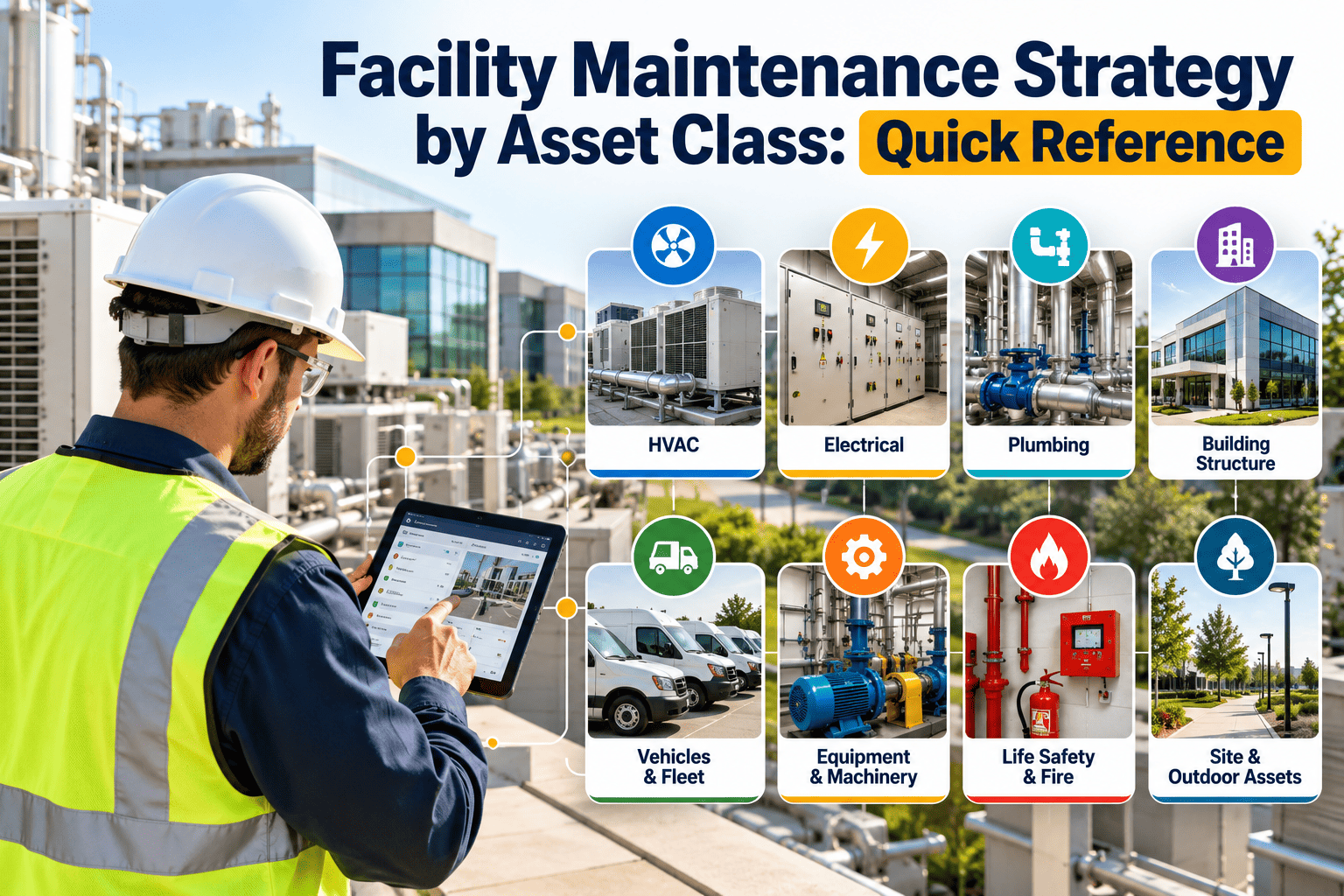
Choosing a maintenance strategy for a building portfolio is not one decision. It is dozens of smaller decisions, made one asset class at a time. A chiller carrying a hospital's cooling load needs different treatment than a restroom exhaust fan. Elevators and roofs sit at opposite ends of the same spectrum, yet both often run on whatever schedule someone set years ago. This quick reference maps chillers, boilers, elevators, roofs and other major systems to the reactive, preventive, condition-based or predictive approach that fits how each one actually fails, and shows how a facility maintenance management platform keeps those decisions enforceable.
Facility maintenance strategy by asset class: match the approach to the failure
Facility managers rarely fail because they lack a maintenance plan. They fail because one plan is applied to every asset. Use the asset class by strategy matrix below to put preventive effort where it pays, monitoring where it detects, and run-to-failure where it is genuinely the cheapest option.
Why a single maintenance strategy fails across a facility
One strategy for everything
- Every asset gets the same quarterly inspection, whether it is critical or trivial
- Technician hours go to low-consequence equipment while critical plant waits
- Failures of unmonitored assets arrive as emergencies with premium repair costs
- Budget requests cannot be defended because no one can explain why a task exists
- Inspection intervals are copied from the last building, not from failure history
Strategy assigned by asset class
- Effort follows consequence of failure and how detectable the failure is
- Low-risk assets are deliberately allowed to run to failure with spares on hand
- Critical systems carry condition data that triggers work before breakdown
- Every task traces back to a documented reason, which makes budgets defensible
- Intervals are reviewed against actual failure and work order history
The goal is not more maintenance. It is the right maintenance, applied to the right asset, at the right trigger.
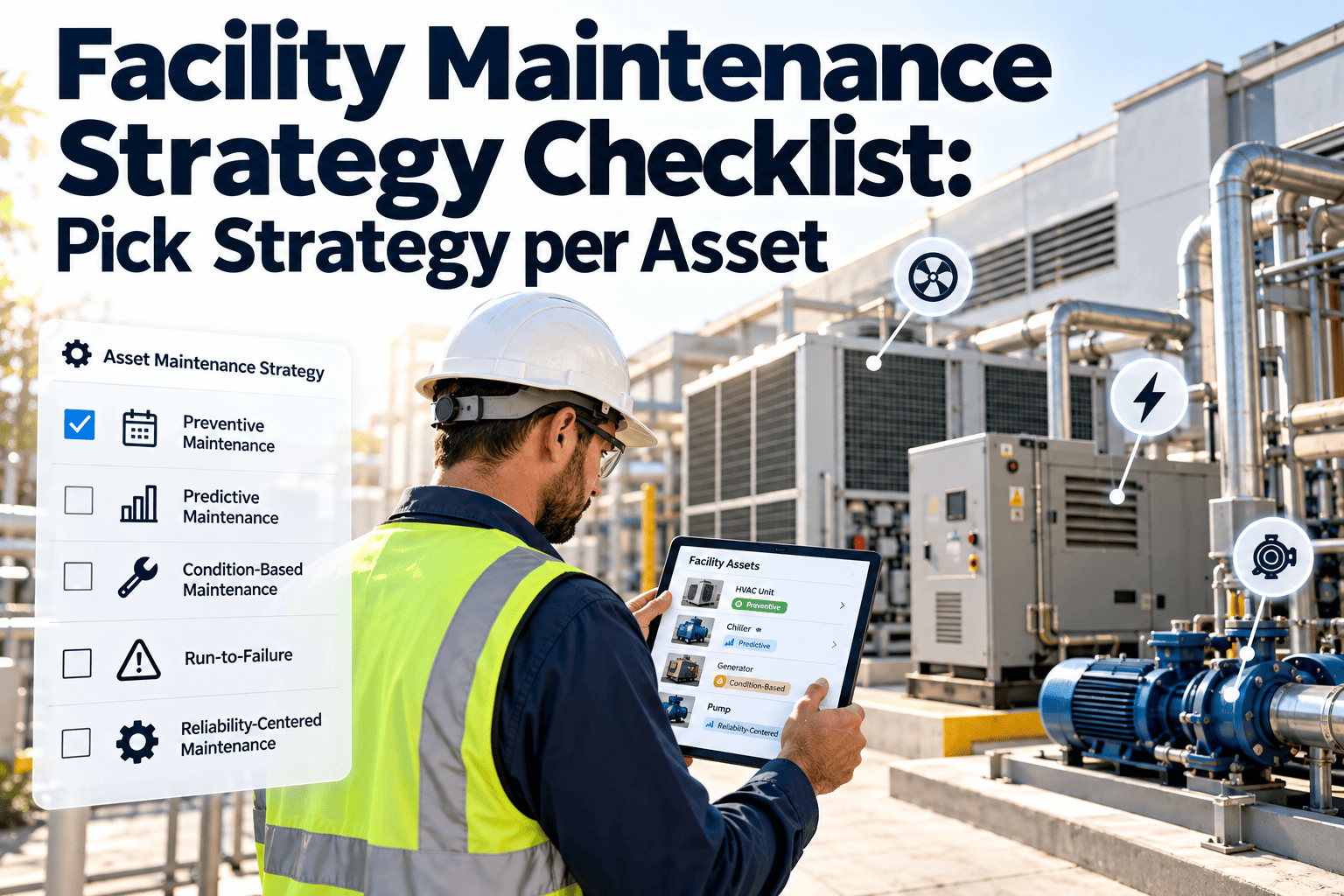
Four strategies, and when each one is the right answer
Run to failure, by design
Appropriate when failure is safe, cheap, redundant and quick to fix. A deliberate reactive strategy still needs spares and a response path.
Calendar or meter-based tasks
Best for assets with predictable wear and age-related failure, such as belts, filters, lubrication points and door operators.
Act when measurements say so
Inspections and readings trigger work. It suits assets where wear is uneven, such as roofs, motors and heat exchangers.
Trend data forecasts the failure window
Reserved for assets where sensors, trend history and a high consequence of failure justify the monitoring effort.
Most facilities need all four strategies at once. The skill is in the assignment, and in revisiting it when conditions change.
Five questions that decide the strategy for any asset class
What does failure cost the occupants?
Loss of cooling in a data hall or a stalled elevator in a hospital is not equivalent to a burned-out corridor light.
Is there a safety or code obligation?
Statutory inspection requirements set a floor that overrides economics. Elevators, boilers, fire protection and backflow devices usually live here.
How does the asset fail?
Age-related wear favors time-based tasks. Random or uneven failure favors condition-based inspection.
Can the early warning be detected?
Predictive approaches only work when a measurable signal appears well before failure.
Is the monitoring cheaper than the failure?
Compare sensor, labor and software cost against the repair cost, downtime and secondary damage you would avoid.
Asset class by strategy matrix for commercial facilities
| Asset class | Primary strategy | Supporting strategy | Typical triggers and tasks |
|---|---|---|---|
| Chillers | Condition-based | Preventive, predictive on critical sites | Approach temperature, amperage, refrigerant levels, oil analysis, tube cleaning |
| Boilers | Preventive | Condition-based | Combustion tuning, burner inspection, water treatment, jurisdictional inspection |
| Air handling units | Preventive | Condition-based | Filter differential pressure, belts, coils, dampers, actuators |
| Elevators | Preventive | Condition-based with telemetry | Contract service visits, door cycles, trip and fault codes, code inspections |
| Roofs | Condition-based | Preventive | Seasonal inspections, post-storm checks, drain clearing, moisture surveys |
| Switchgear and panels | Condition-based | Preventive | Infrared scans, torque checks, breaker testing, cleaning |
| Pumps and motors | Condition-based | Predictive on critical duty | Vibration, temperature, seal condition, run hours |
| Fire and life safety | Preventive (code-driven) | Inspection records | Test and inspection intervals set by the applicable code and the local authority |
| Backup generators | Preventive | Condition-based | Scheduled run tests, battery checks, fuel quality, load testing |
| Lighting and fixtures | Reactive | Group relamping | Failure reports, spare stock, periodic area walk-throughs |
| Plumbing fixtures | Reactive | Preventive on valves | Tenant requests, leak inspections, valve exercising |
Treat this matrix as a starting point. Your own failure history, occupancy type and local code requirements should adjust every row.
Strategy stacks for chillers, boilers, elevators and roofs
Chillers
Boilers
Elevators
Roofs
Put a defined strategy behind every asset class
Oxmaint helps maintenance teams assign preventive, condition-based and reactive workflows by asset, then track the work in one place. Start with your first asset class today or walk through your portfolio with our team.
Reading how each asset class fails before choosing a task
Wear-out failures
Belts, bearings, seals, door operators and filters degrade with use or time. Meter-based or calendar preventive tasks work well because the failure window is reasonably predictable.
Random failures
Electronic controls, sensors and some drives fail without a steady wear curve. Time-based replacement wastes money here. Spares, fast diagnosis and redundancy matter more than frequent inspection.
Environmental failures
Roofs, exterior envelopes, cooling towers and below-grade plumbing deteriorate with weather, water chemistry and exposure. Condition inspections with photo records tell you more than a fixed calendar.
Operating-practice failures
Short cycling boilers, overloaded chillers and neglected filters fail because of how they are run. The fix is often a setpoint, a schedule or a training change, not another repair.
- Review the last two to three years of corrective work orders by asset class before assigning a strategy
- Separate failures caused by age from those caused by poor operation or missed tasks
- Record failure cause codes consistently so patterns are visible in reports
- Treat repeat failures on the same asset as a signal to change the strategy, not just repeat the repair
How occupancy type shifts the strategy for the same asset
| Facility type | Higher strategy priority | Why it shifts |
|---|---|---|
| Hospitals and clinics | Chillers, boilers, generators, medical gas, elevators | Loss of service affects patient care and regulatory standing, so monitoring and tested redundancy carry more weight |
| Offices and commercial towers | Air handling, chillers, elevators, roofs | Tenant comfort and vertical transport drive complaints, lease expectations and service-level commitments |
| Schools and campuses | Boilers, roofs, fire systems, lighting | Seasonal operation and tight budgets favor scheduled seasonal checklists and clear deferred-maintenance tracking |
| Retail portfolios | Rooftop units, refrigeration, doors, lighting | Many similar sites make standard templates and vendor performance tracking especially valuable |
| Data and technical spaces | Cooling plant, power distribution, controls | Downtime cost is high, so condition data and redundancy testing justify predictive effort |
The same chiller can sit in different strategy tiers at two sites. Record the reason for each assignment so the next reviewer understands it.
When regulation overrides the economic strategy
Elevators and lifting equipment
Periodic inspections and test records are typically required by the local jurisdiction, regardless of condition.
Pressure vessels and boilers
Many jurisdictions require certified inspections and posted certificates at fixed intervals.
Fire protection systems
Inspection, testing and maintenance frequencies are set by fire codes and referenced standards, and records must be retrievable.
Refrigerant-bearing equipment
Leak checks and service records may be required depending on equipment size, refrigerant type and local rules.
- Confirm the governing code and authority for each building before finalizing any strategy
- Store inspection certificates, test reports and contractor sign-offs against the asset record
- Schedule statutory tasks as fixed work orders that cannot be quietly deferred
- Use condition data to add inspections beyond the minimum, never to skip required ones
KPIs that show whether your asset strategy is working
How to implement an asset class strategy in five phases
Build the asset register
List assets by class, location, age and criticality so every strategy decision has a clear subject.
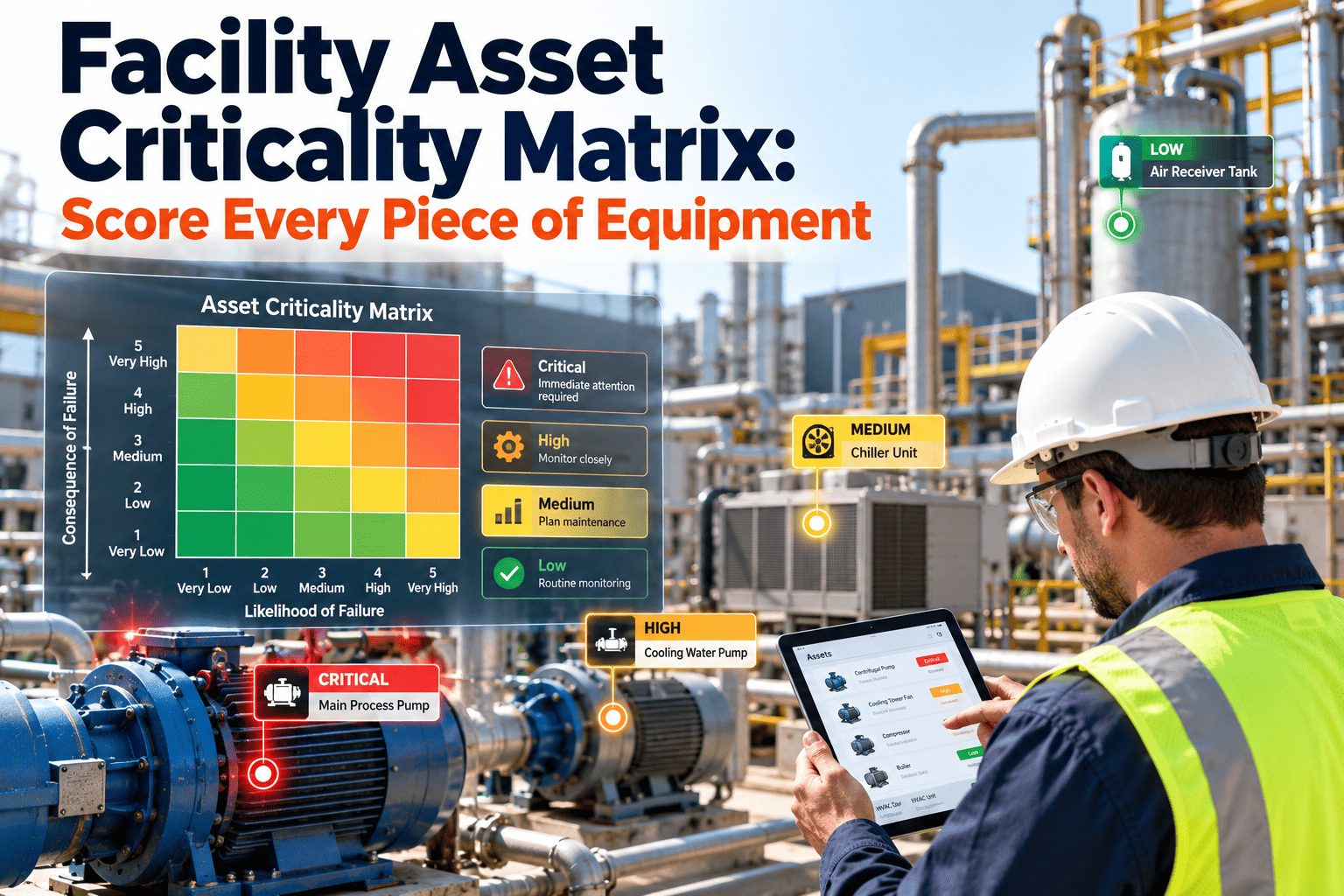
Score criticality
Rate each class by safety, occupant impact, redundancy and repair cost to separate critical plant from routine equipment.
Assign strategies and templates
Map each class to a primary strategy and build standard task lists, intervals and acceptance criteria.
Run, record and compare
Execute through work orders, capture findings and readings, and compare results against the intended strategy.
Review and adjust
Revisit intervals and strategies at least annually, using failure history to extend, shorten or replace tasks.
How Oxmaint supports a strategy-by-asset-class program
- Preventive maintenance schedules tied to each asset class and its chosen strategy
- Work orders that carry checklists, parts used, labor time and technician notes
- Inspection records that support code compliance and audit requests
- Inventory tracking so spares for run-to-failure assets are on the shelf
- Reports that compare planned and corrective work across classes and sites
Teams that want to explore this on their own data can start with a few asset classes and expand as the workflow settles.
Common mistakes in asset class maintenance strategy
- Assigning predictive monitoring to assets whose failure is cheap and easy to fix
- Letting contractor visit schedules define strategy instead of asset condition
- Treating all roofs, or all chillers, as identical regardless of age and exposure
- Skipping spares for deliberate run-to-failure assets, which turns a cheap failure into a long outage
- Collecting condition data that never triggers a work order
- Never reviewing intervals against failure history after the first setup
- Ignoring statutory deadlines because they are tracked in a separate spreadsheet
- Applying the same inspection frequency to a ten-year-old rooftop unit and a brand-new one without reviewing condition
- Choosing a strategy once during commissioning and never documenting why, so future teams cannot challenge or improve it
- Measuring only overall PM completion, which hides missed tasks on the most critical asset classes
Facility maintenance strategy by asset class: common questions
Which maintenance strategy is best for chillers?
Most commercial chillers suit condition-based maintenance backed by preventive tasks. Critical sites can add predictive monitoring through asset-level work orders.
Is run-to-failure ever acceptable in facilities?
Yes, for low-risk, redundant, inexpensive assets such as standard lighting, provided spares and a response path exist.
How do elevators differ from other asset classes?
Elevators combine code-driven inspections with contractor service, so strategy centers on record-keeping, callback analysis and fault trends.
How often should roof inspections happen?
Commonly twice a year and after severe weather, adjusted for roof age, material and leak history.
Can I test this approach on a small portfolio first?
Yes. Pilot one or two classes, then book a demo to plan the wider rollout.
Turn your asset class matrix into scheduled work
Move from one-size-fits-all maintenance to a strategy that matches each asset. Set up your classes, schedules and inspections in Oxmaint, or talk through your portfolio with our team.