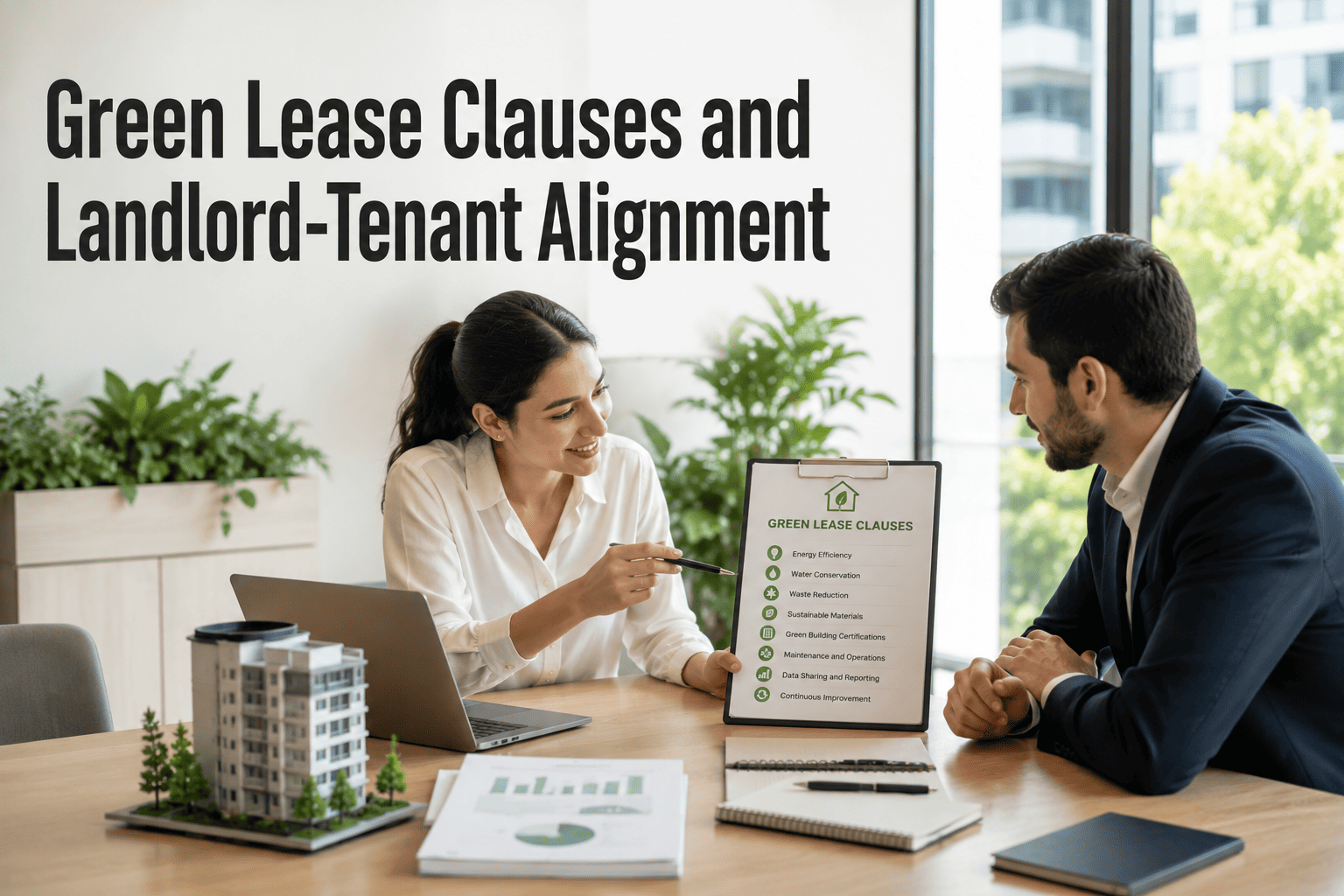
Green lease clauses resolve the split incentive problem that quietly kills building efficiency projects — the landlord pays for capital upgrades, but the tenant collects the energy savings. In a typical commercial green lease agreement, building owners forfeit 60–80% of the financial upside from efficiency retrofits, which is exactly why so many worthwhile FM projects never leave the spreadsheet. Green lease provisions flip that dynamic by aligning cost recovery with sustainability investment through shared-savings mechanisms, data-sharing requirements, and submetering clauses that make ROI transparent to every party. When landlord-tenant green lease terms are structured correctly, facility management teams finally get the budget approval they need to deploy modern maintenance technology at portfolio scale. Explore how a properly structured green lease unlocks these projects — then Start Free Trial to see how OxMaint proves the savings.
Split Incentive, Solved
$50B in building efficiency projects stalled by split incentives every year — green lease clauses unlock them.
20–30% of commercial building energy is wasted because landlords can't recover retrofit costs from tenants who benefit. Green lease provisions align landlord and tenant interests so FM efficiency work finally gets funded, measured, and scaled.
The Core Problem
Why the split incentive blocks green leasing FM investment
In a standard commercial lease, the building owner absorbs 100% of the capital cost for an efficiency upgrade — new HVAC, LED retrofits, BMS optimization — while the tenant captures 100% of the energy savings. The result: a rational landlord says no, even when the project has a 3-year payback and would raise asset value by 5–7%.
- Owner funds $200K retrofit out of pocket
- Tenant's energy bill drops 25% — owner sees $0
- ROI to landlord: negative, so project is rejected
- Building continues wasting 20–30% of energy
- Owner funds retrofit; recovers cost via lease clause
- Tenant pays a sustainability charge — still nets savings
- ROI to landlord: 8–12% over 5-year recovery period
- Building efficiency improves, asset value rises
Clause Architecture
Standard green lease provisions that align landlord and tenant
A well-structured green lease agreement building framework doesn't reinvent commercial real estate law — it layers five to seven specific provisions onto a standard lease that make sustainability investment measurable, recoverable, and fair.
Cost-Recovery Mechanism
Owner recovers capital cost of efficiency upgrades through a sustainability charge or capital amortization over a defined recovery period (typically 3–7 years). Tenant pays a share calibrated so their net cost is still lower than pre-retrofit energy bills.
Shared-Savings Formula
Energy savings are split between landlord and tenant at an agreed ratio (e.g., 70/30 landlord-favorable during recovery, 50/50 after). Clause defines baseline consumption, measurement methodology, and true-up frequency.
Data-Sharing & Submetering
Tenant grants landlord access to whole-building and subsystem energy data via submeters or BMS integration. Monthly consumption reports become the verification engine for shared-savings calculations and green lease efficiency tracking.
Performance Standards Clause
Lease references specific efficiency benchmarks — Energy Star score, kWh/sqm intensity, or ASHRAE 90.1 compliance. Both parties commit to operating practices (after-hours HVAC, plug-load management) that maintain target performance.
Operating Cost Definition
Redefines "operating costs" in the lease to include sustainability investments, so they become recoverable through standard OPEX pass-throughs rather than requiring a separate negotiation each time.
Dispute Resolution & True-Up
Defines how disagreements over savings calculations are resolved — typically a third-party M&V (measurement & verification) firm — and an annual true-up process so neither party carries risk of miscalculation beyond 12 months.
The Math
How a green lease energy cost-recovery formula works
The shared-savings formula is the engine of a green lease. Get it right and both parties see a return. Get it wrong and the clause creates more disputes than savings. Here's the standard structure.
A 12,000 sqm office building with a $180K HVAC retrofit
Baseline energy: 420,000 kWh/yr at $0.18/kWh = $75,600/yr. Post-retrofit actual: 294,000 kWh/yr = $52,920/yr. Annual savings: $22,680. Recovery period: 6 years. Sustainability charge: $30,000/yr. Net tenant benefit: $22,680 − $30,000 = negative in year one — so the clause auto-adjusts the charge down to $18,000 to guarantee positive tenant savings. Landlord still recovers $108K (60%) of capital cost over 6 years while the tenant saves $2,808/yr minimum.
| Recovery Year | Annual Energy Savings | Sustainability Charge | Net Tenant Benefit | Landlord Recovery |
|---|---|---|---|---|
| Year 1 | $22,680 | $18,000 | $4,680 | $18,000 |
| Year 2 | $22,680 | $18,000 | $4,680 | $18,000 |
| Year 3 | $23,814 | $18,000 | $5,814 | $18,000 |
| Year 4 | $23,814 | $18,000 | $5,814 | $18,000 |
| Year 5 | $24,948 | $18,000 | $6,948 | $18,000 |
| Year 6 | $24,948 | $18,000 | $6,948 | $18,000 |
| 6-Year Total | $142,884 | $108,000 | $34,884 | $108,000 |
| Year 7+ (post-recovery) | ~$26,000/yr | $0 | ~$26,000/yr | $0 (asset value gain) |
Negotiation Realities
Green lease negotiation: what actually gets debated
Green lease commercial negotiations rarely stall on whether sustainability is good — they stall on measurement, risk allocation, and who controls the data. Here's what comes up in 80% of negotiations and how to resolve it.
"We can't agree on a baseline — the tenant's usage has always been volatile."
Resolution: Use a 24-month weather-normalized baseline (kWh per cooling degree day). Green lease provisions should reference IPMVP Option B or C methodology so both parties trust the number. OxMaint's analytics engine can auto-generate normalized baselines from BMS and submeter data.
"What if the retrofit underperforms? The tenant shouldn't pay for a failed project."
Resolution: Include a savings guarantee floor — if measured savings fall below the sustainability charge in any year, the charge auto-adjusts downward. Landlord carries performance risk during recovery; tenant only pays when they save. This is the clause that closes 90% of stalled negotiations.
"Our facilities team doesn't have the tools to track and verify all this data monthly."
Resolution: This is where most green leasing FM programs fail. Manual spreadsheet tracking consumes 15–20 hours/month per building and is error-prone. Teams need an integrated CMMS that ingests energy data, generates M&V reports automatically, and flags deviations — which is exactly the gap OxMaint closes.
How OxMaint Helps
How OxMaint powers green lease facility management
A green lease is only as good as the data behind it. OxMaint gives FM teams the AI-powered CMMS infrastructure to measure savings, automate recovery calculations, and keep both landlord and tenant aligned — without 20 hours of spreadsheet work every month.
Automated Energy & Savings Tracking
OxMaint ingests submeter and BMS data to auto-calculate consumption against the green lease baseline. Monthly M&V reports generate in seconds — no manual data entry. Teams reclaim 15–20 hours per building every month and eliminate reporting disputes.
Recovery-Ready Work Order Documentation
Every efficiency retrofit — HVAC upgrade, LED conversion, BMS optimization — is tracked as a work order with capital cost, completion date, and linked asset records. When the landlord needs to prove the investment was made, the audit trail is one click away.
Predictive Maintenance That Protects Savings
Green lease efficiency targets assume equipment performs as designed. OxMaint's predictive analytics detect degradation in HVAC, chillers, and pumps before savings erode — cutting unplanned downtime 30–50% and keeping actual consumption within 2% of modeled savings.
Lease-Clause-Linked Analytics Dashboards
Build dashboards that map directly to each green lease provision — baseline vs. actual, sustainability charge accrued, net tenant benefit, recovery schedule. Share read-only access with tenants so transparency is built in and trust is maintained across the portfolio.
See OxMaint prove your green lease savings — book a 30-minute demo
Watch how OxMaint ingests your building data, auto-generates baseline calculations, and produces the M&V reports that make green lease cost recovery transparent and dispute-free.
Green Lease FAQ
Green lease clauses: frequently asked questions
What is a green lease clause?
A green lease clause is a provision added to a commercial lease that aligns landlord and tenant interests around building efficiency. It defines how the cost of sustainability upgrades is recovered, how energy savings are measured and shared, and what performance standards both parties must maintain. Green lease provisions transform efficiency investment from a landlord-only cost into a shared financial benefit.
How do green lease clauses solve the split incentive problem?
Split incentives occur when the landlord pays for upgrades but the tenant receives the savings. Green lease clauses solve this by introducing cost-recovery mechanisms — typically a sustainability charge or shared-savings formula — so the landlord recovers capital costs over a defined period while the tenant still nets positive savings. The clause guarantees the tenant's net benefit is always above zero during the recovery period. Start Free Trial to see how OxMaint automates the savings verification behind these clauses.
What should be included in a green lease agreement for a building?
A complete green lease agreement building framework should include: a cost-recovery or shared-savings mechanism, submetering and data-sharing requirements, a weather-normalized energy baseline (referencing IPMVP methodology), performance standards (Energy Star score or kWh/sqm target), a redefined operating-cost definition that includes sustainability investment, and a dispute resolution process with annual true-up.
How long does a green lease cost-recovery period typically last?
Most green lease cost-recovery periods run 3 to 7 years, depending on the capital cost of the upgrade and the projected savings. A $180K HVAC retrofit with $22K/yr in savings typically uses a 6-year recovery at $18K/yr, leaving the tenant with $4K+ in net annual savings. After recovery ends, the tenant keeps 100% of ongoing savings — which is the long-term incentive for agreeing to the clause.
Can existing leases be converted to green leases without a full renegotiation?
Yes, through a green lease addendum — a standalone agreement that layers sustainability provisions onto an existing lease without reopening base rent or term. Addenda work best when paired with a specific retrofit project where both parties can see the immediate savings opportunity. Book a Demo to see how OxMaint's analytics identify which buildings in your portfolio have the strongest retrofit payback to anchor an addendum negotiation.
Turn green lease clauses into measured, verified, recoverable savings
OxMaint gives your FM team the CMMS infrastructure to track efficiency projects, automate M&V reporting, and prove ROI to every landlord and tenant stakeholder — all from one AI-powered platform.
Free 14-day trial · No credit card