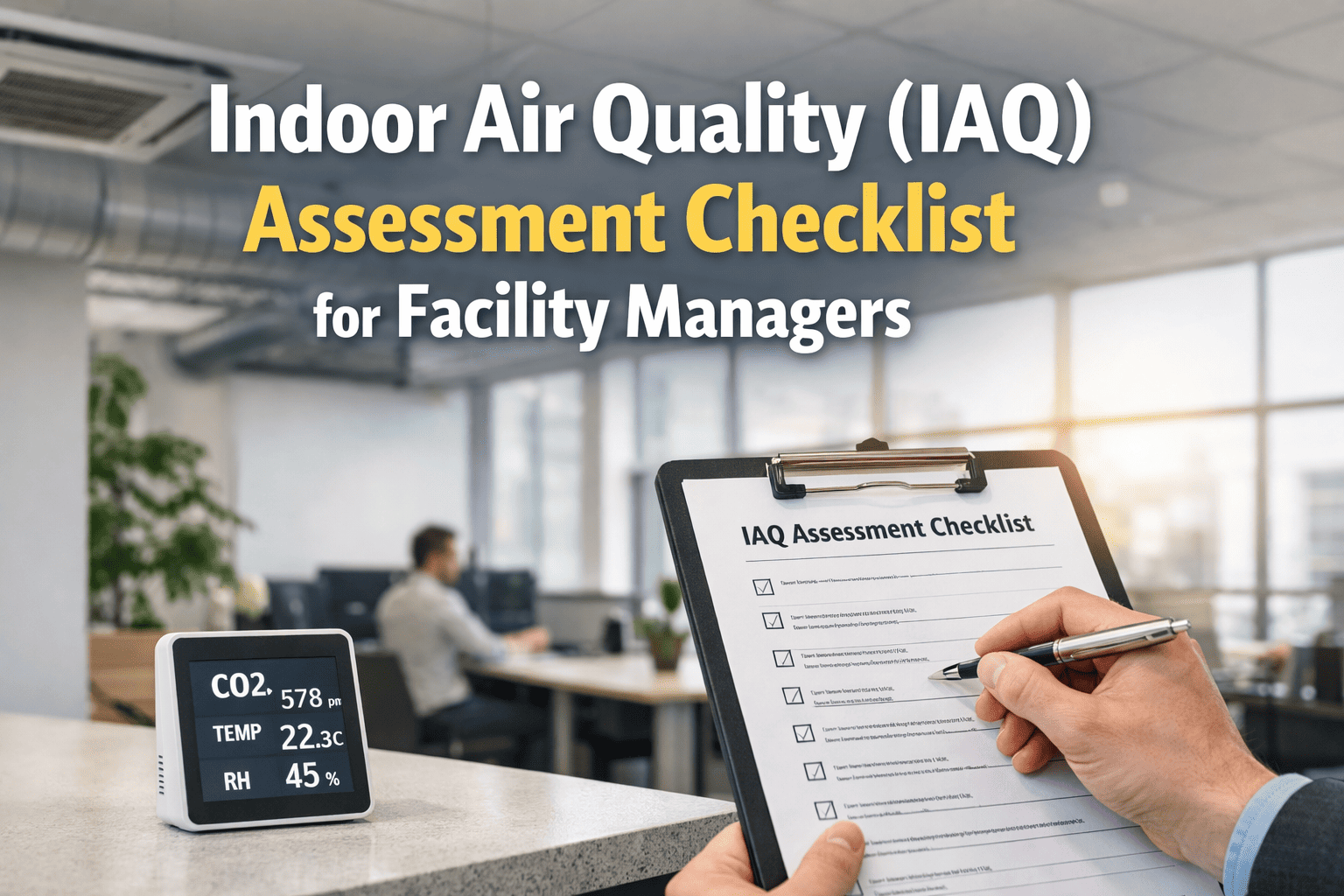
Most commercial buildings are losing 25–30% of their energy spend to waste they cannot see. A fouled chiller coil running 18% below rated COP. HVAC systems conditioning spaces two hours before occupants arrive. Lighting burning at full output in zones empty 60% of the day. None of these show up on a utility bill as a line item — they blend invisibly into the total. A building energy audit surfaces exactly these losses, quantifies them in dollars, ranks them by payback period, and produces the documentation that unlocks utility incentive funding for up to 40% of upgrade costs. This guide covers the complete 2026 audit process from pre-audit data collection through ASHRAE level selection, EUI benchmarking, on-site assessment, ECM prioritization, and utility incentive applications. OxMaint's Energy and Sustainability Module automates the maintenance history, asset condition, and PM compliance data that makes every audit faster and more actionable. Sign up free or book a demo to see the audit data workflow in your CMMS.
Energy & Sustainability
Building Energy Audit: Step-by-Step Process for Facility Managers
8–10 min read
30%
Of commercial building energy is wasted — DOE estimate, fully recoverable through structured audit programs
$0.89
Average energy cost per sq ft per year in US commercial buildings — top quartile reaches $0.62 post-audit
40%
Of qualifying upgrade costs fundable through utility incentives when formal audit documentation is provided
10x
Average return on audit investment — $1 in audit cost returns $10 in identified savings opportunities
OxMaint Cuts Energy Audit Prep Time from 3 Weeks to Under 10 Minutes.
Maintenance history, asset condition scores, PM compliance records, and equipment age data — all exported audit-ready from your live CMMS in one step. Then track ECM implementation and verify post-upgrade savings in the same platform. Free to start. No credit card required.
What a Building Energy Audit Produces
An energy audit is not a utility bill review. It is a structured engineering process that connects physical building systems, operational patterns, occupancy data, and maintenance history to produce one primary output: a ranked list of Energy Conservation Measures with documented costs, verified savings estimates, and payback periods. Every other output — the EUI baseline, the benchmarking report, the utility incentive application — serves that deliverable.
What Goes In
24 months of utility billing data — electricity, gas, water
Building floor area, occupancy schedules, and use type per zone
Equipment inventory — HVAC, lighting, DHW, controls, plug loads
Maintenance history and PM compliance records exported from CMMS
BAS setpoints and operating schedules if available
Previous audit reports and completed upgrade project records
→
What Comes Out
EUI baseline and peer group benchmark position for the building
System-level energy breakdown — HVAC, lighting, DHW, plug loads
Ranked ECM list with cost, annual savings, and payback per measure
Utility incentive qualification documentation per qualifying ECM
Maintenance gap analysis linking deferred PM to quantified energy waste
Capital investment plan integrated into building CapEx forecast
The 3 ASHRAE Audit Levels: Choosing the Right Depth
ASHRAE Standard 211 defines three levels of commercial building energy audit with increasing depth, cost, and accuracy. Choosing the wrong level wastes money on over-auditing or leaves opportunity on the table by under-auditing. The right level depends on your audit history, the scale of investment being considered, and whether utility incentive programs require a specific audit depth to qualify.
Level 1
Walk-Through Assessment
Benchmarking and low-cost opportunities
Utility bill analysis plus a brief on-site survey. Establishes EUI baseline, identifies obvious inefficiencies, and flags buildings warranting Level 2. No detailed measurements. Not suitable for incentive applications or capital budget justification.
Level 2 — Most Common
Energy Survey and Analysis
Investment-grade ECM analysis — standard for FM decisions
Detailed energy survey with system-level measurements, operational data analysis, and investment-grade financial analysis per ECM. Produces documentation for utility incentive applications, financing approvals, and capital budget justification. This is the standard level for commercial FM decision-making.
Level 3
Detailed Capital-Intensive Analysis
High-accuracy modelling for major projects
Rigorous engineering analysis using calibrated energy simulation models and extensive metering for large-scale capital modifications — complete HVAC replacement, full envelope upgrades, or renewable energy systems. Required for large utility incentive programs and energy performance contracting.
EUI Benchmarking: Where Does Your Building Stand?
Energy Use Intensity (EUI) — expressed as kBtu per square foot per year — is the foundational metric of any energy audit. It normalizes consumption for direct comparison between buildings of different sizes. Calculate yours against the benchmarks below before the auditor arrives.
Building Type
Median EUI
Top 25%
ES 75th Pctile
Office — Large Commercial965854
Retail — Single Tenant1126863
Hotel / Lodging1489488
Healthcare — Outpatient182118110
K–12 School784844
Warehouse / Distribution422422
Multifamily Residential885248
Source: CBECS 2018, ENERGY STAR Portfolio Manager, DOE BTO 2024. All values kBtu/sq ft/yr.
5 Signs Your Building Needs an Energy Audit — Right Now
Most facility managers delay energy audits until a compliance deadline forces the issue. These five signals indicate that delay is already costing money and that audit-identified savings will outpace the audit cost within the first service year.
01
Your EUI is above the median for your building type
A building operating above the median EUI is paying a measurable energy penalty every month. For a 100,000 sq ft office running at 110 kBtu/sq ft instead of the 96 kBtu median, the annual energy overspend at $0.07/kBtu is approximately $98,000 per year — before any investigation into why the gap exists. An audit identifies which systems drive the excess and which interventions close the gap fastest.
02
Utility costs are rising faster than occupancy or floor area
Energy costs rising faster than occupancy signal developing equipment inefficiency or operational drift — BAS setpoints that have shifted, filters and coils that have degraded, equipment running on outdated schedules. These changes accumulate slowly and escape monthly budget reviews. An audit quantifies the total drift and produces the corrective action list that reverses it.
03
Major HVAC or lighting equipment is approaching end of life
Equipment replacement decisions made without audit data default to like-for-like replacement — missing opportunities for higher-efficiency alternatives with 3–4 year payback. Buildings that audit before replacing equipment capture an additional $15,000–$60,000 in incentive funding that like-for-like replacements miss entirely, plus the ongoing operating cost savings from the efficiency upgrade.
04
You face mandatory energy disclosure requirements in 2026
NYC Local Law 97, UK MEES, NABERS mandatory disclosure, and the EU EPBD recast all require commercial building operators to document and improve energy performance on defined timelines. NYC LL97 penalty exposure is $0.142 per kBtu over the carbon limit — equivalent to $85,000 per year for a 100,000 sq ft office at the 2026 threshold. A formal energy audit is the first step in the compliance pathway for every one of these frameworks.
05
Your PM program has gaps that have never been quantified in energy terms
Every deferred PM event on an energy-consuming system generates a measurable energy penalty. A chiller with overdue coil cleaning runs 15–20% above rated consumption. An AHU with a blocked filter increases fan motor draw by 18–22%. An energy audit converts deferred maintenance from a reliability risk into a documented financial liability — with a cost figure that justifies the maintenance spend to finance leadership in terms they act on.
OxMaint Exports Audit-Ready Maintenance Data in Under 10 Minutes
PM compliance history, deferred maintenance log, equipment condition scores, and asset age data — all in one export step, saving 2–3 weeks of manual data assembly that most facility managers spend before an auditor arrives.
The Hidden Cost of Skipping or Delaying an Energy Audit
Each year without a formal energy audit is not a neutral choice — it has a quantifiable cost. The calculation below uses conservative estimates for a 150,000 sq ft commercial office building operating above median EUI. The numbers below represent ongoing annual waste that a Level 2 audit and ECM implementation would eliminate.
Annual Cost of No Audit
EUI above median — energy overspend
~$98,000/yr
HVAC maintenance deficiencies — chiller and AHU efficiency loss
~$37,000/yr
Lighting above optimal efficacy — T8 vs LED gap
~$22,000/yr
BAS scheduling misalignment — after-hours conditioning
~$18,000/yr
Missed utility incentives — foregone rebate funding
~$45,000 one-time
Conservative annual waste without audit
~$175,000/yr
Value Recovered After Level 2 Audit
EUI reduction to top quartile through Tier 1+2 ECMs
+$62,000/yr
HVAC maintenance correction — PM schedule alignment
+$37,000/yr
LED retrofit — 50% lighting energy reduction
+$22,000/yr
BAS schedule correction — immediate no-cost ECM
+$18,000/yr
Utility incentives captured through audit documentation
+$45,000 one-time
Conservative annual value recovered
~$139,000/yr + $45K incentives
ECM Prioritization: From 20 Measures to a Funded Action Plan
A Level 2 audit typically identifies 15–25 Energy Conservation Measures. Without a prioritization framework, the list sits in a report binder until the next audit. The four-tier model below converts it into a time-phased program with defined funding sources per tier and clear implementation owners.
Tier 1
Under 6 months
Implement Now
No-Cost Operational Changes
BAS scheduling corrections, thermostat setback, lighting timer adjustments, equipment shutdown policies. Zero capital required. Typical savings: 5–10% of total building energy with no investment. Implementation this quarter.
Examples: HVAC pre-cooling schedule correction, weekend setback activation, lighting timer adjustment
Tier 2
6 months — 3 years
This Year
Low Capital — Utility Incentive Eligible
LED lighting retrofit, occupancy sensors, VFDs on secondary pumps, coil cleaning program. Simple payback under 3 years before incentives — typically under 18 months after utility rebates are applied. Fund from OpEx or minor CapEx.
Examples: T8 to LED conversion, AHU occupancy sensor controls, secondary pump VFD installation
Tier 3
3–7 years
Next CapEx
Equipment Lifecycle-Aligned Capital
Chiller replacement with high-efficiency unit, AHU upgrade, heat pump conversion, BAS replacement. Align with equipment end-of-life cycle to avoid double capital spend. Include in next CapEx submission with RUL data from CMMS.
Examples: Chiller upgrade at end-of-life, rooftop unit replacement with variable-capacity unit
Tier 4
7+ years
Monitor & Defer
Long-Horizon Strategic Investments
Full building envelope retrofit, rooftop solar, battery storage, deep geothermal. Payback over 7 years or technology not yet mature for this asset class. Monitor regulatory incentive landscape and reassess at next audit cycle.
Examples: Full exterior insulation upgrade, on-site solar PV, ground-source heat pump system
Utility Incentive Programs: Fund 40% of Upgrade Costs
Utility incentive programs in every major commercial building market fund a significant portion of audit-identified upgrade costs — but only when applications are supported by formal audit documentation. Most facility managers leave substantial incentive money unclaimed because upgrades are implemented without the supporting paperwork.
USA
IRA Section 179D, utility DSM programs, NYSERDA, CPUC, ComEd Energy Efficiency
Up to $5.00/sq ft tax deduction (179D) plus $0.50–$1.50/sq ft utility rebates per qualifying measure
ASHRAE Level 2 minimum. Qualified energy assessor certification required for 179D claims.
UK
UKEF Green Economy Finance, Salix Finance, ECO4 scheme, Climate Change Agreements
0% or low-interest financing for public sector. ECO4 grants cover 100% of qualifying upgrades in eligible properties.
Current EPC rating and documented energy audit required. MEES compliance pathway must be demonstrated.
Canada
Canada Greener Homes, NRCan Industrial Energy Efficiency, provincial utility programs
Up to $40,000 per building through Greener Homes. Provincial rebates add $0.08–$0.22 per kWh saved.
Pre- and post-audit assessments by registered energy advisors required. NRCan-registered auditor preferred.
Australia
ARENA Commercial Retrofit, ESS/VEET/REES state programs, AusIndustry Energy Efficiency Grants
ESS/VEET certificate values $40–$80/MWh certified. AusIndustry grants up to $25,000 per site.
Accredited assessor required. NABERS baseline rating required. Independent savings verification post-implementation.
25%
Average energy cost reduction from full implementation of audit-identified ECMs in commercial buildings
2.3 yr
Average simple payback on Tier 1 and Tier 2 ECMs combined after utility incentive deductions are applied
40%
Of qualifying upgrade costs fundable through utility incentive programs with formal audit documentation
$0
Audit incentive funding left unclaimed when OxMaint CMMS data supports the application from day one
Start Your Energy Audit Program with OxMaint's Energy and Sustainability Module.
Continuous energy tracking per asset. Audit-ready CMMS data exports. ECM implementation tracking. Post-upgrade savings verification. ESG compliance documentation. All in one platform. Free to start — no credit card, no time limit, no implementation fees.
Frequently Asked Questions
QHow often should a commercial building undergo a formal energy audit?
ASHRAE recommends a Level 1 walkthrough every 3–5 years and a Level 2 detailed audit every 5–10 years for buildings meeting energy benchmarks. Buildings above median EUI should conduct a Level 2 immediately and re-audit every 3 years until top-quartile performance is reached. Buildings subject to mandatory disclosure — NYC Local Law 97, UK MEES, NABERS Australia — should align audit frequency with compliance reporting cycles. OxMaint tracks energy consumption continuously between formal audits, flagging deviations that indicate when an unscheduled investigation is warranted.
Book a demo or
sign up free to start tracking your building's energy baseline today.
QWhat CMMS data should I export before the energy auditor arrives?
The highest-value CMMS export for an auditor: 24 months of PM completion records for all HVAC, lighting, and electrical systems; the full asset register with installation dates and last service dates identifying equipment likely below rated efficiency; all deferred maintenance items related to filters, coils, belts, and controls; and energy-related work orders flagging abnormal consumption or occupant comfort complaints. OxMaint exports all of this in one step in the format most auditors use — saving 2–3 weeks of manual data assembly.
Sign up free to build this data asset or
book a demo to see the audit export workflow.
QCan I conduct a Level 1 energy audit without hiring an external auditor?
Yes. A Level 1 walkthrough can be conducted internally by a facility manager with utility billing data, a free EUI benchmarking tool (ENERGY STAR Portfolio Manager), and the building equipment list. It identifies whether the building warrants a Level 2 by a certified auditor and flags low-cost operational ECMs implementable immediately. OxMaint's Energy Module provides EUI calculation, equipment data export, and the maintenance gap analysis that form the core of a Level 1 internal assessment.
Book a demo to see the assessment workflow or
sign up free to run your first Level 1 today.
QHow does OxMaint track ECM implementation after the audit report is delivered?
OxMaint converts each approved ECM into a tracked project in the CMMS — with upgrade specification, target savings, implementation timeline, assigned contractor, and audit-reported budget attached to the project record. As work orders are completed, OxMaint records actual implementation cost and triggers post-implementation energy monitoring against the audit's savings projection. Verified savings are captured per ECM, providing documentation for utility incentive reimbursement and ESG reporting.
Sign up free to activate ECM tracking or
book a demo to see the post-audit workflow in detail.
Every Building Energy Audit Starts with Better Maintenance Data. OxMaint Provides It.
Audit-ready asset data. Continuous EUI tracking. ECM project management. Post-upgrade savings verification. ESG compliance documentation. All operational from day one. Start free — no credit card, your building's energy baseline starts the moment your account is active.
Continue Reading
Connected resources in the Energy and Sustainability cluster.
Pillar
12 min
Net Zero Buildings Roadmap for Facility Operations
The complete FM roadmap from current energy performance to net zero — strategy, technology, compliance milestones, and CapEx planning framework for commercial portfolios.
Read the Guide →
Core
9 min
ESG Compliance and Sustainability Reporting for Facility Managers
How FM teams generate investor-grade ESG reports from CMMS operational data — covering SEC Climate Disclosure, MEES, CSRD, NABERS, and all major 2026 frameworks.
Read the Guide →
Authority
10 min
Building Performance Standards Compliance Guide
The definitive compliance guide for building performance standards — NYC Local Law 97, UK MEES, EU EPBD, UAE Green Building Regulations, and Australia NABERS mandatory disclosure.
Read the Guide →
Spoke
7 min
LED Lighting Retrofit Guide for Facility Managers
Complete LED retrofit planning — fixture selection, lighting power density targets, utility rebate qualification, control integration, and payback analysis for commercial buildings.
Read the Guide →