40%
of global energy consumption comes from building and facility operations (IEA)
25–35%
energy cost reduction achievable through structured maintenance and controls optimisation
$10T
of global ESG-linked assets under management — sustainability reporting is now a financial requirement
2030
deadline for 50% emissions reduction under most science-based target commitments — 5 years away
The Five Pillars
Sustainable Facility Management — Five Operational Pillars
01
Energy Management
Track energy intensity (kWh per m² or per occupant) by building zone, equipment, and time period. Identify where energy is consumed, when consumption spikes, and which maintenance interventions — filter cleaning, coil servicing, controls calibration — deliver measurable reductions.
kWh/m²
kW/ton (HVAC)
Peak demand kW
02
Carbon Reduction
Calculate Scope 1 (direct combustion), Scope 2 (purchased electricity), and Scope 3 (supply chain and waste) emissions. Link carbon reduction directly to maintenance actions — refrigerant leak prevention, boiler efficiency maintenance, LED retrofit tracking. Every maintenance task that reduces energy use reduces carbon intensity.
kgCO₂/m²
Scope 1 + 2 total
Carbon intensity trend
03
Water Conservation
Monitor water consumption by building, floor, and system (HVAC, irrigation, domestic). Leak detection programmes linked to the CMMS — every confirmed leak becomes a work order, every repaired leak becomes a measured water saving. Water intensity per occupant or per m² tracked against reduction targets.
m³/occupant
Leak WO rate
Cooling tower cycles
04
Waste and Circular Economy
Track waste streams from facility operations — general waste, recyclable materials, hazardous maintenance waste (lubricants, refrigerants, batteries), and equipment at end of life. Diversion rate (% of waste not sent to landfill) is the primary KPI. Sustainable procurement for maintenance parts and materials reduces upstream embodied carbon.
% waste diverted
Hazardous waste kg
Recycled parts %
05
ESG Compliance and Reporting
GRI, SASB, TCFD, GRESB, and BREEAM In-Use all require documented facility performance data with an auditable trail. Sustainability reports built from maintenance logs and spreadsheets are difficult to verify and time-consuming to compile. CMMS-linked ESG reporting turns compliance from a quarterly project into an always-ready data export.
GRI reporting
GRESB benchmark
BREEAM In-Use
Book a Demo — See Live Sustainability KPIs Built From Your Facility's Maintenance Data.
Energy intensity · Carbon per m² · Water consumption · Waste diversion · PM compliance — all tracked automatically in OxMaint and exportable for GRI, GRESB, and BREEAM In-Use reporting.
KPI Reference
Sustainability KPIs for Facility Management — Targets and Benchmarks
| KPI | Unit | World-Class Target | Industry Average | Maintenance Driver |
| Energy Use Intensity (EUI) |
kWh/m²/yr |
Below 100 (office) |
140–200 |
HVAC servicing, lighting controls, BAS optimisation |
| Carbon Intensity |
kgCO₂e/m²/yr |
Below 20 |
35–60 |
Refrigerant management, boiler efficiency, electrification |
| Water Use Intensity |
m³/occupant/yr |
Below 5.0 |
8–15 |
Leak detection PM, cooling tower optimisation |
| Waste Diversion Rate |
% from landfill |
Above 75% |
40–55% |
Hazardous waste tracking, parts reuse programme |
| Planned Maintenance Ratio |
% planned WOs |
Above 85% |
45–65% |
PM compliance directly reduces emergency energy waste |
| Refrigerant Leak Rate |
kg/yr per tonne charge |
Below 5% |
15–25% |
Quarterly leak checks, prompt repair WOs on detection |
| HVAC Efficiency (kW/ton) |
kW per tonne cooling |
Below 0.6 (chiller) |
0.75–1.1 |
Tube cleaning, coil servicing, refrigerant management |
| Net Zero Pathway Progress |
% reduction vs baseline |
On pathway to −50% by 2030 |
−10 to −20% |
All energy and carbon maintenance actions tracked |
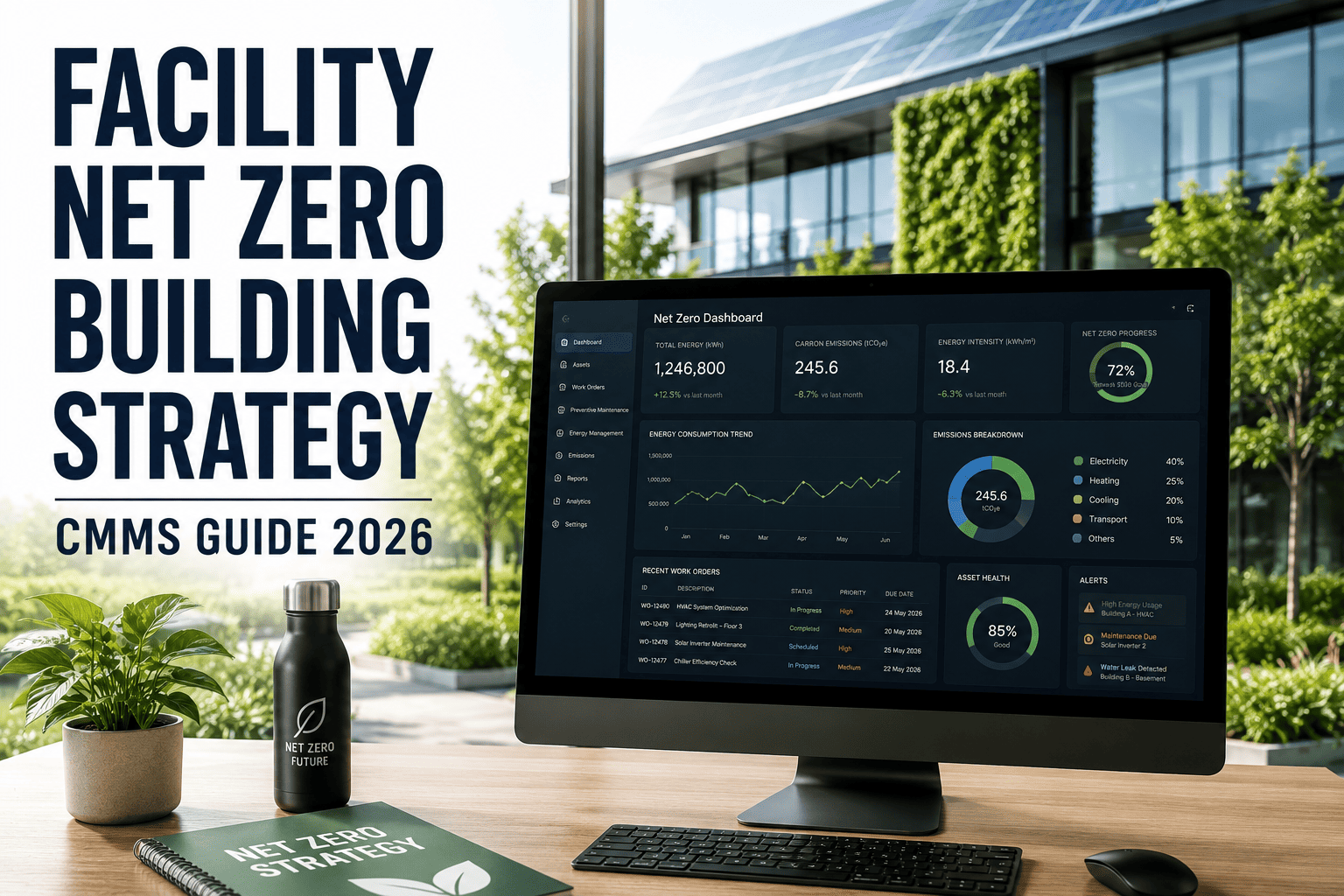
OxMaint tracks all eight KPIs continuously from maintenance work orders, energy meter integrations, and manually entered sustainability readings. Sign in to configure your sustainability KPI dashboard.
Maintenance and Sustainability Link
How Preventive Maintenance Directly Reduces Environmental Impact
HVAC Coil Cleaning
Fouled coils: system uses 15–25% more energy to deliver the same cooling
→
Clean coils: kW/ton back to design efficiency. Carbon intensity reduces proportionally.
OxMaint: Quarterly coil cleaning WO → energy meter reading before and after → kWh saving recorded
Refrigerant Leak Prevention
R-410A has a GWP of 2,088 — 1 kg leaked = 2.1 tonnes CO₂e in atmosphere
→
Quarterly leak check programme: detected leaks repaired before significant charge loss
OxMaint: Quarterly leak check WO → leak finding → repair WO → refrigerant top-up volume recorded
Compressed Air Leak Reduction
Typical industrial facility loses 20–30% of compressed air to leaks — compressors run unnecessarily
→
Annual ultrasonic leak detection tour and repair: 15–20% compressor energy reduction documented
OxMaint: Annual compressed air audit WO → leak list → repair WOs → compressor kWh trend comparison
BAS Controls Calibration
Drifted sensors, failed actuators, and overridden setpoints cause simultaneous heating and cooling
→
Annual controls calibration eliminates simultaneous conditioning — 10–15% HVAC energy saving
OxMaint: Annual BAS calibration WO → setpoint audit findings → energy reading before and after
Lighting and Controls Maintenance
Failed occupancy sensors and daylight sensors leave lights running in unoccupied spaces continuously
→
Quarterly sensor check programme restores designed energy savings from lighting controls
OxMaint: Quarterly controls check WO → failed sensor replacement WO → lighting kWh trend
Water System Leak Detection
A single 1mm pipe leak wastes up to 3,000 litres per day — invisible without meter monitoring
→
Monthly meter check programme: anomalous consumption triggers investigation WO within 24 hours
OxMaint: Monthly meter check WO → consumption vs baseline → anomaly triggers leak investigation WO
What Sustainable Facility Management Leaders Say
"
Sustainability in facility management is not a separate initiative — it is the output of doing maintenance correctly. A building where coils are cleaned on schedule, refrigerant leaks are caught and repaired promptly, BAS sensors are calibrated annually, and compressed air leaks are systematically found and fixed will outperform its sustainability targets without any additional green investment. The CMMS is the sustainability tool. Every work order closed with a measured outcome is an environmental data point. Buildings that treat their CMMS as a compliance and reporting platform, not just a task scheduler, have the evidence base to support genuine ESG disclosure.
Sheila Sheridan, CFM, LEED AP
Principal, Sustainable Facility Strategies · IFMA Sustainability Community Chair · Author, The Green FM Handbook · 25 years sustainable facility management consulting
25–35%
energy cost reduction from structured maintenance and controls optimisation — no capital investment required
$10T
in ESG-linked global assets under management — sustainability reporting is now a financial requirement
40%
of global energy consumption from building operations — facility teams are the most impactful sustainability actor
OxMaint for Sustainability
How OxMaint Tracks Sustainability Performance in Facility Management
01
Energy Meter Integration — kWh Linked to Maintenance Actions
OxMaint integrates with energy meters and BAS/BMS systems via MQTT and OPC-UA — receiving real-time kWh, kVA, and demand readings per circuit, zone, or system. When a maintenance action (coil cleaning, controls calibration) is completed, OxMaint records the energy reading before and after — creating an auditable energy saving per maintenance event.
Sign in to configure energy meter integration in OxMaint.
02
Carbon Intensity Dashboard — Scope 1 and 2 per Building
OxMaint calculates Scope 1 (direct fuel combustion from boilers and generators) and Scope 2 (purchased electricity) carbon intensity per facility using configurable emission factors — updated as the grid decarbonises. Carbon intensity per m² and per occupant is tracked over time, with trend alerts when intensity rises above the configured reduction pathway.
Book a demo to see carbon intensity tracking per building.
03
ESG Report Generation — GRI, GRESB, and BREEAM In-Use
OxMaint generates sustainability performance reports aligned with GRI Standards (energy, emissions, water, waste disclosures), GRESB Real Estate Assessment inputs, and BREEAM In-Use management category evidence — directly from maintenance and energy data, without manual compilation. Report preparation time reduced from weeks to hours.
Sign in to configure ESG reporting templates in OxMaint.
04
Sustainability PM Schedules — Green Maintenance Automatically Scheduled
Sustainability-critical maintenance tasks — refrigerant leak checks, BAS sensor calibration, water meter monitoring, lighting controls inspection — are configured as OxMaint PM templates with defined intervals and outcome measurement fields. Compliance with green maintenance schedules is tracked on the sustainability dashboard alongside energy and carbon KPIs.
Book a demo to see sustainability PM scheduling in OxMaint.
FAQ
Sustainability in Facility Management — Common Questions
What sustainability KPIs should a facility team track first?
Start with Energy Use Intensity (kWh/m²/year) and carbon intensity (kgCO₂e/m²) — the two most required ESG metrics, both directly influenced by maintenance actions. Add water intensity and refrigerant leak rate once baselined. Sign in to activate your sustainability KPI dashboard in OxMaint.
How does OxMaint link maintenance work orders to ESG energy savings?
Each energy-linked PM work order in OxMaint includes before and after energy reading fields. Twelve months of coil cleaning, controls calibration, and refrigerant management WOs each carrying a recorded saving creates an auditable ESG evidence trail. Book a demo to see energy saving tracking per WO.
Which ESG reporting frameworks does OxMaint support?
OxMaint supports GRI Standards (301–306), GRESB Real Estate Assessment inputs, BREEAM In-Use management evidence, and ENERGY STAR Portfolio Manager — all from the same data source, eliminating inconsistencies across frameworks. Sign in to configure your ESG reporting templates in OxMaint.
Can facilities reduce carbon meaningfully without capital investment?
Yes — 25–35% energy and carbon reduction is achievable through operational maintenance alone: coil cleaning, controls calibration, refrigerant leak prevention, and compressed air audits. Capital upgrades amplify these gains but are not required for near-term reduction targets. Book a demo to see maintenance-driven carbon reduction tracking in OxMaint.
Book a Demo — See OxMaint Tracking Your Facility's Sustainability Performance.
Energy intensity per building · Carbon per m² · Water consumption · Waste diversion · Refrigerant leak rate · PM compliance · GRI, GRESB, and BREEAM In-Use reporting. Every maintenance action documented. Every sustainability gain provable.