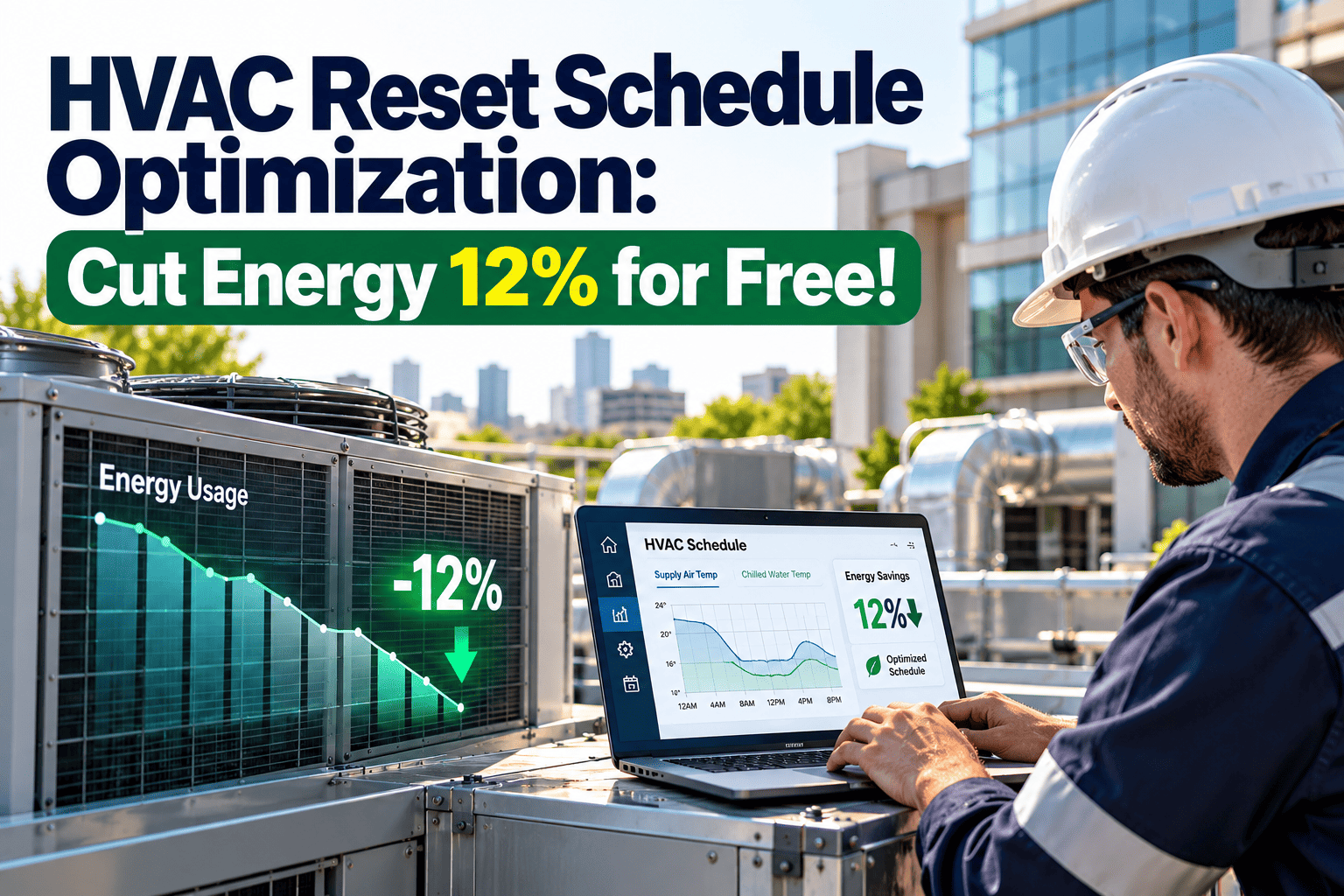
Many commercial HVAC systems still run fixed setpoints all year: the same supply air temperature, chilled water temperature, and hot water temperature whether it is a mild spring morning or a peak summer afternoon. Reset schedules let those setpoints move with load, so equipment stops working harder than the building demands. Done well, resets cost nothing beyond control programming and verification, and a maintenance management system helps keep the sensors and valves behind them trustworthy.
HVAC Reset Schedule Optimization: Cut Energy 12% for Free
Supply air, chilled water, and hot water resets, built on ASHRAE Guideline 36 logic, reduce energy with no new equipment when the underlying hardware is healthy.
Where the saving actually comes from
Reset is about matching supply to demand
A fixed setpoint is sized for the hottest or coldest design day. For most of the year the building needs far less, so equipment is working against its own setpoint for no benefit.
Lower lift
Raising chilled water supply temperature reduces the temperature difference the compressor works against. Efficiency gains per degree vary by machine, often cited in the range of one to two percent.
Less static pressure
Fan power falls steeply as speed drops, so lowering duct static pressure when dampers are mostly open cuts fan energy significantly.
Condensing operation
Lower hot water temperature reduces losses and lets condensing boilers return water cool enough to condense, which is where their efficiency advantage lies.
Lower differential pressure
Resetting loop differential pressure to what the most demanding valve needs reduces pump speed and distribution losses.
A note on the 12 percent figure
Twelve percent is a headline target for well-executed resets on suitable systems, not a guarantee. Results depend on climate, load profile, equipment, and the control sequences you start from, so measure before and after.
What ASHRAE Guideline 36 brings to resets
Trim and respond logic
Guideline 36 uses zone-driven requests to move setpoints. Instead of a fixed schedule tied only to outdoor temperature, the setpoint drifts toward efficiency until zones say they need more.
Why this beats a fixed curve alone
- It reacts to the actual weakest zone, not an assumed load profile.
- It limits comfort complaints because a struggling zone pulls the setpoint back.
- It adapts when occupancy, equipment, or use patterns change.
- Outdoor air temperature can still set limits so the setpoint stays within a safe range.
The reset schedules most buildings need
Starting points by system
| Setpoint | Resets based on | Direction | Watch for |
|---|---|---|---|
| Supply air temperature | Outdoor air temperature and zone cooling requests | Warmer when load is light, colder when zones request cooling | Humidity control and higher fan speed at warmer supply air |
| Duct static pressure | Zone damper requests | Lower until a zone damper needs more airflow | Stuck or failed dampers that pin the setpoint high |
| Chilled water supply temperature | Cooling coil valve requests and outdoor conditions | Warmer when valves are not demanding | Dehumidification needs and coil capacity |
| Chilled water differential pressure | Valve position requests | Lower until a valve nears fully open | Leaking or stuck valves distorting requests |
| Hot water supply temperature | Outdoor air temperature and heating requests | Cooler in mild weather | Condensing boiler return temperature and coil capacity |
| Hot water differential pressure | Heating valve requests | Lower until a valve nears fully open | Poorly balanced branches |
Treat ranges as site-specific
Guideline 36 provides default limits and parameters, but your climate, coils, and building use decide the final minimum and maximum. Confirm them against the current edition and your design data.
An illustrative reset curve in practice
Hot water example
The values below are an example of the shape, not a recommendation. Set your own limits from coil selection and boiler data.
| Outdoor air condition | Example hot water supply | Reason |
|---|---|---|
| Design cold day | Upper limit of the range | Coils need full capacity |
| Cold | Reduced from the maximum | Load is below peak, so lower temperature still meets demand |
| Cool | Midrange | Condensing boilers begin to operate efficiently |
| Mild | Lower limit of the range | Minimal heating demand and lower distribution losses |
| Above the lockout point | System off | Heating is not needed |
Chilled water follows the same logic in reverse
- Warmer chilled water in mild conditions reduces compressor lift.
- Colder chilled water returns when coils demand more capacity or humidity control needs it.
- A lower limit protects against freezing and ensures dehumidification.
- An upper limit protects coil capacity and comfort.
Make sure the hardware behind your resets is ready
Track sensor calibration, valve checks, and control inspections so reset logic acts on reliable data.
Before you reset: the readiness checklist
Reset logic assumes the sensors, valves, and dampers tell the truth. When they do not, the controller chases bad data and comfort suffers.
The hidden maintenance dependency
One leaking valve or one stuck damper can send constant requests and keep an entire system at its least efficient setpoint. Resets expose maintenance problems that fixed setpoints used to hide.
Trade-offs to manage deliberately
| Change | Energy benefit | Risk to manage | Safeguard |
|---|---|---|---|
| Warmer supply air | Less cooling energy | Higher fan energy and weaker dehumidification | Limit the maximum and watch indoor humidity |
| Lower static pressure | Lower fan energy | Starved zones | Respond to damper requests and set a minimum |
| Warmer chilled water | Lower chiller energy | Reduced coil capacity and humidity control | Allow chilled water to drop when coils demand more |
| Cooler hot water | Lower losses, better condensing | Insufficient heating on cold mornings | Use a morning warm-up allowance and a lower limit |
| Lower loop pressure | Lower pump energy | Poor flow to remote loads | Reset to the most demanding valve |
Simultaneous heating and cooling
Poorly tuned resets can create reheat while cooling, wasting the savings. Review reheat valve activity after changes and adjust supply air limits if reheat rises.
A phased rollout that limits comfort risk
Baseline and repair
Trend data, fix faulty sensors and valves, and document current sequences.
Pilot one system
Apply resets to a single air handler or loop and monitor zone complaints.
Tune limits
Adjust minimums, maximums, and request thresholds from observed behaviour.
Scale and verify
Extend to other systems and compare energy against the baseline.
Seasonal review
- Check cooling resets at the start of the cooling season and heating resets before winter.
- Review shoulder season behaviour, when changeover problems often appear.
- Re-tune after major repairs, retrofits, or occupancy changes.
- Share seasonal findings with operators so overrides are explained, recorded, and removed once the cause is fixed.
- Keep a short log of every limit change, including the date, the person responsible, and the comfort or energy result that followed.
Before and after: fixed setpoints vs reset schedules
Fixed setpoints
- Same temperatures all year
- Chillers and boilers work harder than needed
- Fans run at high pressure with dampers throttled
- Faults hidden behind constant operation
- No link between zone demand and plant output
Reset schedules
- Setpoints follow load and zone requests
- Lower lift and better boiler efficiency
- Fan and pump speeds fall with demand
- Faulty valves and dampers become visible
- Plant output tracks the weakest zone
Measuring whether the reset worked
Compare like with like
Energy use depends on weather and occupancy, so compare periods with similar conditions or normalise consumption against degree days. Raw before-and-after totals can mislead.
Connecting resets to fault detection
- A setpoint stuck at its limit for long periods often points to a hardware or zone problem.
- Reheat running while the plant cools suggests supply air limits need review.
- A zone sending constant requests may have a damper, sensor, or airflow issue.
- Each finding becomes a corrective work order with an owner and a closeout record.
Why fan and pump savings are larger than they look
The affinity laws in plain terms
For fans and pumps, power falls roughly with the cube of speed under ideal conditions. A modest reduction in speed therefore produces a much larger reduction in power.
Real systems are less ideal
- Static pressure in the system, motor and drive efficiency, and minimum speed limits reduce the theoretical gain.
- Equipment without variable speed drives cannot capture these savings, so confirm the hardware first.
- Throttled dampers and valves waste the benefit, which is why their condition matters.
Codes, standards, and documentation
Where resets appear in standards
Many energy codes, including editions of ASHRAE Standard 90.1, include reset requirements for certain system types. Check which edition your jurisdiction has adopted before assuming a requirement applies.
Records worth keeping
- The sequence of operations before and after each change.
- Minimum, maximum, and request settings, with the reason for each value.
- Calibration results for the sensors used by the reset logic.
- Seasonal review dates, findings, and who approved any adjustments.
- Complaint logs that explain why limits were relaxed or tightened.
Why documentation protects the savings
Without records, a technician responding to a complaint may override a setpoint and forget to restore it. Recorded settings make drift visible and reversible.
Which buildings benefit most
| Building situation | Reset opportunity | Main caution |
|---|---|---|
| Office with variable air volume systems | Supply air and static pressure resets | Zone dampers must respond reliably |
| Campus with a central chilled water plant | Chilled water temperature and differential pressure | Remote buildings may have uneven valve behaviour |
| Facility with condensing boilers | Hot water supply temperature reset | Return water must be cool enough to condense |
| Humid climate or high ventilation loads | Limited chilled water and supply air resets | Dehumidification may restrict how warm setpoints can go |
| Older building with manual controls | Basic outdoor air schedules first | Controls upgrades may be needed before advanced logic |
Reading reset behaviour as a fault signal
What unusual patterns usually mean
Turn each pattern into action
Log the finding against the asset, raise a work order, and record the cause on closeout. Over time, repeat causes show which components deserve replacement rather than another repair.
Common reset mistakes
- Applying resets without calibrating the sensors that drive them.
- Setting limits too aggressively and creating comfort complaints that lead to the reset being switched off.
- Ignoring humidity, especially in humid climates or spaces with high latent load.
- Failing to document original sequences, which makes problems hard to reverse.
- Letting a single faulty zone dominate requests without investigating it.
- Skipping seasonal reviews and assuming one tune lasts forever.
How Oxmaint supports reset optimization
Keeping the equipment honest
Relevant capabilities
- Preventive maintenance schedules for sensor calibration, valve and damper checks, and actuator inspection.
- Corrective work orders when trends show a stuck valve, failed damper, or drifting sensor.
- Asset management linking air handlers, pumps, chillers, boilers, valves, and their repair history.
- Mobile inspections so technicians can record setpoint, valve, and damper checks in the field.
- Reporting and dashboards for repeat failures, open work, and completion of seasonal reviews.
Facilities teams can start organising this work or review a plan with the team before the next season begins.
Frequently asked questions
Are reset schedules really free?
They need controls programming and verification time, not new equipment. Savings depend on starting conditions, so measure them.
Do resets risk comfort complaints?
They can if limits are aggressive. Use request-based logic, pilot first, and keep fallback settings. Talk to our team about rollout tracking.
What should I fix before implementing resets?
Calibrate sensors, test valves and dampers, and clear stuck actuators. Faulty devices distort the requests that drive resets.
How often should reset limits be reviewed?
At the start of each cooling and heating season, and after any major repair or retrofit.
How do I track the maintenance tasks behind resets?
Schedule calibration and valve checks as recurring tasks. You can sign up to set them up.
Capture the energy savings your controls already allow
Keep the sensors, valves, and dampers behind your reset schedules reliable, season after season.