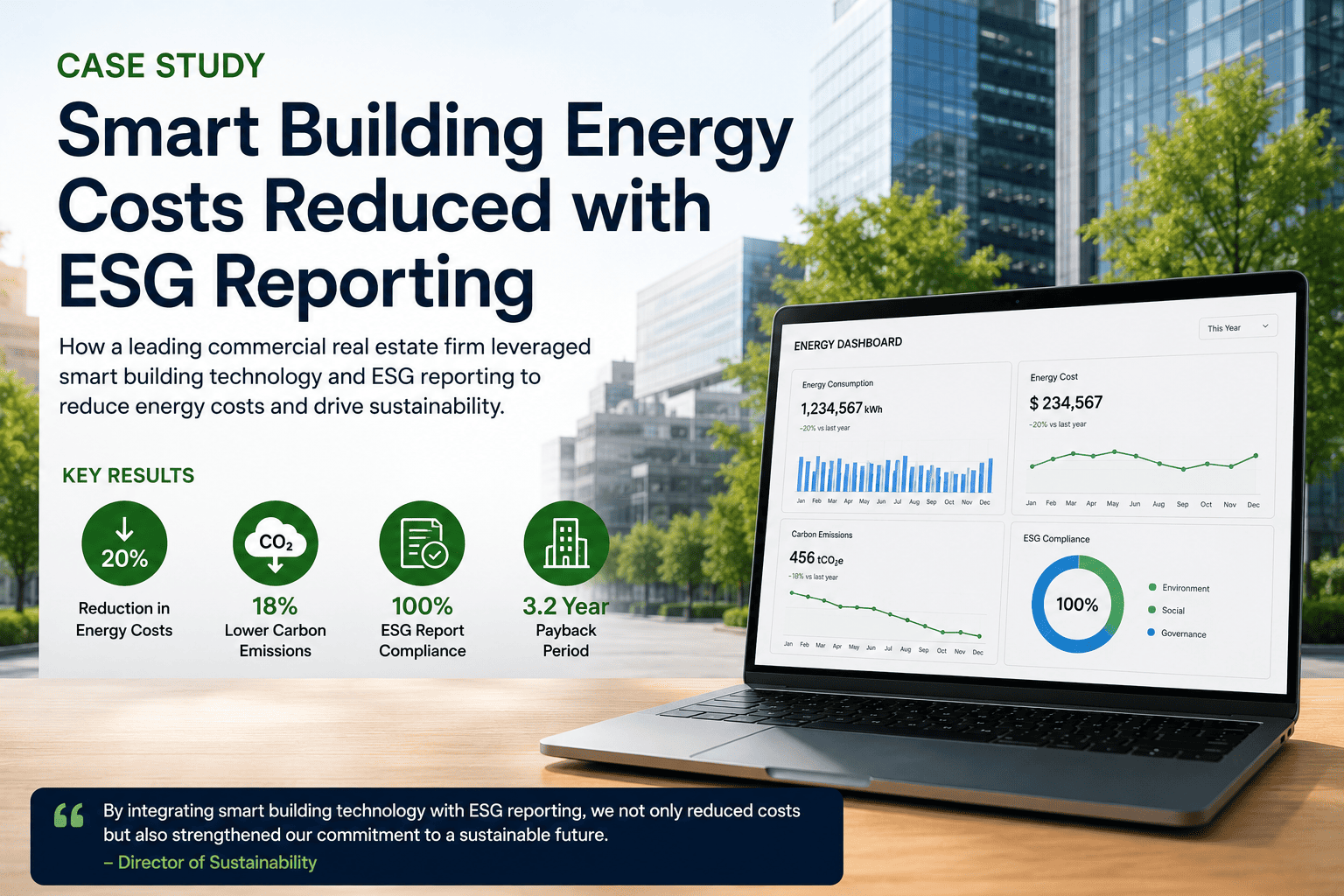
Commercial buildings waste an estimated 30% of the energy they consume — not through system failure, but through suboptimal scheduling, setpoint drift, occupancy mismatch, and the slow accumulation of equipment inefficiency that fixed-threshold alarm systems are never configured to catch. AI energy optimisation changes the economics of building operations by replacing the monthly utility bill review with continuous, granular visibility over every energy-consuming system in real time. The facilities achieving 20–30% energy cost reduction are not doing more maintenance — they are doing smarter maintenance, guided by AI that sees what the building is doing at 3:00 AM on a Tuesday and flags the deviation from expected behaviour before it compounds for another 30 days. OxMaint integrates energy monitoring with maintenance workflows — so every anomaly becomes a work order, not just a data point.
Article · HVAC & Energy · AI Optimisation
AI Energy Optimisation for Commercial Buildings: Cut Costs 30%
HVAC Scheduling · Demand Response · Lighting Controls · Load Balancing · Real-Time Anomaly Detection · Proven 20–30% Cost Reduction
30%
average energy waste in commercial buildings from scheduling, setpoint, and equipment inefficiency
$2.10
per square foot annual energy cost in a typical Class A commercial office — AI reduces this to $1.50–$1.70
6 mo
typical payback period for AI energy monitoring investment in a 50,000+ sq ft commercial building
5 Ways AI Reduces Commercial Building Energy Costs
01
HVAC Schedule Optimisation
AI analyses occupancy patterns from access control, BMS, and sensor data to build a precise picture of when and where cooling and heating are actually needed. Systems running to a fixed 6 AM–10 PM schedule in a building where 80% of occupants leave by 6:30 PM are conditioning empty space for 3.5 hours every day — a direct and quantifiable energy cost.
Typical saving: 18–28% of HVAC energy
02
Demand Response Automation
AI integrates with utility demand response programmes to pre-cool or pre-heat the building before peak tariff windows, then coast through peak periods with reduced equipment load. Buildings that manage peak demand manually — if they manage it at all — consistently pay premium rates that AI-automated demand response eliminates.
Typical saving: 12–22% on demand charges
03
Equipment Efficiency Monitoring
A chiller running at 0.7 kW/ton when its design efficiency is 0.55 kW/ton is wasting 27% of its energy input — every hour it runs. AI monitors efficiency ratios continuously and alerts the maintenance team when performance degrades beyond threshold, converting an energy waste into a work order before it accumulates on the utility bill.
Typical saving: 15–25% on major plant energy
04
Lighting and Small Power Control
Occupancy-linked lighting AI eliminates over-illumination in vacant zones and identifies lighting circuits that are operating outside expected patterns — failed sensors, bypassed controls, or misconfigurations that have been wasting energy undetected since the last BMS commissioning exercise.
Typical saving: 25–35% of lighting energy
05
Anomaly Detection and Alerting
AI establishes a consumption baseline for every major system — chiller, AHU, boiler, pump — and flags deviations that fall outside normal operating ranges. A weekend consumption spike that would be invisible until the next monthly bill is detected within hours, and a maintenance work order is raised automatically before the anomaly compounds.
Typical saving: catches $8K–$40K per anomaly event
Energy Savings by System — What AI Delivers
HVAC Scheduling
18–28%
Lighting Controls
25–35%
Chiller Efficiency
15–25%
Demand Charges
12–22%
Savings ranges based on ASHRAE, DOE commercial building benchmarking data, and OxMaint customer outcomes. Actual results vary by building type, climate zone, and baseline efficiency.
See Your Building's Energy Baseline — and Where AI Finds the Savings
OxMaint connects to your BMS and energy meters in days. Within the first month, AI identifies the top three energy waste opportunities in your building — specific, actionable, and quantified in dollar terms.
Implementation Path — From Baseline to 30% Savings
1
Baseline Establishment (Week 1–2)
OxMaint connects to energy meters, BMS, and major plant data feeds. AI establishes consumption baselines per system, per zone, per time-of-day — creating the reference model that all future anomalies are measured against.
2
Anomaly Identification (Week 2–4)
Within the first two to four weeks, AI surfaces the highest-value energy waste events in your building — typically 3–8 specific, quantified opportunities ranging from BMS scheduling misconfigurations to equipment efficiency degradation.
3
Work Order Integration (Month 1–2)
Each energy anomaly generates a maintenance work order in OxMaint — assigned to the responsible technician with the asset, deviation data, and recommended corrective action pre-populated. Energy savings and maintenance activity are tracked on the same platform.
4
Continuous Optimisation (Month 3+)
AI models refine against seasonal occupancy patterns, equipment age trends, and tariff structure. Portfolio-level energy benchmarking identifies the buildings with the highest remaining savings potential — directing capital investment and FM attention where it delivers the most return.
"
The commercial buildings that are achieving 25–30% energy cost reduction through AI are not doing anything technically exotic. What they have done is replace the monthly utility bill as their primary energy management tool with a system that tells them what changed, when it changed, and which specific piece of equipment or BMS configuration is responsible — within hours rather than 30 days. That shift from lagging indicator to leading indicator is where all the value lives. A building manager who gets a work order on Monday saying chiller kW/ton has risen 22% from baseline since Friday is in a completely different position than the one who discovers the same efficiency loss on the next utility bill. Same data, completely different outcome — because the timing of the information determines whether you can act on it or just absorb the cost. OxMaint gives FM teams the former, which is why the ROI case for AI energy monitoring is so consistently strong.
Dr. Olusegun Adeyemi, PhD, CEng
Director of Building Energy Systems · 20 Years Commercial Building Energy Engineering · Chartered Engineer · PhD in Building Energy Systems (UCL) · Specialist in AI energy optimisation deployment, commercial building EPC improvement, and demand-side energy management for large commercial and mixed-use portfolios
Frequently Asked Questions
How does AI energy optimisation connect to our existing BMS without a full system replacement?
OxMaint connects to existing BMS platforms — Siemens Desigo, Honeywell EBI, Johnson Controls Metasys, Schneider EcoStruxure, and others — via BACnet, Modbus, and OPC-UA protocols without requiring system replacement or BMS software upgrades. The AI layer sits above the BMS, reading data and identifying optimisation opportunities that the BMS itself is not configured to detect. In most deployments, the BMS continues to control the building while OxMaint provides the intelligence layer that identifies what is suboptimal and generates work orders to correct it. Start a free trial to assess your BMS connectivity options. For older buildings without a centralised BMS, OxMaint can connect to individual equipment controllers, energy sub-meters, and smart plug loads — building an energy monitoring picture progressively without requiring a building-wide controls upgrade before AI optimisation can begin.
How long does it realistically take to achieve 20–30% energy reduction with AI optimisation?
Most commercial buildings see measurable energy reduction within the first 30–60 days of AI monitoring, because the easiest wins — BMS scheduling misconfigurations, setpoint drift, and equipment running outside occupied hours — are typically identified and corrected in the first month. The full 20–30% reduction typically emerges over 3–6 months as AI models refine against seasonal patterns and more complex optimisation opportunities are identified and acted on. Book a demo to see a realistic savings projection for your building type. The facilities that reach the upper end of the savings range are those where the FM team acts quickly on AI-generated work orders — the AI finds the opportunity, but a responsive maintenance team determines how fast the saving is captured and how long it is sustained.
Can AI energy optimisation support ESG reporting and sustainability commitments?
Yes — OxMaint's energy analytics module generates consumption reports by building, by system, and by time period in formats compatible with ESG reporting frameworks including GRI, SASB, and GRESB. Scope 1 and Scope 2 emissions calculations are generated automatically from energy consumption data using configurable emissions factors for the relevant grid region. Explore OxMaint's ESG reporting features with a free trial. For property companies and institutional investors with public net-zero commitments, OxMaint provides the building-level consumption trail and year-on-year reduction evidence that assurance providers and ESG rating agencies require — replacing manual data collection from utility invoices with a continuous, auditable digital record of energy performance across the entire portfolio.
OxMaint · AI Energy Optimisation
Your Building Is Wasting 30% of Its Energy Budget Right Now.
OxMaint's AI energy monitoring finds the waste, raises the work order, and tracks the saving — so energy reduction is a managed outcome, not an occasional project.