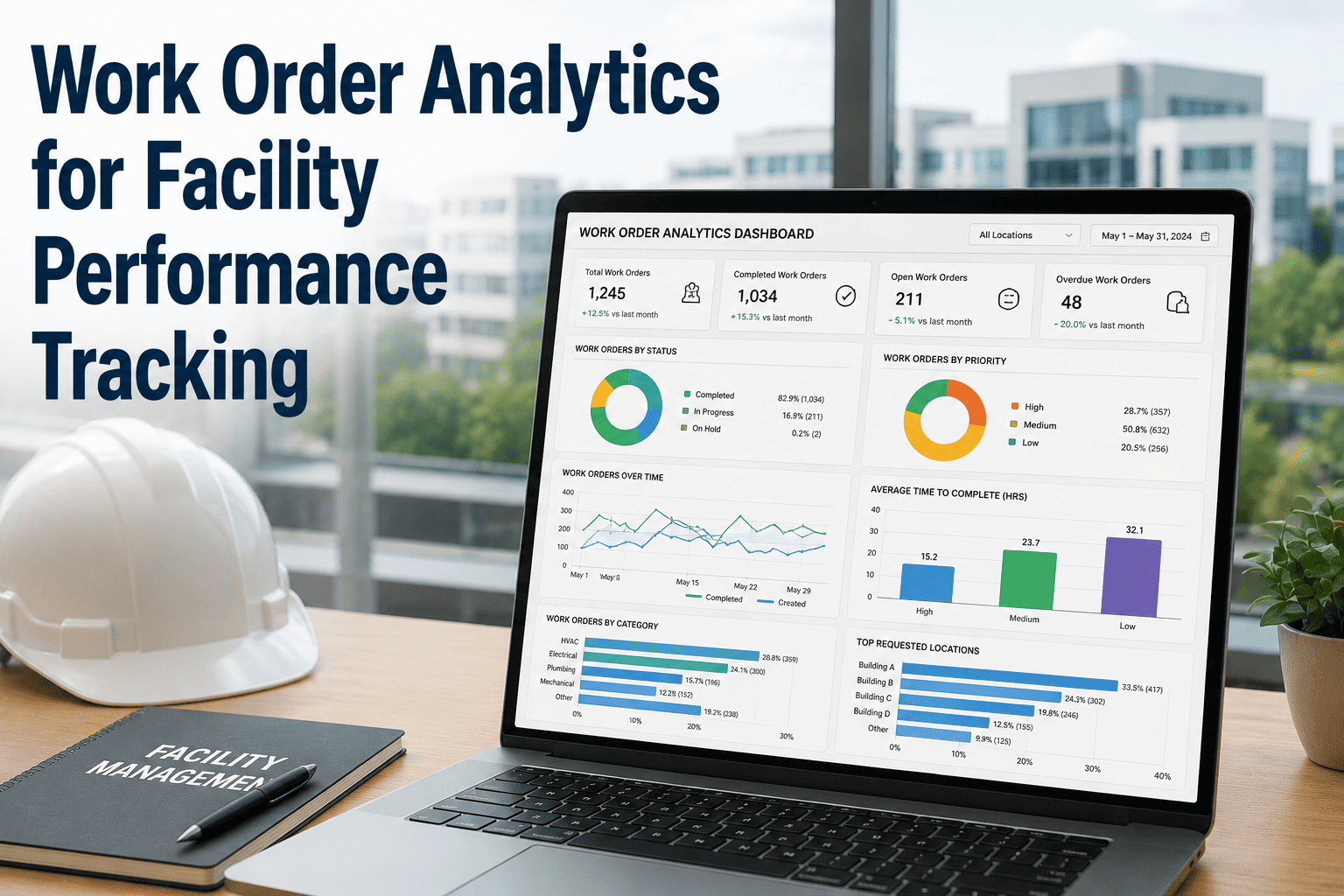
The corporate campus facility director reviews the quarterly maintenance report with growing frustration—$2.3 million spent on reactive repairs across 12 buildings, yet HVAC systems failed 47 times, elevator downtime reached 312 hours, and employee satisfaction scores dropped 23% due to "comfort complaints." The CFO demands ROI justification for the proposed $180,000 IoT asset tracking investment, but without baseline data, predictive maintenance facility management metrics, or audit trail documentation, the presentation collapses into vague promises rather than bankable projections. Meanwhile, competing campuses showcase 40-60% maintenance cost reductions with real-time condition monitoring dashboards that make budget conversations strategic rather than defensive.
This scenario repeats across corporate campuses nationwide as facility management teams struggle to bridge the gap between traditional maintenance approaches and data-driven asset tracking facility management excellence. The average corporate campus manages 15,000-50,000 trackable assets spanning HVAC systems, electrical infrastructure, elevators, fire safety equipment and building automation systems—yet 72% operate without centralized visibility into asset health, maintenance history or predictive failure indicators.
Corporate campuses implementing IoT sensors combined with barcode/QR identification systems, AI analytics platforms, and work order automation workflows achieve 45-65% reductions in unplanned downtime while generating comprehensive audit trail documentation that transforms maintenance from cost center to strategic asset. The transformation requires calculating precise ROI projections using condition monitoring data, SLA reporting benchmarks, and facility management CMMS best practices that justify investments with measurable outcomes. Facility teams ready to move beyond reactive maintenance can explore how connected asset tracking changes the equation.
What if you could walk into your next budget meeting with a data-backed ROI projection showing exactly when your IoT investment pays for itself?
While other facility managers defend reactive maintenance costs, forward-thinking campuses use predictive CMMS platforms to prevent 70% of equipment failures before they impact operations. Discover why leading corporate campuses trust Oxmaint to protect their building investments.
Elevate Facility Management Energy Performance Using Mobile Inspections
Effective asset tracking facility management for corporate campuses begins with understanding how IoT sensors, mobile inspections, and AI analytics create an interconnected ecosystem that transforms reactive firefighting into proactive stewardship. Modern maintenance software facility management platforms extend beyond simple work order tracking to include real-time equipment health monitoring, automated threshold alerts and predictive failure algorithms that identify problems 30-90 days before operational impact.
Traditional inspection approaches relying on clipboard rounds and paper checklists miss 55-70% of developing equipment problems while consuming 35% of technician time on administrative tasks rather than actual maintenance activities. Mobile inspections equipped with barcode/QR scanning, photo documentation, and GPS-verified task completion ensure every inspection generates actionable data feeding predictive maintenance facility management algorithms. Organizations looking to eliminate paper-based inefficiencies can see how mobile inspection workflows operate in practice.
Real-time monitoring of airflow, temperature differentials, and compressor performance identifying efficiency degradation before comfort complaints arise. Prevents 65% of HVAC failures.
Power quality monitoring detecting harmonic distortion, voltage imbalances, and phase anomalies indicating equipment stress. Reduces electrical failures by 70% while optimizing utility costs.
Vibration analysis and door cycle monitoring predicting motor wear, brake degradation, and control system anomalies 45-60 days before service disruption.
Flow monitoring, pressure analytics, and leak detection preventing water damage while identifying irrigation inefficiencies and restroom fixture problems before visible symptoms.
ROI Calculator Approach: Quantifying IoT Asset Tracking Returns
Justifying IoT asset tracking investments requires systematic ROI calculation that translates technical capabilities into financial outcomes executives understand. Facility management CMMS best practices demonstrate that structured ROI frameworks incorporating baseline costs, projected savings, and risk-adjusted timelines achieve 85% budget approval rates compared to 23% for proposals lacking quantified projections.
The foundation of accurate ROI calculation lies in capturing current maintenance spending across emergency repairs, contractor premiums, energy waste, and productivity losses from equipment downtime. Campuses lacking visibility into these baseline costs often underestimate savings potential by 40-60%, undermining budget proposals that could otherwise demonstrate compelling returns. Facility directors preparing for budget conversations can walk through ROI calculation methodologies with implementation specialists.
Corporate Campus ROI Calculator Framework
| Investment Category | Traditional Approach Cost | IoT-Enabled Approach Cost | Annual Savings | ROI Timeline |
|---|---|---|---|---|
| HVAC Maintenance | $180,000 - $450,000 | $95,000 - $220,000 | 45-55% reduction | 8-14 months |
| Elevator Service | $75,000 - $180,000 | $45,000 - $95,000 | 40-50% reduction | 12-18 months |
| Electrical Systems | $120,000 - $320,000 | $65,000 - $175,000 | 45-55% reduction | 10-16 months |
| Plumbing Infrastructure | $85,000 - $210,000 | $50,000 - $120,000 | 40-45% reduction | 14-20 months |
| Fire Safety Systems | $45,000 - $95,000 | $30,000 - $55,000 | 35-45% reduction | 16-24 months |
Making Audits Painless — A Facility Management Strategy with Analytics
Corporate campuses face increasingly stringent facility management compliance requirements spanning fire safety codes, OSHA regulations, environmental standards, and insurance mandates. Traditional audit preparation consuming 60-120 hours quarterly transforms into 2-4 hour automated report generation when comprehensive audit trail documentation captures every inspection, work order, and equipment intervention with timestamped accountability.
Strategic CMMS implementation creates perpetual audit readiness where compliance verification becomes a dashboard query rather than a documentation scramble. AI analytics identify compliance gaps proactively, flagging overdue inspections, expired certifications, and approaching regulatory deadlines with automated escalation ensuring nothing falls through administrative cracks. Teams spending excessive hours on manual compliance documentation can discover how automated audit trails eliminate preparation stress.
Automated tracking of fire suppression system inspections, emergency lighting tests, and evacuation equipment verification with instant audit report generation.
- Monthly fire extinguisher inspections
- Quarterly sprinkler system testing
- Annual fire alarm certification
- Emergency lighting verification logs
Documentation of equipment safety inspections, hazard assessments, and corrective action tracking demonstrating due diligence compliance.
- Equipment safety inspection logs
- Hazard identification documentation
- Corrective action tracking
- Training completion records
Refrigerant tracking, waste management documentation, and energy efficiency reporting meeting EPA and local environmental requirements.
- Refrigerant leak detection logs
- Hazardous waste disposal records
- Energy consumption reporting
- Air quality monitoring data
Comprehensive maintenance documentation supporting insurance claims, liability defense, and risk mitigation verification.
- Preventive maintenance completion proof
- Incident documentation with photos
- Equipment certification tracking
- Contractor compliance verification
Audit-Ready Analytics Benefits
Corporate Campus Asset Risk Assessment Matrix
Strategic resource allocation requires systematic risk scoring that evaluates each building system based on failure probability, operational impact, and replacement cost. Facility management CMMS best practices demonstrate that risk-based prioritization enables 35-45% more effective maintenance resource deployment while ensuring critical systems receive appropriate attention regardless of historical patterns.
Risk assessment frameworks combining asset criticality with real-time condition data outperform calendar-based approaches by 60-75% in failure prevention effectiveness. The distinction lies in evaluating actual equipment health rather than assumed degradation curves that ignore usage intensity, environmental factors, and maintenance quality variations. Campus teams implementing risk-based prioritization can understand how AI-driven scoring optimizes resource allocation.
| Asset Category | Critical Risk Factors | IoT Monitoring Priority | Failure Impact | Recommended PM Frequency |
|---|---|---|---|---|
| Central HVAC Plants | Age, runtime hours, refrigerant condition | Critical - Continuous monitoring | Building-wide comfort failure | Weekly inspection, Monthly deep PM |
| Electrical Switchgear | Load patterns, thermal signatures, age | Critical - Real-time thermal | Power outage, safety hazard | Monthly thermal scan, Quarterly PM |
| Elevator Systems | Usage cycles, door operations, motor wear | High - Vibration & cycle monitoring | Accessibility impact, entrapment risk | Weekly inspection, Monthly service |
| Building Automation | Software version, sensor calibration, network health | High - System health monitoring | Energy waste, comfort complaints | Monthly calibration, Quarterly review |
| Fire Suppression | Pressure levels, valve condition, inspection status | Moderate - Pressure monitoring | Life safety, code violation | Monthly inspection, Annual certification |
Asset Criticality Scoring Matrix
IoT Asset Tracking Implementation Playbook for Corporate Campuses
Transforming corporate campus maintenance from reactive chaos to predictive excellence requires systematic implementation following proven facility management CMMS best practices. Organizations rushing technology deployment without workflow redesign achieve only 30-40% of potential benefits, while structured implementations following phased playbooks consistently deliver 80-95% of projected outcomes.
The implementation sequence matters significantly—asset discovery must precede sensor deployment, baseline data collection must precede AI analytics activation, and workflow configuration must precede mobile rollout. Campuses inverting these sequences experience 2-3x longer time-to-value while generating user frustration that undermines adoption. Teams planning implementation can discuss phased rollout strategies with deployment specialists.
Corporate Campus Implementation Playbook
Deploy barcode/QR tags across all trackable assets with comprehensive specifications, installation dates, warranty information, and maintenance history imported into centralized CMMS platform.
Install IoT sensors on critical assets beginning with HVAC, electrical, and elevator systems. Collect 60-90 days baseline data establishing normal operating parameters for AI analytics comparison.
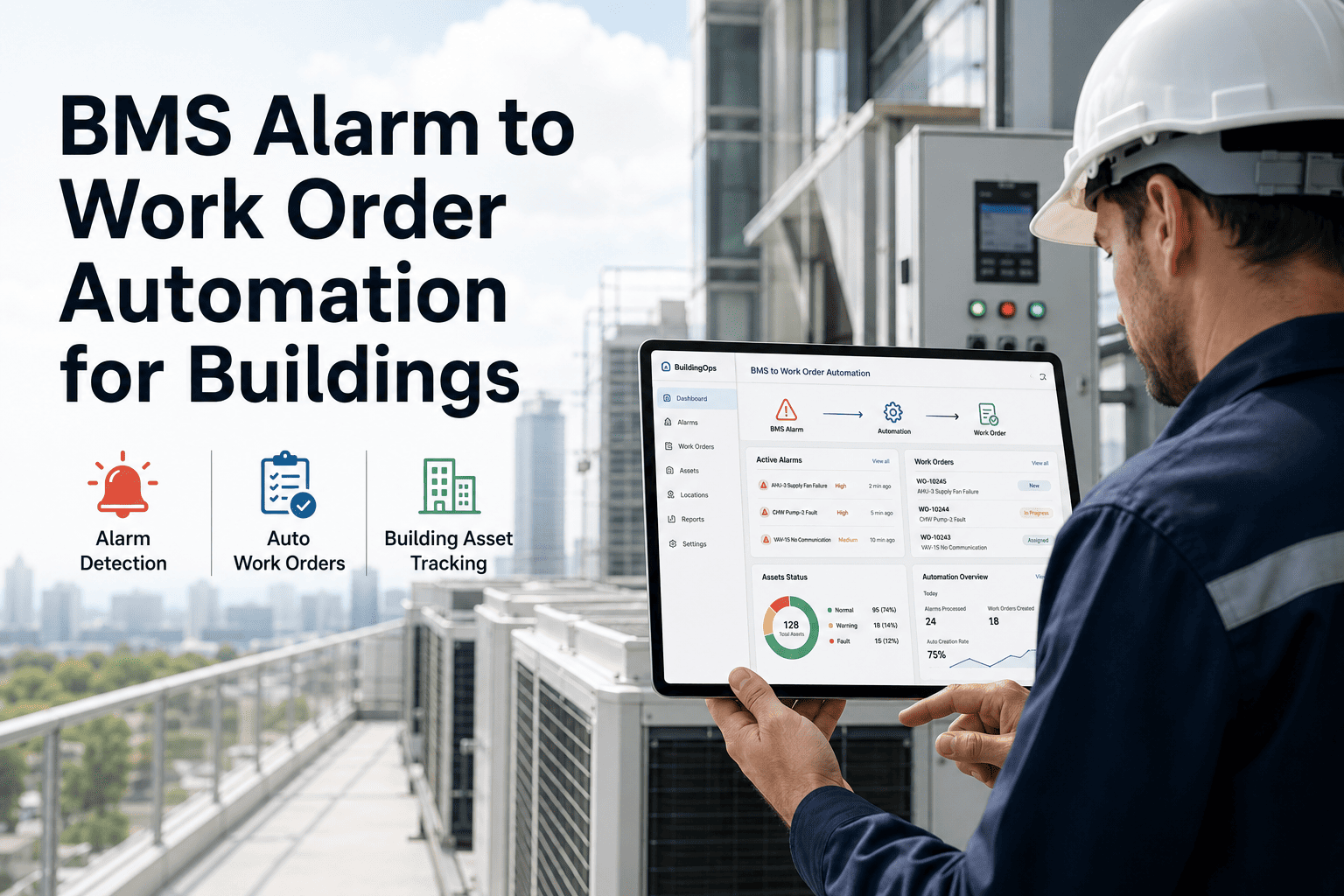
Configure automated work order generation triggered by sensor threshold breaches, scheduled PM intervals, and mobile inspection findings with intelligent routing to appropriate technicians.
Equip technicians with tablet-based inspection apps featuring offline capability, barcode scanning, photo documentation, and GPS-verified task completion ensuring comprehensive audit trail capture.
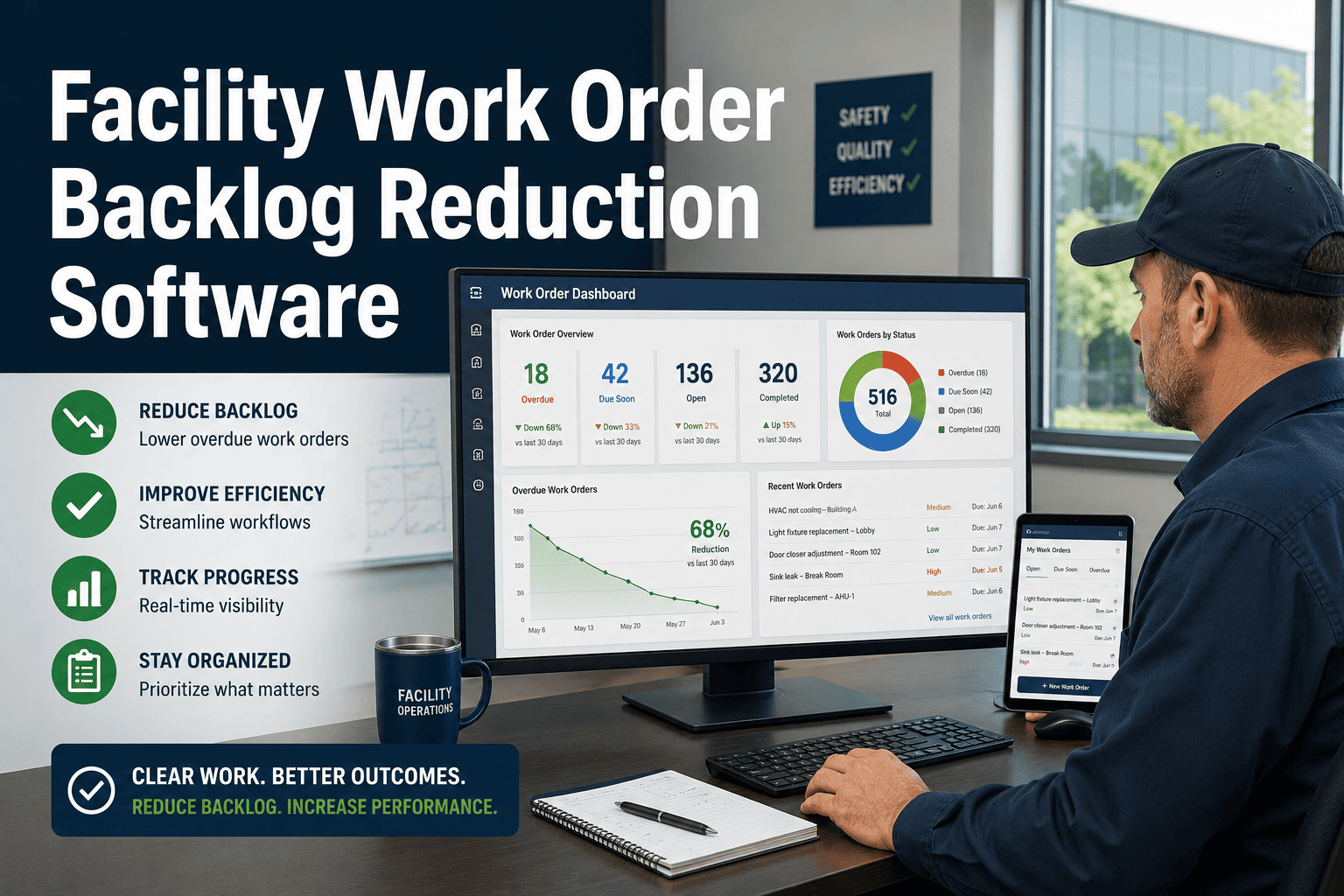
Enable real-time SLA reporting dashboards tracking PM compliance, response times, work order aging, and equipment uptime with automated escalation for missed performance targets.
Activate predictive maintenance facility management algorithms analyzing sensor data patterns, work order history, and equipment performance to identify failures 30-90 days before occurrence.
SLA Reporting Dashboards & Performance KPIs
Measuring predictive maintenance facility management success requires establishing clear KPIs tracked through real-time SLA reporting dashboards that transform maintenance activities into executive-ready metrics. Effective downtime reduction strategies depend on consistent measurement enabling continuous improvement rather than anecdotal success claims.
Dashboard design significantly impacts organizational adoption—executives need high-level trend visualization while technicians require actionable task queues. Multi-layer dashboard architectures serving different stakeholder needs achieve 3x higher utilization rates than one-size-fits-all approaches. Teams designing performance measurement frameworks can explore dashboard configuration options tailored to organizational structure.
Percentage of scheduled preventive maintenance tasks completed on time. Leading indicator of equipment reliability and failure prevention effectiveness.
Average duration from failure identification to service restoration. Measures response efficiency and parts availability optimization.
Distribution of planned maintenance versus emergency repairs. Primary indicator of predictive capability maturity and cost optimization.
Total maintenance expenditure normalized by building area. Enables benchmarking across facilities and industry comparisons.
Percentage of time critical assets operate without failure. Direct measure of predictive maintenance effectiveness and operational impact.
Average time from work order creation to completion. Indicates workflow efficiency and resource allocation effectiveness.
IoT Sensor & CMMS Integration Architecture
Successful asset tracking facility management requires seamless integration between IoT sensors, building automation systems, and CMMS platforms creating a unified data ecosystem. Fragmented implementations with disconnected data silos achieve only 40-50% of potential benefits while creating administrative overhead that undermines ROI projections.
Integration architecture design determines long-term scalability—campuses selecting open-protocol platforms maintain flexibility for future sensor additions and system expansions while avoiding vendor lock-in that inflates lifecycle costs. Teams evaluating integration requirements can discuss compatibility with existing building systems.
Conclusion
IoT-driven asset tracking for corporate campuses represents the evolution from reactive maintenance chaos to data-driven operational excellence, where predictive maintenance facility management capabilities directly translate into measurable cost savings, improved occupant satisfaction, and strategic budget positioning. Corporate campuses implementing comprehensive IoT sensor networks with AI analytics and work order automation achieve 45-65% reductions in unplanned downtime while generating audit trail documentation that transforms compliance from burden to competitive advantage.
Understanding the interconnected architecture of barcode/QR asset identification, condition monitoring, and SLA reporting dashboards reveals that successful implementations require systematic transformation extending far beyond simple technology deployment. Facility management CMMS best practices demonstrate that ROI projections become reality when technology investments combine with workflow redesign, mobile inspection deployment, and performance measurement establishing accountability at every level.
The 2025 operating environment rewards facility teams demonstrating data-driven asset stewardship while penalizing those maintaining reactive approaches that produce emergency repair invoices and occupant complaints. Success requires balancing proven work order automation workflows delivering immediate efficiency improvements with emerging AI analytics innovations positioning departments for continuous optimization and executive credibility.
Imagine presenting your next budget request with documented proof that your IoT investment prevented $1.2 million in emergency repairs—what doors would that open for your facilities career?
Every month without predictive asset tracking is another month accumulating preventable failures and wasted budget. Join the forward-thinking corporate campuses that transformed facility management from reactive firefighting to predictive excellence with Oxmaint's connected CMMS platform—the same technology protecting commercial real estate portfolios nationwide.