Every facility team knows the feeling: technicians still closing last week's corrective jobs while this week's PMs come due, and the open work order count climbing no matter how hard everyone runs. A bloated backlog isn't just a long to-do list — facilities without disciplined work order processes carry maintenance costs roughly 35% higher, backlogs of four to six weeks, and first-time fix rates under 70%. The fix is rarely more headcount; it's prioritizing the right work, routing the right technician, capturing updates on mobile, and watching the numbers across every building. This page shows how facility teams cut their backlog to a healthy range with OxMaint's work order management — and you can book a demo to see it run against your own queue.
Work Order Automation / Work Order Management
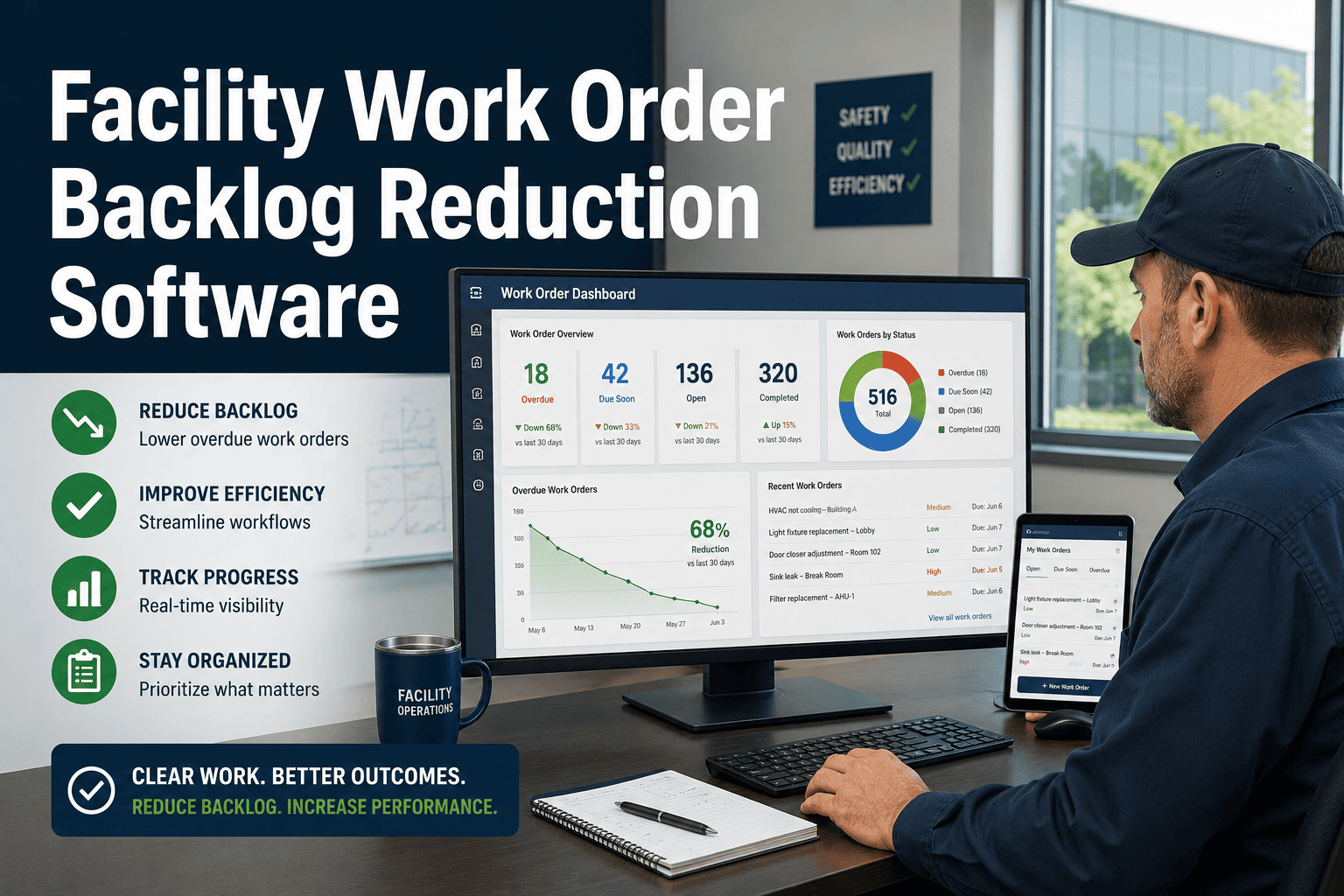
Work Order Backlog Reduction for Facility Maintenance Teams
Prioritized work orders, technician routing, mobile updates, and KPI visibility across every building — to pull your backlog into the healthy zone and keep it there.
4-6 wk
Typical backlog when work order processes lack discipline
25-30%
Average technician wrench time lost to poor planning
35%
Higher maintenance cost in reactive, backlog-heavy teams
<15%
Emergency work order target that stops backlog growth
Find your backlog's healthy zone
Backlog isn't a number to drive to zero — an empty queue usually means inspections stopped finding work. The target is the Goldilocks range: enough planned work to keep crews productive, not so much that jobs age into risk.
Above six to eight weeks signals systemic problems — poor planning, parts delays, or an emergency culture that defers everything else. The goal is steady backlog velocity that trends down until it settles in the healthy band.
Four levers that pull the backlog down
Each lever frees capacity the next one builds on. Together they shift a team from firefighting to a steady, plannable flow of work.
1
PrioritizeA clear priority matrix ranks every work order so critical and safety jobs lead and low-value work doesn't crowd the queue.
2
RouteSkill- and location-based dispatch sends the right technician to the right building, cutting travel and second trips.
3
Go mobileOffline-capable mobile updates lift wrench time and kill duplicate data entry, so more of each shift is spent on the wrench.
4
MeasureReal-time dashboards show backlog velocity and KPIs across every building, so a growing queue gets caught in days, not quarters.
Pull your backlog into the healthy zone
OxMaint prioritizes, routes, and tracks every work order across your buildings — so capacity goes to the work that matters most.
The KPI scoreboard that proves it
Backlog is one number on a wider board. Track these together and the trend becomes undeniable — to your team and to the people who fund it.
2-4 wk
Work order backlog
<15%
Emergency work orders
90%+
PM schedule compliance
What teams recover
Structured, CMMS-driven backlog reduction pays off fast — usually without adding a single permanent hire.
52%
Open work order count cut in the first quarter, as reported by facility teams
Weeks 3-6
When the first 25% reduction typically lands, via duplicate purging and batch work
30%+
Daily capacity recovered when emergencies drop below 15% of work
10-14 mo
To clear a 1,000-2,000 work order backlog without new headcount
Expert Review
"Most managers think their backlog problem is a staffing problem. Almost always it's a flow problem. When wrench time sits at 25 to 30 percent, more than half of every paid hour is going to travel, waiting on parts, and hunting for information — so the queue grows even with a full crew. Get the priority matrix honest, route by skill and location, and put the work order in the technician's hand on mobile, and you effectively double output without a new hire. The backlog doesn't shrink because people work harder; it shrinks because the system stops wasting the hours they already give you."
Reviewed by a multi-site facilities maintenance director, 21+ years in CMMS-driven work order and reliability programs.
See your backlog trend turn negative
Walk through a live cleanup on your own work order queue — prioritized, routed, and tracked across every building in one view.
Frequently asked questions
What is a healthy work order backlog?
The widely used benchmark is two to four weeks of ready, planned work per technician — enough to schedule efficiently without letting jobs age into risk. OxMaint tracks your backlog against that band automatically.
Book a demo to see your zone.
Is a zero backlog good?
No — an empty queue usually means inspections have stopped generating findings, which hides real deterioration. A small, healthy backlog is a sign of a working program. See balanced backlog tracking in
OxMaint.
Do we need to hire to cut the backlog?
In most cases, no. Lifting wrench time from the typical 25-30% toward 55% roughly doubles effective capacity, so the recovered hours clear the queue.
Book a demo to see where your hours are leaking.
How fast can we see results?
Teams often see the first 25% reduction within weeks three to six, largely from purging duplicates and batching contractor-eligible work. A full 1,000-2,000 order clear typically runs 10-14 months. Start the cleanup in
OxMaint.
What KPIs should we track alongside backlog?
Pair backlog with planned-maintenance percentage, wrench time, emergency work order share, PM compliance, and first-time fix rate. Together they tell the real story. OxMaint surfaces them on one dashboard —
see it in a demo.
How does prioritization reduce backlog?
A documented priority matrix ensures critical and safety work leads while low-value jobs don't consume scarce capacity, so the queue shrinks where it matters most. Configure your matrix in
OxMaint.
How does mobile help technicians?
Offline-capable mobile work orders cut duplicate entry and keep techs on the job instead of returning to a desk, lifting wrench time directly. More wrench time means a faster-shrinking backlog.
Book a demo to see mobile execution.
How does OxMaint reduce our backlog?
OxMaint prioritizes every work order, routes by skill and location, runs execution on mobile, and shows backlog velocity and KPIs across all buildings. Try it on your own queue with a
free trial.
Stop running to stay in place
Turn a growing pile of work orders into a prioritized, routed, measurable flow — and pull your facility backlog into the healthy zone for good.