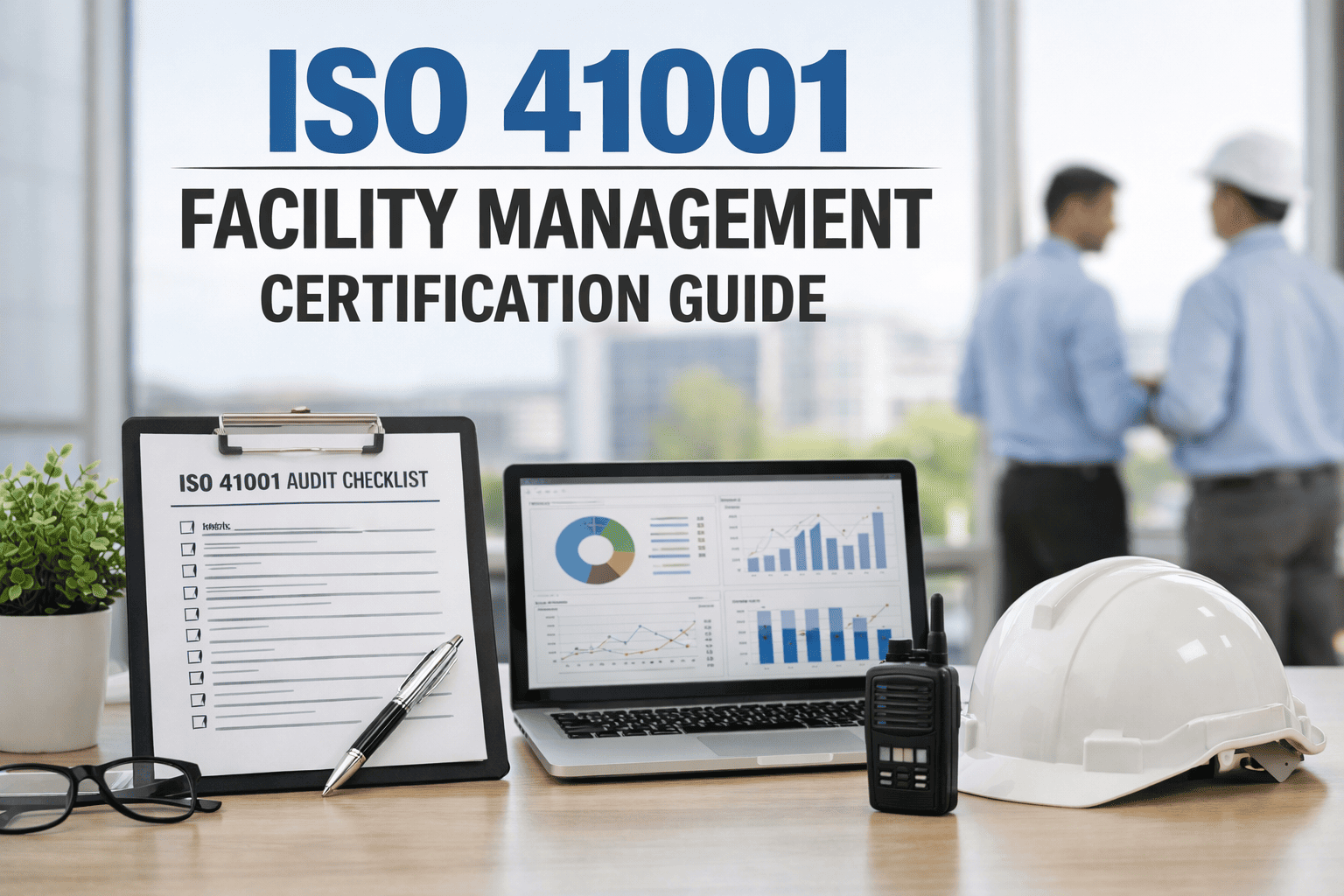
ISO 41001:2018 is the first international standard that defines a management system framework specifically for facility management — not a technical standard for individual building systems, but a system-of-systems standard for how an organisation manages, measures, and continuously improves all FM activities across its portfolio. Published by ISO Technical Committee 267, it is structured around the Plan-Do-Check-Act management system model used by ISO 9001 and ISO 14001, making it compatible with integrated management system strategies and attractive to organisations already operating within ISO certification frameworks. Achieving ISO 41001 certification demonstrates to clients, regulators, and stakeholders that an FM organisation operates within a structured quality framework — not just performing maintenance tasks, but managing facility performance against documented objectives with evidence of continuous improvement. OxMaint’s Compliance Tracking platform structures the documentation, audit trails, KPI trending, and corrective action management that ISO 41001 clause requirements demand — connecting the standard’s intent to the daily operational records that ISO auditors examine.
ISO 41001 Facility Management Certification Guide
Implementation steps, clause-by-clause requirements, audit preparation, gap assessment, and CMMS integration for organisations pursuing ISO 41001 certification or maintaining compliance across a multi-site FM portfolio.
ISO 41001 Clause Structure: The Management System Framework
ISO 41001 is built on the ISO Annex SL high-level structure — the same 10-clause framework used by ISO 9001 (quality), ISO 14001 (environment), and ISO 45001 (occupational health & safety). This means an organisation already certified to any of these standards has an existing management system architecture into which ISO 41001 requirements can be integrated with reduced duplication of documentation and audit effort. Understanding the clause structure is the prerequisite to effective gap assessment.
Gap Assessment & Implementation Roadmap
A gap assessment compares current FM management practice against every applicable ISO 41001 clause requirement to identify what exists, what is partially in place, and what is absent. The output is a prioritised action plan that drives the implementation programme. Organisations that attempt ISO 41001 certification without a documented gap assessment consistently underestimate the documentation and process development effort required, particularly in Clauses 7 (competence records), 8 (operational controls), and 9 (performance measurement).
Key Clause Requirements: What Auditors Actually Examine
ISO 41001 auditors do not read documentation and accept it at face value. They trace the management system from policy to objectives to operational activity to measurement to improvement — looking for evidence that each element functions as described, not just that it has been written down. Understanding what auditors examine in each clause helps FM teams focus implementation effort on the evidence that matters, rather than generating documentation that satisfies the letter but not the intent of the standard.
| Clause | Primary Audit Evidence Required | Common Nonconformity | OxMaint Evidence Source |
|---|---|---|---|
| 4 — Context | Scope statement, stakeholder register, interested party requirements analysis | Scope excludes significant FM activities without justification; interested parties not identified beyond direct clients | Asset register defines scope boundaries; stakeholder list in compliance module |
| 5 — Leadership | Signed FM Policy, FM objectives linked to policy, documented role assignments | Policy is generic; objectives are not measurable; senior management cannot demonstrate system knowledge | Compliance tracking policy document storage; KPI objectives with targets per manager |
| 6 — Planning | Risk register with FM-specific risks, FM objectives with plans (action, owner, timeline, measure) | Objectives lack measurable targets or review dates; risks identified but not evaluated for likelihood/consequence | Risk register with owner, rating, and control; objective tracking with deadline and status |
| 7 — Support | Competence records for all FM staff and contractors, training completion logs, communication plan | Competence records incomplete for contractors; no evidence of training effectiveness evaluation | Technician certification tracking, training records, contractor qualification log |
| 8 — Operation | Work order records, asset maintenance logs, contractor performance data, emergency procedure records | Outsourced FM activities lack performance monitoring; emergency plans not tested; work records incomplete | Work order history per asset, PM completion rates, contractor SLA tracking, drill records |
| 9 — Performance | KPI trend data over minimum 3 months, internal audit reports, management review minutes with all required inputs | KPIs measured once for certification; no trend; management review lacks required inputs (audit results, complaints, improvement status) | KPI dashboards with historical trending, audit finding log, management review report template |
| 10 — Improvement | Nonconformity log with root cause analysis, corrective actions, effectiveness verification, improvement project records | Corrective actions closed without verified effectiveness; no continual improvement projects beyond reactive fixes | Corrective action register with root cause, action, due date, closure, and effectiveness check |
ISO 41001 Clause 9 Requires Ongoing KPI Evidence — Not a Pre-Audit Report Sprint.
Documentation Requirements: What the Standard Mandates vs What Is Best Practice
ISO 41001 distinguishes between “documented information” that the standard explicitly requires (mandatory documents) and documented information that the organisation determines is necessary for the effectiveness of the FM management system (discretionary). Auditors will verify that all mandatory documents exist, are controlled, and are current. Best practice documentation beyond the mandatory minimum strengthens audit evidence and reduces surveillance audit risk.
Audit Preparation: Stage 1 and Stage 2 Readiness
ISO 41001 certification involves a two-stage audit process conducted by an accredited certification body. Stage 1 is a documentation review — the auditor confirms that mandatory documents exist, are controlled, and indicate a sufficiently implemented management system to proceed to Stage 2. Stage 2 is an on-site verification audit where the auditor traces evidence that the documented management system is actually operating as described. A management system that passes Stage 1 on documentation quality but fails Stage 2 on operational evidence is the most common certification failure mode for FM organisations.
The auditor reviews the FM Policy, scope statement, FM objectives, management system manual, and key procedures to confirm the management system is designed to meet ISO 41001 requirements. Stage 1 readiness checklist: Is the FM Policy signed, dated, and publicly available? Does the scope accurately describe system boundaries? Are FM objectives measurable with planned review dates? Does the organisation have evidence of at least one completed internal audit cycle? Has a management review been completed within the past 12 months?
A Stage 1 finding does not stop certification — Stage 1 findings must be resolved before Stage 2 commences, but they do not trigger a nonconformity in the certification decision. Use Stage 1 findings as the final pre-certification corrective action list.
The auditor traces the management system through interviews, observation, and record review. Typical Stage 2 evidence requests: Show me the last three months of KPI data for your FM objectives. Show me a corrective action that was raised, investigated, and closed in the past six months. Show me the competence records for the technician who performed this work order. Show me the contractor performance review for your largest outsourced FM contract. Show me the management review minutes from your last management review.
Major nonconformities (which must be resolved before certification is issued) arise when a mandatory clause requirement is absent entirely or when a fundamental system element is not functioning as documented. Minor nonconformities (which must be resolved within an agreed timeframe, typically 90 days) arise from isolated failures of implementation where the system exists but evidence of consistent application is lacking.
CMMS & Technology Integration: How OxMaint Supports ISO 41001 Compliance
ISO 41001 does not prescribe technology, but the evidence requirements of Clauses 7, 8, 9, and 10 are substantially easier to satisfy when FM operational data is captured in a CMMS that generates structured, searchable, exportable records automatically as a byproduct of work execution. The alternative — manual records assembled specifically for audit — creates a compliance programme that operates separately from the FM programme it is supposed to document, producing records that describe intended practice rather than actual practice.
The specific ISO 41001 clause requirements that CMMS integration addresses most directly are: Clause 7.2 (competence records) satisfied by technician qualification and training records per asset and work order type; Clause 8.1 (operational planning and control) satisfied by scheduled PM work orders with procedure documentation; Clause 9.1 (monitoring and measurement) satisfied by KPI dashboards with historical trend data across all FM activities; and Clause 10.1 (nonconformity and corrective action) satisfied by a structured corrective action register with root cause, action, due date, and effectiveness verification per finding.
An FM organisation that enters a Stage 2 ISO 41001 audit with 12 months of structured work order records, technician qualification logs, KPI trending reports, and a corrective action register in OxMaint is demonstrably better positioned than one presenting assembled paper files — not because the technology counts as compliance, but because the records it generates are complete, timestamped, and traceable to individual assets, work types, and personnel in a way that paper records rarely achieve consistently across a large portfolio.
What ISO 41001 Implementation Specialists Say
The most consistent failure point in ISO 41001 certification attempts is Clause 9 — performance evaluation. Organisations invest heavily in developing documentation during implementation, then treat KPI measurement as something to be demonstrated rather than something to be practised. When the auditor asks to see six months of FM objective performance data, the organisation that has been measuring weekly since Month 3 of implementation has genuine trend evidence. The organisation that started measuring two months before the audit has a data set that any experienced auditor will recognise as recently assembled. ISO certification is not an event you prepare for — it is a system you operate.
Lead ISO 41001 Auditor, BSI Group · 14 Years ISO Management System Auditing · Chartered Member, IWFMIntegrated management system implementation — combining ISO 41001 with an existing ISO 9001 or ISO 14001 certification — is significantly more efficient than treating them as parallel systems. The Annex SL structure means that Clauses 4, 5, 6, 7, 9, and 10 are architecturally identical across all three standards. An organisation that already has a functioning internal audit programme, management review process, and corrective action system under ISO 9001 needs to extend those systems to cover FM-specific content, not build separate processes from scratch. The ISO 41001-specific substance lives primarily in Clause 8 operational controls and the FM-specific KPIs in Clause 9.
Integrated Management Systems Consultant — 19 Years ISO 9001/14001/45001/41001 Implementation · IRCA Registered Lead AuditorThe contractor management requirement in Clause 8 is consistently underestimated during ISO 41001 implementation. Most FM organisations use multiple outsourced service contractors — M&E maintenance, cleaning, security, catering — and the standard requires evidence that the performance of externally provided services is monitored and controlled. A contract and an invoice are not sufficient evidence. The auditor is looking for performance criteria defined in the contract, actual performance data tracked against those criteria, and a review process that feeds into the FM organisation’s management review. If the organisation cannot produce this for its major contractors, Clause 8 produces a major nonconformity.
Head of FM Quality & Compliance, Major Integrated FM Service Provider · 23 Years FM Operations & ISO Management