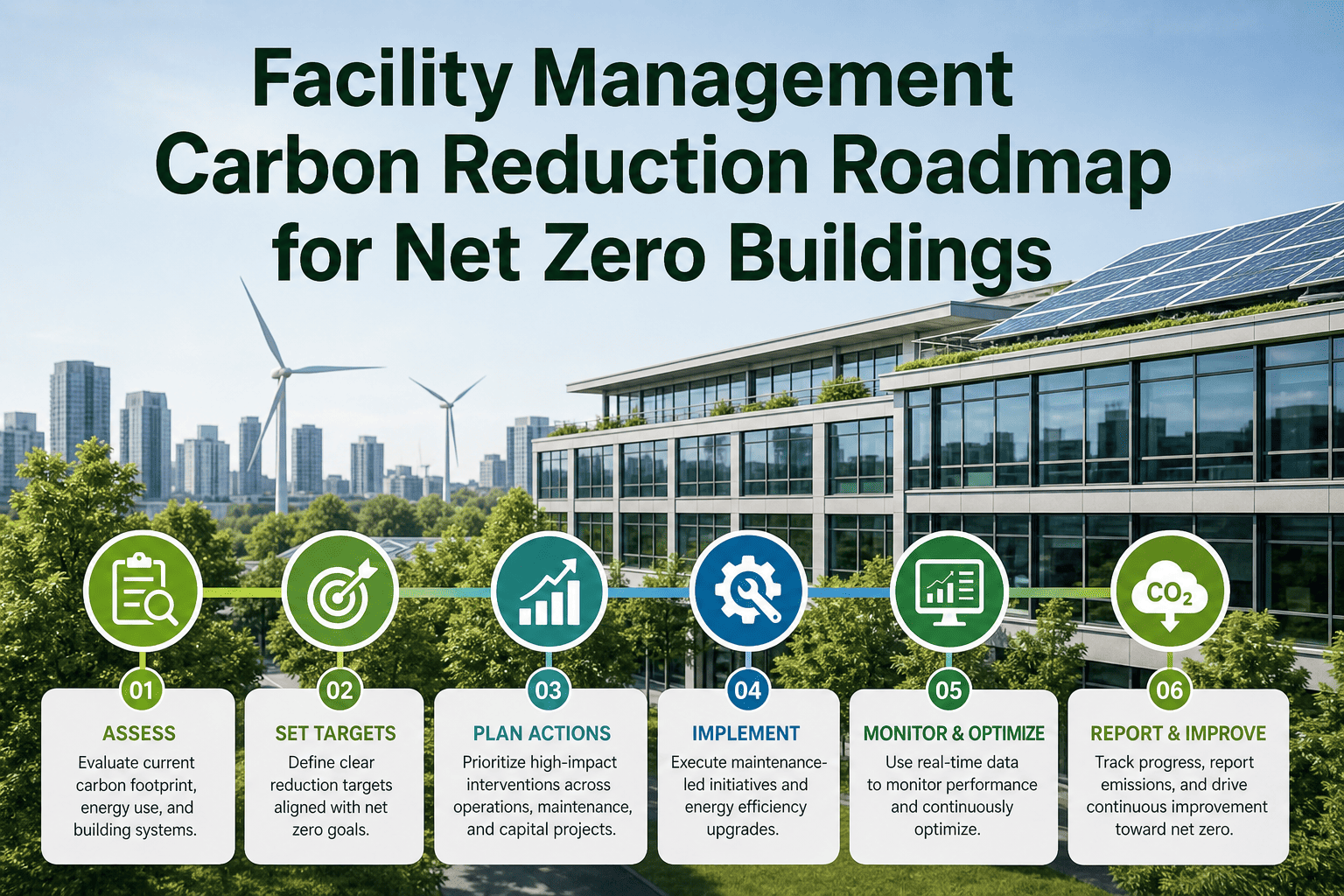
New York City Local Law 97 — the most aggressive building emissions regulation in the United States — sets carbon intensity limits for buildings over 25,000 square feet that take effect in 2024 and tighten significantly in 2030. Non-compliance carries fines of $268 per metric ton of CO₂ over the limit, annually. For a 100,000-square-foot commercial building, that can mean six-figure annual penalties — not once, but every year the building remains over its cap. The path to compliance runs through your building systems: HVAC efficiency, envelope integrity, lighting controls, domestic hot water, and the operational maintenance programme that keeps those systems performing at their rated efficiency rather than at the degraded performance of unmaintained equipment. Book a demo to see how OxMaint's Compliance Tracking manages LL97 maintenance schedules, energy performance monitoring, and compliance documentation across your New York building portfolio.
NYC Local Law 97 Compliance Checklist for Facility Managers
Carbon emission limits, HVAC maintenance requirements, envelope improvements, and documentation obligations — a complete compliance framework for New York City buildings over 25,000 square feet.
Baseline Assessment & Carbon Budget Calculation
Before any compliance strategy can be built, the facility manager must establish the building's current carbon intensity — the tonnes of CO₂e emitted per square foot per year from covered energy sources. LL97 penalties are calculated against the building's permitted annual limit, which is based on occupancy category. If you do not know where you currently stand against the limit, you cannot prioritise the interventions that will achieve compliance at the lowest cost.
HVAC Systems — The Largest Controllable Emission Source
For most NYC commercial buildings, HVAC represents 40–60% of total energy consumption — making it the highest-leverage target for LL97 emission reductions. Poorly maintained HVAC equipment does not just consume more energy; it produces more carbon per unit of useful heating and cooling delivered, degrading the building's carbon intensity at a rate that is invisible without monitoring. The maintenance tasks below are directly traceable to measurable reductions in HVAC energy consumption and CO₂e output.
OxMaint schedules LL97-aligned HVAC maintenance tasks, tracks energy performance deviations, and generates the compliance documentation NYC DOF requires for annual reporting.
Building Envelope — Reducing Heating and Cooling Load
The building envelope — roof, walls, windows, and below-grade — determines how much energy is required to maintain interior comfort conditions. Envelope deficiencies that allow heat transfer directly translate to increased HVAC runtime and carbon output. Envelope improvements are high-capital but have long lifespans, making them particularly valuable for 2030 compliance planning.
Lighting & Plug Loads — Controlled Carbon Sources
Documentation, Annual Reporting & Compliance Filing
LL97 compliance is not self-certifying — the building owner must file an annual report demonstrating compliance with the permitted carbon limit or face automatic fines. The documentation programme below ensures that the data needed for annual filing is collected continuously throughout the year rather than assembled under time pressure before the filing deadline.
LL97 Compliance Reference Table — Building Type Carbon Limits
| Occupancy Group | Building Type Examples | 2024 Limit (tCO₂e/sq ft) | 2030 Limit (tCO₂e/sq ft) | % Reduction Required (2024→2030) |
|---|---|---|---|---|
| Group E | Office buildings | 0.00846 | 0.00424 | ~50% |
| Group R-2 | Multi-family residential | 0.00675 | 0.00338 | ~50% |
| Group R-1 | Hotels | 0.01074 | 0.00537 | ~50% |
| Group A-2 | Restaurants | 0.01579 | 0.00790 | ~50% |
| Group I-2 | Hospitals | 0.02381 | 0.01191 | ~50% |
| Group M | Retail | 0.01181 | 0.00590 | ~50% |
What NYC Building Compliance Professionals Say
The facility managers who are already in trouble on LL97 are not the ones who ignored the regulation — they are the ones who did a compliance assessment, found they were marginally over the 2024 limit, and decided to wait for the 2030 compliance cycle before making capital investments. They did not account for how much harder and more expensive 2030 compliance will be from their current starting point. Every tonne of CO₂e you eliminate before 2030 is a tonne you do not have to eliminate in a compressed capital deployment window when every contractor and every product manufacturer in NYC is trying to serve the same compliance deadline simultaneously.
NYC Building Energy Compliance Consultant · LL97 Compliance Advisor, REBNY · 14 Years NYC Building Energy ManagementSteam trap maintenance is the most undervalued LL97 compliance measure in the portfolio of a New York City building manager. Failed-open steam traps release live steam continuously — each one can waste $3,000–$8,000 in steam energy per year. A building with 200 steam traps and a 20% failure rate is wasting 40 traps worth of steam. That is $120,000–$320,000 in annual energy cost and a proportional amount of CO₂e going directly to LL97 penalty exposure. A steam trap survey costs $5,000–$15,000. The ROI is typically measured in weeks, not years.
Certified Energy Manager (CEM) · Principal, NYC Building Services & Compliance · 19 Years Building Energy OptimisationOxMaint changed how we manage LL97 maintenance documentation. Before, retro-commissioning reports, steam trap surveys, chiller performance tests, and filter change logs all lived in different systems or binders — and when the May 1 filing deadline approached, we spent three weeks assembling a compliance package from five different sources. Now every maintenance event that has an LL97 implication is tagged in OxMaint and generates a compliance record automatically. The annual filing is a report generation exercise, not a document assembly project.
Director of Facilities, Commercial Real Estate Portfolio · 2.1M sq ft NYC Office and Retail Under ManagementFrequently Asked Questions
What happens if a building misses the LL97 annual filing deadline?
Late or missing annual reports carry separate penalties from the carbon exceedance penalties — the NYC Department of Finance can assess fines for failure to file regardless of whether the building is actually over its carbon limit. The annual report is due May 1 covering the prior calendar year. Buildings that are compliant with their carbon limits but fail to file on time still face filing-related penalties. OxMaint generates a pre-filing data package from maintenance records and energy tracking data, reducing the preparation time for the May 1 submission. Book a demo to see OxMaint's LL97 compliance reporting workflow.
Can Renewable Energy Credits (RECs) fully offset a building's LL97 liability?
RECs can offset a portion of a building's LL97 emissions — specifically the emissions from electricity consumption — but they cannot offset natural gas, steam, or fuel oil combustion emissions. LL97 distinguishes between electricity-derived and direct-combustion emissions, and RECs only apply to the former. For buildings with significant heating systems using natural gas or steam, RECs alone will not achieve full compliance. The most cost-effective path typically combines operational efficiency improvements (HVAC maintenance, envelope, controls) with targeted REC purchases to bridge remaining gaps. See how OxMaint tracks REC purchase documentation and remaining compliance gaps.
How does Local Law 87 (retro-commissioning) relate to LL97 compliance?
Local Law 87 requires buildings over 50,000 sq ft to conduct energy audits and retro-commissioning studies on a 10-year cycle. The retro-commissioning process identifies HVAC, lighting, and control deficiencies that, when corrected, directly reduce the building's energy consumption and carbon intensity — making LL87 a compliance mechanism for LL97. Buildings that are current on LL87 retro-commissioning and have implemented the identified efficiency measures are typically significantly closer to LL97 compliance than those that have allowed LL87 to lapse. OxMaint tracks LL87 cycle compliance alongside LL97 maintenance tasks in the same compliance dashboard.