This blog is published by OxMaint as part of its Energy ESG Reporting resource series. Buildings account for approximately 30% of global final energy consumption — and facility managers are the professionals who determine whether that number goes down or stays flat. Net zero is no longer a distant target written into corporate sustainability strategies. NYC's Local Law 97 is fining buildings today. Boston's BERDO 2.0 levies $1,000 per day on non-compliant facilities. The EU's Energy Performance of Buildings Directive mandates zero emissions for new public buildings from 2026. This blog gives FM teams a practical, sequenced roadmap to reduce carbon emissions — starting with what maintenance-led actions can deliver right now, before any capital investment is made.
Blog · Sustainability & ESG · Net Zero
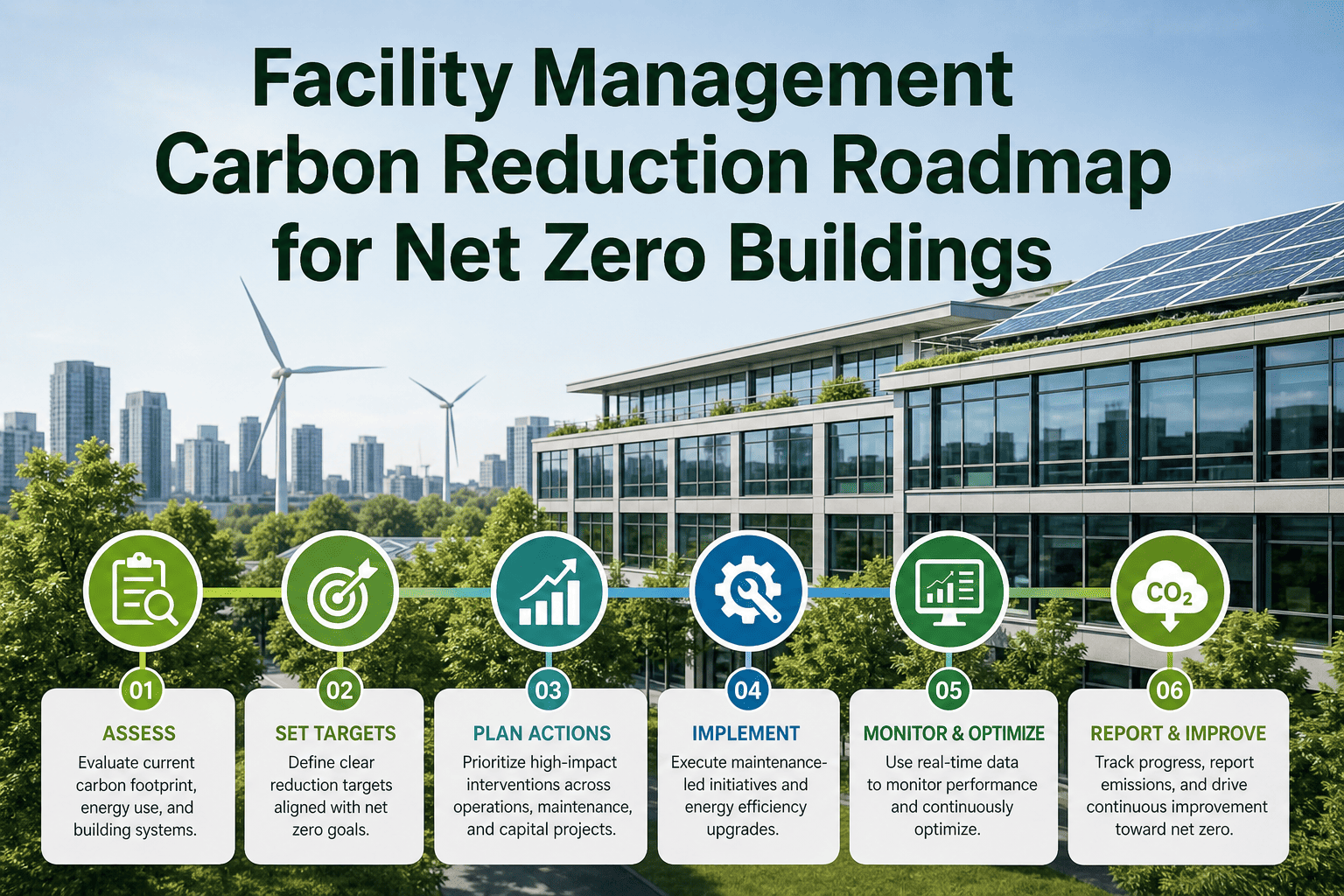
Facility Management Carbon Reduction Roadmap for Net Zero Buildings
From energy audits to electrification — a practical, maintenance-led sequence for FM teams building their path to net zero. Because facilities that optimise operations before investing in hardware consistently spend 15–30% less to get there.
40%
of global carbon
from buildings
$268
per tonne CO2 fine
NYC Local Law 97
$55.9B
net zero buildings
market in 2026
19.8%
annual market
growth rate
New York City — LL97
$268/tonne CO2 over limit
Covers ~50,000 buildings over 25,000 sqft. First compliance reports filed in 2025. Limits tighten significantly in 2030. A 200,000 sqft office 1,000 tonnes over its cap faces $268,000 annually.
Boston — BERDO 2.0
$1,000/day for non-compliance
Five-year compliance cycles from 2025–2050. Buildings over 35,000 sqft that exceed emissions limits also pay $234 per tonne into the Equitable Emissions Investment Fund.
EU — EPBD 2026
Zero emissions, new public buildings
EU's revised Energy Performance of Buildings Directive mandates zero emissions for all new public buildings from 2026 and all new buildings from 2028. Large commercial buildings need automated monitoring to comply.
1 What Net Zero Actually Means for FM Teams
Net zero carbon for a building means Scope 1 and Scope 2 emissions reach zero through electrification, operational efficiency, and renewable energy — with any residual Scope 3 emissions offset by verified carbon credits. Facility managers own the operational pathway. Understanding the three emission scopes determines where your maintenance programme directly impacts the target.
Scope 1
Direct Emissions
On-site combustion — gas boilers, diesel generators, HVAC refrigerant leaks. FM teams control these directly through fuel switching, refrigerant management, and equipment upgrades. R-410A has a GWP of 2,088 vs R-32 at 675.
Scope 2
Purchased Energy
Electricity and heat purchased from the grid. Reduced by cutting energy waste through HVAC optimisation, lighting efficiency, and building automation — then further reduced by renewable energy procurement or on-site generation.
Scope 3
Indirect Emissions
Supply chain, maintenance vehicles, embodied carbon in replacement materials. FM fleet electrification and low-carbon procurement policies address this scope. Often required under institutional investor net-zero frameworks.
2 The Net Zero Roadmap: 4 Phases for FM Teams
The sequence matters. FM teams that skip straight to solar panels or heat pump installations before optimising operations consistently overspend by 15–30%. Efficiency first — then electrify, then generate.
01
Baseline & Audit
Now — 6 months
Deploy IoT sub-meters. Establish EUI and carbon intensity per system. Identify ghost loads, HVAC overcycling, and after-hours waste.
02
Optimise Operations
6–24 months
BMS control reviews, HVAC scheduling, LED upgrades, occupancy-based controls. Target 50–70% energy reduction before hardware changes.
03
Electrify & Retrofit
2–5 years
Replace gas boilers with heat pumps. Upgrade to low-GWP refrigerants. Electrify FM fleet. Right-size equipment using post-efficiency load data.
04
Generate & Offset
5+ years
On-site solar PV, renewable energy contracts (PPAs, RECs), and verified carbon offsets for residual emissions. Net zero achieved.
3 HVAC: The Largest Single Carbon Reduction Opportunity
HVAC systems typically account for 38–40% of a commercial building's total energy consumption. Optimising HVAC through scheduling, controls, and BMS strategy reviews is where most FM teams find their fastest carbon wins — before any capital expenditure.
10–15%
Energy reduction from HVAC optimisation alone
BMS control strategy reviews, occupancy-based scheduling, and eliminating after-hours operation of conditioned spaces consistently deliver 10–15% energy reduction without replacing any equipment. This is the highest-ROI first step for any facility carbon programme.
4 Maintenance-Led Carbon Reduction Actions — by Impact
These are the FM-controllable actions that reduce carbon emissions — ranked by impact level and implementation speed. Most of the high-impact, quick-win actions require CMMS-enabled scheduling and monitoring, not capital investment.
| Action |
Scope |
Carbon Impact |
Speed |
FM-Led? |
| HVAC scheduling & BMS review |
Scope 2 |
10–15% reduction |
0–6 months |
Yes |
| Ghost load identification & elimination |
Scope 2 |
5–10% reduction |
Immediate |
Yes |
| LED lighting conversion + occupancy sensors |
Scope 2 |
20–30% lighting |
3–12 months |
Yes |
| Refrigerant leak tracking & low-GWP upgrade |
Scope 1 |
Significant GWP |
At EOL |
Yes |
| Predictive HVAC maintenance |
Scope 2 |
5–8% efficiency |
Ongoing |
Yes |
| Building envelope maintenance |
Scope 2 |
Heating load reduction |
Seasonal |
Yes |
| Gas boiler to heat pump transition |
Scope 1 |
Full Scope 1 elim. |
Capital required |
Plan-led |
| On-site solar PV installation |
Scope 2 |
Residual offset |
Capital required |
Plan-led |
Track Your Net Zero Progress in Real Time
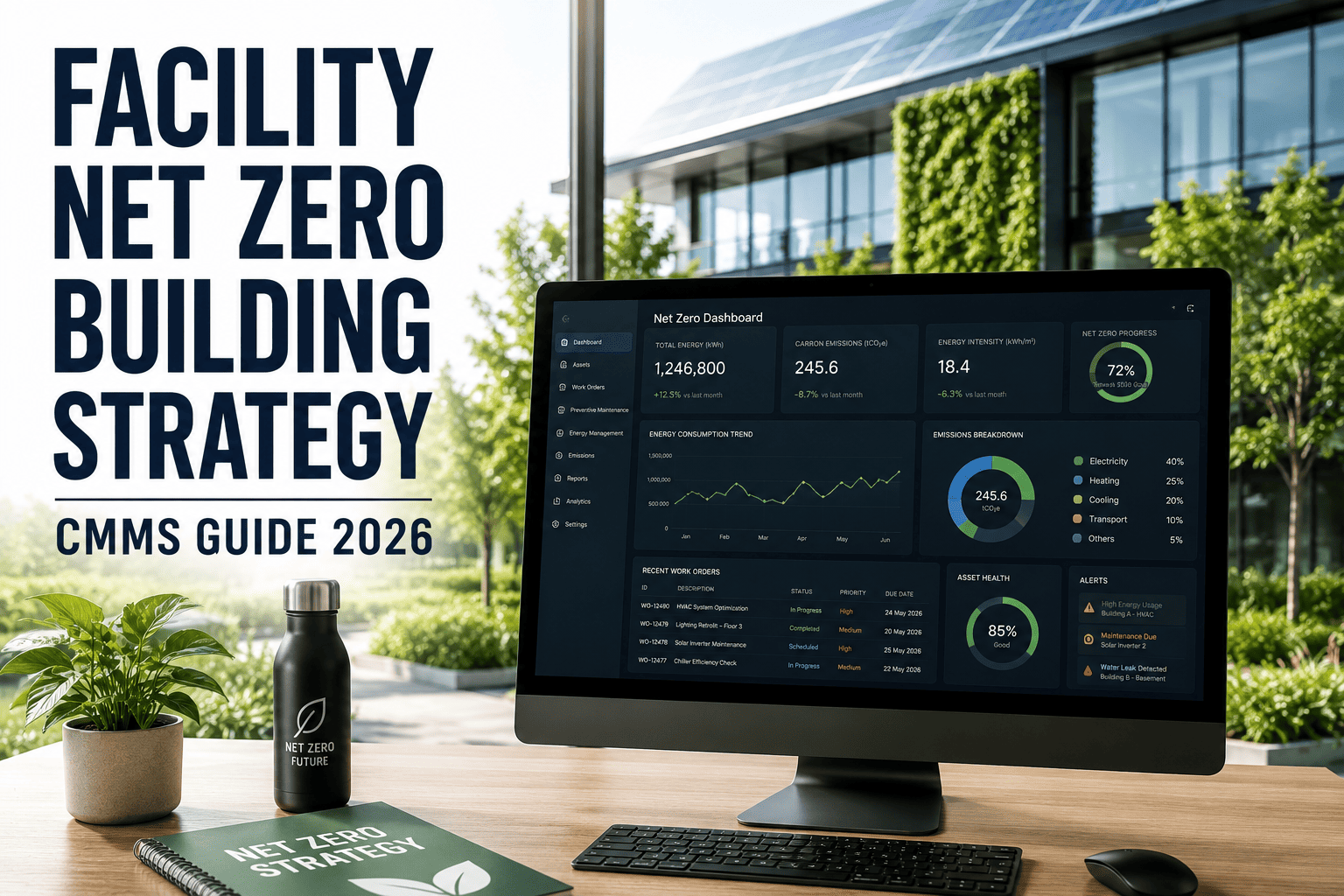
OxMaint's Energy & ESG Reporting module tracks Scope 1, 2, and 3 emissions, maps your building's live carbon intensity, and monitors progress against your 2030 and 2050 milestones — connected directly to your maintenance work orders.
5 Net Zero Milestone Tracking — What to Measure
A building that hits its 2025 EUI target but drifts 12% above baseline in 2026 has lost its gains. Continuous monitoring — not annual audits — is what keeps a net zero programme on track. These are the metrics FM teams should track monthly.
Energy Use Intensity (EUI) — vs 2020 baseline
Target: 50–70% reduction before renewables. Track kWh/sqft/year monthly.
Scope 1 Emissions — on-site combustion
Track refrigerant GWP-weighted leaks, gas boiler consumption, and diesel generator run hours.
Scope 2 Emissions — purchased electricity
Track against renewable energy procurement percentage and grid carbon intensity by time of use.
HVAC Planned Maintenance Compliance
Deferred HVAC maintenance directly degrades efficiency and increases energy consumption. Track completion rate weekly.
Renewable Energy Coverage
% of electricity consumption covered by on-site generation plus contracted renewable supply (PPAs, RECs).
Carbon Offset Quality Score
Residual Scope 3 emissions require verified, high-quality offsets. Track against Gold Standard or VCS certification for credible reporting.
LP
The facility managers I see consistently hitting their 2030 carbon targets are not the ones who started with the biggest solar arrays or heat pump programmes. They are the ones who started by getting real visibility into what their buildings were actually consuming and wasting — hour by hour, system by system. Once you can see where the energy is going, the 10–15% reduction from HVAC scheduling alone almost always pays for the monitoring infrastructure in the first year. That operational foundation is also what makes the capital investment in electrification credible — you know exactly what load you are electrifying, so you right-size the heat pump instead of oversizing it by 25% and spending $300,000 more than necessary. Net zero is an operational discipline first and a capital programme second.
Lena Patel
Head of Sustainability, Global Real Estate Portfolio · LEED AP BD+C · 16 years in Net Zero Building Strategy
6 Frequently Asked Questions
Where do facility managers start on a net zero carbon roadmap?
The correct starting point is establishing a baseline — deploying IoT sub-meters and connecting utility data to understand current Energy Use Intensity (EUI) and carbon intensity per building system. Without this baseline, you cannot measure progress, right-size retrofits, or prove compliance to regulators. The most common and costly mistake is investing in hardware — solar panels, heat pumps — before optimising operations. Facilities that baseline first and optimise HVAC scheduling, eliminate ghost loads, and close building envelope gaps typically achieve 20–35% energy reduction before spending any capital. This operational reduction then makes the subsequent electrification investment smaller and cheaper.
OxMaint's Energy & ESG Reporting module establishes this baseline and tracks it continuously.
What building decarbonisation regulations are currently in force in 2026?
Several major jurisdictions are actively fining non-compliant buildings in 2026. NYC's Local Law 97 covers approximately 50,000 buildings over 25,000 square feet with penalties of $268 per tonne of CO2 equivalent over the annual carbon limit — first compliance reports were filed in 2025. Boston's BERDO 2.0 covers buildings responsible for over 60% of city emissions, with $1,000 per day fines and $234 per tonne of excess emissions. Washington D.C.'s BEPS programme exposes owners to penalties reaching $10 per square foot. The EU's revised Energy Performance of Buildings Directive mandates zero emissions for all new public buildings from 2026. Colorado, Washington State, Maryland, and California all have active building performance standards with tightening requirements. .
How does HVAC maintenance directly reduce carbon emissions?
HVAC systems account for 38–40% of a commercial building's total energy consumption, making them the single largest Scope 2 emissions driver in most facilities. There are three maintenance-led pathways to carbon reduction: first, scheduling optimisation — ensuring HVAC runs only when spaces are occupied, eliminating after-hours overcooling and overheating; second, predictive maintenance — keeping heat exchangers clean, filters fresh, and refrigerant levels correct, as a 10% degradation in coil efficiency increases energy consumption by up to 8%; third, refrigerant management — tracking and minimising refrigerant leaks, since common refrigerants like R-410A have global warming potentials of 1,300–4,000 times CO2. Transitioning to low-GWP refrigerants like R-32 (GWP: 675) at equipment end of life is a direct Scope 1 emissions reduction. CMMS platforms that schedule and track these activities turn HVAC maintenance into a measurable carbon reduction programme.
How does OxMaint support net zero and ESG reporting for facility teams?
OxMaint's Energy & ESG Reporting module collects Scope 1, 2, and 3 data from IoT sensors, utility meters, and maintenance records — and maps each building's live carbon intensity against your 2030 and 2050 milestones in real time. Critically, OxMaint connects energy consumption data directly to the maintenance work orders that influence it, so FM teams can see the carbon impact of deferred HVAC maintenance, refrigerant leaks, or lighting system faults as they occur rather than discovering them in quarterly reports. The platform generates audit-ready ESG reports compatible with regulatory compliance submissions and institutional investor reporting frameworks. For a live demonstration of how OxMaint maps a portfolio against net-zero milestones,
book a demo with the team.




.jpeg)
