The national median cost to build a new parking structure is $29,900 per space (WGI 2024 Parking Structure Cost Outlook). A chloride-induced concrete spall repair costs $75 per square foot — a 1,400 square foot section totals $105,000. The economics of parking structure maintenance are unambiguous: structured inspection and early intervention consistently cost a fraction of deferred deterioration. Yet most parking facility operators manage their structures with annual walk-rounds that produce written reports filed in a cabinet, with no systematic link between findings, work orders, repair tracking, or condition trend analysis. The result is a structure whose deterioration is documented but not managed — and a facility manager who discovers at the next engineering inspection that deferred findings from three years ago have progressed from $75-per-square-foot spall repair to structural remediation requiring the deck to be closed. NYC Local Law 126 of 2021 now mandates periodic inspections for every parking structure in the city on a 6-year cycle. Similar legislation is advancing in New Jersey, Wisconsin, and multiple other states following high-profile structural failures. Book a demo to see OxMaint's parking garage maintenance and compliance tracking platform — or start free today.
Article · Parking Facilities · Compliance Tracking · Structural Maintenance
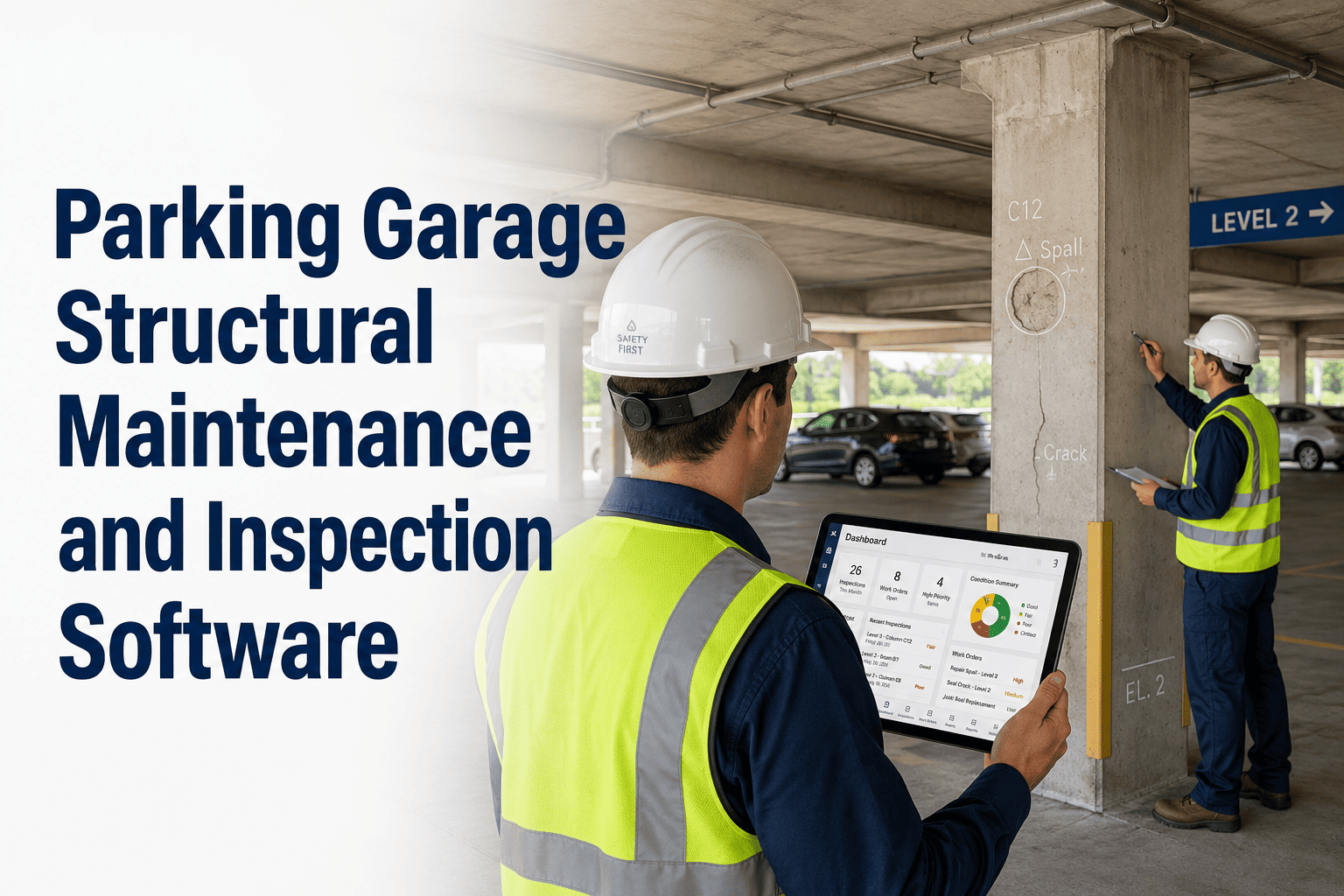
Parking Garage Structural Maintenance and Inspection Software
Manage concrete inspections, repair tracking, drainage, lighting, life safety systems, and regulatory compliance for every parking structure in your portfolio — from a single digital platform.
Regulatory Compliance Requirements
IBC §1705.12
Periodic structural inspections by qualified inspector — frequency varies by jurisdiction
NYC LL 126 / 2021
6-year inspection cycle; initial observation filed by Aug 1, 2024; annual observation checklist required
OSHA 29 CFR 1910.22
Walking-working surfaces — parking decks must be maintained free of hazards at all times
ACI 362.2-21
Guide for Structural Maintenance of Parking Structures — best practices for inspection intervals, repair sequencing
NFPA 70 NEC Art. 511
Commercial garages — electrical installation requirements for wet and hazardous locations
Structural Defect Severity Matrix — What to Look For and When to Act
Not all defects require the same response timeline. This matrix maps defect type to severity level to the required action, repair cost range, and the progression if deferred — the framework that turns an inspection finding into a prioritised work order.
Concrete spalling
Surface pop-out <1" depth, no rebar exposure. Monitor quarterly.
Spall >1" with aggregate exposure. Repair within 6 months. ~$75/SF.
Rebar exposed and corroding. Immediate repair. Risk of progressive delamination.
Concrete cracking
Hairline cracks <0.1mm. Seal preventively during next maintenance cycle.
Structural cracks 0.1–0.5mm. Engineer assessment within 90 days. Epoxy injection.
Active cracks >0.5mm or at post-tension zones. Structural closure may be required.
Rebar corrosion
Minor surface rust visible through crack. Monitor for progression.
Delamination audible on sounding. Remove spall, treat rebar, patch. ~$90–$120/SF.
Section loss on rebar. Structural capacity affected. Engineer-directed immediate repair.
Expansion joint failure
Minor cracking at joint edge. Re-caulk at next scheduled maintenance.
Joint open or displaced. Water entering structure. Replace within 30 days.
Joint failed across full depth. Structural movement uncontrolled. Immediate repair.
Drainage and ponding
Slow drainage — drain partial blockage. Clear within 2 weeks.
Standing water >48 hrs. Accelerates membrane and joint degradation. Resolve within 7 days.
Drainage failure with active membrane saturation. Membrane replacement likely required.
Traffic membrane
Surface wear — minor loss of aggregate. Monitor for delamination.
Visible delamination or blistering. Repair section before water infiltrates deck. ~$6–$12/SF.
Membrane failure — water reaching structural concrete. Full section replacement required.
Parking Garage Inspection Schedule — Minimum Frequencies by Element
| Inspection Element |
Annual (In-House) |
Engineering Cycle |
Trigger-Based |
OxMaint Action |
| Structural elements — slabs, beams, columns |
Visual by facility manager — photo documentation of any new conditions |
Every 3–6 years by QPSI (Qualified Parking Structure Inspector) per local code |
After any impact event, seismic event, or vehicle collision with structure |
Annual visual WO with mandatory photo; engineering cycle scheduled in CMMS; event-triggered WO on impact report |
| Concrete deck and traffic membrane |
Walk-over sounding for delamination; visual for cracks, spalls, membrane blistering |
Include in engineering inspection; sounding grid documented |
After severe weather or freeze-thaw season in cold climates |
Post-winter inspection WO in cold-climate assets; sounding findings linked to condition score per deck section |
| Drainage system and drains |
Quarterly — drain flow check; debris clearing |
Annual full drainage inspection with flow test |
After any heavy precipitation event |
Quarterly PM WO; storm event trigger; drain flow sensor alert if equipped |
| Lighting — all levels |
Monthly visual — all fixtures functional, no dark zones |
Annual full lighting compliance check (IES RP-20 parking facility standards) |
After any complaint or incident report involving lighting failure |
Monthly WO with zone coverage check; IES compliance report generated annually |
| Life safety — fire suppression, egress |
Monthly visual — sprinkler head clearance, exit sign illumination |
NFPA 25 quarterly/annual inspection by licensed contractor |
After any system activation or damage event |
NFPA 25 PM schedule in CMMS; activation event auto-triggers inspection WO |
| Expansion joints and sealants |
Annual — sealant condition, joint compression, debris in joint |
Include in engineering inspection; measure opening widths |
After any temperature extreme cycle or seismic event |
Annual PM WO; failed sealant generates repair WO with location photo |
Inspection Findings Without Work Orders Are Just Documentation. OxMaint Closes the Gap.
OxMaint links every parking garage inspection finding to a prioritised work order, tracks repair completion and cost per defect, scores condition trends per deck section, and produces the compliance documentation that IBC, OSHA, and local parking structure laws require — without paper, without manual assembly, and without the deferred findings that become structural emergencies.
Expert Review
"The fundamental problem with parking garage maintenance programmes is not that facility managers do not inspect their structures — most do. It is that the inspection finding and the repair action exist in separate systems that are never connected. An engineer submits a report identifying 14 delamination areas on Level 2. The report is filed. A year later, the same engineer re-inspects and finds that 11 of the 14 areas have progressed because no repair work orders were ever generated from the previous report. This cycle repeats until the deferred defects reach a severity that requires structural engineering intervention at 5–10 times the cost of the original repair. The CMMS connection is the missing link: every inspection finding generates a work order, every work order has a priority and deadline, every completed work order updates the condition score for that section of the structure, and the condition trend for each section tells the facility manager whether the maintenance programme is winning or losing the battle against chloride-induced corrosion and freeze-thaw damage. That is not a complex technology requirement. It is a data connection between two activities — inspecting and repairing — that most parking facility operators currently manage as completely separate processes."
James Okonkwo, PE, BEMP, HBDP
Licensed Professional Engineer · Building Energy Modelling Professional (ASHRAE) · High Performance Building Design Professional (ASHRAE) · 18 years structural facility management and parking structure assessment programme design
Frequently Asked Questions
What structural elements must be included in a parking garage inspection?
Per ACI 362.2-21 (Guide for Structural Maintenance of Parking Structures) and IBC Section 1705.12, a complete parking structure inspection must address:
structural concrete — slabs, beams, columns, and post-tensioned elements for spalling, cracking, delamination, and rebar exposure;
expansion joints — condition, compression range, and sealant integrity;
traffic-bearing membranes — delamination, blistering, and wear through to substrate;
drainage system — drain flow, standing water conditions, and distressed piping;
lighting — all fixtures functional with no dark zones; and
life safety systems — fire suppression, egress, and signage. For jurisdictions subject to NYC Local Law 126 or similar legislation, the inspection must be performed by or under the direct supervision of a Qualified Parking Structure Inspector (QPSI) and a condition assessment report filed with the local authority.
Book a demo to see OxMaint's parking garage inspection templates and compliance tracking.
How quickly does chloride-induced concrete corrosion progress in parking structures?
Chloride-induced corrosion progression is the most significant deterioration mechanism in parking structures, particularly in regions with road salt application or coastal chloride exposure. Research shows chloride attack can reduce structural service life by 50% or more without proper protective maintenance. In practical terms: chloride penetration to reinforcing steel depth typically takes 10–15 years without membrane protection; once rebar corrosion initiates, visible concrete cracking appears within 2–5 years; unchecked corrosion causes delamination and spalling within another 2–3 years. The critical intervention point is before rebar corrosion initiates — which requires traffic membrane maintenance (preventing chloride penetration) and early crack sealing (preventing chloride infiltration through the structural concrete). Annual inspections that catch cracks and membrane defects at the sealing stage prevent the entire corrosion chain that produces $75–$120/SF spall repair costs.
What does NYC Local Law 126 require for parking structure owners?
NYC Local Law 126 of 2021 added Article 323 to Title 28 of the NYC Administrative Code, requiring:
one-time initial observation of every parking structure by a Qualified Parking Structure Inspector (QPSI) with a report filed to the NYC Department of Buildings — deadline August 1, 2024;
periodic inspections on a 6-year cycle, divided into three sub-cycles by borough and community district (Cycle 1A: 2022–2023; Cycle 1B: 2024–2025; Cycle 1C: 2026–2027); and
annual observation checklists completed by or under supervision of a QPSI. A condition assessment report must be filed after each periodic inspection. Non-compliance risks stop-work orders and structural closure. OxMaint tracks LL 126 inspection due dates by structure, generates inspection work orders at the correct sub-cycle, and stores the condition assessment documentation for DOB filing.
Start free to register your parking structures and configure LL 126 compliance tracking.
How does OxMaint track repair costs and condition trends per parking structure deck section?
OxMaint divides each parking structure into a deck section hierarchy — Level / Zone / Section — with each section carrying its own asset record, condition score history, and cumulative repair cost. Every work order linked to a deck section is costed at closure (labour and materials), and the cumulative repair spend per section per year is tracked against the section's replacement cost. When cumulative annual repair spend exceeds a configured threshold (typically 20–25% of replacement cost), OxMaint flags the section for capital replacement consideration. Condition scores are updated at every inspection event — creating a score trend that shows whether conditions are stable, slowly deteriorating, or accelerating toward the failure threshold. The capital planning report aggregates this data across all sections in the portfolio, producing a 5-year replacement forecast with projected costs per year.
PARKING FACILITY COMPLIANCE · STRUCTURAL MAINTENANCE · OXMAINT
The $105,000 Spall Repair Was $75,000 When It Was Identified. The CMMS Determines Which Invoice You Pay.
OxMaint tracks parking garage inspection findings, generates prioritised repair work orders, scores condition trends per deck section, monitors drainage and lighting compliance, and produces the IBC, OSHA, and Local Law 126 documentation that regulators and engineers require — so every defect is managed at the intervention cost, not the remediation cost.