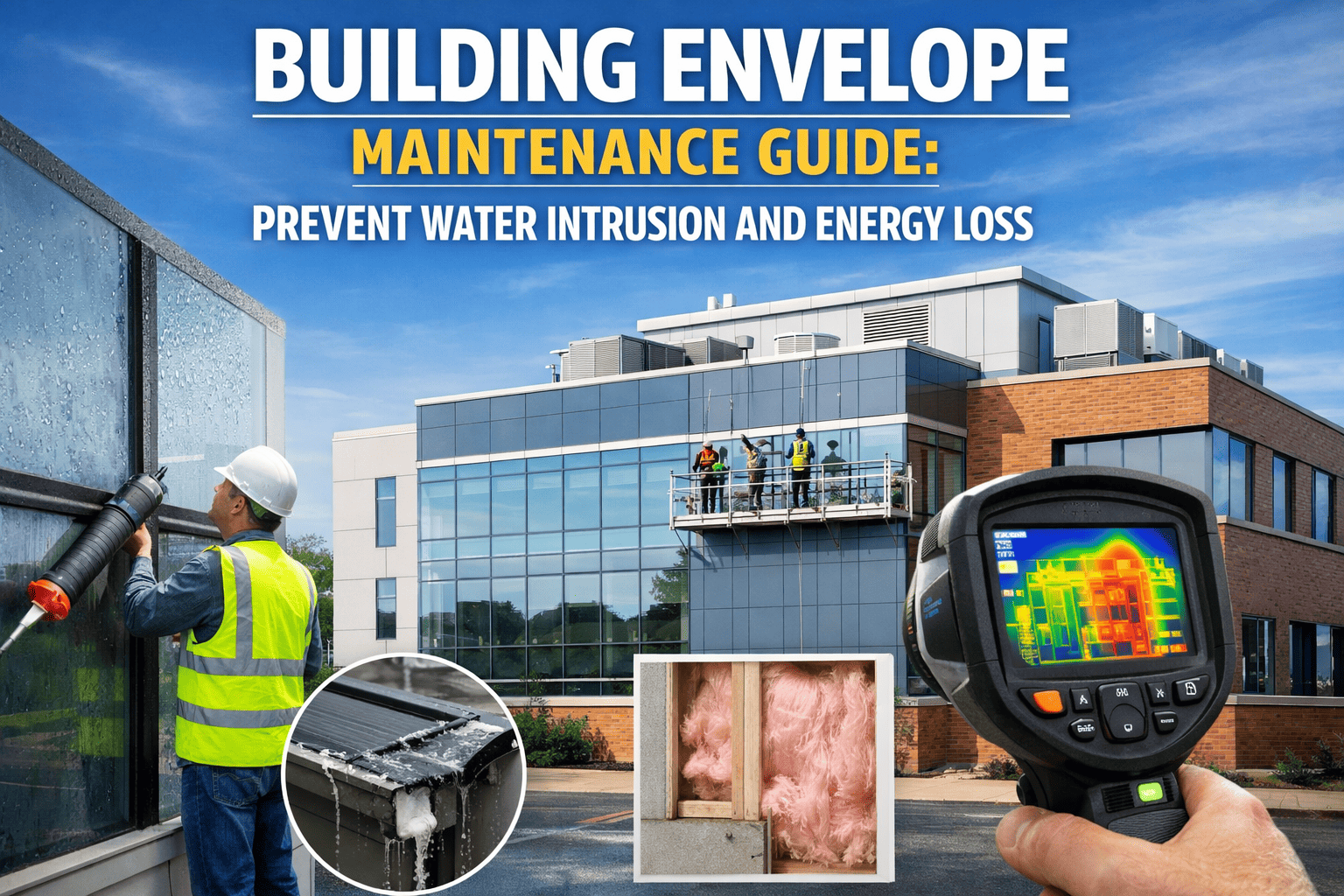
Roof Leak Prediction and Facility Envelope Maintenance

By James Smith on May 27, 2026

roof-leak-prediction-and-facility-envelope-maintenance

Water damage is the leading cause of non-weather-related commercial building insurance claims — and the most expensive version of it is never a sudden catastrophic failure. It is a slow leak that progressed invisibly from a lifted flashing edge in October to wet insulation in December, deck rot in February, and a structural repair costing $140,000 in April. The entire chain is preventable at the $800 intervention point if the flashing edge is caught at the October inspection. Predictive maintenance for roof and building envelope management does not require exotic technology. It requires consistent inspection data linked to a work order system that tracks what was found, what was done, when it was done, and what the condition trend is telling you about what needs to happen next before the next storm season. Book a demo to see OxMaint's Predictive Maintenance AI for roof and building envelope management — or start free and register your first building today.

Guide · Building Envelope · Predictive Maintenance AI · Facility Management

Roof Leak Prediction and Facility Envelope Maintenance

How to build an inspection, sensor, and CMMS workflow that catches building envelope defects at the $800 intervention point — not the $140,000 remediation point.

The Leak Defect Cost Cascade — Same Defect, Detected at Different Points
Detection at inspection

$800
Flashing resealed on-site during inspection
Found after first rain event

$6,200
Insulation replacement + flashing repair
Found after 3 months

$38,000
Deck rot + full section replacement
Found after structural impact

$140,000+
Structural repair + interior remediation + mould abatement
10 yrs
Roof life extension from predictive vs reactive maintenance
90%
Reduction in water damage claim risk with sensor monitoring
175×
Cost ratio: structural repair vs early flashing intervention

The 5 Prediction Signals That Indicate a Leak Before It Happens

Roof leaks rarely appear without precursors. Five signal types — collectively managed in OxMaint — give facility managers early warning of developing failures weeks or months before water penetrates the interior.

01
Inspection History Trend
What it measures
Condition score trend across consecutive inspections. A roof scoring A→A→B→C across four semi-annual inspections is not failing — it is telling you the rate at which it is degrading. AI models the trend to project when it will reach the Grade D threshold requiring emergency intervention.
Action: When trend rate predicts Grade D within 2 inspection cycles, elevate to quarterly inspection and budget replacement.
02
Moisture Sensor Readings
What it measures
Embedded moisture sensors in the roof membrane or insulation layer detect water intrusion at the material level — before it migrates to the deck or ceiling. A sensor reading rising moisture content in the insulation layer signals a slow infiltration event that no visual inspection would catch at this stage.
Action: Any moisture reading above baseline triggers an inspection work order within 24 hours — before moisture migrates to structural layers.
03
Weather Event Correlation
What it measures
AI correlates weather event data (wind speed, precipitation intensity, hail) with subsequent moisture sensor readings and interior stain reports. Roofs that show moisture elevation specifically after wind events above 40 mph have a flashing or seam vulnerability. The correlation narrows the inspection scope to the specific failure mechanism.
Action: Post-storm inspection work order auto-triggered for any building where wind exceeds the threshold linked to prior moisture events.
04
Drain and Ponding Monitoring
What it measures
Ponding water — water remaining on the roof surface more than 48 hours after rainfall — accelerates membrane degradation at 3–5× the rate of drained sections. Drain flow sensors and area cameras identify drain blockages before ponding reaches the 48-hour threshold. Ponding patterns also map to low points on the roof structure where deck deflection may be developing.
Action: Drain flow anomaly triggers immediate clearing work order. Recurring ponding in the same zone triggers structural assessment.
05
Repair History Pattern
What it measures
The cumulative repair cost per section, per year, compared against the replacement cost of that section. AI surfaces the economic crossover point — the moment when continued patching costs more annually than replacing the section. Nationally, this occurs when repair spend exceeds 25% of replacement value in a 12-month period.
Action: When repair cost threshold reaches 20% of replacement cost, replacement project is flagged for the next capital budget cycle.

Every One of These Signals Is Invisible Without a CMMS That Connects Inspection Data, Sensor Readings, and Work Order History.

OxMaint's Predictive Maintenance AI tracks all five signals per roof asset, scores condition trend, correlates weather events with sensor readings, and triggers inspection and repair work orders before the $800 defect becomes the $140,000 remediation.

Building Envelope PM Schedule — What to Inspect, When, and What to Look For

Envelope Component Inspection Frequency Key Inspection Points Failure Precursor (Catch It Here) OxMaint Trigger
Roof membrane (TPO/EPDM/BUR) Semi-annual + post-storm Seam integrity, blister and crack pattern, surfacing loss, lap adhesion Surface cracking and early lap separation — resealable at this point; unsealed = full section replacement Semi-annual PM WO; storm event auto-triggers post-storm inspection WO
Flashings — all penetrations and perimeters Semi-annual + post-wind events Separation at base, caulk condition, metal corrosion, uplift from edge Base caulk cracking and edge separation — $400 repair vs $12,000+ water intrusion remediation if missed Included in semi-annual WO; high-wind event trigger for exposed perimeters
Roof drains and scuppers Quarterly + after leaf season Debris accumulation, drain bowl condition, clamping ring seal, overflow scupper clear Partial blockage causing slow drainage — leads to ponding-accelerated membrane degradation in low spots Quarterly PM WO; seasonal leaf-fall trigger; drain flow sensor alert
Parapet walls and copings Annual + after freeze-thaw cycles Coping cap joint condition, parapet cap flashing, wall face crack pattern, mortar joint condition Coping joint opening from thermal movement — water tracks into wall cavity before any interior sign visible Annual PM WO; post-winter freeze-thaw inspection triggered for cold climates
Rooftop equipment curbs and pads Semi-annual (aligned with HVAC PM) Curb flashing condition, equipment vibration seal, condensate drain routing Cracked curb flashing — condenser vibration loosens flashing over time; most common leak point on commercial roofs HVAC rooftop PM WO auto-includes roof penetration inspection step
Facade and glazing seals Annual + post-settlement events Sealant condition at glazing joints, facade panel connections, window perimeter seal Sealant UV degradation and hardening — loses elasticity before cracking; replaceability window closes once cracking begins Annual facade inspection WO; post-seismic or settlement event trigger

Expert Review

"The 175-to-1 cost ratio between catching a flashing separation at inspection and remediating the structural damage it causes two years later is not a hypothetical. I have documented this exact progression on commercial properties managed reactively. The $800 repair does not get done because the inspection was missed, or because the inspection found the condition but did not generate a work order, or because the work order was generated but deferred. By the time anyone acts on it, the problem has progressed through insulation saturation, deck deterioration, and in cold climates, freeze-thaw amplification of whatever water has accumulated. The technology to prevent this has always existed — scheduled inspections and a work order system that closes the loop on findings. What predictive maintenance AI adds is the pattern recognition layer: correlating moisture sensor readings with weather events to narrow inspection scope, tracking condition score trends to project failure timing, and identifying the economic crossover point where continued repair spending no longer makes financial sense compared to section replacement. These are calculations that a spreadsheet could theoretically do, but that nobody with a 200-building portfolio has time to do manually for every roof section every quarter."
James Okonkwo, PE, BEMP, HBDP
Licensed Professional Engineer · Building Energy Modelling Professional (ASHRAE) · High Performance Building Design Professional (ASHRAE) · 18 years building envelope design, assessment, and predictive maintenance programme implementation across commercial and institutional portfolios

Frequently Asked Questions

How does AI predict roof leaks before they happen?
OxMaint's Predictive Maintenance AI uses four data streams to forecast roof failure risk: inspection condition score trends — modelling the rate of condition decline to project when a roof will require emergency intervention; moisture sensor data — detecting elevated moisture in the membrane or insulation layer before visible signs appear; weather event correlation — identifying which roofs respond to specific weather conditions (wind events, temperature cycling) with moisture elevation; and repair cost accumulation — tracking cumulative repair spend per roof section against the replacement cost threshold. None of these individually predicts a leak with certainty. Together, they narrow the inspection focus and trigger proactive intervention at the stage where the repair costs a fraction of the emergency alternative. Book a demo to see all four signals on OxMaint's roof prediction dashboard.
What types of sensors are most effective for roof leak early detection?
Three sensor types provide the best coverage for early roof leak detection: embedded moisture sensors in the roof membrane or insulation layer detect water infiltration at the material level — before it migrates to the deck. Readings above 20% relative moisture in polyisocyanurate insulation indicate active infiltration. Drain flow sensors detect blockage-caused slow drainage that leads to ponding and accelerated membrane degradation. Interior ceiling moisture sensors in critical spaces (data rooms, storage areas, archives) provide the last-line detection that catches any leak that passes through the membrane and deck. For most commercial buildings, the highest-ROI sensor deployment starts with drain flow sensors (covering the most common ponding mechanism) and adds membrane sensors at known vulnerability zones identified in the most recent inspection. Start free to configure OxMaint's sensor alert workflow for your roof assets.
When is it more cost-effective to replace a roof section than continue repairing it?
The standard industry threshold is when annual repair costs for a roof section exceed 25% of its replacement cost. At this point, the cumulative repair spend over 4 years would equal the replacement cost — with no improvement in the asset's condition or remaining useful life trajectory. OxMaint tracks cumulative repair spend per roof section as a percentage of replacement cost, and alerts the facility manager when spend crosses the 20% threshold — giving a planning cycle to include the section replacement in the next capital budget rather than responding to an emergency failure at full emergency cost. A second threshold is the condition score: any section reaching Grade D (below 50) where repair cost would exceed 15% of replacement cost is a replacement candidate regardless of annual spend.
How does OxMaint generate capital budget forecasts from roof condition data?
OxMaint generates capital budget forecasts from three data inputs per roof section: current condition score, condition trend rate (the rate of decline per inspection cycle), and replacement cost estimate (entered at asset registration, updated with inflation factor annually). From these three inputs, the system projects the year in which each section will reach the Grade D threshold requiring replacement — producing a rolling 5-year capital forecast showing projected replacement expenditure per year across the entire roof portfolio. This forecast updates automatically after each inspection as new condition scores are entered. For a facility manager presenting a capital budget to a board or budget committee, the OxMaint forecast provides the data-backed justification that "we need $280,000 for roof replacements in Year 3 based on current condition trends" — replacing the estimate-based request that is frequently deferred.
PREDICTIVE MAINTENANCE AI · BUILDING ENVELOPE · OXMAINT

The $800 Repair and the $140,000 Remediation Are the Same Defect. The CMMS Determines Which One You Pay.

OxMaint Predictive Maintenance AI tracks inspection trends, moisture sensor readings, weather event correlations, and repair cost accumulation per roof section — generating the early warning signals, inspection work orders, and capital budget forecasts that keep every building envelope intervention at the preventive cost, not the emergency one.

Share This Story, Choose Your Platform!