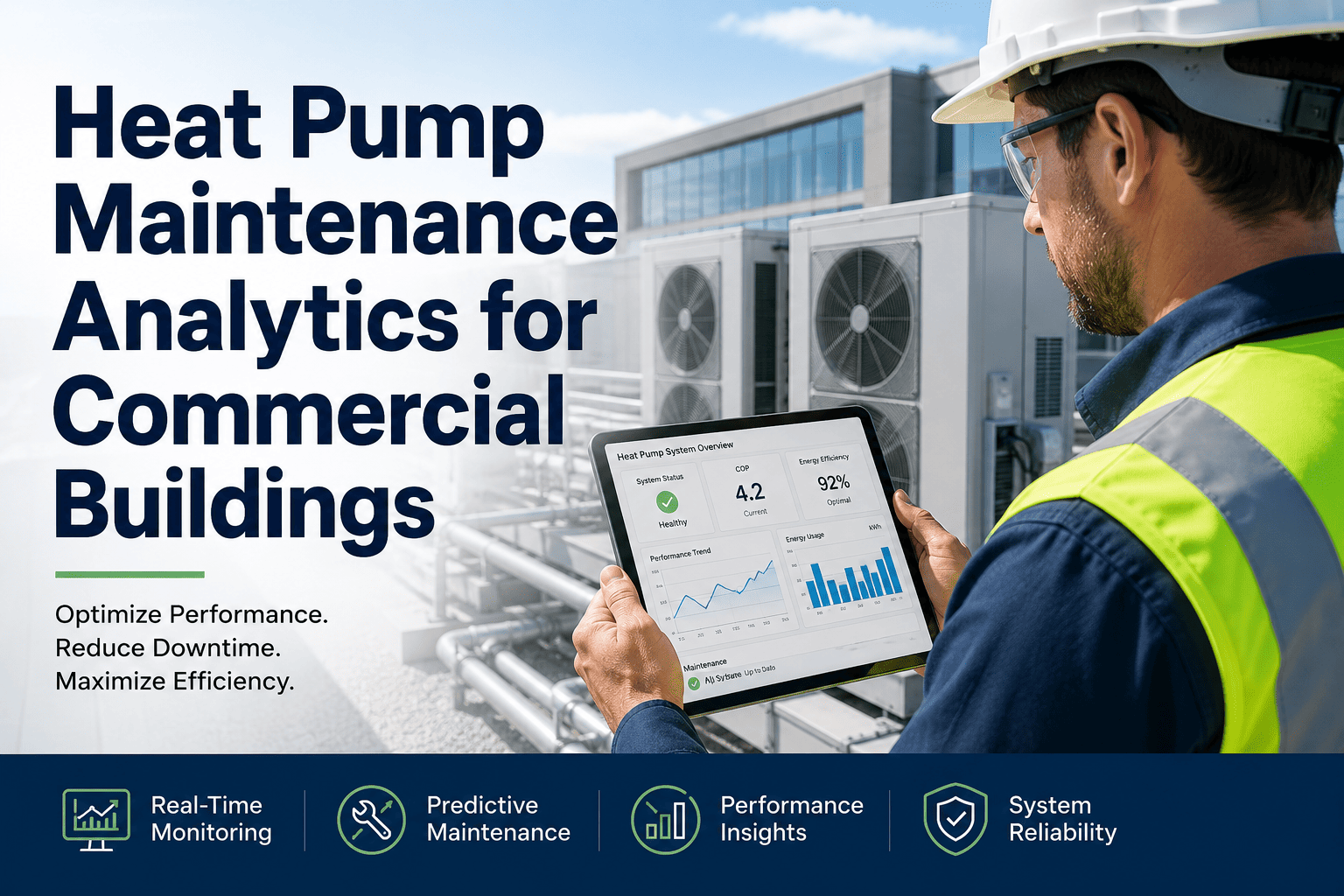
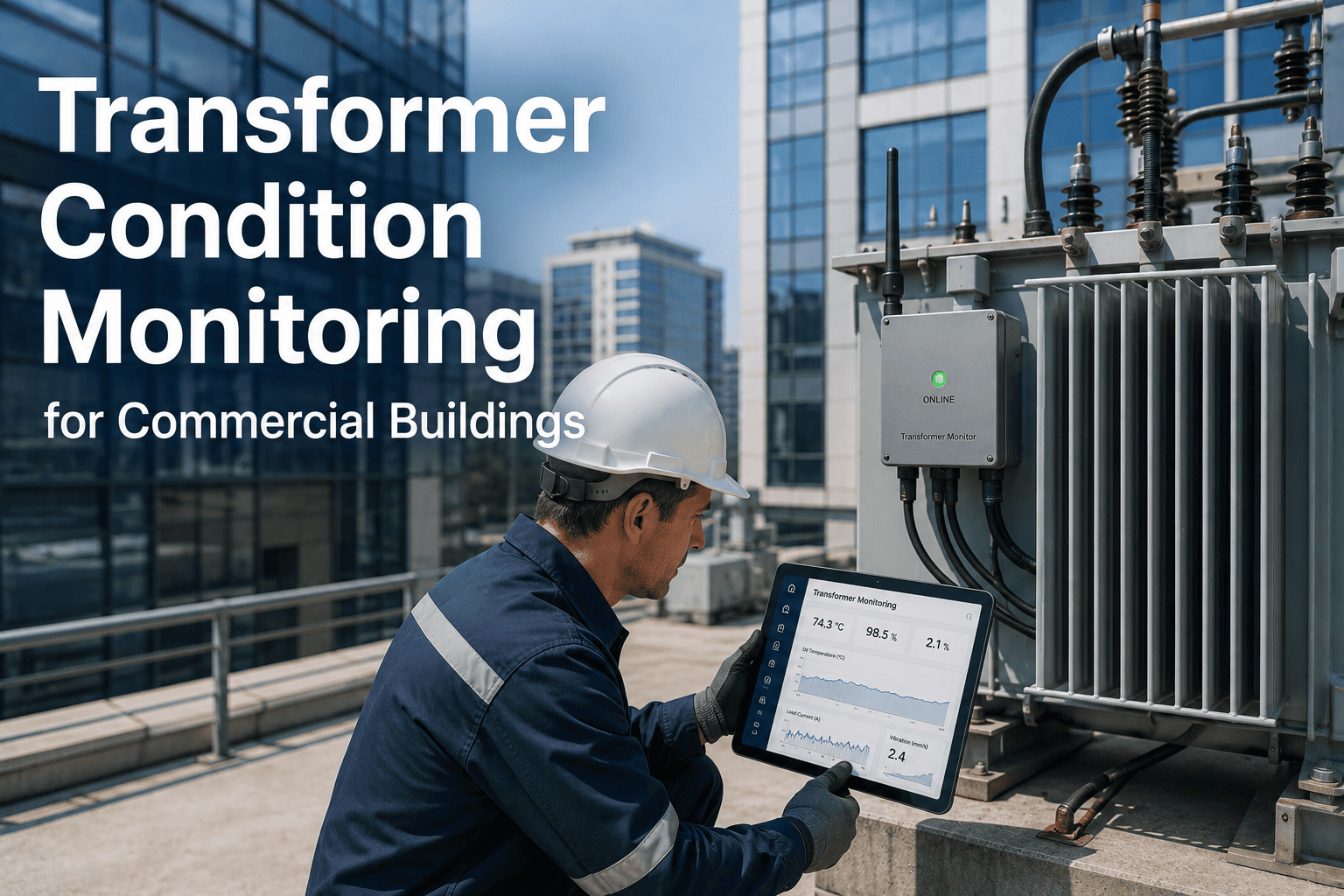
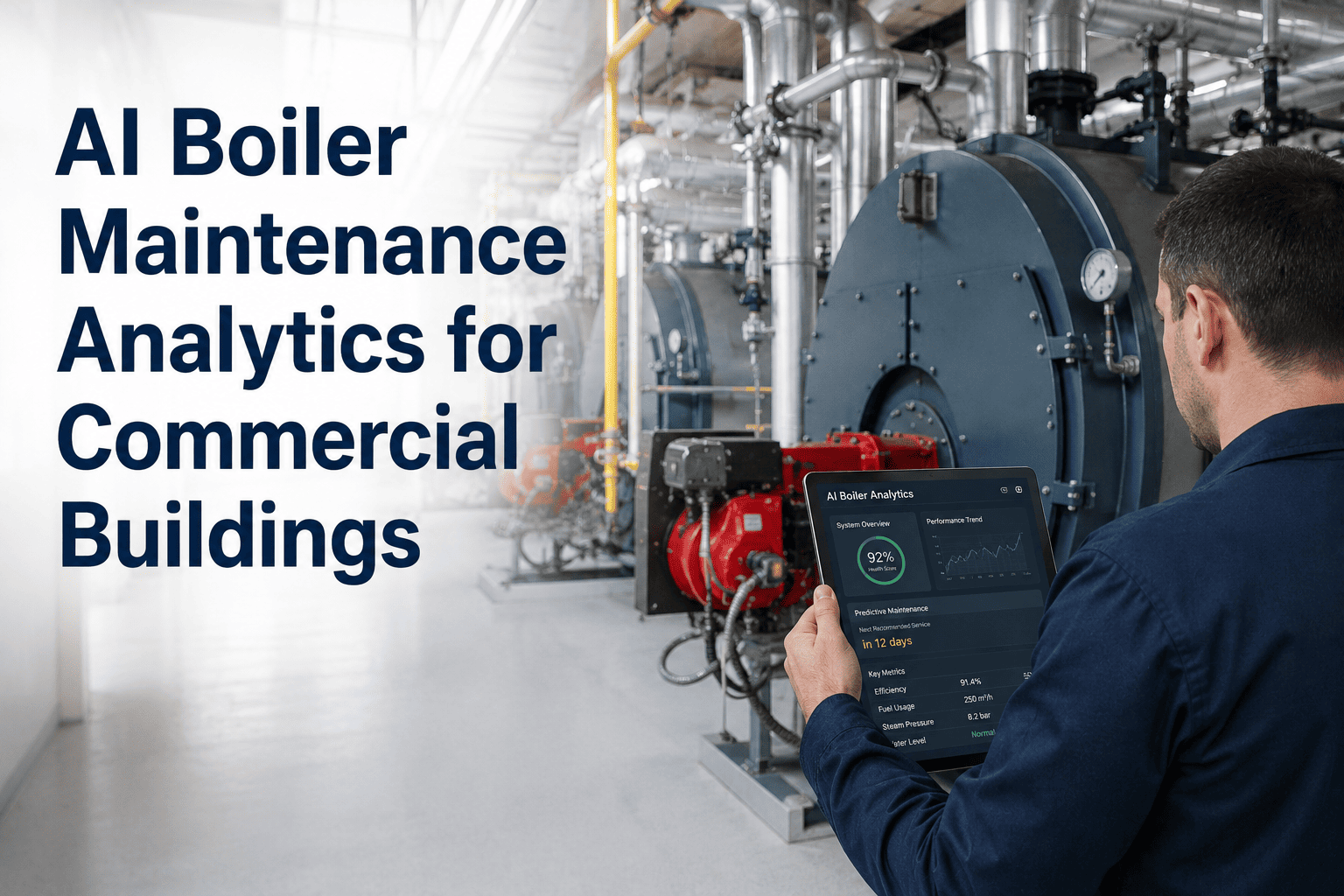
A 2024 McKinsey report found that 40% of commercial real estate firms are already using AI for predictive maintenance — yet only 5% of those programmes achieved their goals. The failure point is not the AI itself. It is deploying intelligence on top of disconnected data: BMS alarms that never become work orders, IoT sensors feeding dashboards nobody checks, and maintenance teams still operating on calendar schedules while condition data sits untouched. Predictive analytics for commercial buildings only delivers ROI when sensor data, AI models, and maintenance execution are connected end to end. Sign in to OxMaint to see how IoT sensor streams become maintenance work orders automatically, or book a demo to see predictive analytics working across HVAC, elevators, electrical, and plumbing systems in one platform.
Blog · Predictive Analytics · Commercial Buildings · IoT + AI
Predictive Analytics for Commercial Buildings with IoT & AI
HVAC, elevators, electrical, and plumbing — monitored by IoT sensors, analyzed by AI failure prediction models, and connected to work order automation. The complete framework for commercial building predictive maintenance in 2025.
Documented Outcomes — AI PdM in Commercial Buildings
10–30x
ROI within 18 months of full deployment (McKinsey)
25%
Maintenance cost reduction — sensor-driven programmes (Deloitte)
40%
Energy use reduction with IoT + AI integration (IBM)
95%
Of predictive maintenance adopters report positive ROI
Maintenance Maturity
Where Is Your Building's Maintenance Programme Today?
Most commercial building maintenance programmes sit between reactive and preventive. Predictive analytics moves the programme to condition-based — the highest-ROI operating model available.
Level 1
Reactive
Fix it when it breaks. Emergency repairs cost 3–10x more than planned work. No data. No prediction. Highest total cost of ownership.
52% of facilities still here
→
Level 2
Preventive
Calendar-based PM. Over-maintains some assets, under-maintains others. Reduces reactive events by 30–50% but still wastes significant maintenance spend.
Most buildings are here
→
Level 3
Predictive
Sensor data + AI models. Maintain assets only when condition data indicates they need it. 25–30% lower total maintenance costs vs reactive. 95% report positive ROI.
Leaders operate here
System Coverage
IoT Sensors + AI Models by Building System
| Building System |
IoT Sensors Required |
AI Prediction Output |
Lead Time |
Failure Cost Avoided |
| HVAC — Chillers & AHUs |
Vibration, temperature, pressure, current draw, flow rate |
Compressor bearing failure, coil fouling, refrigerant leak, condenser fouling |
2–8 weeks |
$5K–$45K per event |
| Elevators — Traction & Hydraulic |
Motor current signature, door cycle time, levelling accuracy, vibration |
Motor bearing wear, door operator failure, rope/belt degradation |
3–7 weeks |
$15K–$80K per event |
| Electrical — Panels & Switchgear |
Thermal imaging, current draw, power quality, insulation resistance |
Connection overheating, breaker failure, transformer degradation |
2–6 weeks |
$10K–$200K per event |
| Plumbing — Pumps & Water Systems |
Vibration, differential pressure, flow rate, motor current, seal temp |
Pump bearing wear, seal failure, impeller cavitation, pipe anomalies |
2–5 weeks |
$8K–$40K per event |
| Standby Generators |
Battery voltage, fuel quality, coolant temp, oil pressure, load test |
Battery degradation, fuel system failure, cooling failure, AVR fault |
4–10 weeks |
$50K–$500K per event |
See Predictive Analytics Working Across Your Building Systems Live
OxMaint connects IoT sensor streams from HVAC, elevators, electrical, and plumbing to AI failure prediction models that auto-generate maintenance work orders at the optimal intervention window — before failure cost is incurred.
Financial Impact
Before vs After Predictive Analytics — 12-Month Outcomes
Calendar-Based Preventive Programme
Unplanned failure events / year94 events
Reactive maintenance ratio41% of all work
Average defect detection timingAfter failure occurs
Total annual maintenance cost$2.4M
Energy deviation from baseline+19% above baseline
OxMaint Predictive Analytics Programme
Unplanned failure events / year17 events (−82%)
Reactive maintenance ratio16% — world-class benchmark
Average defect detection timing3.2 weeks before failure
Total annual maintenance cost$1.72M (−28%)
Energy deviation from baseline+4% (largely corrected)
Data from 12-building, 1.4M sq ft commercial office portfolio. 12-month measured period post-OxMaint deployment vs prior 12-month baseline.
Getting Started
Three Things Required to Start — and Two That Are Not
Required
IoT Sensors or BMS Data
Temperature sensors alone can start HVAC fouling detection. Vibration sensors enable bearing prediction. BACnet, OPC-UA, and MQTT connected to OxMaint via standard API. Begin with your highest-criticality assets — expand as ROI justifies sensor additions.
Required
12+ Months CMMS Work Order History
Historical work orders calibrate AI failure signatures against actual events on your specific equipment. This moves model accuracy from generic industry baseline to site-specific within 30–60 days. Most buildings have this data — it just has not been connected to an AI layer before.
Required
Work Order Execution System
Predictive alerts that do not become maintenance actions deliver no ROI. OxMaint closes the loop automatically — AI anomaly detection generates a work order, assigns a technician, and tracks completion. The prediction is only as valuable as the maintenance action it triggers.
Not Required
Full Sensor Retrofit
Start with your highest-criticality assets. A main chiller, primary AHU, and standby generator can generate ROI in 60 days without sensoring every asset in the building. Sensor additions are justified by ROI from the initial deployment.
Not Required
In-House Data Science Team
OxMaint's AI models are pre-trained on commercial building equipment failure patterns and calibrate automatically to your building's operating profile during the 30-day baseline period. Predictions surface as work orders in plain language — no data science expertise required from your maintenance team.
"
The adoption gap between intention and implementation in building predictive analytics closed faster than I expected. Three years ago, the barrier was infrastructure — most buildings did not have the sensor coverage or the data connectivity to feed an AI model. That is no longer the primary constraint. Today, the constraint is integration: facilities have BMS data, they have IoT sensors, they have CMMS work order history — and none of it talks to each other in a way that produces a maintenance action. The commercial building teams that are winning are the ones that stopped treating these as three separate systems and started treating them as one pipeline: sensor detects, AI predicts, CMMS executes. Once that pipeline is connected, the ROI numbers that once looked like marketing claims become routine outcomes.
Frequently Asked Questions
How many IoT sensors does a commercial building need to start predictive analytics?
There is no minimum sensor count — the right starting point is your highest-criticality assets. A 200,000 sq ft office building typically starts with 8–15 sensors on primary HVAC (main chiller, primary AHUs), 4–6 on pumps, and existing BMS data for the rest. This limited deployment typically generates enough ROI in 60–90 days to justify a full-building sensor expansion. OxMaint works with partial coverage from day one and expands analytics as sensor data accumulates.
Sign in to assess your building's sensor readiness.
How long does it take for AI predictions to become accurate in a new building deployment?
OxMaint's AI models run a 30-day calibration period after connection to a building's sensor streams, during which the system establishes each asset's normal operating signature and filters out environmental variables specific to that building's usage patterns. After calibration, prediction accuracy typically reaches 85–93% for confirmed degradation patterns. Historical work order data accelerates this process — buildings with 12+ months of CMMS history reach full calibration accuracy faster.
Book a demo to see the calibration process and timeline.
Does OxMaint integrate with existing BMS platforms like Johnson Controls, Siemens, or Honeywell?
Yes. OxMaint integrates with all major BMS platforms via standard protocols — BACnet, OPC-UA, Modbus, and REST API. The integration typically completes in days using pre-built protocol connectors, with no custom middleware development required. BMS sensor data feeds directly into OxMaint's AI analytics layer alongside IoT sensor streams. Critically, OxMaint adds the AI analytics and work order automation layer that most BMS platforms lack — it does not replace the BMS, it makes the BMS data actionable.
Sign in to start your BMS integration.
What is the typical payback period for IoT and AI predictive maintenance in a commercial building?
Most commercial building deployments identify significant savings within the first 30–60 days of monitoring — typically from early anomaly detection on HVAC and electrical systems that prevents one or two major failures in the first quarter. Full investment payback typically occurs within 6–12 months. ROI ratios of 10:1 to 30:1 are commonly reported within 18 months of full deployment. For context: a single avoided chiller compressor failure (reactive cost: $18,000–$45,000) versus a planned intervention ($3,500–$8,000) covers months of platform cost.
Book a demo to model your building's ROI potential.
Stop Calendar-Based PM. Start Condition-Based Maintenance.
OxMaint connects IoT sensors, AI failure prediction models, and work order automation in one platform — detecting building system degradation weeks before failure and converting predictions into maintenance actions automatically.