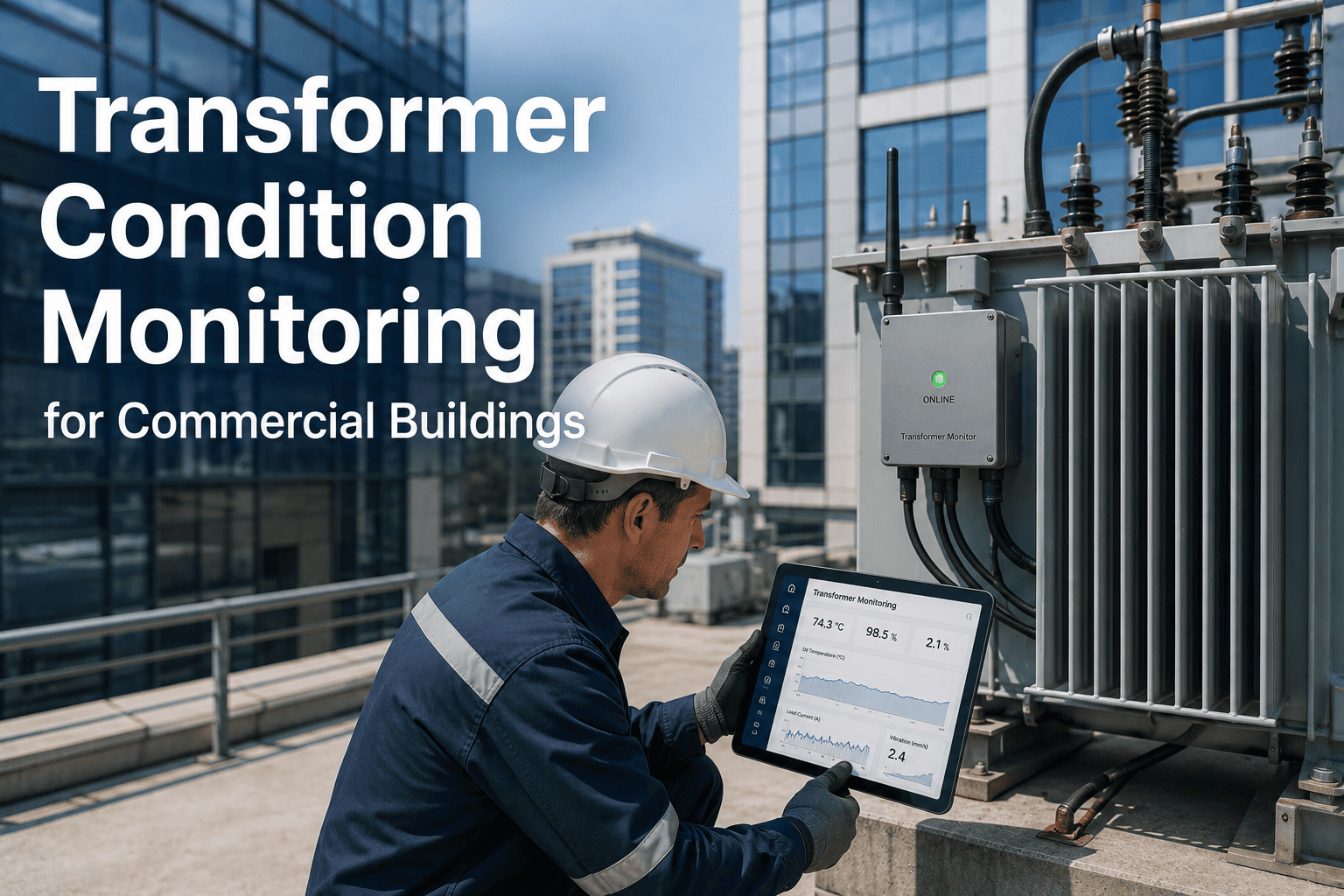
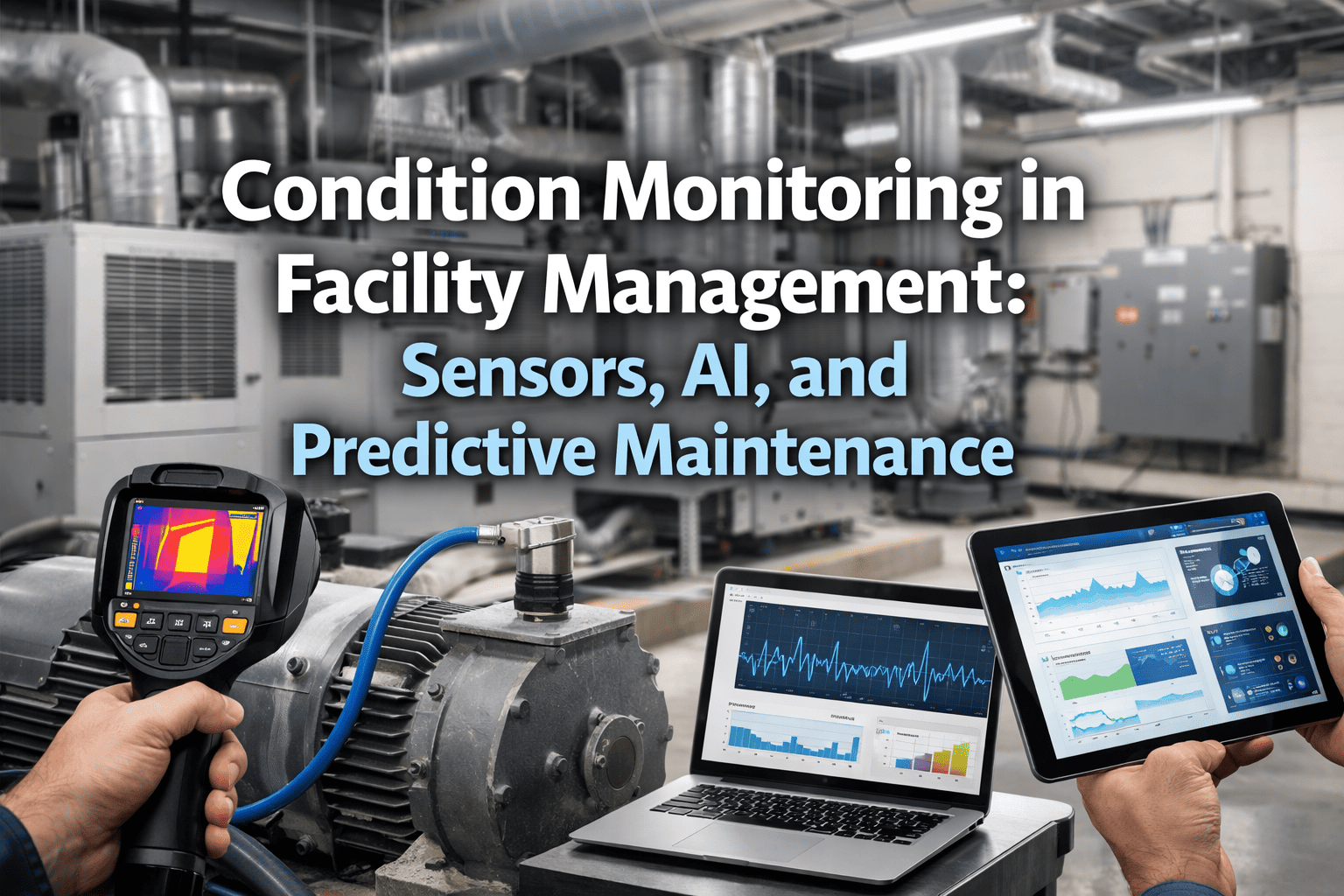
Transformers are the highest-value, longest-lead-time electrical assets in any commercial building — and the ones most often maintained reactively until something catastrophic forces action. A transformer failure in a multi-tenant commercial building can mean days without power, six-figure emergency procurement costs, and legal exposure from lease violations. Condition monitoring closes the gap between quarterly routine checks and real-time awareness of transformer health.
Predictive Maintenance AI · Article
Transformer Condition Monitoring for Commercial Buildings
Track temperature, load trends, oil analysis results, and degradation indicators — and let AI predict failure before it disrupts your building operations.
Transformer Failure Cost Exposure
Emergency transformer procurement
$80K – $400K
Building downtime (commercial)
$15K – $50K / day
Oil spill cleanup and remediation
$20K – $120K
Lead time for replacement unit
12 – 52 weeks
The 5 Transformer Condition Indicators That Predict Failure
Transformer failures rarely occur without warning. The problem is that the warning signs — temperature trends, oil test deviations, load patterns — are only visible if someone is systematically collecting and analyzing the data. These five indicators together give facilities an 80–90% probability of predicting failure with 3–6 months of lead time.
01
Winding Temperature Rise
Every 10°C rise above design operating temperature halves insulation service life. Hot-spot temperatures above 110°C (for Class A insulation) indicate overloading or cooling system failure. Track average and peak temperatures by hour, not just spot readings.
Alert: sustained > 85°C top oil · Action: > 95°C
02
Load Factor Trend
Operating consistently above 85% of nameplate kVA accelerates insulation aging and increases the probability of thermal failure during demand peaks. Load trending over 90 days reveals gradual capacity creep that point-in-time readings miss entirely.
Alert: > 85% of nameplate kVA · Action: > 95%
03
Dissolved Gas Analysis (DGA)
Oil-filled transformers produce specific gases as insulation degrades — hydrogen, methane, ethylene, and acetylene each indicate different fault types. Annual DGA is the gold standard for early fault detection, with results interpreted against IEEE C57.104 key ratio methods.
Alert: acetylene > 5 ppm · Action: > 35 ppm (immediate)
04
Oil Dielectric Strength
Oil dielectric strength below 25 kV/2.5mm gap indicates contamination by water, particles, or oxidation products — all of which increase the risk of internal arcing. Oil dielectric testing is a simple, low-cost annual test that provides a direct indicator of insulation system health.
Alert: < 30 kV · Action: < 25 kV — dry/filter oil
05
Tank Vibration Signature
Loose core laminations or winding displacement produces vibration signatures that deviate from the healthy baseline. Periodic vibration measurements on transformer tanks can detect core looseness and winding displacement — fault modes invisible to oil tests or temperature monitoring alone.
Alert: 2× baseline vibration amplitude at 100 Hz
OxMaint's predictive maintenance AI tracks all five indicators over time — surfacing degradation trends and triggering maintenance work orders before parameters reach critical levels. Book a demo to see transformer monitoring in action.
Oil Test Results Interpretation Guide
Oil analysis results require interpretation against established limits and — more importantly — against the asset's own historical baseline. A rising trend toward a limit is more actionable than a single result near the limit. The table below provides the primary oil test parameters and their decision thresholds per IEEE C57.106 and IEC 60422.
| Test Parameter |
Good Condition |
Investigate |
Urgent Action |
Fault Indicated |
| Dielectric strength |
> 40 kV |
30 – 40 kV |
< 25 kV |
Water or particle contamination |
| Moisture content (ppm) |
< 15 ppm |
15 – 25 ppm |
> 35 ppm |
Insulation moisture ingress |
| Acid number (mg KOH/g) |
< 0.10 |
0.10 – 0.30 |
> 0.40 |
Oil oxidation — inhibitor depletion |
| Interfacial tension (mN/m) |
> 30 |
20 – 30 |
< 18 |
Contamination, oxidation products |
| Hydrogen (ppm) — DGA |
< 100 |
100 – 200 |
> 300 |
Corona discharge, arcing |
| Acetylene (ppm) — DGA |
< 5 |
5 – 35 |
> 35 |
High-energy arcing — immediate |
Transformer Monitoring Schedule by Asset Criticality
Not all transformers carry the same risk profile. The monitoring schedule should reflect the consequence of failure — a transformer feeding a data center or hospital demands more frequent attention than one serving a low-occupancy warehouse. OxMaint allows you to assign criticality tiers to assets and auto-schedule the appropriate PM frequency for each tier.
Tier 1 — Critical
Data centers, hospitals, mission-critical facilities
DailyTemperature and load logging via BMS or IoT sensor
MonthlyOil level, sight glass, pressure relief check
QuarterlyIR scan of HV/LV terminals; DGA oil sample
AnnualFull oil analysis; insulation PF test; turns ratio test
Tier 2 — High
Multi-tenant commercial, retail centers, campuses
WeeklyTemperature and load spot check — log reading
QuarterlyOil level; visual inspection; IR terminal scan
AnnualFull oil analysis including DGA; winding resistance
3-YearInsulation power factor test; turns ratio verification
Tier 3 — Standard
Office buildings, light industrial, low-consequence loads
MonthlyVisual inspection, nameplate condition, no oil leaks
AnnualIR thermography; oil dielectric and acid number test
3-YearFull oil analysis; insulation resistance test (Megger)
5-YearComprehensive electrical tests; consider DGA first time
The most significant improvement any commercial building facility team can make to transformer reliability is simply trending the data they already collect — rather than looking at each oil test result in isolation. I have seen buildings where three consecutive annual DGA samples showed rising hydrogen trending from 45 ppm to 90 ppm to 160 ppm, and each individual result was filed away as within limits. The trend told a completely different story. When you plot those three points against the asset record, you see a transformer that needed investigation two years earlier. A CMMS like OxMaint keeps every oil test result against the asset and can chart the trend automatically — that is the difference between reactive and genuinely predictive maintenance. It does not require more data collection; it requires better use of the data you already have.
Frequently Asked Questions
How often should a building transformer oil be changed or reconditioned?
Oil replacement decisions should be condition-based, not calendar-based. Well-maintained mineral oil in a sealed transformer can remain serviceable for 20–30 years. Reconditioning — typically through filtration, drying, and inhibitor replenishment — is appropriate when acid number exceeds 0.15 mg KOH/g or moisture content is elevated. Full oil replacement is warranted when acid number exceeds 0.40, dielectric strength is persistently below 25 kV despite filtering, or interfacial tension has dropped below 18 mN/m. Annual oil testing tracked in
OxMaint provides the trend data to make these decisions confidently rather than on a guess or a fixed schedule.
Can dry-type transformers in commercial buildings benefit from condition monitoring?
Absolutely. While dry-type transformers have no oil to sample, they are still subject to thermal aging, insulation contamination, connection loosening from thermal cycling, and winding vibration issues. The primary monitoring methods are: temperature trending via embedded RTDs or spot checks, annual IR thermography of all connection points and winding surfaces, visual inspection for dust accumulation and insulation discoloration, and periodic insulation resistance testing of winding-to-core and winding-to-winding.
OxMaint's PM module supports dry-type inspection checklists with all required reading fields — separate from oil-filled transformer workflows.
Book a demo to configure your asset types.
What is the ROI of implementing transformer condition monitoring in a commercial building portfolio?
For a portfolio of 10–20 commercial buildings, the financial case for condition monitoring is straightforward: preventing a single transformer failure (worth $150K–$500K in direct costs) pays for several years of monitoring and CMMS software. Beyond failure prevention, condition monitoring extends service life by identifying candidates for reconditioning rather than replacement, enables budget planning for replacements 18–24 months in advance instead of emergency procurement, and reduces insurance risk in some policy frameworks. Most OxMaint users in commercial real estate see a measurable reduction in reactive maintenance spend within the first year — typically 25–40% on electrical systems specifically.
Book a 30-minute demo to model the ROI for your portfolio.
Predict Transformer Failures — Before They Shut Your Building Down
OxMaint tracks temperature, load, oil test results, and vibration data against your transformer assets — surfacing degradation trends and auto-generating maintenance work orders before failures occur. Purpose-built for commercial facility teams.