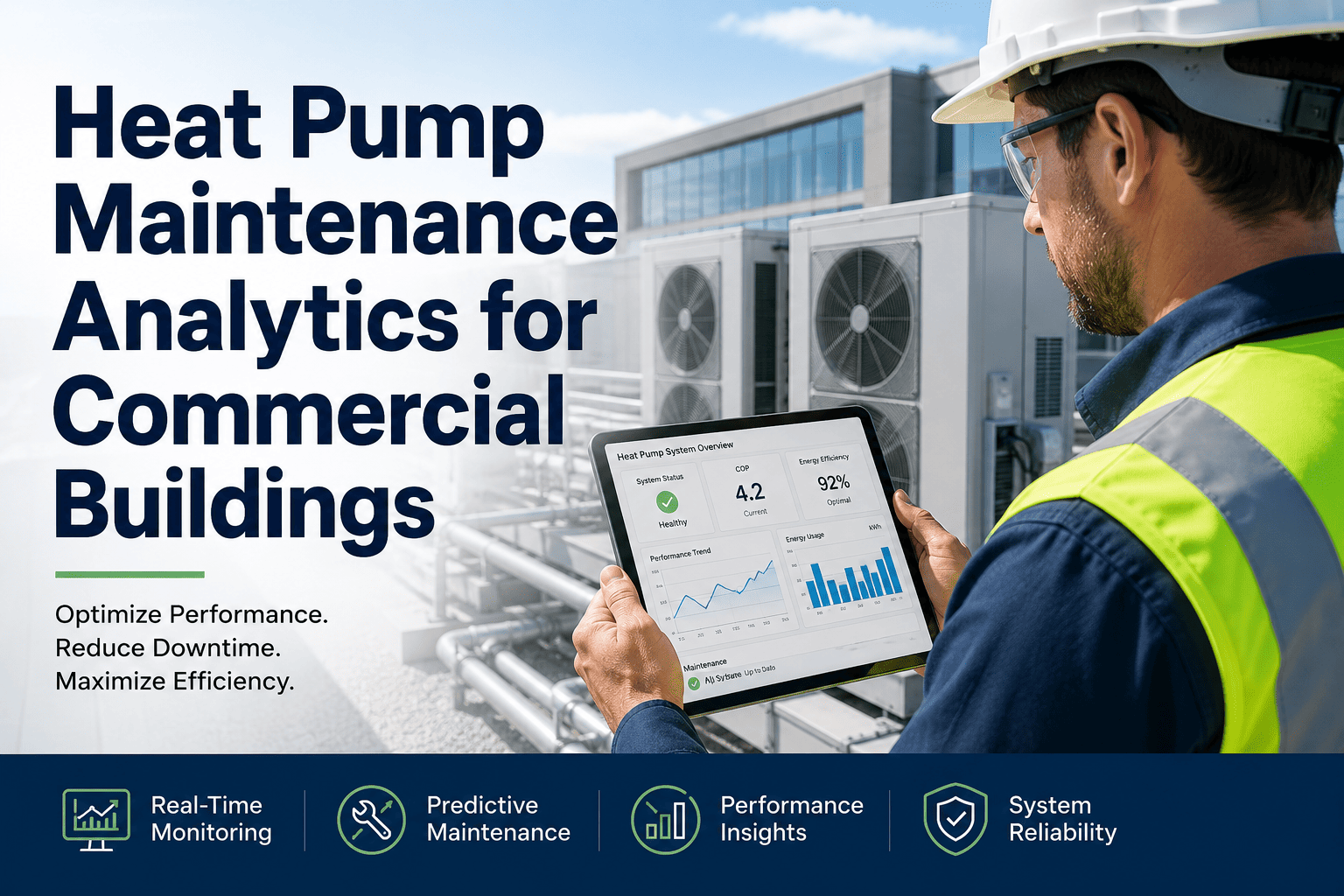
Commercial heat pump adoption is accelerating rapidly as buildings pursue electrification and decarbonization targets. Heat pumps now account for a growing share of new commercial HVAC installations, yet most maintenance programs still treat them like legacy gas-fired systems — with static PM schedules that miss the performance degradation patterns specific to heat pump operation. Seasonal reversals, refrigerant-side efficiency drift, and defrost cycle anomalies are failure modes that maintenance analytics catch months before a unit trips on safety, but only if the data is being analyzed rather than simply logged. Oxmaint's Analytics and Reporting provides the heat pump performance intelligence that static PM checklists cannot.
25–35%
COP reduction before typical maintenance trigger
3.5 to 4.5
Target COP range for commercial heat pump cooling mode
40%
Of heat pump failures occur within 30 days of seasonal switchover
18 months
Typical payback on predictive maintenance analytics for commercial heat pumps
Heat Pump Performance Metrics That Matter
Heat pump maintenance is fundamentally a data problem. The machines produce measurable performance signals — COP trends, suction and discharge pressure differentials, entering and leaving fluid temperatures, defrost cycle frequency and duration — that degrade in predictable patterns before failure occurs. The gap between best-in-class maintenance programs and average programs is almost entirely explained by whether these performance metrics are being tracked and trended, or simply logged and ignored.
COP is the primary efficiency metric for heat pump operation. Trending COP below 3.0 in cooling mode typically indicates refrigerant charge loss, condenser fouling, or compressor degradation. A 20% COP decline represents a proportional increase in electricity consumption — directly visible on utility bills if tracked. Monthly COP trending against design specification is the single highest-value data point in a heat pump analytics program.
Suction and discharge pressure readings reveal refrigerant charge status, compressor valve condition, and expansion device performance in a single measurement pair. Gradual suction pressure decline with normal discharge pressure is the signature of slow refrigerant loss. Rapid discharge pressure elevation with normal suction indicates condenser heat rejection failure — typically fouling, airflow obstruction, or entering fluid temperature issue.
In heating mode, defrost cycle frequency and completion time are reliable indicators of outdoor coil condition, refrigerant charge, and reversing valve performance. Excessive defrost initiation — more than twice the design frequency — indicates early-stage refrigerant undercharge or coil frosting beyond normal operation. Incomplete defrost cycles that abort before coil temperature recovery signal reversing valve or defrost control board issues.
For water-source and geothermal heat pumps, the entering water temperature and the delta-T across the heat exchanger define the thermal performance envelope. Delta-T compression below 80% of design value indicates heat exchanger fouling, flow rate imbalance, or refrigerant-side degradation. Trending this value monthly against seasonal baselines catches heat exchanger fouling before it reaches the point of capacity loss visible to building occupants.
Seasonal Readiness Checklist — Cooling and Heating Mode Switchover
The 30 days surrounding seasonal mode switchover represent the highest-risk period in the commercial heat pump maintenance calendar. Systems that have been running in cooling mode all summer enter heating mode with accumulated refrigerant drift, compressor wear, and reversing valve fatigue — and failures concentrated at switchover produce the highest emergency service cost and peak-demand energy penalties. A structured pre-switchover inspection protocol reduces failure rates at this vulnerability window.
| Inspection Item |
Pre-Cooling Season |
Pre-Heating Season |
Analytics Indicator |
| Refrigerant charge verification |
Required |
Required |
Suction pressure vs. baseline |
| Reversing valve operation test |
Optional |
Required |
Mode switchover time vs. norm |
| Outdoor coil cleaning |
Required |
Required |
Discharge pressure trend |
| Defrost control board test |
Optional |
Required |
Defrost initiation frequency |
| Compressor amp draw check |
Required |
Required |
Amp draw vs. COP correlation |
| COP baseline recalibration |
Required |
Required |
Seasonal COP delta tracking |
Get Ahead of Heat Pump Failures Before Seasonal Demand Peaks
Oxmaint tracks COP trends, pressure differentials, and defrost anomalies across your heat pump fleet — surfacing degradation before it becomes a peak-load failure event.
"Heat pump maintenance programs that rely entirely on annual or semi-annual PM visits are flying blind on the metrics that actually predict failure. COP trending catches refrigerant issues 3 to 5 months before a technician would notice anything abnormal in a routine inspection. Pressure differential analysis identifies heat exchanger fouling months before capacity loss is measurable by occupants. The data is there — modern equipment produces it continuously. The only question is whether your maintenance program is using it. Teams that implement analytics-driven heat pump programs consistently achieve 20 to 30% lower reactive maintenance spend within the first operating year."
Priya Vasanthakumar, PE, CEM
Mechanical Systems Engineer · Commercial Building Electrification Specialist · ASHRAE Distinguished Lecturer
Frequently Asked Questions
How does refrigerant loss affect heat pump COP, and how quickly does the impact accumulate?
A refrigerant charge reduction of as little as 10% below optimal can reduce heat pump COP by 5 to 10%, with the efficiency penalty increasing non-linearly as charge drops further. At 20% undercharge, COP degradation of 15 to 25% is commonly observed in field studies, compounded by compressor overheating risk as suction superheat rises. The progression is typically gradual — a slow leak from a service valve or brazed joint loses charge over weeks or months, so the COP decline is slow enough that it does not trigger any BAS alarm and is not obvious to occupants until the unit begins struggling to meet setpoint on peak demand days. Monthly COP trending against a seasonal-adjusted baseline is the only reliable method for detecting this failure mode early.
Oxmaint's analytics dashboard automates this trending for every heat pump in your fleet.
What is the expected commercial heat pump lifespan, and how does maintenance quality affect it?
Commercial heat pump systems have a design life of 15 to 20 years with proper maintenance, though field surveys consistently show average lifespans of 12 to 15 years in facilities with reactive-dominated maintenance programs. The primary life-limiting components are the compressor and reversing valve — both of which are disproportionately affected by operation outside normal performance parameters, particularly refrigerant undercharge and compressor overheating. Facilities with analytics-driven maintenance programs that maintain equipment within design performance envelopes consistently achieve equipment lifespans at or above the design maximum, with the compressor replacement rate approximately 40% lower than facilities running static PM-only programs. The economics are clear: extending a commercial heat pump's service life by even 3 years on a $25,000 unit more than justifies the cost of an analytics subscription many times over.
Can heat pump maintenance analytics integrate with our existing BAS and work order system?
Yes, and integration is the key factor that determines whether analytics actually improve maintenance outcomes or just add another data screen for the team to check. Effective heat pump analytics pull performance data from the BAS or equipment controllers, apply anomaly detection and trend analysis, and surface actionable work orders directly into the CMMS that technicians already use — without requiring them to log into a separate analytics platform to understand what needs attention.
Book a demo to see how Oxmaint connects to your existing BAS infrastructure and delivers prioritized maintenance recommendations directly into your work order queue based on real-time performance data from your heat pump fleet.
Heat Pumps Are Your Highest-Efficiency Assets. Treat Them That Way.