A neglected commercial roof costs facility managers far more than a proactive inspection programme. Sign in to OxMaint to digitise your roof inspection checklists, track defects by zone, schedule seasonal tasks, and generate audit-ready maintenance records — or book a demo to see the asset lifecycle workflow configured for your facility portfolio.
Facility Management / Asset Lifecycle
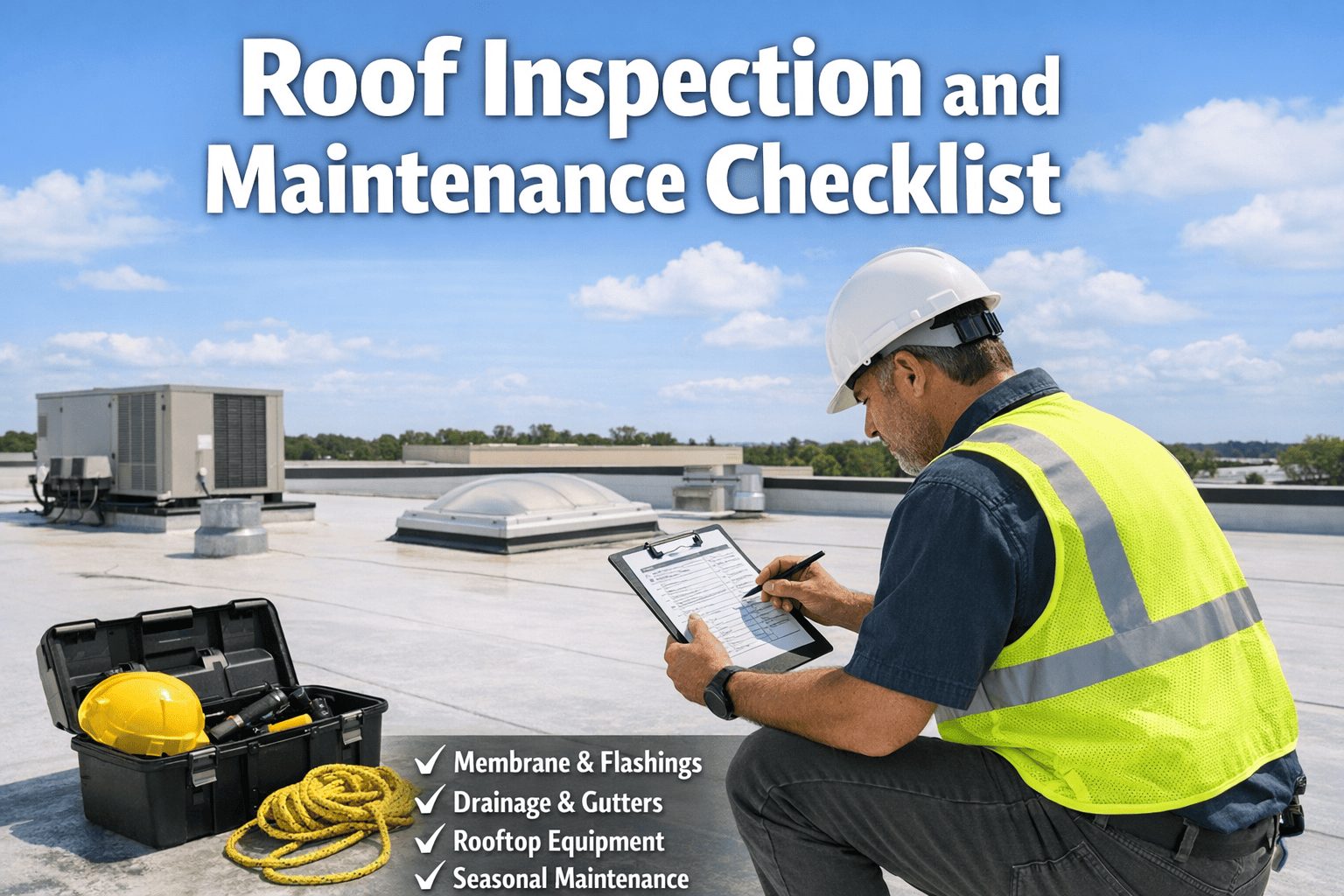
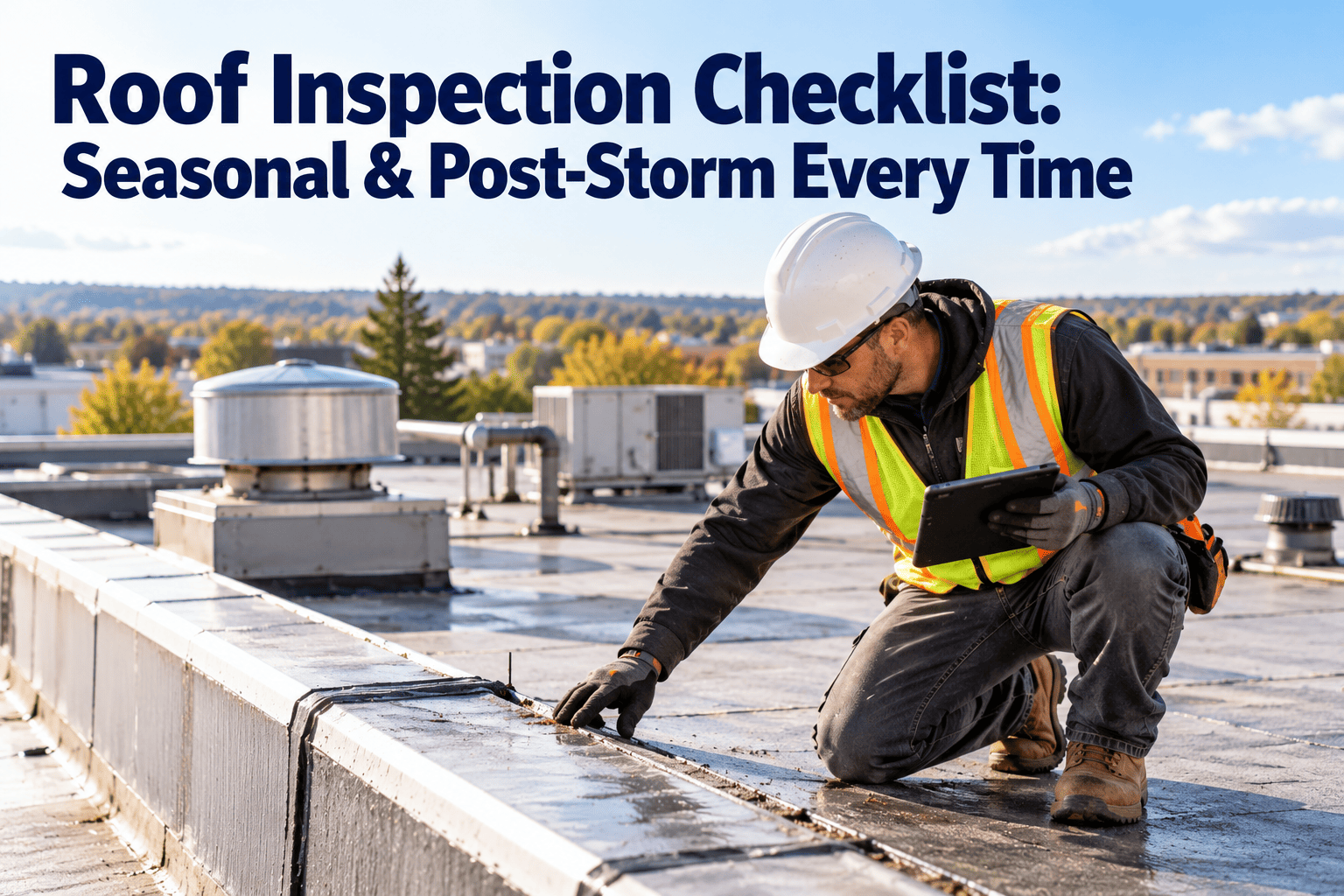
Roof Inspection & Maintenance Checklist for Commercial Buildings
Membrane integrity, flashings, drainage, penetrations, rooftop equipment, and seasonal tasks — the complete inspection framework for facility managers responsible for commercial roof assets.
2x
Inspections per year recommended — spring and fall — plus post-storm checks
21yr
Average roof lifespan with regular inspection vs. 13 years with reactive maintenance
25%
Damage threshold where repairs risk voiding remaining warranty coverage
$1.1B
Commercial roof maintenance market size in 2025 — up from $0.44B in 2024
Why Roof Inspections Cannot Be Reactive
Most commercial roof damage is invisible from ground level and only surfaces after a professional inspection — or after a leak has already compromised insulation, drywall, or inventory. Undetected minor leaks are the leading cause of maintenance escalation on commercial roofs. Emergency roof work consistently costs more than routine service, and failing to maintain inspection records can void manufacturer warranties and weaken insurance claims. A structured inspection checklist gives your team a consistent, repeatable record of what was checked and when.
01
Membrane Surface
Primary waterproofing layer — most consequential failure zone
02
Flashings & Seals
Transition points — statistically highest source of active leaks
03
Drainage System
Gutters, drains, downspouts — ponding water accelerates all damage
04
Penetrations
Pipes, vents, conduits — each is a potential water ingress point
05
Rooftop Equipment
HVAC units, skylights, solar — vibration and heat cycling stress the membrane
06
Structural Deck
Foundation of the roofing system — deck failure puts the entire assembly at risk
Complete Inspection Checklist by Zone
Each zone below represents a discrete inspection scope. Assign a condition rating — Good, Monitor, Action Required — to every item. Open items rated Action Required must be logged as maintenance work orders before the inspection cycle closes.
Check for blistering, bubbling, or separation on the membrane surface across all roof fields
Inspect seams and laps for UV-related separation or thermal movement gaps
Look for punctures, tears, or abrasion damage — especially near rooftop equipment and access routes
Identify surface crazing, granule loss, or discolouration indicating UV degradation
Confirm walk pads are intact on all designated access routes and maintenance zones
Estimate total surface area showing visible deterioration and compare against the 25% replacement threshold
Inspect all wall-to-roof transition flashings for lifting, separation, or corrosion
Check drip edges, fascia, and coping caps for secure attachment and rust
Examine parapet flashings — confirm counterflashing is properly seated in reglets
Verify skylight curb flashings and frame seals show no cracking or separation
Inspect expansion joint covers across their full length for tears or misalignment
Document any open or brittle sealant joints requiring reapplication
Clear all primary and secondary roof drains of debris — confirm strainer baskets are in place
Check gutters and downspouts for blockages, deformation, and secure attachment
Identify any areas of ponding water remaining more than 48 hours after the last rain event
Confirm drainage slope directs water toward outlets — inspect for settled low spots
Run controlled water test at suspect areas to observe real-time drainage performance
Inspect interior downspout discharge points for staining or moisture evidence at building base
Inspect pitch pans and pipe boots around all conduit, pipe, and structural penetrations
Check vent curb flashings for gaps and confirm vent caps are secure
Examine all equipment curbs for membrane termination integrity at the top of each curb
Verify pitch pockets are filled and show no cracking or shrinkage of fill material
Log all newly added penetrations that were not present at the last inspection cycle
Check HVAC unit base flashings and condensate drain lines for blockage and membrane contact damage
Inspect equipment mounting points for loose anchors, vibration damage, or membrane cracking at base
Verify electrical conduits and equipment access hatches are sealed at roof penetration points
Check solar panel racking attachment points and penetration seals — confirm no displacement since last cycle
Inspect antenna mounts and communication equipment bases for corrosion and sealant integrity
Inspect the underside of the deck from interior — check for staining, rust streaks, or moisture evidence
Look for sagging or deflection in deck panels under equipment load points
Check attic or plenum space for light infiltration, insulation displacement, or mould growth
Verify interior wall surfaces near the roofline show no active staining or peeling that indicates ongoing leak
Confirm insulation system has not been wet — schedule moisture survey if subsurface saturation is suspected
Run Every Inspection in OxMaint — Mobile, Offline-Ready, Auto-Scheduled
Replace paper checklists with digital inspection records that capture zone-by-zone condition ratings, photo evidence, and maintenance work orders from the roof — all linked to your asset register.
Start Free Trial
Book a Demo
Seasonal Maintenance Tasks
Roof condition requirements shift with the seasons. The table below maps the critical maintenance actions to each period and the primary risk each task mitigates.
| Season |
Priority Tasks |
Risk Mitigated |
Frequency |
| Spring |
Full membrane inspection, drain clearing, flashing audit, post-winter damage survey |
Freeze-thaw cracking, ice dam water entry, clogged drains from leaf accumulation |
Annual |
| Summer |
UV membrane check, equipment inspection, coating reapplication on degraded surfaces |
UV blistering, thermal cycling seam failure, HVAC condensate overflow |
Annual |
| Autumn |
Full debris removal, gutter flush, drain check, penetration sealant survey |
Drain blockage from leaf fall, standing water before freeze season |
Annual |
| Winter |
Post-storm inspection, snow load assessment on flat roofs, ice dam monitoring |
Structural overload, ice expansion in membrane cracks, parapet freeze damage |
Post-event |
| Ongoing |
Rooftop access log review, maintenance crew walkpath compliance, drain status after rain |
Foot traffic membrane punctures, undetected ponding between scheduled cycles |
Monthly |
Condition Rating System
Standardise how your team scores inspection findings so every inspector produces comparable, actionable data that drives consistent capital planning decisions across your portfolio.
1
Good
No visible defects. No action required this cycle. Record and monitor at next scheduled inspection.
2
Monitor
Minor wear noted. No immediate action needed but schedule re-inspection within 90 days to track progression rate.
3
Action Required
Active defect or water ingress risk. Raise a maintenance work order before closing this inspection cycle. Do not defer.
4
Critical
Immediate structural or waterproofing failure risk. Escalate same-day to facility manager. Emergency repair required.
"
The single most expensive failure pattern I see in commercial facility portfolios is not a catastrophic roof event — it is the accumulation of deferred minor maintenance across two or three inspection cycles. A blocked drain documented as "Monitor" in spring and then missed at the autumn inspection becomes a ponding water claim by February. The checklist is not the problem; the lack of a closed-loop work order system attached to the checklist is. When every rated defect automatically generates a tracked maintenance task, deferral becomes visible and accountable — it stops being a quiet decision and becomes a documented risk acceptance. That accountability change is worth more than any technology feature.
Marcus Holt, CFM, IFMA
Certified Facility Manager · 22 years commercial property operations · Former VP Facilities, multi-site industrial portfolio · Specialist in preventive maintenance programme design and roofing asset lifecycle management
How OxMaint Manages Roof Asset Inspections
Digital Checklists
Zone-by-Zone Inspection Forms
Pre-built roof inspection templates mapped to each zone — membrane, flashings, drainage, penetrations, equipment. Inspectors rate every item on mobile, attach photos, and add notes from the roof without paper or transcription.
Work Orders
Defect-to-Work-Order in One Tap
Any item rated Action Required or Critical automatically generates a corrective maintenance work order with the zone location, condition description, and inspector photo attached. Nothing falls through the gap between inspection and repair.
Scheduling
Seasonal & Event-Triggered Scheduling
Configure spring and autumn inspection cycles per asset, with additional post-storm triggers that auto-generate inspection tasks when weather events are logged. No manual scheduling required each cycle.
Lifecycle
Roof Asset Condition History
Every inspection record is stored against the roof asset in OxMaint. Condition trend data across multiple cycles gives facility managers the evidence base to plan capital replacements with data rather than anecdotal repair requests.
Every Roof Zone. Every Cycle. Always Documented.
OxMaint replaces paper roof inspection checklists with digital records, closed-loop work orders, and asset condition history — so no defect is deferred without a documented decision.
Frequently Asked Questions
How often should a commercial roof be inspected?
Industry best practice — and the requirement of most commercial roof warranties — is a minimum of two formal inspections per year, typically in spring and autumn. In addition to scheduled cycles, a post-storm inspection should be performed after any significant weather event involving hail, high winds, or heavy snow load. Facilities with heavy rooftop equipment, manufacturing exhaust exposure, or roofs older than 15 years may need quarterly checks for specific zones.
Sign in to OxMaint to configure inspection frequency per asset based on roof age, type, and risk profile.
What is the 25% rule for commercial roofs and why does it matter?
The 25% rule is the threshold at which a commercial roof has sustained enough damage or deterioration that repair work may void the remaining warranty coverage and replacement typically becomes more cost-effective than continued patching. Accurately documenting the percentage of affected surface area across inspection cycles is essential — it provides the data needed to support capital expenditure requests and insurance claims. Inspections that use a consistent condition rating system and photograph defect locations give facility managers defensible evidence when the 25% threshold is approached.
Book a demo to see how OxMaint tracks roof condition trends across inspection cycles.
Which zones on a commercial roof are most likely to fail first?
Flashings and penetration seals are statistically the most frequent source of active leaks on commercial roofs — they are the transition points where the membrane connects to walls, curbs, pipes, and equipment, and every transition is a potential water path. Drainage zones are the second highest-risk area; blocked drains allow ponding water that accelerates membrane deterioration across the entire roof field. Membrane seams in high-UV zones and areas with heavy foot traffic from HVAC maintenance crews are the third common failure category. A structured checklist that prioritises these zones at every inspection cycle catches the majority of failures before they become water ingress events.
Can facility staff conduct roof inspections or is a specialist required?
Trained facility staff can and should conduct routine visual inspections using a standardised checklist — this is the most effective way to maintain inspection frequency and catch issues between professional visits. A qualified roofing contractor is required for warranty compliance documentation, insurance claim support, post-storm structural assessment, and any investigation involving suspected subsurface moisture where non-destructive testing such as infrared scanning is needed. For portfolios with multiple buildings, the practical model is trained internal staff running checklist inspections biannually and after weather events, with a professional contractor conducting an annual detailed inspection per asset.
Sign in to OxMaint to manage both internal and contractor inspection records in one system.