Irrigation is the single largest source of water waste on commercial and institutional properties — yet most of that waste is invisible. A broken sprinkler head can waste up to 25,000 gallons per year while looking perfectly normal from a distance. A controller running last season's schedule through a wetter month adds weeks of unnecessary runtime. Leaks as small as 1/32 of an inch waste 6,300 gallons per month. Collectively, poor irrigation maintenance wastes 30–60% of outdoor water use — a number that shows up directly in utility bills, ESG water intensity scores, and increasingly in regulatory reporting. OxMaint's preventive maintenance platform schedules every inspection tier automatically, tracks water consumption per zone, and generates the ESG-ready water usage records that sustainability teams need without adding manual reporting overhead.
Checklist · Sustainability & ESG
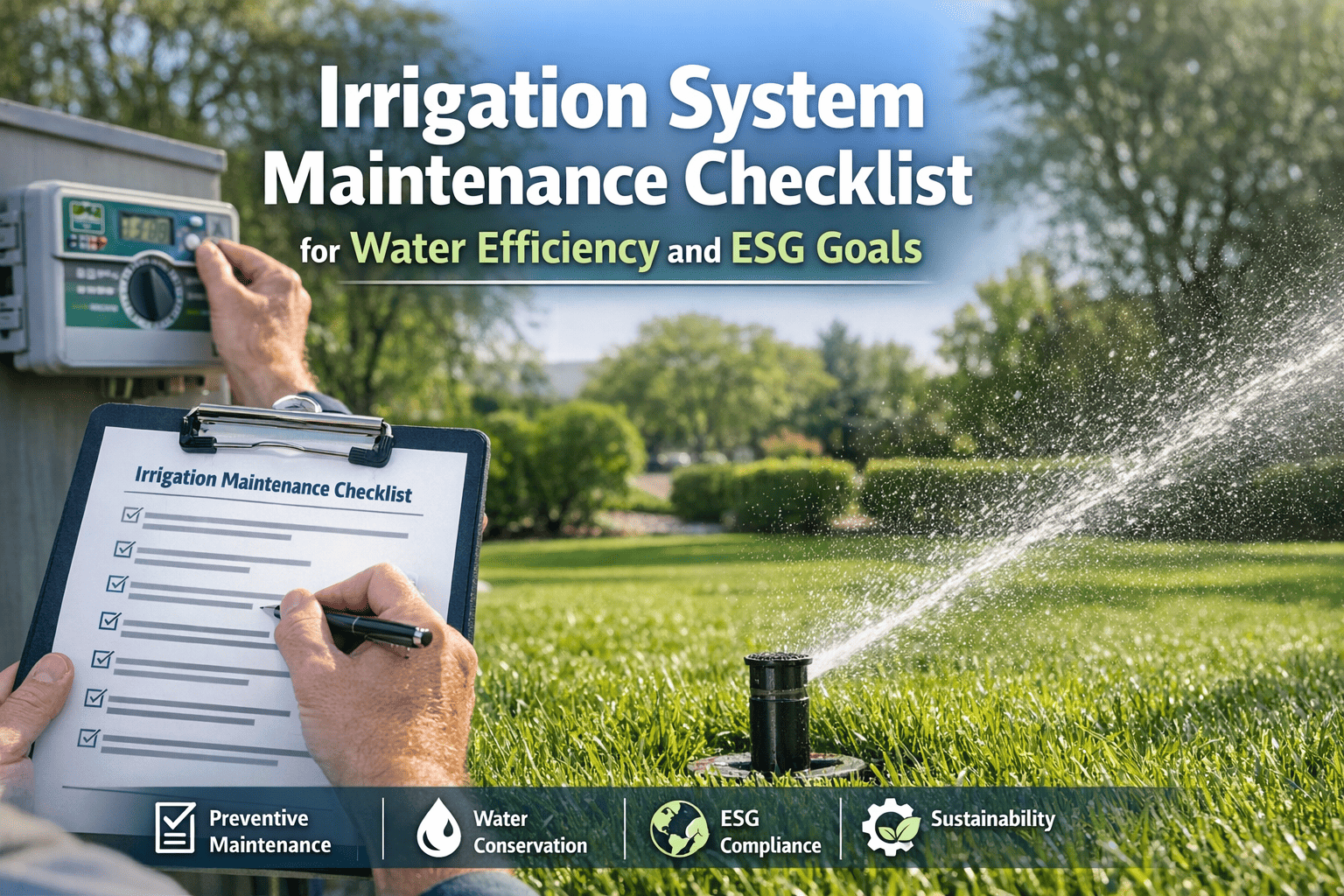
Irrigation System Maintenance Checklist for Water Efficiency and ESG Goals
4 inspection zones · Monthly, quarterly, and seasonal tiers · EPA WaterSense aligned · Covers sprinkler heads, valves, controllers, drip systems, and ESG water metering.
30–60%
of irrigation water wasted by poor maintenance (EPA WaterSense)
25,000
gallons/year wasted by a single broken sprinkler head
20–30%
water reduction achievable through maintenance alone
15,000
gallons/year saved by WaterSense-labeled smart controllers vs. timers
Monthly
Quarterly
Seasonal (Spring/Fall)
Annual Audit
Zone 01 — Sprinkler Heads, Nozzles & Distribution
Monthly — Grounds Technician
Run each zone manually and walk the coverage area — identify broken, clogged, tilted, or missing heads; any head spraying pavement, building, or sidewalk must be redirected immediatelyEPA WaterSense · Work order for each defect found
Sprinkler heads flush and seated — no sinking below grade (reduces throw radius), no elevation above grade (causes mowing damage and misaligned spray)Visual inspection · Photo of each defective head
Check for puddles, saturated patches, or standing water after a run cycle — indicates a stuck open valve, underground pipe leak, or broken lateral lineVisual walkthrough · Report location and zone number
Quarterly — Irrigation Technician
Head-to-head coverage verified — each head should overlap the spray radius of the adjacent head; gaps cause dry zones, leading to overcompensation and wasted water in neighbouring zonesEPA WaterSense best practice · Spacing map updated in OxMaint
Nozzle arc and radius settings checked against zone design spec — worn nozzles underperform rated output; replace matched precipitation rate nozzles as a set to avoid distribution non-uniformityManufacturer spec · Photo + work order for replacements
Distribution uniformity (DU) assessment on critical turf zones — target DU ≥65% per EPA WaterSense commercial guidelines; below 55% indicates systematic coverage failure requiring redesignEPA WaterSense at Work §5.3 · DU measurement log
Zone 02 — Valves, Pipes & Pressure
Monthly — Visual Check
All zone valves open and close correctly — a stuck-open valve continuously applies water to a zone even when the controller is off; a stuck-closed valve leaves a zone unwatered regardless of scheduleOperational test · Zone-by-zone log
Check valve boxes for standing water, debris, root intrusion, or pest damage — wet valve boxes indicate leak at valve body or union; damaged wiring in boxes causes erratic zone behaviourVisual inspection · Photo if defect found
Quarterly — Pressure and Flow Test
Static water pressure measured at point of connection — commercial systems typically require 45–80 PSI; pressure above 80 PSI causes misting, overspray, and accelerated head wear; below 40 PSI produces inadequate throw radiusPressure gauge test · Logged reading vs. design spec
Flow monitoring check — if flow sensors installed, compare current zone flow readings to baseline; a 20%+ increase indicates a leak or broken head; a significant decrease indicates a blockage or partial valve failureFlow sensor data · Trend logged in OxMaint asset record
Backflow preventer inspected and tested — required annually in most US jurisdictions; device prevents irrigation water from contaminating potable supply; failed devices create public health liabilityState/local code requirement · Certified test report retained
Track Water Use Per Zone. Generate ESG Reports Automatically.
OxMaint logs every inspection, work order, and water consumption reading — and converts that data into the ESG water intensity reports your sustainability team needs.
Zone 03 — Controllers, Sensors & Scheduling
Monthly — Programme Review
Irrigation schedule matches current season — the single most common source of commercial irrigation waste; a schedule set in August running unchanged in October can double outdoor water use relative to plant demandEPA WaterSense scheduling guidance · Schedule update logged in OxMaint
Start times set before 8:00 AM — watering after sunrise causes significant evaporative loss; midday watering in summer can lose 30–40% of applied water to evaporation before soil absorptionEPA WaterSense best practice · Controller programme log
Quarterly — Controller and Sensor Test
Rain sensor tested — simulate a rain event and confirm all zones skip as programmed; a failed rain sensor means full irrigation runtime during and after rainfall; a single skipped cycle saves hundreds of gallons per zoneSNWA best practice · Sensor test log
Soil moisture sensors calibrated — sensors should reflect actual volumetric water content; drift of ±5% from calibration causes either chronic underwatering (plant stress) or chronic overwatering (runoff and ESG waste)Sensor manufacturer spec · Calibration record per sensor
ET-based or weather-based controller settings reviewed — evapotranspiration data should reflect current crop coefficient and local weather; controllers running generic ET factors over-apply water in cooler or cloudy periodsWaterSense labeled controller guidance · Settings log
Zone 04 — Seasonal Procedures & ESG Water Tracking
Spring Startup — Grounds and Irrigation Technician
System pressure tested before activating any zones — pressurising a damaged system causes pipe failures, head blow-outs, and immediate water waste; check mainline first, then zone by zoneBest practice · Startup inspection log
Full zone-by-zone manual run with two-person team — one at controller, one walking each zone; all heads confirmed operational, oriented correctly, free of winter damageEPA WaterSense startup guidance · Photo log per zone
Water sub-meters and flow meters baseline recorded — document start-of-season reading per zone or sector; ESG water intensity reporting requires full-year consumption data from a reliable baseline dateGRI 303-3 / LEED WEc · Meter reading logged in OxMaint
Fall Winterisation — Irrigation Technician
Full system blow-out completed — compressed air purge per zone to remove residual water from laterals; un-blown lines in freeze zones crack underground, causing undetected leaks that run all the following season before discoveryManufacturer guidance · Blow-out certificate per system
End-of-season water meter readings recorded — compare to start-of-season baseline; this is the annual water consumption figure used in ESG reports, LEED submissions, GRESB assessments, and GRI 303-3 disclosuresGRI 303-3 / GRESB / LEED WEc · Annual consumption report exported from OxMaint
Annual — Certified Irrigation Auditor (WaterSense Program)
Full system audit by IA-certified auditor — EPA WaterSense commercial guidelines require a full audit every 3 years at minimum; covers DU assessment, pressure testing, controller optimisation, and ESG water budget comparison against actualsEPA WaterSense at Work §5.3 · Certified audit report retained
ESG Water Reporting — What OxMaint Tracks
GRI 303-3
Water withdrawal by source — OxMaint logs meter readings per zone with timestamp and date, exportable for annual GRI disclosure
LEED WEc
Water efficiency credits require baseline and actual consumption documentation — OxMaint generates this from seasonal meter records
GRESB
Landscape water intensity score requires documented consumption per property area — auto-calculated from OxMaint zone-level data
ISO 14001
Environmental management requires documented PM programmes for significant environmental aspects — irrigation maintenance records satisfy this requirement directly
"
The most actionable ESG water intervention for most commercial properties is not a sensor upgrade or a smart controller — it is a monthly inspection programme that finds and fixes what is already broken. I have audited corporate campuses where 40% of outdoor water waste was traced to malfunctioning equipment that had been in place for over a year. The maintenance records showed no inspections. The controller was running a schedule from three years ago. Two heads were spraying the carpark. None of this requires new technology. It requires a scheduled inspection that someone is accountable for completing, and a work order system that tracks the fix to closure. That is the 20–30% water reduction that most properties achieve in their first year of structured irrigation maintenance — before any capital investment.
Sandra Obeng-Asante, CLWM, QWEL
Certified Landscape Water Manager · Qualified Water Efficient Landscaper (QWEL) · 14 Years Commercial Irrigation Audit and Water Efficiency Consulting · Specialist in LEED WEc certification, GRESB water intensity benchmarking, and CMMS-driven irrigation PM programmes for corporate campuses and mixed-use properties
Frequently Asked Questions
How does OxMaint connect irrigation maintenance to ESG water reporting?
OxMaint logs water meter readings, inspection dates, work order completions, and zone-level flow data in the asset record for each irrigation system. At season end, the platform exports consumption summaries — total withdrawal by zone, by period, and by source — formatted for GRI 303-3, LEED WEc, and GRESB disclosure. The maintenance work order history also satisfies ISO 14001 documented PM requirements for significant environmental aspects. No separate spreadsheet compilation is needed.
Start your free trial to configure irrigation asset tracking for your property.
How often should a commercial irrigation system be professionally audited?
EPA WaterSense commercial guidelines recommend a full audit every three years at minimum, conducted by an IA-certified or WaterSense-labelled programme auditor. The audit covers distribution uniformity, pressure testing, controller optimisation, and comparison of actual water use against the property water budget. Between formal audits, monthly technician inspections and quarterly pressure and flow checks — tracked in OxMaint — maintain the system at audited performance levels. Properties pursuing energy and ESG reporting goals typically schedule audits annually to support year-on-year intensity improvement data.
Book a demo to see irrigation PM scheduling in OxMaint.
What is the fastest way to reduce commercial irrigation water use without capital investment?
Three actions — all maintenance-only, zero capital — consistently deliver 20–30% water reduction: fix broken or misaligned sprinkler heads (most commercial properties have between 3–8% of heads underperforming at any given time), adjust the controller schedule to match current season and plant demand, and set start times before 8:00 AM to eliminate evaporative loss. A single monthly inspection programme that finds and fixes these issues systematically delivers the same water savings as most smart controller upgrades — without the hardware cost. OxMaint structures this as a recurring PM work order.
Sign in to set up your irrigation monthly inspection schedule.
How does irrigation maintenance connect to OxMaint's other sustainability and compliance features?
Irrigation PM & ESG Water Tracking — OxMaint
30–60% of Your Irrigation Water Is Being Wasted Right Now. A Scheduled Inspection Programme Recovers Most of It.
OxMaint schedules monthly, quarterly, and seasonal irrigation inspections automatically, tracks water consumption per zone, auto-generates work orders for every defect, and exports ESG-ready water disclosure reports for GRI, LEED, and GRESB — without any additional reporting effort from your team.