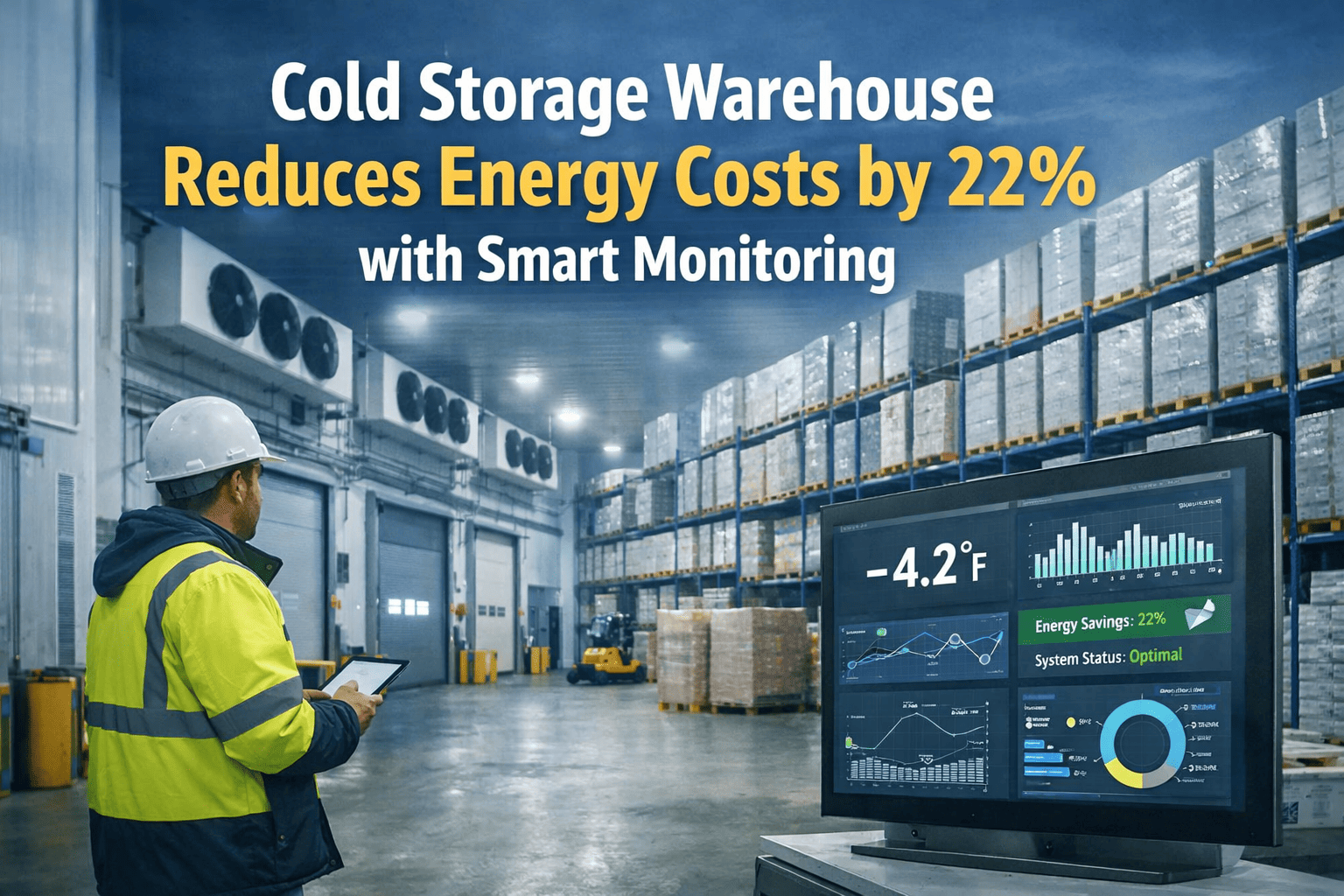
Refrigeration is the largest single cost driver in any cold storage operation — accounting for up to 70% of total electricity consumption and 9–18% of total revenue. For a 180,000 sq ft cold storage warehouse running multi-temperature zones, that is not a utility line item. It is the margin. When compressors run inefficiently because a maintenance team without monitoring tools cannot detect gradual performance degradation, every degree of temperature drift and every percent of COP decline is silent revenue loss. The facility in this case study was spending $684,000 per year on electricity before OxMaint's energy and ESG reporting module connected refrigeration sensor data to a maintenance-driven optimisation workflow — delivering a 22% reduction in energy spend, $150,000 in annual savings, and zero cold-chain compliance failures in the 18 months following deployment.
Case Study · Cold Storage & Cold Chain
Cold Storage Warehouse Reduces Energy Costs by 22% with Smart Monitoring
How a 180,000 sq ft multi-temperature cold storage facility turned refrigeration sensor data into maintenance actions — eliminating $150K in annual energy waste and achieving zero temperature exceedance events in 18 months.
22%
Energy Cost Reduction
$150,000 saved annually
0Temperature Exceedances in 18 months
34%Fewer Compressor Emergency Calls
8 wksBaseline to Live Monitoring
Facility180,000 sq ft multi-temp cold storage, US Midwest
ZonesFrozen (−18°C), Blast Freeze (−30°C), Chilled (+2°C)
Prior SetupManual temperature logs, no CMMS, reactive compressor repair
OxMaint FeatureEnergy & ESG Reporting + Predictive Alerts + PM Scheduling
Why Cold Storage Energy Waste Is Hard to See
70%
of cold storage electricity consumed by refrigeration systems
25 kWh
per sq ft per year — 4–5× more energy-intensive than standard warehouses
9–18%
of total revenue consumed by utility costs in cold chain facilities
The Hidden Degradation Problem
A compressor losing 8% COP over six months does not trigger an alarm. A condenser fouled enough to run 12°C above its clean setpoint keeps the zone cold — but at 18% higher energy draw. These degradation patterns are invisible without sensor trending. They were invisible at this facility for years before OxMaint connected sensor data to maintenance action.
What Was Actually Happening Before Monitoring
Compressors Running at 83% Rated COP — Undetected
Three of seven compressor units showed COP degradation detectable only through suction/discharge pressure trending. No monitoring meant no detection. The team knew "the freezer runs harder in summer" but not that three units were underperforming year-round at significant energy penalty.
Condenser Coils Fouled — Cleaned Once Per Year on Calendar
Condenser cleaning was scheduled annually by calendar. Actual coil fouling in the facility's dusty dock environment required quarterly cleaning to maintain rated performance. The 9-month gap between "calendar clean" and "actual fouling threshold" was costing an estimated $38,000/year in excess energy draw alone.
Door Seal Failures Generating Heat Load — No Inspection Programme
Walk-in door seals and dock door gaskets were inspected only when a failure was reported — typically when temperature fluctuations triggered manual checks. Six failing door seals across the facility were generating continuous heat infiltration load estimated at 14% of total refrigeration demand in the affected zones.
Defrost Cycles Running on Fixed Timer — Not Load-Based
Defrost cycles were set on a fixed 6-hour timer across all evaporator units regardless of actual frost accumulation. In low-throughput periods, unnecessary defrost cycles were running 40% more frequently than required — adding heat load and compressor runtime. No system existed to trigger defrost based on actual coil condition.
Refrigeration Degradation Is Silent. OxMaint Makes It Visible.
Connect sensor data to maintenance actions — compressor COP trending, condenser fouling alerts, door seal inspection schedules, and load-based defrost optimisation in one platform.
Book a Demo
Start Free Trial
How OxMaint Fixed Each Problem
01
Compressor Performance Monitoring — COP Trending
Suction pressure, discharge pressure, and motor current sensors connected to OxMaint. Baseline COP established per compressor over 30 days. Predictive alerts fire when COP falls more than 6% below baseline — triggering a maintenance work order before efficiency loss becomes significant. Three underperforming compressors identified and serviced in Month 2, recovering estimated 11% of those units' energy draw.
Energy saved: ~$62,000/yr from compressor optimisation
02
Condition-Based Condenser Cleaning — Not Calendar
Condenser discharge temperature monitored continuously. OxMaint generates a cleaning work order when discharge temperature exceeds a zone-specific threshold — indicating actual fouling rather than assumed fouling. This shifted cleaning frequency from once annually to condition-triggered, averaging 3.2 cleans per year in Year 1. Each clean restored rated condenser performance within 48 hours of completion.
Energy saved: ~$38,000/yr from condenser performance recovery
03
Monthly Door Seal Inspection — Mobile Checklist
Monthly door seal and gasket inspection work orders deployed across all 34 walk-in and dock doors, completed by maintenance technicians via mobile with photo sign-off. All six failing seals identified in the first inspection cycle and replaced. Post-replacement temperature logging confirmed zone heat load reduction within 2 weeks, measurable in compressor runtime data.
Energy saved: ~$28,000/yr from heat infiltration reduction
04
Load-Based Defrost Scheduling via Sensor Data
Evaporator coil differential pressure sensors (indicating frost accumulation) connected to OxMaint. Defrost cycles now triggered by actual coil condition rather than fixed timer. Average defrost frequency reduced from every 6 hours to every 9.4 hours in low-throughput periods — a 36% reduction in unnecessary defrost heat load and associated compressor recovery runtime.
Energy saved: ~$22,000/yr from defrost optimisation
12-Month Energy and Compliance Results
| Metric |
Before |
After Year 1 |
Impact |
| Annual electricity spend |
$684,000 |
$534,000 |
↓ $150,000 |
| Temperature exceedance events |
7 per year |
0 in 18 months |
↓ 100% |
| Compressor emergency callouts |
11/year |
7/year |
↓ 34% |
| Condenser cleaning frequency |
Annual (1×) |
Condition-based (3.2× avg) |
Performance sustained |
| Average compressor COP vs rated |
83% of rated |
97% of rated |
+14 pts recovery |
| Cold chain audit compliance score |
74/100 |
96/100 |
+22 pts |
Where the $150K Came From
Compressor optimisation
$62K
Condenser performance
$38K
Defrost optimisation
$22K
Total: $150,000 / year
Expert Review
"
Cold storage operators almost universally underestimate how much energy they are wasting to equipment degradation rather than operational load. A compressor running at 83% rated COP feels like a working compressor to any operator who doesn't have COP trending data — the zone stays cold, the alarms don't fire, the temperature log shows compliance. But the energy meter is running 20% higher than it should, and nobody knows why until the annual utility review. What OxMaint changes is the gap between sensor data and maintenance action. That gap — between a condenser running 12°C above clean setpoint and the work order that gets a technician with a pressure washer in front of that condenser — is where most cold storage energy waste lives. Shortening that gap from "noticed at annual review" to "flagged within 48 hours of threshold breach and scheduled this week" is where the 22% comes from. The equipment was never the problem. The maintenance system was.
Dr. Rachel Ng, P.Eng
Principal Refrigeration Systems Engineer — Cold Chain Logistics Consortium · 16 Years Industrial Refrigeration and Cold Storage Energy Optimisation · Specialist in ammonia and CO₂ refrigeration system performance, cold chain compliance, and CMMS-driven energy management
Frequently Asked Questions
What sensors are needed to start energy monitoring with OxMaint in a cold storage facility?
The minimum effective sensor set for cold storage energy monitoring is suction and discharge pressure sensors on each compressor unit, discharge temperature sensors on condenser units, and zone temperature sensors with continuous logging. These cover the three most common energy waste sources: compressor COP degradation, condenser fouling, and temperature drift indicating door seal or insulation failure. OxMaint ingests data from existing BMS or SCADA systems where available — for many facilities, the sensors are already present but disconnected from any maintenance action workflow.
Start your free trial to configure sensor connectivity for your refrigeration assets.
How does OxMaint connect energy monitoring to maintenance workflows — not just dashboards?
OxMaint's energy module does not just display sensor data — it converts threshold breaches into maintenance work orders automatically. When a compressor's COP drops below its configured baseline, a predictive work order fires immediately, pre-populated with the asset ID, sensor trend, and recommended corrective action. This is the same
sensor-to-work-order workflow used in logistics conveyor predictive maintenance — applied to refrigeration assets. The work order closes the loop that dashboards leave open: seeing the problem is not the same as fixing it.
Book a demo to see the full alert-to-work-order workflow for refrigeration assets.
How does cold storage energy monitoring support ESG and cold chain compliance reporting?
OxMaint's ESG reporting module generates continuous electricity consumption records per asset and per zone, CO₂-equivalent emissions calculations based on actual kWh data, and temperature compliance logs showing every zone's exceedance history (or absence of exceedances) across any reporting period. These records satisfy requirements for FSMA cold chain compliance documentation, ISO 22000 temperature management records, and sustainability reporting under GHG Protocol Scope 2. The facility in this case study used OxMaint's compliance report to support their cold chain audit, achieving a 96/100 score — up from 74. See how
compliance tracking works in similarly regulated environments.
Sign in to explore OxMaint's ESG and compliance reporting dashboard.
Can OxMaint manage both refrigeration PM schedules and reactive maintenance in the same system?
Cold Storage Energy & ESG — OxMaint
Your Refrigeration System Is Already Telling You Where the Energy Is Going. OxMaint Makes It Actionable.
Connect sensor data to scheduled maintenance, predictive alerts, and ESG-ready compliance records — in one platform built to turn refrigeration performance data into saved kilowatt-hours, audit-ready cold chain logs, and a maintenance team that fixes degradation before it hits the energy bill.