Indoor Air Quality Management for Smart Buildings: IAQ Monitoring and HVAC Optimization
By Lewis Abbott on April 17, 2026
Indoor air quality used to be a quarterly checklist item — swap filters, check CO2 once a year, file the report. That era ended in 2025. ASHRAE 62.1-2025 now expects ventilation to adjust dynamically to real-time occupancy and pollutant levels, EPA documentation failures carry fines starting at $10,000, and tenants pursuing WELL or LEED certification demand continuous IAQ data they can audit. The facility manager's job has changed — not because IAQ got harder, but because the standard of proof got higher. Oxmaint turns IAQ sensor data into scheduled maintenance work orders against the specific AHU, filter, or ventilation zone that triggered the threshold breach — or book 30 minutes to see IAQ-triggered work orders on live data.
Sustainability & ESG
IAQ Used to Be a Checklist. In 2026, It's a Continuous Compliance Obligation.
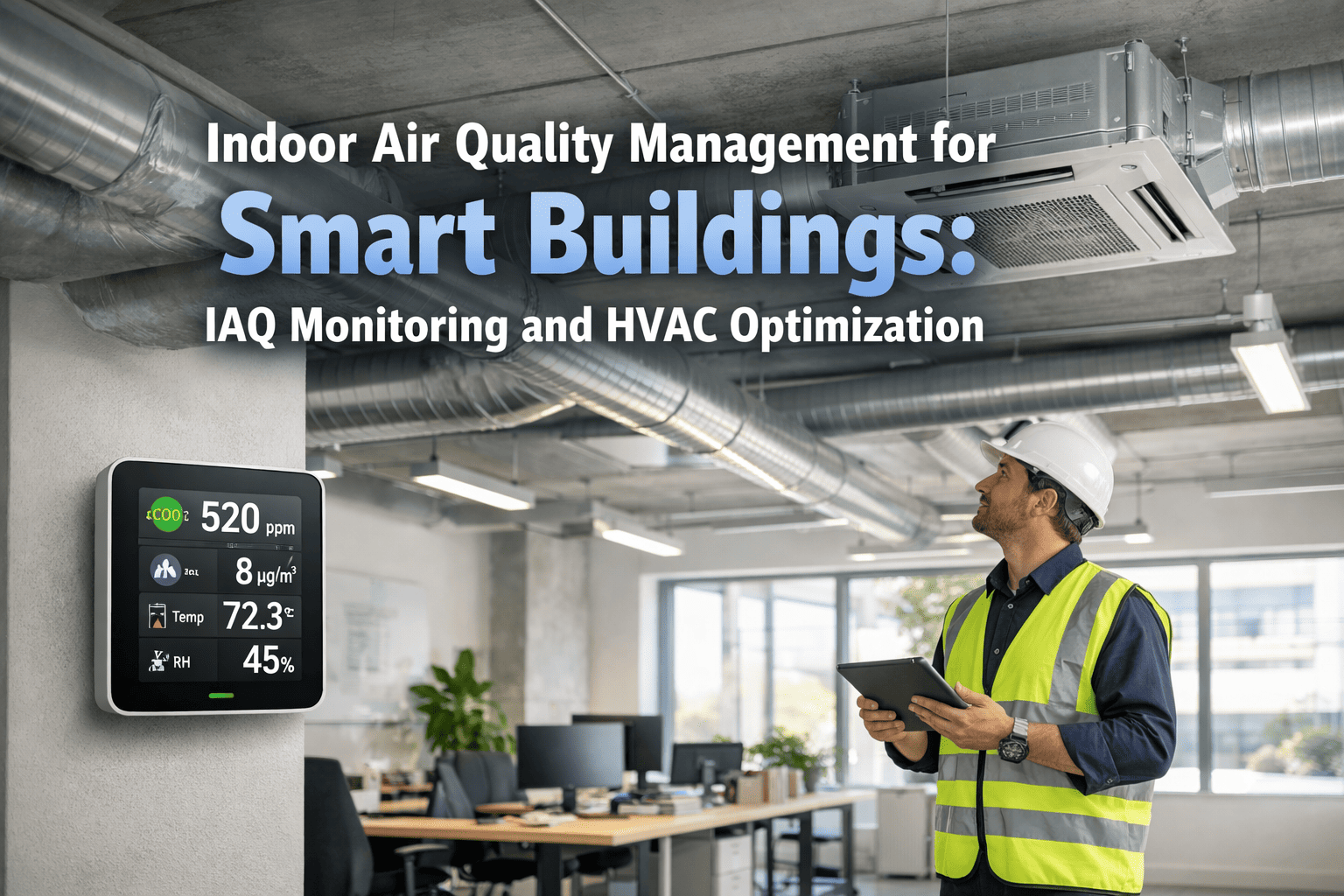
CO2 at 1,450 ppm in the third-floor conference room. PM2.5 at 18 µg/m³ at the atrium after Tuesday's construction. VOCs spiking in the lobby after carpet replacement. None of these show up in a quarterly walk-through — and all of them trigger tenant complaints, cognitive performance losses, and compliance flags under ASHRAE 62.1-2025. This guide covers what facility teams need to measure, what thresholds to hold, and how to turn IAQ data into maintenance action.
Live IAQ Dashboard — Sample Office Building
CO2
742
ppm
Target: <1,000
PM2.5
18
µg/m³
Target: <12
TVOC
180
ppb
Target: <250
RH
48
%
Target: 40-60
Why IAQ Became a Boardroom Topic
Three forces turned indoor air quality from a maintenance subtask into a line item on the sustainability report and the building valuation. None of them are going away. All of them reward buildings that moved to continuous monitoring early.
Regulatory
ASHRAE 62.1-2025 Moved to Continuous
Static ventilation set to maximum occupancy is no longer compliant. The standard now expects demand-controlled ventilation tied to real-time CO2, occupancy, and contaminant sensors. Documentation failures carry fines starting at $10,000.
Productivity
Cognition Drops 50% Above 1,000 ppm CO2
Harvard studies show decision-making performance declines measurably when indoor CO2 passes 1,000 ppm. Conference rooms with 8-15 people routinely hit 1,500 ppm within 30 minutes. Cognitive losses are a direct P&L impact.
ESG / Tenant
WELL & LEED Now Require Data, Not Attestations
WELL v2 and LEED v4.1 award points specifically for continuous IAQ monitoring — CO2 under 800 ppm earns enhanced IAQ points, PM2.5 under 12 µg/m³ earns filtration points. Tenant lease renewals increasingly reference the certifications.
The Six Pollutants Every Commercial Building Must Track
Each pollutant has a distinct source, a distinct health consequence, and a distinct regulatory threshold. Single-metric monitoring (just CO2, just temperature) misses three out of six problems. Continuous multi-parameter sensing is now baseline — these are the thresholds.
Pollutant
Target / Action Limit
Typical Sources
Health & Compliance Impact
CO2
Carbon Dioxide
<1,000 ppm
Enhanced: <800 ppm
Occupant respiration. Rising CO2 is a direct indicator of insufficient outside air delivery to the zone.
Cognitive decline above 1,000 ppm. Primary signal for ASHRAE 62.1 demand-controlled ventilation compliance.
Sensor Placement — Where Monitoring Actually Works
A single lobby sensor reporting building-wide IAQ is marketing theater, not compliance. Real-world IAQ variation between zones on the same floor can exceed 40% for CO2 and 3x for PM2.5. Sensor placement determines whether the data drives action or creates noise.
1
Open Office Floor
One sensor per 500-800 m² at occupant breathing height (1.1-1.7 m). Covers CO2 and PM2.5 drift from print stations and HVAC distribution.
2
Conference & Meeting Rooms
Dedicated sensor in every room above 8-person capacity. CO2 can rise 500 ppm in 15 minutes under full load.
3
Executive & Private Offices
Often on separate VAV zones with independent ventilation behavior. A single floor-level sensor will not catch dedicated-zone drift.
4
Lobby / Reception
Captures outdoor air infiltration, PM2.5 from entrance traffic, and seasonal humidity drift. First zone to show outside-air quality events.
5
Pantry / Printer / Copy Zones
TVOC and PM2.5 hotspots. Cooking, printer emissions, and cleaning products all spike here first and diffuse outward.
Sensors without action are dashboards. Sensors plus work orders are compliance.
Stop Staring at IAQ Dashboards. Turn Every Threshold Breach Into a Work Order.
Oxmaint reads your CO2, PM2.5, VOC, and humidity sensor feeds and generates a work order against the responsible AHU, filter, or ventilation zone when thresholds breach. No more dashboard watching — the fix lands in the technician's queue automatically.
Filter replacement is the single highest-leverage IAQ intervention a facility team controls. Wrong MERV, wrong cadence, wrong documentation — and the building fails continuous monitoring even with the expensive sensor stack. The four tiers below cover 95% of commercial filter programs.
MERV 5-8
Pleated Standard
Standard offices, retail, low-occupancy zones
Captures: dust, pollen, mold spores, lint, pet dander (3-10 µm)
Replacement
60-90 days
Good starting point for 70% of standard commercial buildings. Low pressure drop keeps blower motors within spec.
MERV 9-11
High-Efficiency Commercial
Schools, dense offices, hospitality, retail with traffic
Captures: fine dust, auto emissions, lead dust, humidifier dust (1-3 µm)
Replacement
30-60 days
Baseline recommended for most offices. Higher dust-holding capacity reduces emergency replacements during pollen or wildfire events.
Captures: bacteria, most aerosols, smoke, virus carriers (0.3-1 µm at 50%+)
Replacement
30-60 days
Required for WELL v2 and recommended by EPA post-pandemic. Verify blower can overcome the added pressure drop before installation.
Recommended Baseline
MERV 17+ / HEPA
Critical Environment
Hospitals, cleanrooms, labs, pharmaceutical production
Captures: 99.97% of all particles at 0.3 µm — viruses, fine aerosols, radioactive particles
Replacement
Pressure-based
Replacement driven by measured pressure drop, not calendar. Requires purpose-built AHU. 2,000x more efficient than MERV 13 at sub-micron capture.
ASHRAE 62.1 Compliance — Two Paths, One Decision
ASHRAE 62.1-2025 offers two compliance procedures. The Ventilation Rate Procedure is prescriptive and easy to follow but over-ventilates most spaces. The Indoor Air Quality Procedure is performance-based and can cut outdoor air requirements by 30-60% — but it demands continuous monitoring as the validation mechanism.
Path A
Ventilation Rate Procedure (VRP)
The prescriptive path
How It Works
Set fresh air CFM based on fixed occupancy tables. Office example: 5 CFM/person plus 0.06 CFM/sq ft. Design to the worst case and hold.
Simple to design and audit against paper records
Compatible with most existing BAS configurations
Over-ventilates low-occupancy periods, wasting energy
Cannot demonstrate air quality, only design intent
No response to outdoor air quality events
Path B
Indoor Air Quality Procedure (IAQP)
The performance path
How It Works
Design outdoor air based on maintaining specific contaminant concentrations below design limits. Continuous monitoring proves compliance.
Reduces outdoor air requirements by 30-60% — major energy savings
Proves actual air quality through continuous data
Adjusts dynamically to occupancy and outdoor events
Requires calibrated sensor network and documentation
Needs CMMS or BAS integration to trigger maintenance
The IAQ-to-Maintenance Workflow — Five Stages
The gap between a sensor reading and a maintenance outcome is where most IAQ programs break down. Threshold breaches pile up in email. Work orders get created manually a week later. The sequence below is what a closed-loop IAQ program actually runs.
01
Continuous Sense
Multi-parameter sensors at breathing height, one per defined zone, sampling every 60 seconds. Calibrated against traceable reference every 6-12 months as a tracked PM task.
02
Threshold Breach Detection
Each parameter carries its target and alert limits per zone type. Sustained breach — not a single-minute spike — triggers the workflow to prevent alarm fatigue.
03
Root Cause Attribution
CO2 breach in Zone 3-North maps to AHU-3 damper and VAV-312. PM2.5 spike at lobby maps to filter stage 2 of RTU-1. Attribution turns data into accountability.
04
Automatic Work Order
Oxmaint generates the work order against the attributed asset, pre-populated with the task, priority, technician assignment, and compliance tag for audit trail.
05
Verification & Close-Out
Post-fix sensor readings confirm the threshold has returned to compliant range. Work order closes with before/after IAQ data attached. Audit-ready.
What an Integrated IAQ Program Returns
Facility teams running continuous IAQ with CMMS integration report measurable impact across four categories — compliance, energy, tenant satisfaction, and maintenance productivity. The numbers below are typical for a 250,000 sq ft commercial office portfolio after 12 months.
100%
ASHRAE 62.1 Documentation
Continuous sensor data and work-order trail satisfy IAQP documentation without manual report assembly.
22-35%
Outside Air Energy Reduction
Demand-controlled ventilation under IAQP cuts conditioning energy during low-occupancy periods without compliance risk.
-40%
Tenant IAQ Complaints
Threshold breaches caught and resolved before occupant perception. Measurable drop in facility helpdesk tickets.
3x
Filter Replacement Precision
Pressure-based and load-based replacement cadence replaces calendar-only cycles. Filters replaced when they actually need it.
Built for FM teams, not just BAS integrators
Connect Your Sensors. Register Your AHUs. Let Oxmaint Run the Loop.
No rip-and-replace of your BAS. Oxmaint integrates with your existing IAQ sensors and turns threshold data into preventive maintenance actions — across every AHU, filter, and ventilation zone in your portfolio.
What MERV rating is recommended for a standard office?
MERV 9-11 is the baseline for most offices. MERV 13 is recommended for WELL/LEED and post-pandemic best practice — but verify blower capacity first.
How often should IAQ sensors be calibrated?
Every 6-12 months for commercial-grade sensors, tracked as a scheduled PM task in the CMMS. Calibration drift is the top cause of false compliance readings.
Does IAQP really reduce outside air by 30-60%?
Yes — provided continuous monitoring proves design compound concentrations stay within limits. The energy savings come with a documentation obligation.
Can Oxmaint integrate with our existing BAS and IAQ sensors?
Yes. Oxmaint reads from BACnet, Modbus, and most common IAQ sensor APIs. No control system replacement needed — the CMMS layer sits above them.
IAQ compliance, automated
Stop Chasing Sensor Alerts. Let IAQ Data Drive the PM Schedule Itself.
Oxmaint connects your CO2, PM2.5, VOC, and humidity sensors to your HVAC asset records and PM schedules. Threshold breaches trigger work orders. Filter cycles adjust to actual loading. Compliance reports export with one click. Start with one building — prove the loop — scale to the portfolio.