Scope 3 emissions across the FM supply chain represent the largest yet least visible portion of a facility's carbon footprint, often accounting for 70–90% of total greenhouse gas output. When cleaning contractors fire up gas boilers, catering teams run diesel delivery vans, or HVAC vendors use high-GWP refrigerants, those vendor emissions ultimately land in your facility Scope 3 reporting. The challenge for maintenance and reliability leaders is that most portfolios still track Scope 1 and 2 meticulously while leaving Scope 3 contractor emissions as a reporting mystery. This guide maps the GHG Protocol categories relevant to FM, breaks down the calculation methodology for supply chain emissions, and explains how to turn opaque FM vendor carbon data into a managed disclosure category. Ready to replace spreadsheet guesswork with audit-ready asset and vendor analytics? Start Free Trial and centralize your facility's maintenance data today.
SCOPE 3 FACILITY SUPPLY CHAIN
Are Your Vendors' Emissions Wrecking Your Scope 3 Report?
Up to 90% of a building's total carbon footprint sits upstream in cleaning, catering, and contractor services. Most FM teams cannot see it, cannot measure it, and cannot report it.
Scope 3 emissions from the FM supply chain and vendors is the emerging reporting frontier. When regulators and investors demand verified facility Scope 3 supply chain data, scattered invoices and manual spreadsheets will not survive an audit.
CATEGORY MAPPING
Where Scope 3 Vendor Emissions Hide in Your Facility
The GHG Protocol defines 15 Scope 3 categories. For FM teams, facility scope 3 reporting hinges on mapping building services to just four high-impact upstream categories.
Purchased Goods & Services
Covers emissions from raw material extraction, production, and transportation of cleaning chemicals, paper goods, and catering food inputs purchased by your facility.
Capital Goods
Tracks the embodied carbon of FM assets like new HVAC chillers, roofing systems, and major electrical upgrades installed by external contractors.
Fuel & Energy Related
Captures upstream emissions from the generation of purchased electricity, steam, and heating/cooling consumed by the facility, excluding direct combustion.
Upstream Transportation
Includes diesel van emissions from contractor logistics, catering delivery fleets, and spare parts shipping routed to your maintenance docks.
CALCULATION METHODOLOGY
How to Measure Supply Chain Emissions Facility-Wide
Accurate scope 3 emissions measurement FM relies on mixing primary data (vendor-specific) and secondary data (industry-average). Start with spend-based estimates, then transition to supplier-specific factors as vendor maturity grows.
SPEND-BASED SCOPE 3 FORMULA
Emissions = Financial Spend ($) × EEIO Emission Factor (kg CO2e / $)
Multiply the dollar amount spent on a vendor service (e.g., $50,000 on contract cleaning) by the Environmentally-Extended Input-Output (EEIO) factor for that sector to estimate baseline FM supply chain carbon.
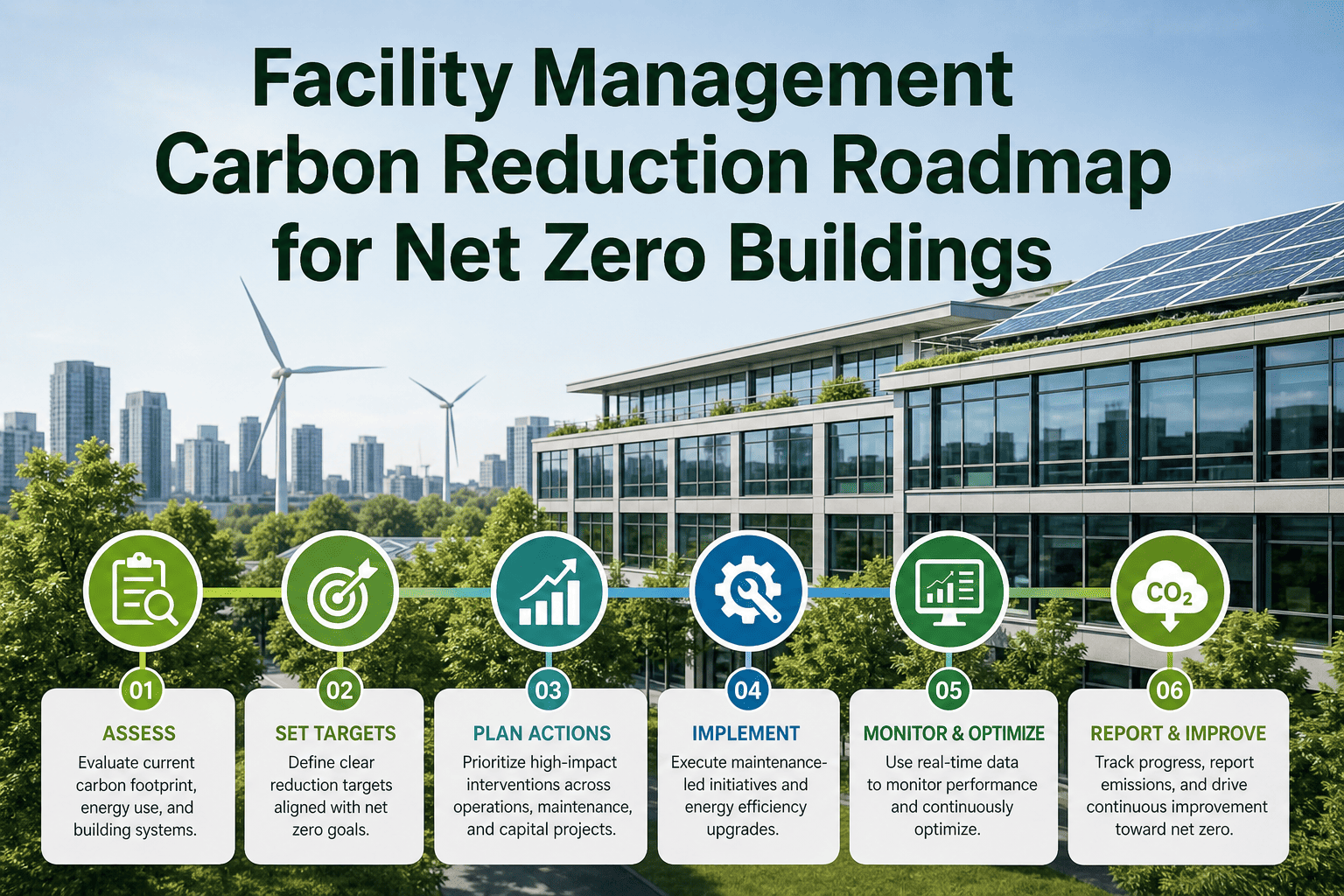
MONTH 1-2
Vendor Identification & Mapping
Audit current FM contracts. Tag every vendor in cleaning, catering, security, and HVAC maintenance with an emission category and operational boundary.
MONTH 3-4
Data Collection & Spend Analysis
Extract 12 months of AP data. Apply spend-based EEIO factors to establish a baseline for scope 3 contractor emissions across the portfolio.
MONTH 5-6
Supplier Engagement
Issue carbon disclosure requests to top 20% of vendors representing 80% of emissions. Request primary energy data and refrigerant logs.
MONTH 7+
Refinement & Reporting
Replace secondary averages with primary vendor data. Generate audit-ready facility scope 3 supply chain reports aligned with GHG Protocol and CDP standards.
REAL-WORLD SCENARIO
The Cost of Ignoring FM Scope 3 Emissions
Consider a 500,000 sq ft commercial facility spending $1.2M annually on outsourced cleaning, catering, and HVAC contractors.
Outsourced services tracking blindly through accounts payable without emission tagging.
Using spend-based EEIO factors, the unmeasured scope 3 building services footprint.
Exposure to local building performance standards and ESG disclosure penalties for inaccurate reporting.
Without a centralized system linking work orders to vendor activities and energy logs, this facility would face a 6-month delay in compiling its mandatory Scope 3 disclosure, risking investor confidence and compliance status.
PROCUREMENT & REDUCTION
FM Procurement Changes That Cut Supply Chain Carbon
Measuring emissions is step one. The real ROI comes from adjusting FM procurement policies to actively reduce scope 3 facility vendors' carbon output.
| Procurement Strategy | Vendor Action Required | Expected Scope 3 Reduction |
|---|---|---|
| Green Cleaning Mandates | Switch to cold-water enzymes and concentrated chemicals | 8–12% cut in cleaning emissions |
| Local Catering Sourcing | Require 60% of food sourced within 150 miles | 15–20% cut in catering transport |
| EV Fleet Transition | Contractors must use electric vans for site visits | 30–40% cut in maintenance transport |
| Refrigerant Audits | Mandate low-GWP refrigerants in HVAC service contracts | Up to 50% cut in HVAC vendor emissions |
HOW OXMAINT HELPS
Turn Scope 3 From a Reporting Mystery Into Managed Data
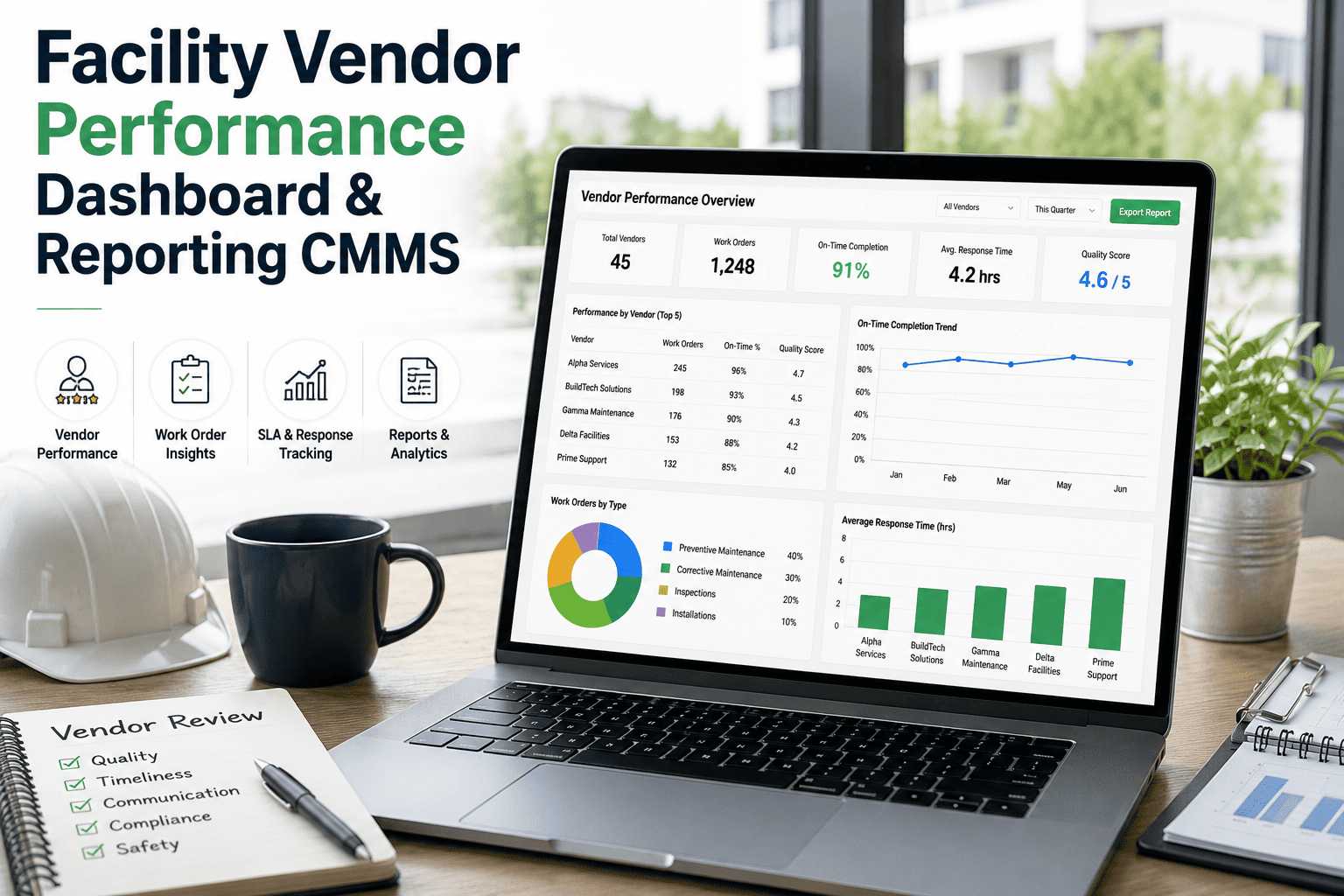
OxMaint centralizes maintenance operations and vendor management into a single AI-powered CMMS, giving you the infrastructure to link daily work orders directly to emissions data.
Vendor Activity Tracking
Tag every external contractor work order with emission categories. Capture fuel usage, refrigerant top-ups, and chemical volumes automatically to build primary scope 3 vendor emissions data.
Predictive Energy Analytics
AI-driven insights correlate asset performance with energy consumption, identifying inefficient equipment before it inflates your facility scope 3 reporting and driving down unplanned downtime by 30–50%.
Audit-Ready Reporting
Generate instant compliance reports mapping FM supply chain carbon data to GHG Protocol categories. Eliminate weeks of manual spreadsheet aggregation and ensure CDP/BREEAM readiness.
Centralized Asset Register
Maintain a unified EAM database of all facility assets and their associated vendors, making it effortless to calculate lifecycle emissions and scope 3 contractor emissions per equipment unit.
See OxMaint on Your Assets — Book a 30-Min Demo
Stop guessing at supply chain emissions. Let us show you how to link vendor work orders to carbon data and generate audit-ready Scope 3 reports in minutes.
FREQUENTLY ASKED QUESTIONS
Scope 3 Emissions FM: Your Questions Answered
What are Scope 3 emissions in facility management?
Scope 3 emissions in FM are indirect greenhouse gas emissions generated across the facility's value chain, excluding direct fuel combustion (Scope 1) and purchased electricity (Scope 2). This includes vendor activities like cleaning chemical production, catering food transport, and contractor fleet emissions. To centralize tracking, you can Start Free Trial on OxMaint to link these activities to work orders.
How do you calculate Scope 3 contractor emissions?
Calculate Scope 3 contractor emissions using the spend-based method: multiply vendor spend by an industry-average EEIO emission factor. As data matures, transition to the supplier-specific method by collecting actual fuel logs and energy bills directly from contractors servicing the facility.
Why is FM supply chain carbon so hard to track?
FM supply chain carbon is difficult because vendors rarely provide granular energy data, services are fragmented across dozens of contracts, and AP systems only capture dollar amounts, not emission factors. A CMMS like OxMaint bridges this gap by tying vendor execution logs directly to asset and energy data.
Which GHG Protocol categories apply to building services?
The most relevant GHG Protocol categories for FM Scope 3 emissions are Category 1 (Purchased Goods and Services), Category 2 (Capital Goods), Category 3 (Fuel and Energy-Related Activities), and Category 4 (Upstream Transportation and Distribution), which together cover the bulk of facility vendor emissions.
Can a CMMS help with facility Scope 3 reporting?
Yes. An AI-powered CMMS like OxMaint captures real-time data on contractor work orders, spare parts inventory, and equipment energy consumption, providing a verifiable audit trail for facility Scope 3 reporting. Book a Demo to see how it replaces spreadsheet guesswork.
Transform Your FM Scope 3 Data Into Action
Join forward-thinking maintenance teams using OxMaint to track vendor emissions, prevent asset failures, and achieve full carbon disclosure compliance.
Free 14-day trial · No credit card