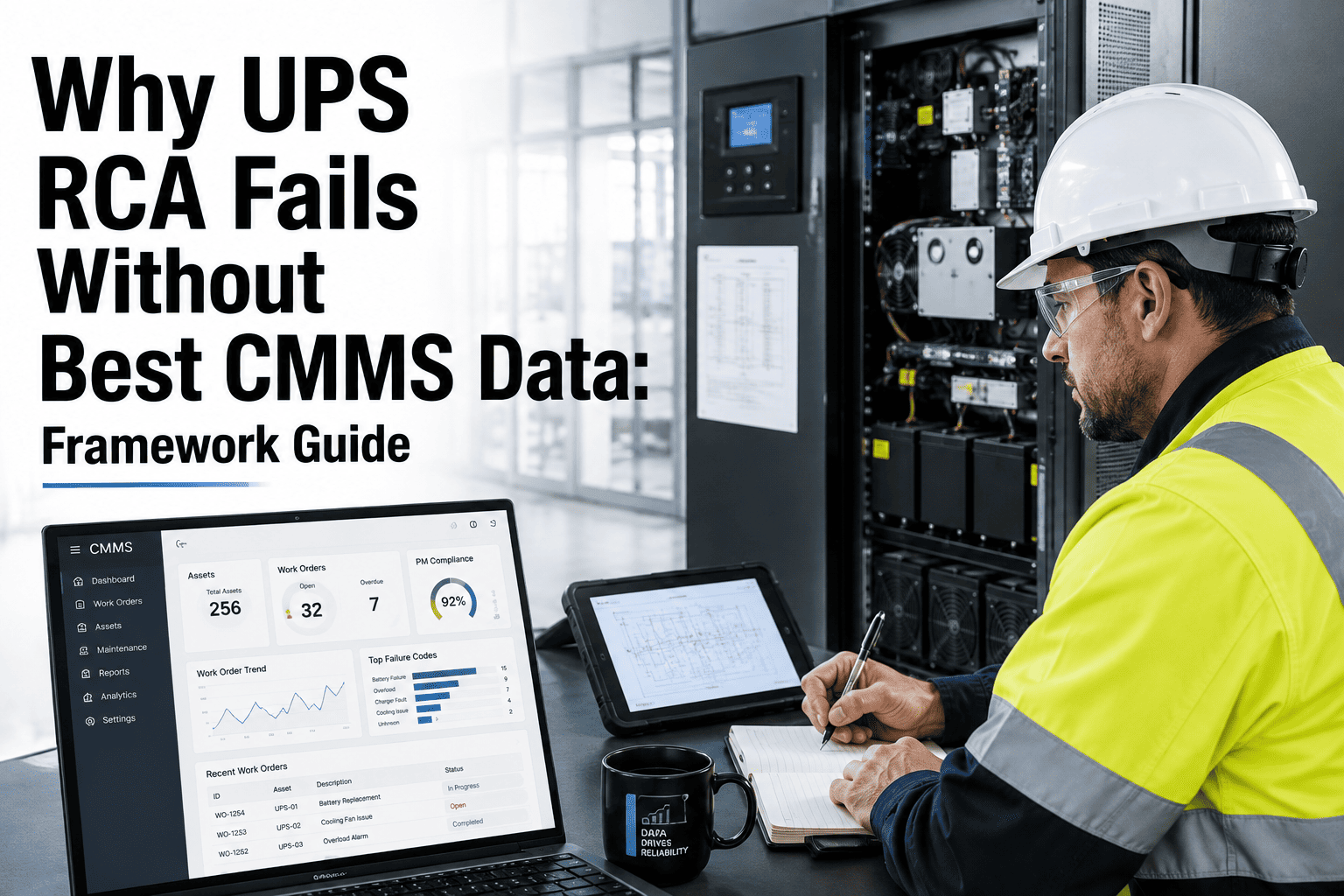
When a UPS unit trips offline, most facility teams start their root cause analysis with a guess. They pull load logs from one system, battery readings from another, and technician notes from a paper clipboard, hoping the timeline lines up — it rarely does, and the investigation stalls before it reaches the real failure mode. A dependable UPS RCA framework only works when every reading, alarm, and repair sits on one verified timeline instead of three disconnected tools. That kind of unified record lives naturally inside a CMMS built for critical power assets, not in a spreadsheet rebuilt after every incident. See what your own fleet's data looks like once it is finally connected by starting a free trial at OxMaint.
UPS RCA Framework
Stop guessing why your UPS tripped. Start proving it.
Most UPS root cause reports fail for the same reason: the data was never on one timeline to begin with. OxMaint links telemetry, alarms, and maintenance history to a single asset record, so your next RCA finds a real cause instead of a shrug.
The Real Problem
Why UPS root cause analysis keeps ending in "undetermined"
A UPS trip investigation touches four or five separate records: battery test sheets, load telemetry, alarm history, and a technician's memory of what happened at 2 a.m. When those sources don't share a timestamp or asset ID, the investigation cannot reconstruct a real sequence of events, so it settles for a guess. Here is what that gap costs facility teams every year.
The Framework
The four-layer UPS RCA framework that actually finds root cause
A working RCA framework is not a report template — it is a data structure. These four layers, captured automatically inside your CMMS, are what separate a real root cause finding from an educated guess.
Continuous power telemetry capture
Load, voltage, and battery internal-resistance readings stream into the asset record automatically, instead of being logged during a monthly walk-through that misses everything in between.
Unified maintenance and alarm history
Every alarm event, work order, and battery test writes to the same asset timeline, so an investigator can see the six months before a trip in one place, not six places.
Standardized failure-mode tagging
Each incident is tagged against a fixed failure taxonomy — capacitor drift, thermal, firmware, battery string — so patterns across a fleet become visible instead of buried in free-text notes.
Closed-loop corrective action tracking
Every fix links back to the failure it resolved, with a sign-off and date, so the next audit — or the next trip — can confirm whether the corrective action actually held.
Side by Side
Manual RCA vs. a CMMS-driven UPS RCA framework
The questions an RCA has to answer never change. What changes is how fast — and how confidently — your team can answer them.
| RCA Question | Manual Process | OxMaint-Driven Process | Typical Result |
|---|---|---|---|
| What caused the trip? | Reconstructed from memory, printouts, and a battery test sheet | Pulled directly from linked telemetry and alarm history | Root cause identified in hours, not days |
| When did the fault begin? | Estimated from technician recollection | Exact timestamp read from the asset record | Precise fault window, no guessing |
| Was this failure predictable? | Rarely cross-checked against prior alerts | Automatically compared against alarm and PM history | Early-warning patterns surface before the next unit fails |
| Was the fix effective? | Tracked informally, if tracked at all | Corrective action is linked to the failure it closed | Repeat-failure rate drops measurably |
Field Result
From six recurring trips to zero: a data-center UPS fleet's turnaround
A 40-unit UPS fleet across three data halls logged six unexplained trips in a single quarter. Each RCA took an average of nine days and closed with "contributing factors undetermined" in four of six cases, leaving the underlying risk unresolved.
With telemetry and maintenance history unified on one asset record, the team traced all six trips to a single batch of aging capacitors within the first week. RCA closure time dropped to under a day per incident, with zero repeat trips across the two quarters since.
See your UPS fleet's RCA framework built in one working session
Bring your asset list and we will show you exactly how telemetry, alarms, and maintenance history connect into a single audit-ready RCA trail — live, on your own fleet.
FAQ
UPS RCA framework: frequently asked questions
What makes a UPS RCA framework actually reliable?
A reliable framework ties every alarm, load reading, and repair to one timestamped source, so investigators aren't reconciling five separate logs. When a CMMS captures this automatically, root cause takes hours instead of weeks. See it in action by booking a demo.
Why does UPS root cause analysis fail without CMMS data?
Without a CMMS, RCA teams work from spreadsheets, paper checklists, and printouts that rarely share a common timestamp. Gaps in that trail force investigators to guess at sequence and cause, which is why so many reports end in "undetermined."
What data should a UPS RCA framework capture?
At minimum: load and battery telemetry, alarm history, preventive maintenance completion, and every corrective action on the unit. Each entry needs a timestamp, technician ID, and asset reference to hold up in an audit or insurance review.
How long does this take to set up on an existing UPS fleet?
Most teams map their asset hierarchy and connect telemetry feeds within two to three weeks, without pausing maintenance work. Historical work orders can be imported so the framework covers existing assets from day one — start a free trial to see your setup timeline.
Does this framework help with insurance and compliance reviews too?
Yes — the same timestamped, source-linked data that resolves an RCA is exactly what insurers and auditors request after a critical power event. Facilities on a connected framework typically close post-incident reviews in days, not weeks.
Give every UPS trip a real root cause, not a guess
Join the facility and reliability teams using OxMaint to turn scattered UPS logs into one connected RCA framework — built from data you're already collecting.
Free 14-day trial · No credit card