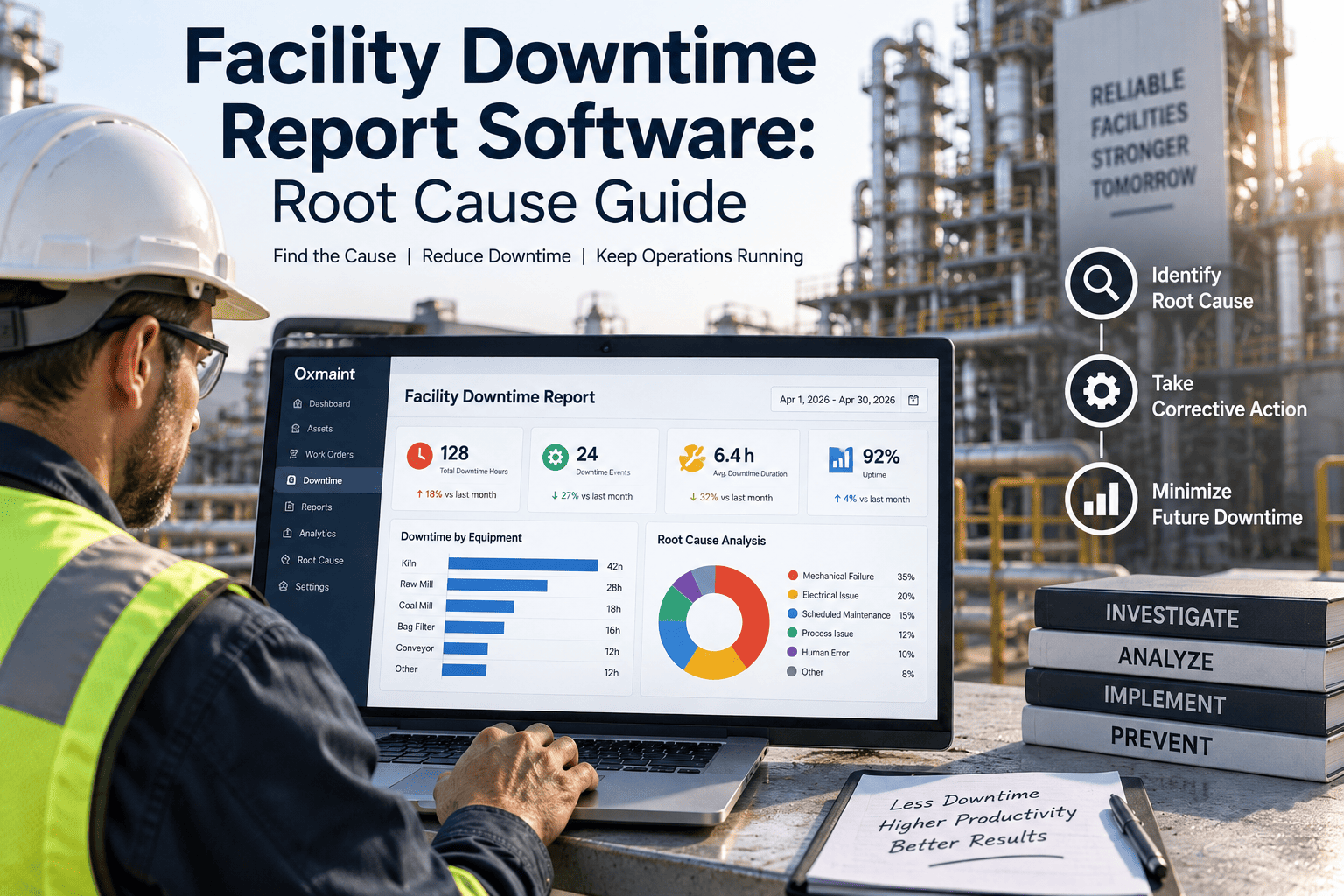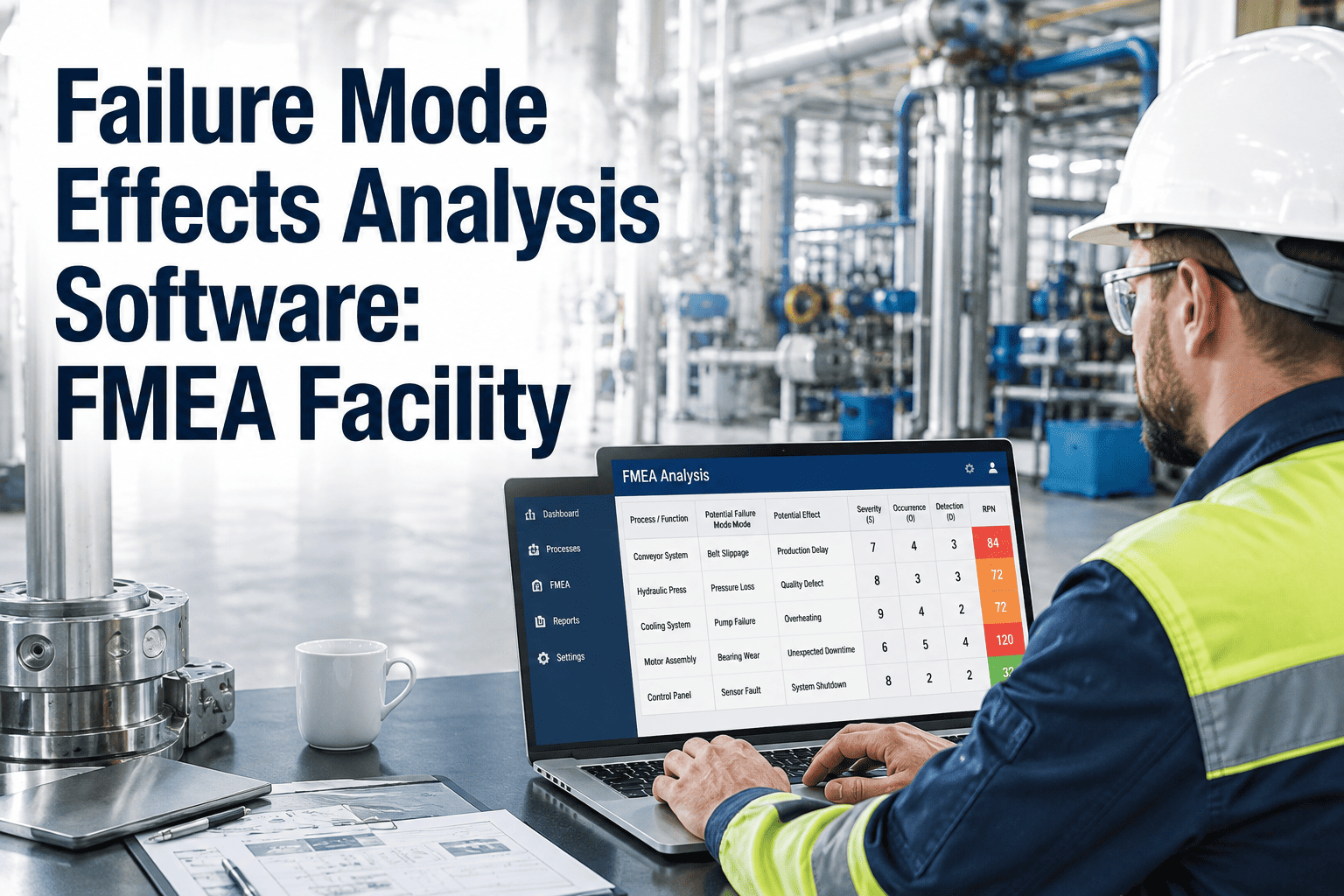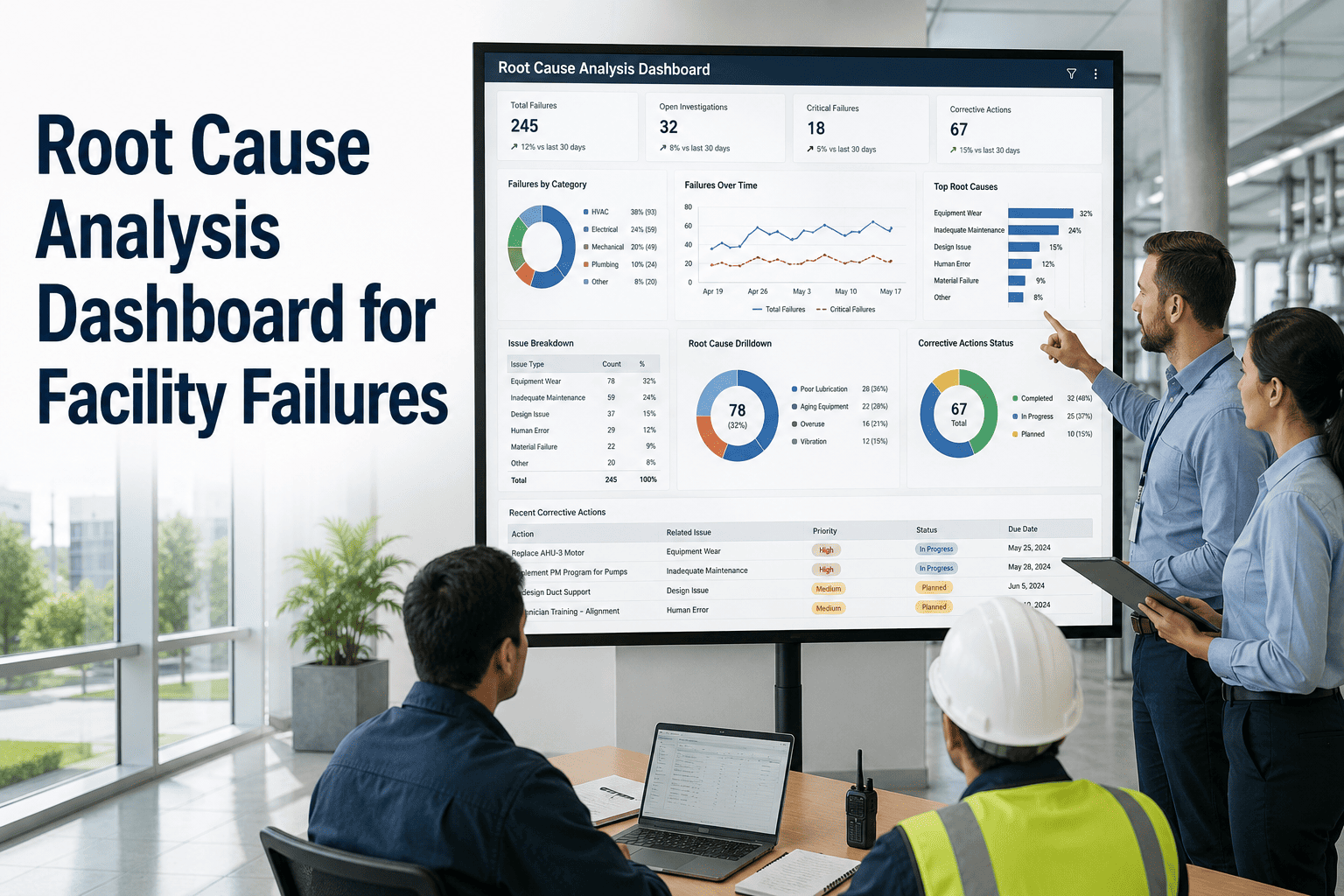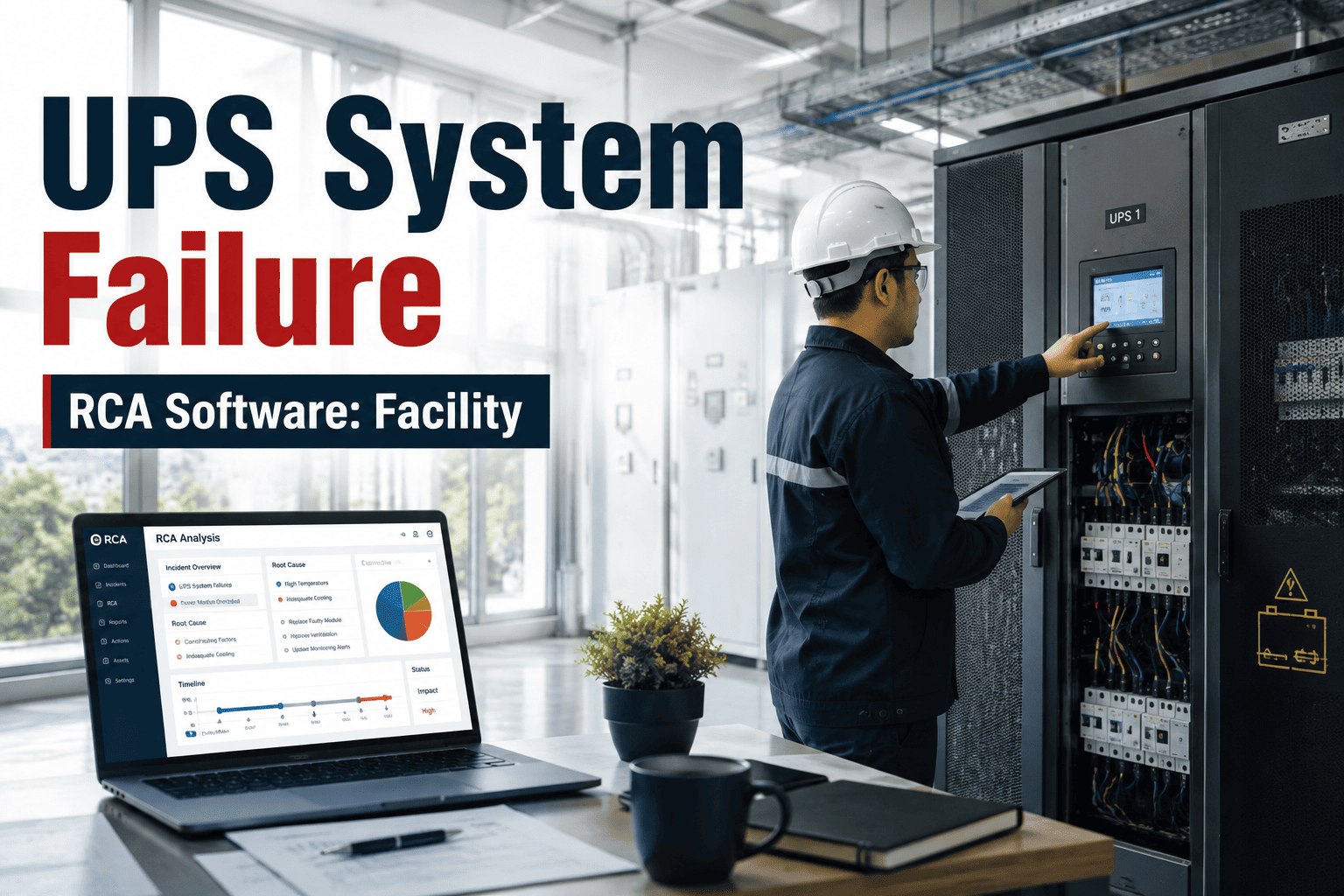
At 2:43 AM, a UPS alarm breaks the silence in the data hall — battery voltage is dropping and the static bypass has already taken the load. The equipment survives, but the harder question starts right after: what actually failed, and why did nobody catch it sooner. A capacitor drying out, a battery losing real capacity, or a charger circuit drifting out of tolerance can all degrade quietly for months before the moment they trigger an outage. Getting from alarm log to a defensible root cause usually means chasing scattered maintenance records, BMS exports, and technician notes that may already be gone by the time anyone goes looking. OxMaint's facility CMMS turns that scattered evidence into a structured UPS root cause analysis workflow, built directly into the maintenance record.
UPS Reliability · Root Cause Analysis · OxMaint
Most UPS Failures Give Warning Signs For Weeks. Most Facility Teams Only See Them After The Outage.
Battery internal resistance, capacitor ESR drift, inverter thermal cycling, transfer switch contact wear — each leaves a trail. OxMaint captures that trail on every asset so the root cause investigation starts with evidence, not guesswork.
$9,000
Estimated cost per minute of unplanned data center downtime industry-wide
75%
Of UPS failures are considered preventable with proper monitoring and maintenance
55%
Of UPS failures trace back to battery-related causes — the single leading category
80% fewer
Unplanned UPS failures reported by facilities running predictive maintenance programmes
Four Places A UPS Failure Actually Starts
A UPS rarely fails as a single unit. It fails one component at a time, and each component leaves a different signature — if the maintenance record is built to catch it.
Battery Bank
VRLA Capacity Loss
Capacity degrades non-linearly under thermal cycling and partial discharge. A battery testing at 95% capacity at month 24 can fall below the 80% critical threshold within a few months. Calendar-based replacement has almost no relationship to actual condition.
Track internal resistance against baseline, not install date
DC Bus
Capacitor ESR Drift
Electrolytic capacitors dry out over years of service, and rising equivalent series resistance quietly increases ripple and heat long before an alarm fires. By the time it trips a fault, the degradation has usually been building for months.
Trend ripple and temperature readings, not just pass/fail tests
Inverter Stage
Switching Component Failure
When multiple switching components fail together, the components themselves are rarely the root cause — an upstream charging fault or thermal runaway condition usually destroys them in sequence. Investigating the last part to fail misses the actual cause.
RCA must trace upstream, not stop at the burned part
Transfer Path
Static Bypass Contact Wear
Transfer relays and static bypass contacts see repeated switching cycles over the UPS lifespan. Contact resistance rises gradually, and a slow transfer under real load conditions is often the first sign — well after the last scheduled inspection.
Cycle counts and transfer-time logs matter as much as visual checks
The Reliability Gap
Calendar Maintenance Replaces Parts On Schedule. It Does Not Replace Parts Before They Fail.
A UPS fleet run on fixed replacement intervals looks well maintained on paper right up until an outage proves otherwise. The gap is not effort — it is that a battery, capacitor, or contact does not degrade on a calendar, it degrades on its own condition curve, and only condition data catches it in time.
Calendar-Based Programme
Replacement driven by install date, not measured condition · trend data lives in whatever system logged it last · root cause investigation starts from memory and scattered notes · corrective action rarely traced back to a closed work order.
Condition-Based RCA With OxMaint
Replacement driven by measured resistance and trend against baseline · alarm sequence and BMS readings captured to the asset automatically · structured RCA template guides the investigation · every finding closes against a documented work order.
OxMaint · UPS Root Cause Analysis
Every UPS Alarm Becomes A Structured Investigation, Not A Scramble.
Alarm sequence, battery trend, capacitor readings, and transfer logs all attach to the same asset record — so the investigation starts with evidence already in hand.
Anatomy Of A UPS Root Cause Investigation
Investigators reconstruct failures from physical and digital evidence together. The window to preserve that evidence is short — most building management and SCADA platforms overwrite trend data on a rolling schedule.
Step 01
Capture The Alarm Sequence First
The order alarms fired in — not just the final trip — usually points to which component failed first and which failures were downstream consequences.
Step 02
Export BMS And SCADA Trend Data Before It Rolls Over
Building management and monitoring platforms typically retain trend logs on a rolling window. Data not exported promptly can be permanently gone before the investigation is scheduled.
Step 03
Apply A Structured Method — Not A Guess
Five Whys traces a single causal chain; a fishbone diagram maps contributing factors across people, equipment, and environment. Either beats an unstructured write-up after the fact.
Step 04
Correlate Against The Asset's Maintenance History
A capacitor flagged as marginal on the last inspection, or a battery bank that missed its last impedance test, changes the likely root cause significantly.
Step 05
Close The Loop On A Work Order, Not A Memo
A finding that never generates a corrective work order is a finding that will recur — usually on the same asset, usually within the same failure mode.
Manual RCA Versus OxMaint — Where The Evidence Actually Goes
Investigation Step
Manual Or Spreadsheet Process
With OxMaint
Alarm-to-failure timeline
Reconstructed from technician memory and shift notes
Auto-linked alarm log attached to the asset's work order
BMS and SCADA trend data
Lost to rolling overwrite before anyone exports it
Captured and attached to the RCA record at alarm time
Battery condition tracking
Judged against calendar replacement date
Tracked against measured baseline internal resistance
RCA methodology
Applied inconsistently, often skipped under time pressure
Guided Five Whys and fishbone template on the work order
Corrective action closure
Noted in an email thread, rarely verified as complete
Tied to a work order that must close before RCA is resolved
Repeat failure detection
Each incident reviewed as an isolated event
Failure patterns surfaced across the asset's full history
How OxMaint Builds RCA Into The UPS Work Order
Condition Data Attaches To The Asset
Battery internal resistance, capacitor readings, and transfer-time logs live on the UPS asset record, trended against baseline instead of judged against a replacement date.
Alarm Events Trigger An RCA Work Order Automatically
A critical alarm on a monitored UPS asset generates the investigation record immediately, before shift notes fade or trend data ages out of the source system.
Structured Method Built Into The Template
Five Whys and fishbone-style prompts guide the technician through cause analysis instead of leaving the format to whoever writes the report.
Maintenance History Surfaces In The Same View
Prior inspections, deferred findings, and past corrective actions on the same asset appear alongside the current investigation automatically.
Corrective Action Required Before Closure
An RCA cannot be marked resolved until its corrective work order is completed and signed off — no finding closes on a promise.
Fleet-Wide Failure Pattern View
Repeat failure modes across UPS units, sites, and manufacturers surface on one view, so a recurring root cause gets fixed once instead of investigated repeatedly.
The RCA-Ready Facility
What A UPS Fleet Looks Like Once RCA Runs Through OxMaint
Zero
Trend data lost to overwrite when the RCA work order captures BMS readings automatically at alarm time
Every UPS
Battery and capacitor condition trended against its own baseline instead of a shared replacement calendar
One View
Alarm history, prior findings, and corrective actions for a single asset, ready before the investigation starts
14 days
From free trial to live UPS condition monitoring and RCA work order templates in production
Frequently Asked Questions
An alarm log records that something tripped and when. A root cause analysis traces why it tripped, back through the component, the upstream condition, and the maintenance history — and ends in a corrective action, not just a timestamp.
Battery capacity degrades non-linearly under thermal cycling and partial discharge, so a unit can pass a scheduled check and fail months later. Measured internal resistance against a baseline reading is a far more reliable indicator than install date.
Building management and monitoring platforms typically retain trend data on a rolling window, so the export needs to happen soon after the event — not once the investigation is formally scheduled. Book a demo to see how OxMaint captures it automatically.
Yes. The RCA work order template prompts the investigation through a structured cause chain instead of leaving the format up to whoever is writing the report that day. Start a free trial to see the RCA template on a live asset.
The RCA links to a corrective work order that must be completed and signed off before the investigation can be marked resolved, and the finding is stored against the asset so a repeat failure is flagged instead of re-investigated from scratch.
Live In 14 Days · No Implementation Fees · RCA Built Into Every UPS Work Order
The Next UPS Alarm Will Come. Make Sure The Evidence Doesn't Disappear With It.
Condition trending per component · automatic RCA work orders on critical alarms · guided Five Whys and fishbone templates · corrective actions that must close before the case does.