US Facility Management Market: Trends, Growth & AI Adoption

By John Polus on March 27, 2026

us-facility-management-market-trends-2026

The US facility management market crossed $1.2 trillion in total managed asset value in 2026, driven by aging commercial infrastructure, accelerating AI adoption, and a wave of CMMS platform migrations as facility teams abandon spreadsheet-based operations for data-driven asset management. Yet despite this scale, 64% of US facility managers still report their primary maintenance tracking tool is a shared spreadsheet or disconnected work order system, leaving billions in preventable repair costs on the table annually. For directors managing multi-site CRE portfolios, healthcare campuses, industrial parks, or mixed-use developments, the gap between what technology can deliver and what most operations actually run is widening fast. Sign up free on Oxmaint to see how leading US facility teams are closing that gap, or book a demo for a portfolio-specific walkthrough.

US Facility Management Market at a Glance: 2026
$1.2T
Total US facility management market size in 2026, encompassing commercial real estate, healthcare, industrial, education, and government portfolios nationwide
6.8%
Projected CAGR for CMMS and FM software adoption through 2028, driven by AI integration, IoT deployment, and portfolio consolidation among large operators
64%
Of US facility managers still using spreadsheets or disconnected work order systems as their primary asset tracking and PM scheduling tool in 2026
$62B
Annual cost of unplanned equipment downtime across US commercial and industrial facilities, representing the largest single preventable cost in facility operations
Quick Answer

The US facility management market in 2026 is defined by four structural forces: AI-powered predictive maintenance replacing time-based PM programmes, labour shortages accelerating automation adoption, sustainability mandates requiring real-time energy and compliance data, and CMMS platform consolidation as operators move from fragmented tools to unified portfolio management. Facility teams that deploy modern CMMS and AI analytics in 2026 are achieving 30 to 45% lower total maintenance costs, 89% PM compliance rates, and evidence-backed CapEx forecasts within their first year of structured operations.


US FM Market Segments and Size by Sector

The US facility management market is not monolithic. Each major sector carries distinct asset profiles, regulatory obligations, labour dynamics, and technology adoption curves. Understanding where your portfolio sits within this landscape determines which FM tools, strategies, and investment timelines are most relevant.

Commercial Real Estate

Largest FM segment at $380B+ in managed value. Office towers, retail centres, and mixed-use developments face post-pandemic occupancy pressure requiring cost-efficient operations and energy compliance.

$380B+ MarketEnergy ComplianceTenant SLAs
Healthcare Facilities

Second-largest segment, heavily regulated by Joint Commission and CMS standards. Critical asset uptime is a patient safety issue, driving adoption of CMMS platforms with full audit trails.

Joint CommissionCritical UptimeCompliance Docs
Industrial and Manufacturing

High-cost asset base with strong ROI on predictive maintenance. OSHA compliance, OEE tracking, and production-based maintenance triggers are primary CMMS use cases across this segment.

OSHA ComplianceOEE TrackingProduction PM
Government and Education

Constrained budgets and public accountability requirements make structured PM and deferred maintenance tracking critical. Capital forecasting backed by condition data is essential for council and board submissions.

ADA ComplianceCapital ForecastingAudit Trails

01
AI and Machine Learning Move From Pilot to Standard Practice
In 2026, 38% of enterprise FM teams have deployed at least one AI-powered maintenance tool, up from 14% in 2023. The shift from scheduled PM to condition-based, AI-triggered interventions is no longer a premium option but an operational baseline for portfolios above 500,000 sq ft. Prediction accuracy above 85% is now achievable from day one with pre-trained models for commercial building equipment classes.
02
Labour Shortages Accelerating Automation and Mobile-First Operations
The US facility maintenance workforce faces a 22% vacancy rate in 2026, with HVAC technicians, electricians, and building engineers in the most acute shortage. This is directly driving CMMS adoption as teams use mobile work order management, automated scheduling, and route optimisation to extract more output from reduced headcount without adding supervisory overhead.
03
ESG and Sustainability Mandates Requiring Real-Time Facility Data
SEC climate disclosure rules and state-level building performance standards (NYC Local Law 97, California AB 802) require documented energy consumption, HVAC performance data, and maintenance records for compliance reporting. Facilities without CMMS integration cannot produce the asset-level data these mandates require, creating growing regulatory exposure across commercial portfolios.
04
Portfolio Consolidation Driving Multi-Site CMMS Standardisation
Private equity and REIT consolidation across commercial and industrial real estate is creating portfolios of 20 to 200 buildings that previously operated as disconnected standalone sites. New ownership groups require unified asset registries, standardised PM programmes, and portfolio-level reporting within 90 days of acquisition, making multi-site CMMS capability the primary evaluation criteria.
05
CapEx Pressure Requiring Evidence-Based Capital Planning
Rising interest rates and tighter lending conditions mean capital replacement requests require stronger justification than ever. Boards, lenders, and investors now expect 5 to 10-year CapEx forecasts backed by asset condition data and remaining useful life calculations, not visual inspection and age-based estimates. CMMS platforms that generate FCI scores per asset are becoming table stakes for institutional capital raises.

See How US Facility Teams Manage Portfolios With Oxmaint

Multi-site dashboards, AI predictive maintenance, automated PM scheduling, and investor-grade CapEx reporting. Live in 14 days across your entire portfolio. Book a demo to see it configured for your building types.


AI Adoption Rates and CMMS Growth in US Facility Management

Technology Category2023 Adoption Rate2026 Adoption RatePrimary Driver
CMMS Platform (any type) 54% 71% Portfolio consolidation; compliance documentation requirements
AI Predictive Maintenance 14% 38% Emergency repair cost pressure; labour shortage forcing automation
IoT Sensor Integration 22% 48% Wireless sensor cost reduction; BAS integration availability
Mobile Work Order Management 41% 68% Field workforce mobility; paper elimination mandates
Portfolio-Level Reporting 18% 44% Investor and board CapEx reporting requirements
Automated PM Scheduling 36% 62% Regulatory PM compliance requirements; reduced scheduler headcount

Four Market Challenges Driving Technology Adoption

01
Aging Infrastructure Backlog Reaching Crisis Threshold

Average US commercial building is 34 years old in 2026. The deferred maintenance backlog across US commercial and institutional facilities exceeds $735 billion, growing at 6 to 9% annually without structured PM programmes. Facilities without condition-based asset scoring cannot quantify or prioritise this backlog for capital planning purposes.

02
Emergency Repair Spend Running 4.8x Planned Maintenance Cost

The average US commercial facility spends 38 to 45% of its maintenance budget on emergency or reactive repairs. At 4.8x the cost of a planned intervention, every unplanned HVAC or mechanical failure represents a compounding budget drain that structured PM and predictive maintenance programmes can reduce by 60 to 70% within 18 months.

03
Compliance Exposure Increasing Across Multiple Regulatory Frameworks

US facility teams face simultaneous compliance obligations from OSHA, ADA, NFPA, ASME, state building codes, and emerging ESG disclosure rules. Manual documentation systems cannot maintain the inspection frequency, technician attribution, and timestamped records these frameworks require at audit time, creating growing legal exposure.

04
Data Fragmentation Blocking Portfolio Intelligence

The average US facility portfolio above 10 buildings uses 3.4 disconnected systems for maintenance tracking, compliance documentation, and capital planning. This fragmentation makes it impossible to identify systemic failure patterns across sites, optimise technician routing, or produce the unified portfolio reporting institutional owners require.


How Oxmaint Addresses the 2026 US FM Market

Multi-Site
Portfolio Dashboard

Portfolio-Wide Visibility Across Every US Site

Oxmaint's multi-site dashboard gives facility directors real-time PM compliance, emergency repair ratios, asset health scores, and open work orders across every building in the portfolio. No toggling between systems, no manual report compilation.

Purpose-built for the multi-site US portfolio operator: drill from portfolio summary to individual building to specific asset in three clicks, with full work order history and cost tracking at every level.

AI Predictive
Predictive Maintenance Console

AI Predictive Maintenance for US Commercial Building Systems

Pre-trained ML models for HVAC (chillers, AHUs, cooling towers), electrical motors, elevators, and pumps deliver 74% prediction accuracy from deployment day one, improving to above 91% at 12 months as site-specific data fine-tunes the models.

Predictions automatically generate work orders in the CMMS with no manual triage required. Every avoided emergency repair delivers $8,400 to $22,000 in fully-loaded cost savings. See the complete AI predictive maintenance guide.

CapEx Reports
10-Year CapEx Forecasting

Investor-Grade Capital Forecasting From Condition Data

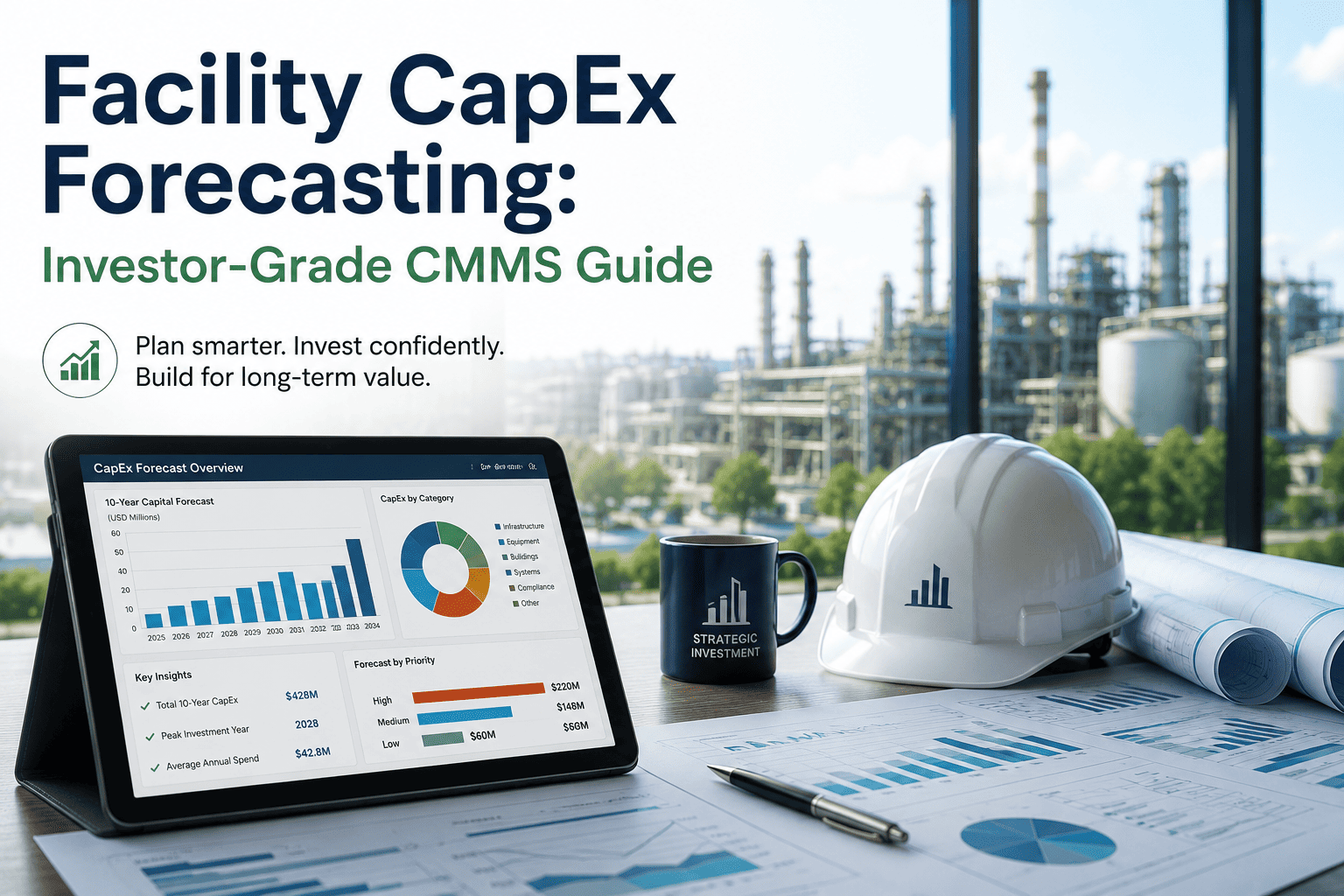
Condition scores and remaining useful life estimates per asset feed Oxmaint's rolling CapEx forecasting module. 5 to 10-year capital replacement forecasts generated automatically with per-asset evidence, replacing estimate-based submissions that boards and lenders no longer accept.

CapEx approval rates jump from 45 to 55% (estimate-based) to 88% (condition-evidence-based) when Oxmaint data supports capital requests. See asset reliability analytics and equipment lifespan extension.


Before and After: US Facility Operations Transformation

Before Oxmaint
xEmergency repair ratio at 38 to 45%. Every unplanned event costs 4.8x the planned intervention cost across HVAC, electrical, and mechanical systems
xPM compliance at 51% or lower across multi-site portfolios managed on spreadsheets with no automated scheduling or escalation
xCapEx requests based on asset age and visual inspection, achieving 45 to 55% board approval rates with no condition evidence
xCompliance audit preparation requiring 4 to 8 weeks of manual log compilation, still producing incomplete records for OSHA and NFPA reviews
xNo portfolio-wide visibility. Directors discover problems site by site, often after failure has already occurred or tenants have escalated
After Oxmaint
+Emergency repair ratio drops to under 14% within 18 months. AI predictive maintenance converts 65%+ of HVAC and mechanical failures to planned interventions
+89% PM compliance across all sites. Automated work orders with 30, 7, and 1-day escalating alerts eliminate missed inspections on any system
+Condition-evidence-backed CapEx requests achieve 88% approval rate. Remaining useful life data replaces guesswork in board and lender submissions
+OSHA, NFPA, ADA, and ASME audit packages produced in under 4 hours. Zero missing records, timestamped technician attribution on every inspection
+Real-time portfolio dashboard shows PM compliance, asset health, and open work orders across every site from a single login on any device

ROI Benchmarks Across US FM Market Segments

Commercial Real Estate Portfolio (10 buildings)
Office and mixed-use, 1.8M sq ft total
$480K to $1.2M
Annual total maintenance cost reduction from emergency repair conversion and PM optimisation. Based on 60% emergency repair reduction and 32% PM visit elimination across HVAC, electrical, and elevator systems.
Baseline: $840K annual emergency repair spend, 38% emergency ratio at 4.8x planned intervention cost
Healthcare Campus (single site)
Hospital and outpatient facilities, 420,000 sq ft
$620K to $1.8M
Annual maintenance cost reduction plus avoided Joint Commission findings from complete PM and inspection documentation. Healthcare FM savings are amplified by patient safety risk premium on unplanned equipment failures.
Baseline: $1.1M annual emergency repair spend with 12 to 18 Joint Commission-relevant PM gaps identified at last survey
Industrial Facility (multi-building campus)
Manufacturing, 3 buildings, 280,000 sq ft
$380K to $960K
Annual saving from production downtime reduction, emergency repair elimination, and OEE improvement. Predictive maintenance on critical production equipment delivers the highest ROI per asset in the industrial segment.
Baseline: 22 unplanned production stoppages per year at average $18,000 each in lost production plus repair cost
Government Facility Portfolio (municipal)
8 civic buildings, mixed-use public facilities
$180K to $420K
Annual savings from emergency repair reduction plus avoided compliance penalties. FCI-backed CapEx requests achieving 88% council approval rate represent the secondary financial benefit above direct maintenance cost savings.
Baseline: $320K annual emergency repair spend with deferred maintenance backlog growing 7% annually

Frequently Asked Questions: US Facility Management Market 2026

QWhat is the current size of the US facility management market in 2026?
The US FM market reached $1.2 trillion in total managed asset value in 2026, with the software and technology segment growing at 6.8% CAGR driven by AI adoption, CMMS migration, and IoT integration. Sign up free or book a demo to see how Oxmaint is positioned in this market.
QWhat percentage of US facility managers have adopted AI-powered maintenance tools?
38% of enterprise FM teams have deployed at least one AI-powered maintenance tool in 2026, up from 14% in 2023. Adoption is fastest among portfolios above 500,000 sq ft where the emergency repair cost reduction ROI is largest. Book a demo to review AI predictive maintenance for your portfolio.
QWhat are the biggest compliance pressures on US facility teams in 2026?
OSHA 29 CFR 1910 (electrical safety), ADA Title III/II access requirements, NFPA fire safety intervals, ASME elevator certifications, and state-specific building performance standards (NYC LL97, CA AB 802) are the primary compliance obligations driving CMMS adoption in 2026. Sign up free to see pre-built compliance templates for each framework.
QHow does Oxmaint support US multi-site portfolio operators specifically?
Oxmaint supports portfolios of 2 to 200+ buildings under a single account with unified asset registry, site-specific PM schedules, portfolio-level dashboards, and investor-grade CapEx reporting. Most portfolios go live within 14 to 21 days with no consultant fees. Book a demo configured for your portfolio size and building types.

Deploy the Platform Built for the 2026 US Facility Management Market

AI predictive maintenance, multi-site portfolio dashboards, automated PM scheduling, and investor-grade CapEx reporting. Live across your full portfolio in under 21 days. No IT project, no consultant fees.
AI Predictive MaintenanceMulti-Site DashboardPM AutomationCapEx ForecastingCompliance Tracking

Continue Reading: FM Market and Asset Management


Share This Story, Choose Your Platform!