Facilities running on reactive maintenance spend 4.8x more per repair event than those with structured programmes, and 68% of equipment failures that managers classify as sudden are preceded by measurable warning signals weeks in advance. AI predictive maintenance closes this gap by continuously analysing sensor data, operational patterns, and asset condition to forecast failures before they occur, automatically triggering work orders at the optimal intervention point. This guide covers how AI predictive maintenance works, what it takes to implement it in a commercial facility portfolio, and what ROI looks like at 12 and 24 months. Sign up free on Oxmaint to see AI predictive maintenance configured for your buildings, or book a demo to review the implementation path for your portfolio.
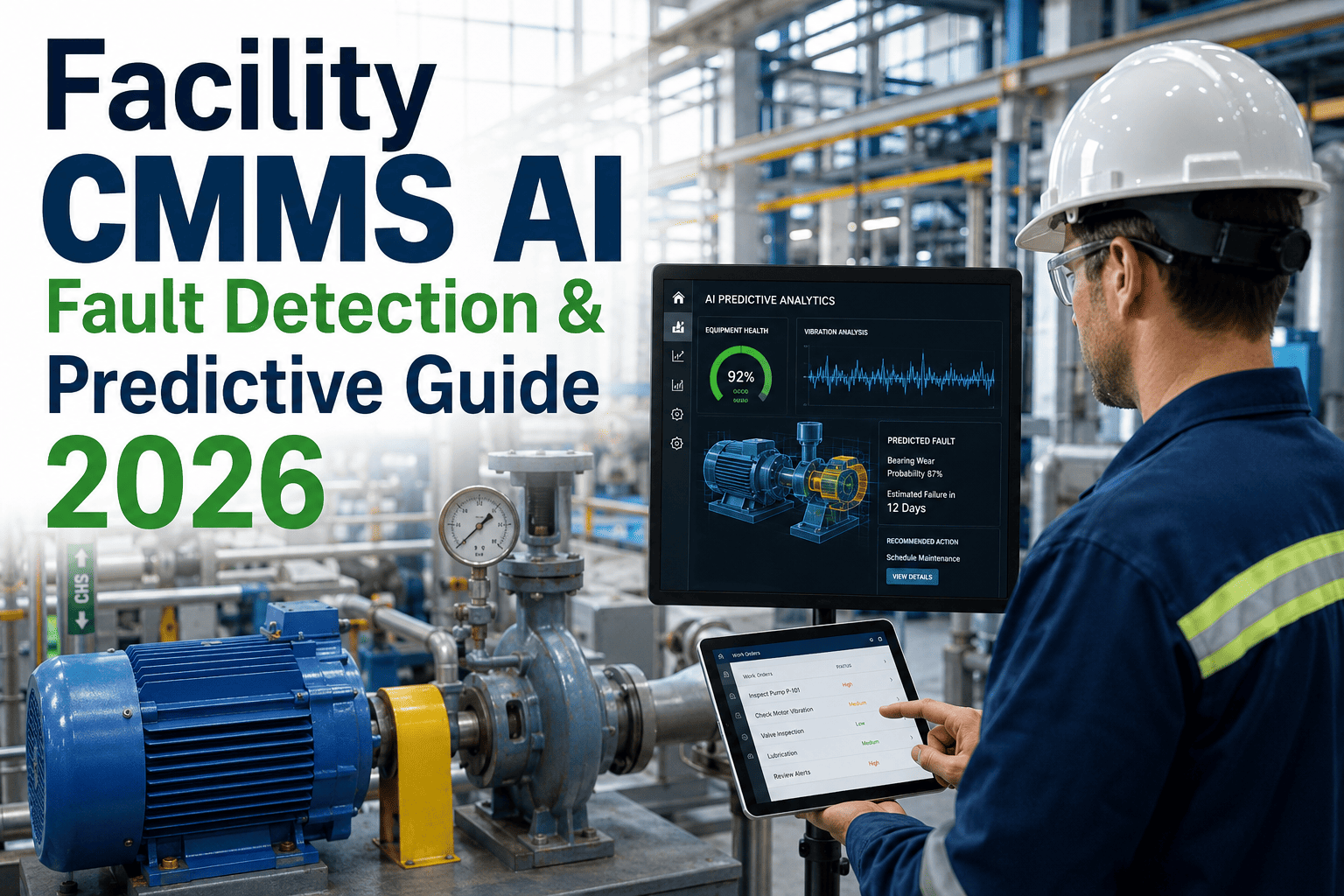
AI predictive maintenance uses machine learning algorithms, IoT sensor data, and asset condition monitoring to forecast equipment failure before it occurs. Rather than scheduling maintenance on fixed time intervals, the system triggers intervention at the optimal point based on actual asset condition. In facility management, this means HVAC, electrical, elevator, and plumbing systems are serviced when they need it, not on a calendar. The result is 45% less downtime, 30% lower total maintenance costs, and a shift from reactive firefighting to data-driven asset operations.
See AI Predictive Maintenance Configured for Your Building Portfolio
Oxmaint's Predictive Maintenance Console connects IoT sensor data to automated work order generation across HVAC, electrical, elevators, and building systems. Live in 14 days. Book a demo to see it configured for your facilities.
What This Guide Covers
- 1What AI Predictive Maintenance Is and How It Works
- 2Core Technology Components
- 3Five Maintenance Challenges AI Predictive Maintenance Solves
- 4Four-Phase Implementation Framework
- 5How Oxmaint Delivers AI Predictive Maintenance
- 6Before and After: Reactive vs AI Predictive Operations
- 7ROI Benchmarks and Results Data
- 8Frequently Asked Questions
What AI Predictive Maintenance Is and How It Works
AI predictive maintenance is a condition-based maintenance strategy that uses sensor data, machine learning models, and asset performance history to predict when equipment is approaching failure. Unlike time-based preventive maintenance (fixed calendar intervals regardless of actual condition) or reactive maintenance (waits for failure), AI predictive maintenance intervenes at precisely the right moment based on real asset condition data.
IoT sensors continuously monitor temperature, vibration, pressure, humidity, energy consumption, and run hours across every connected asset. Readings transmitted to the cloud at defined intervals or when thresholds are exceeded.
IoT SensorsReal-Time DataML models trained on asset-specific failure history analyse incoming sensor streams, identifying anomaly patterns that precede failure. Models improve accuracy as more operational data is accumulated per asset.
ML ModelsAnomaly DetectionWhen sensor patterns match pre-failure signatures, the system calculates remaining useful life and confidence scores. Maintenance intervention is flagged 14 to 42 days before projected failure at the optimal intervention cost point.
RUL CalculationConfidence ScoringPredictions trigger automatic work orders in the CMMS with the finding description, asset record, recommended action, and target completion window pre-populated. No manual supervisor decision required between detection and dispatch.
Auto Work OrdersCMMS IntegrationCore Technology Components of an AI Predictive Maintenance System
A complete AI predictive maintenance deployment for a commercial facility portfolio requires four integrated technology layers. Missing any layer reduces the programme to condition monitoring without the prediction and automation that deliver the cost savings.
Vibration sensors on rotating equipment, temperature sensors on motors and bearings, pressure sensors on HVAC systems, current sensors on electrical panels, and run-hour counters on high-value assets. Wireless sensors reduce installation cost to 60 to 80% below wired alternatives.
Sensor data transmitted via gateway to a cloud processing layer where ML models run continuously. Edge processing handles low-latency alerts for critical threshold breaches. Data pipelines normalise readings across different sensor types into a unified asset condition feed.
Pre-trained models for common commercial building equipment classes (chillers, AHUs, motors, pumps, elevators) reduce time-to-value. Models fine-tune on site-specific operational data over 90 to 180 days, improving prediction accuracy from 74% at deployment to above 91% at 12 months.
Predictions connect to the CMMS to generate actionable work orders with asset context, severity rating, recommended action, and parts requirement. Without CMMS integration, predictions exist as alerts requiring manual triage, eliminating most of the efficiency gain.
Five Maintenance Challenges AI Predictive Maintenance Solves
Four-Phase Implementation Framework for Facility Portfolios
Most commercial facility portfolios reach live AI predictive maintenance within 21 to 30 days using a phased implementation. The four phases below reflect the deployment path used by Oxmaint customers across multi-building commercial, healthcare, retail, and industrial portfolios.
All critical assets registered in the CMMS with manufacturer specs, installation dates, and condition baseline. IoT sensors deployed on priority assets (chillers, AHUs, motors above 15kW, elevators). Wireless sensors commissioned and data flow verified to cloud pipeline within 5 business days of installation.
Pre-trained ML models for each equipment class activated. Operational baselines established using first 7 days of live sensor data. Anomaly detection thresholds calibrated to site-specific operating conditions. Dashboard configured for facility director portfolio view and site-level technician view.
Prediction-to-work-order automation enabled. Technicians trained on mobile work order completion with condition reading entry and photo documentation. First auto-generated predictive work orders reviewed by FM Manager before full autonomous operation is activated.
Model accuracy improves with site-specific operational data. Remaining useful life scores per asset begin feeding the CapEx forecasting module. Monthly KPI review: prediction accuracy rate, emergency repair ratio, PM completion rate. Programme ROI calculation at 6 and 12 months versus baseline.
How Oxmaint Delivers AI Predictive Maintenance for Facility Portfolios
Portfolio-Wide Asset Condition Monitoring in One View
Oxmaint's Predictive Maintenance Console displays real-time health scores for every monitored asset across every building. Condition alerts ranked by criticality, remaining useful life estimates per asset, and trend charts showing deterioration trajectory.
Drill from portfolio overview to individual building to specific equipment, seeing exactly which assets are trending toward failure and when intervention is recommended. Book a demo to see the predictive console live.
Connect Any Sensor, BAS, or SCADA System
Oxmaint integrates with all major IoT sensor protocols (MQTT, BACnet, Modbus, OPC-UA) and connects directly to existing building automation systems without requiring hardware replacement. Sensor data from third-party monitoring systems maps to asset records automatically.
Where sensors are not yet installed, Oxmaint's wireless sensor kit deploys in hours per building with no cabling or infrastructure modification required. Edge gateways handle intermittent connectivity without data loss.
Zero Manual Steps From Prediction to Technician Dispatch
When ML models predict an asset is approaching failure, a work order is automatically generated with the asset record, finding description, recommended action, required parts, and target completion window pre-populated. No supervisor triage or manual creation required.
Work orders routed to the correct technician or contractor based on trade type, site location, and current workload. Priority assigned automatically based on asset criticality and days to projected failure. Sign up free to configure automated work order routing.
Evidence-Backed Capital Replacement Forecasts
Condition scores and remaining useful life estimates from the predictive maintenance programme feed Oxmaint's rolling CapEx forecasting module. Capital replacement recommendations generated 18 to 36 months in advance with cost estimates based on current replacement values per asset class.
Portfolio-level capital forecasts formatted for board and investor reporting, with equipment-level evidence supporting each line item. FCI scores per building updated in real time as asset conditions change.
Before and After: Reactive vs AI Predictive Facility Operations
ROI Benchmarks: AI Predictive Maintenance in Commercial Facility Portfolios
Frequently Asked Questions: AI Predictive Maintenance for Facilities
Reduce Facility Downtime by 45% With AI Predictive Maintenance in Oxmaint
AI-driven condition monitoring, automatic work order generation, and CapEx forecasting from real asset condition data. Deploy across your full portfolio in under 21 days. No IT project, no infrastructure replacement, no implementation fees.