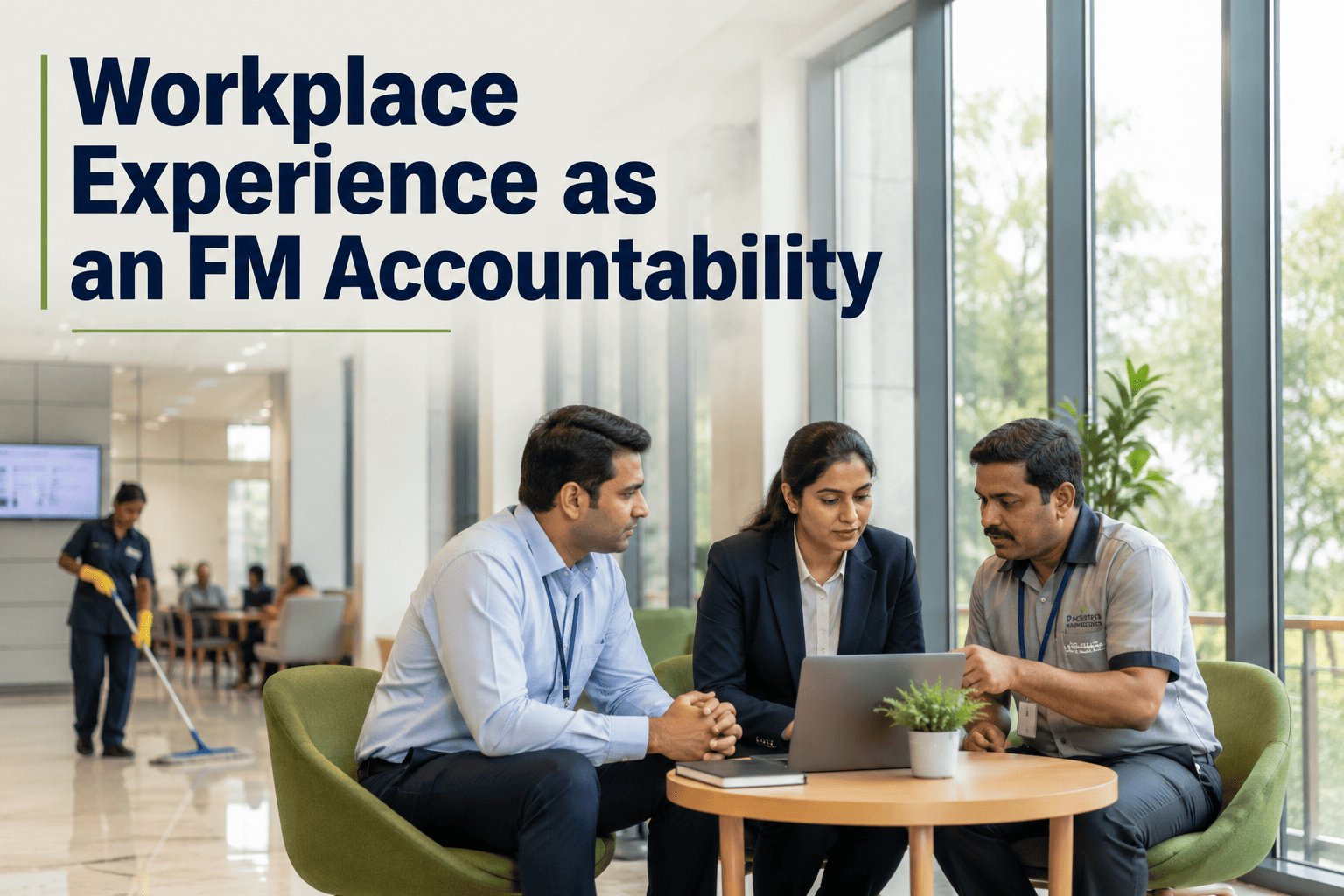
Workplace experience as an FM accountability means treating every functioning asset, comfortable temperature zone, and rapid service response as a measurable output owned by facility management — not an ambient perk that happens on its own. Employees judge workplace experience by what reliably works, and repeated basic failures like broken HVAC, dark meeting rooms, or unresolved tickets quietly reduce office attendance. This guide covers workplace experience facility management accountability, service delivery integration, occupancy driver analysis, and the FM operational framework that positions workplace experience as an owned outcome. See how OxMaint turns that framework into action when you Start Free Trial or book a personalized walkthrough.
When the building fails, who does the employee blame?
In 2024, 72% of hybrid employees say repeated facility failures — not commute time — are the top reason they skip the office. Workplace experience is no longer ambient; it is an FM-owned KPI tied directly to attendance, retention, and productivity.
Why workplace experience accountability belongs to FM
For decades, workplace experience was treated as an ambient responsibility — everyone's job and no one's metric. That model collapses under hybrid work: when attendance is optional, every broken asset, delayed ticket, and uncomfortable zone becomes a reason to stay home. Facility management owns the physical systems that make or break the experience, so accountability must sit with FM.
The shift is from reactive to accountable. When FM owns workplace experience, it measures resolution time, first-time-fix rate, asset uptime, and comfort-zone compliance — then ties those metrics to occupancy and satisfaction scores. The result is a defensible, data-backed narrative that elevates FM from cost center to strategic driver of workplace strategy.
How basic facility failures quietly reduce office attendance
Employees do not complain to leadership about a single broken desk lamp. They simply stop coming. The attendance drag is cumulative and invisible — until occupancy data reveals the trend. Here is how unaccountable FM operations erode workplace experience over time:
Silent asset degradation
Preventive maintenance slips. A conference-room projector bulb burns out, a thermostat drifts 3°F, a door access reader intermittently fails. No ticket is filed because employees assume someone already knows.
Friction accumulates
By week three, multiple small failures stack. The café espresso machine has been down for nine days. Two of six meeting rooms are unusable. Employees who came in twice a week now come in once.
Attendance drops measurably
Badge data shows a 14% occupancy decline month-over-month. HR flags a dip in engagement scores tied to "workplace environment." FM has no dashboard connecting the asset failures to the attendance drop.
Executives ask why
Leadership questions the lease cost per head. FM is asked to justify building spend with no workplace experience metrics to point to — only reactive work-order logs that tell the wrong story.
A 500-employee company losing 14% of planned office attendance to unresolved facility issues forfeits roughly $285,000 per year in productivity and leased-space waste. Workplace experience accountability is not a soft initiative — it is a hard cost line.
Building a workplace experience strategy FM can own
A workplace experience strategy FM team can defend requires four operational pillars. Each converts an ambient expectation into a tracked, accountable outcome. Together they form the framework that positions facility employee experience as a managed service — not a hope.
Experience Measurement
Track real-time asset uptime, comfort-zone temperature compliance, and ticket resolution time — not annual satisfaction surveys. A continuous data stream gives FM a live workplace experience score to report up.
Service Delivery Integration
Unify work orders, preventive maintenance, and employee service requests into a single queue. When FM operations and workplace experience team workflows share one system, nothing falls between cracks.
Occupancy Driver Analysis
Correlate badge-swipe occupancy data with asset failure events and resolution times. This proves which facility issues most directly suppress attendance — turning anecdote into evidence.
Proactive Failure Prevention
Shift from reactive to predictive. Use IoT sensor data and AI-driven asset health scoring to catch degradation before employees ever feel it. The best workplace experience is the one nobody notices because nothing broke.
Who owns workplace experience — and why FM is the answer
A common confusion: who owns workplace experience — FM, IT, or HR? Each function touches the employee environment, but only FM controls the physical systems that determine whether the building actually works. Clear ownership prevents the accountability gap where everyone is responsible and no one is accountable.
| Function | What They Control | Workplace Experience Role | Accountability Level |
|---|---|---|---|
| Facility Management | HVAC, lighting, assets, space, maintenance, service requests | Owns physical environment uptime and comfort — the foundation of experience | Primary owner |
| IT | Network, Wi-Fi, AV hardware, meeting-room tech | Partners with FM on tech-enabled spaces; does not own comfort or assets | Supporting partner |
| HR / People Ops | Policy, culture, engagement surveys, hybrid schedules | Measures sentiment; relies on FM to fix the physical root causes | Stakeholder, not operator |
| Workplace Experience Team | Programming, hospitality, events, amenities | Enhances experience; depends on FM for a functioning building to layer onto | Co-deliverer |
When FM owns workplace experience accountability, the other functions align around a single source of truth: a CMMS that tracks every asset, ticket, and resolution. No more finger-pointing between IT and FM over a "broken meeting room" — the data shows exactly which system failed and who resolved it.
How OxMaint makes workplace experience an accountable FM outcome
OxMaint is an AI-powered CMMS and EAM platform built for maintenance and reliability teams — the same teams that determine whether the building works. By connecting work orders, preventive and predictive maintenance, asset tracking, and analytics in one system, OxMaint gives FM the operational backbone to own workplace experience with measurable, defensible outcomes.
Unified Work Order Management
Every employee service request, preventive task, and corrective ticket flows through one intelligent queue. No orphaned requests, no spreadsheet blind spots — every workplace issue is tracked to resolution.
AI-Powered Predictive Maintenance
OxMaint analyzes asset history and sensor patterns to predict failures before employees ever notice. Prevent the broken projector, the drifting thermostat, and the failed access reader — proactively, not reactively.
Real-Time Asset & Comfort Tracking
Track every asset's health, location, and maintenance history in a live dashboard. Know which zones are trending out of compliance before complaints arrive — and prove uptime to leadership with data.
Maintenance Analytics & KPI Dashboards
OxMaint turns work-order data into the workplace experience scorecard FM needs: first-time-fix rate, mean time to resolution, asset uptime by zone, and PM compliance — exportable for executive review.
A 180-asset office building: from reactive chaos to accountable experience
Consider a 180-asset corporate office housing 420 employees. FM runs on spreadsheets and email. The workplace team receives complaints but has no visibility into root causes. Here is the before-and-after when OxMaint is deployed:
- Avg. resolution time: 6.2 days
- Unplanned asset failures: 11 per month
- PM compliance: 54%
- Occupancy trend: declining 12% QoQ
- FM reporting: manual, retrospective, anecdotal
- Avg. resolution time: 1.8 days
- Unplanned asset failures: 4 per month
- PM compliance: 93%
- Occupancy trend: stabilized, +6% recovery
- FM reporting: live dashboards, predictive alerts
In one quarter, FM went from defending its budget to driving workplace strategy. The same team, the same building — now equipped with the operational system to own workplace experience as a measurable, accountable outcome. The annualized productivity and retention value of recovering 6% attendance at this site exceeds $190,000, against an OxMaint investment that is a fraction of that figure.
Stop letting basic facility failures drive employees home
See how OxMaint gives your FM team the work-order, predictive maintenance, and analytics tools to own workplace experience — with measurable results in 90 days.
Workplace experience accountability: what FM teams ask
What is workplace experience in facility management?
Workplace experience in facility management is the measurable quality of an employee's interaction with the physical building — driven by asset uptime, comfort, service response speed, and space functionality. When FM owns workplace experience, it tracks these as KPIs rather than treating them as background conditions. You can see how OxMaint operationalizes this when you Start Free Trial today.
How does facility management affect employee workplace experience?
FM controls the systems that determine whether the building works: HVAC, lighting, AV, access control, and service response. When these fail repeatedly, employees avoid the office. When FM runs proactive maintenance and fast resolution, the building becomes a reason to come in rather than a reason to stay home.
Who is accountable for workplace experience — FM, IT, or HR?
Facility management is the primary owner because it controls the physical systems and maintenance operations that underpin the experience. IT supports technology-enabled spaces, and HR measures sentiment, but neither can fix a broken building. FM must hold the accountability — supported by a CMMS like OxMaint that provides the data to defend it. Book a walkthrough at calendly.com/oxmaintapp/30min.
How do you measure workplace experience as an FM KPI?
Measure asset uptime percentage, average ticket resolution time, first-time-fix rate, PM compliance rate, and comfort-zone temperature compliance. Correlate these operational metrics with badge-swipe occupancy data and employee satisfaction scores monthly. A CMMS dashboard that surfaces all of these in one view is the foundation of defensible FM workplace experience reporting.
Why does workplace experience affect office attendance?
When attendance is optional under hybrid models, employees weigh the friction of the office against the comfort of home. Repeated small failures — a cold meeting room, a broken projector, a nine-day espresso machine outage — accumulate into a signal that the office is not worth the commute. FM accountability for workplace experience directly protects occupancy and the lease investment behind it.
Give your FM team the system to make workplace experience measurable, accountable, and defensible
OxMaint's AI-powered CMMS unifies work orders, preventive and predictive maintenance, asset tracking, and analytics — so every facility failure is caught before employees feel it, and every resolution is logged for leadership to see.
Free 14-day trial · No credit card