The average commercial fleet technician spends 22% of their workday on administrative tasks that produce no maintenance value — creating work orders manually, chasing parts availability by phone, hunting for vehicle service histories across paper binders, and updating spreadsheets with completion data that nobody else can query. For a 4-technician shop at $28/hour fully loaded, this administrative overhead costs $64,000 annually in labor that generates zero vehicles repaired, zero failures prevented, and zero compliance records completed. AI-powered fleet maintenance software eliminates this overhead entirely — not by asking technicians to work faster, but by automating the tasks that should never have required human time in the first place. When a vehicle telematics signal flags a developing cooling system issue, the work order creates itself, assigns itself to the right technician, checks its own parts inventory, and schedules itself in the next available maintenance window. When a technician opens the work order on their mobile device, they see the vehicle's complete service history, the flagged system, the recommended parts, and the manufacturer repair procedure — without touching a filing cabinet. When the work order closes, the vehicle record, inventory, and compliance documentation update simultaneously. The technician spent zero time on administration and 100% of their time actually fixing the vehicle. This is what AI automation delivers to fleet maintenance operations in 2026 — and it is why fleets deploying it are documenting 15–25% improvements in technician productivity within the first 90 days. Sign up for OxMaint and eliminate manual work order administration from your maintenance operation today.
Fleet Technology · Blog · 2026
AI in Fleet Maintenance Software: Automating Work Orders and Maintenance Tasks
AI-powered fleet maintenance software eliminates the administrative overhead that consumes 22% of technician time — automating work order creation, parts checking, scheduling, assignment, and documentation as a byproduct of maintenance execution rather than a separate manual task layer requiring its own staff time.
22%
Of technician workday spent on administrative tasks — work orders, scheduling, parts lookups, documentation — before AI automation
15–25%
Improvement in technician productivity within 90 days of AI maintenance software deployment — documented across fleet implementations
70%
Of AI maintenance pilots fail to scale because alert-to-work-order automation is not built — the loop OxMaint closes from day one
$64K
Annual administrative overhead cost for a 4-technician shop — eliminated by AI work order automation with no additional staff
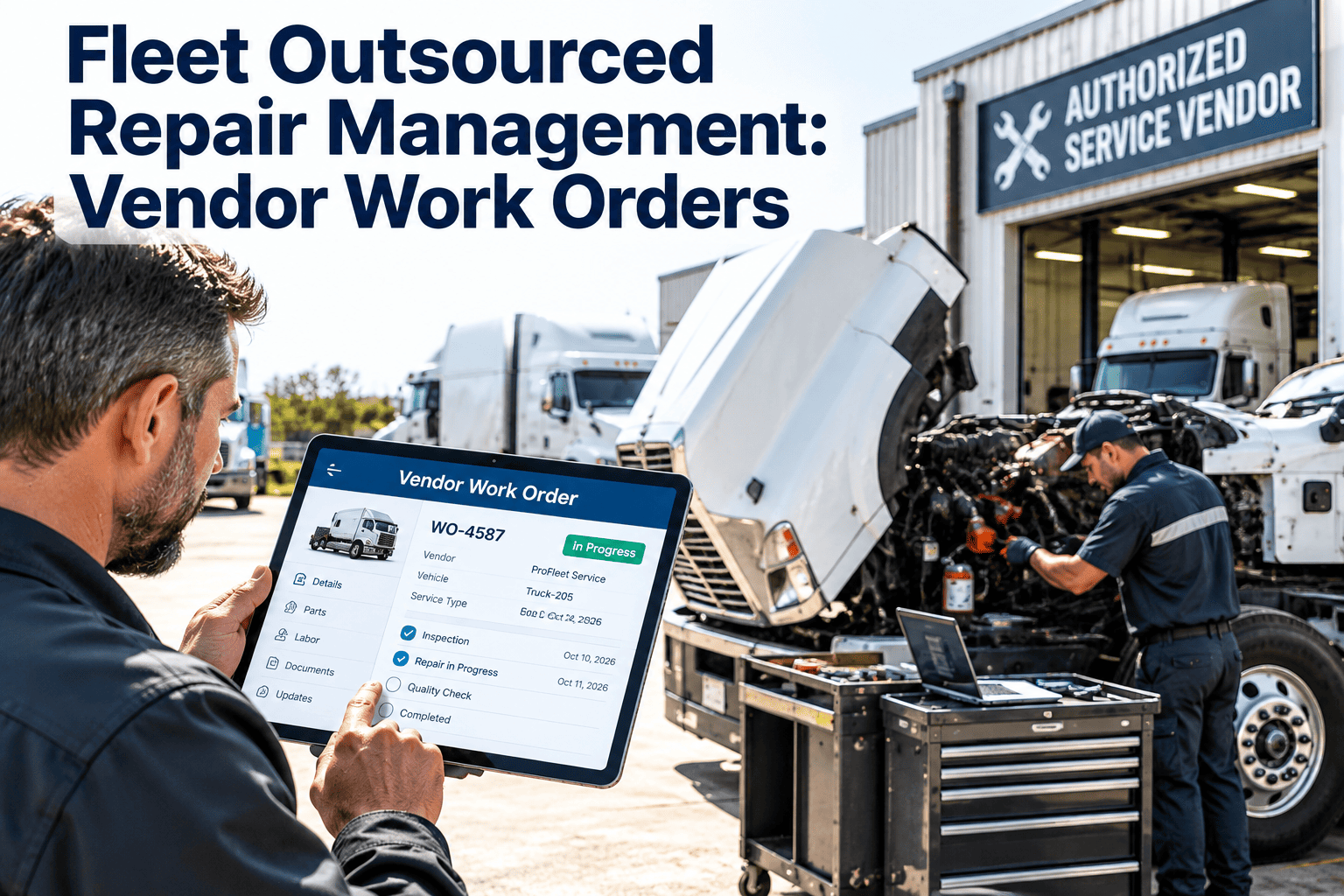
The Manual Work Order Problem: Where Technician Time Goes Before AI
Work orders are the operational unit of fleet maintenance. Every repair, inspection, PM event, and warranty job flows through a work order. In a manual system, each work order requires a series of administrative steps that consume time without adding maintenance value — steps that AI automation handles automatically in an AI-powered system.
Manual Work Order Process
Dispatcher or manager receives alert or driver complaint — manually creates work order in system or on paper (8–15 min)
Manager identifies available technician — phones or radios to check availability and assign (5–12 min)
Parts availability checked by phone or manual inventory count — procurement initiated if parts not on hand (15–30 min)
Technician retrieves vehicle history from paper binder or disconnected system — identifies prior related repairs (10–20 min)
Work completed — technician manually logs labor time, parts used, notes, and closes work order (10–20 min)
Inventory, billing, and compliance records updated separately by administrator (15–25 min per work order)
Total administrative time: 63–122 minutes per work order
AI
AI-Automated Work Order Process
AI telematics signal generates work order automatically — vehicle, system, confidence score, estimated failure window, and recommended action pre-populated (0 min manual)
AI assigns work order to available technician based on skill, shift, and current workload — notification sent to mobile device (0 min manual)
Parts availability checked against live inventory — reorder triggered automatically if below threshold, estimated delivery date displayed (0 min manual)
Technician opens work order on mobile — full vehicle history, prior related repairs, and manufacturer procedure available immediately (0 min retrieval)
Technician completes repair — mobile app captures labor time, parts scanned via QR, notes dictated or typed, work order closed in 2 taps (2–4 min)
Inventory, vehicle record, and compliance documentation updated automatically on work order close — zero separate administrator action (0 min)
Total administrative time: 2–4 minutes per work order — 95% reduction
8 Maintenance Tasks AI Automates in Fleet Maintenance Software
AI automation in fleet maintenance software is not limited to work order creation. It operates across eight maintenance task categories — each one eliminating a manual process that currently consumes staff time, introduces errors, or creates delays between need identification and maintenance action.
Condition-Triggered Work Order Generation
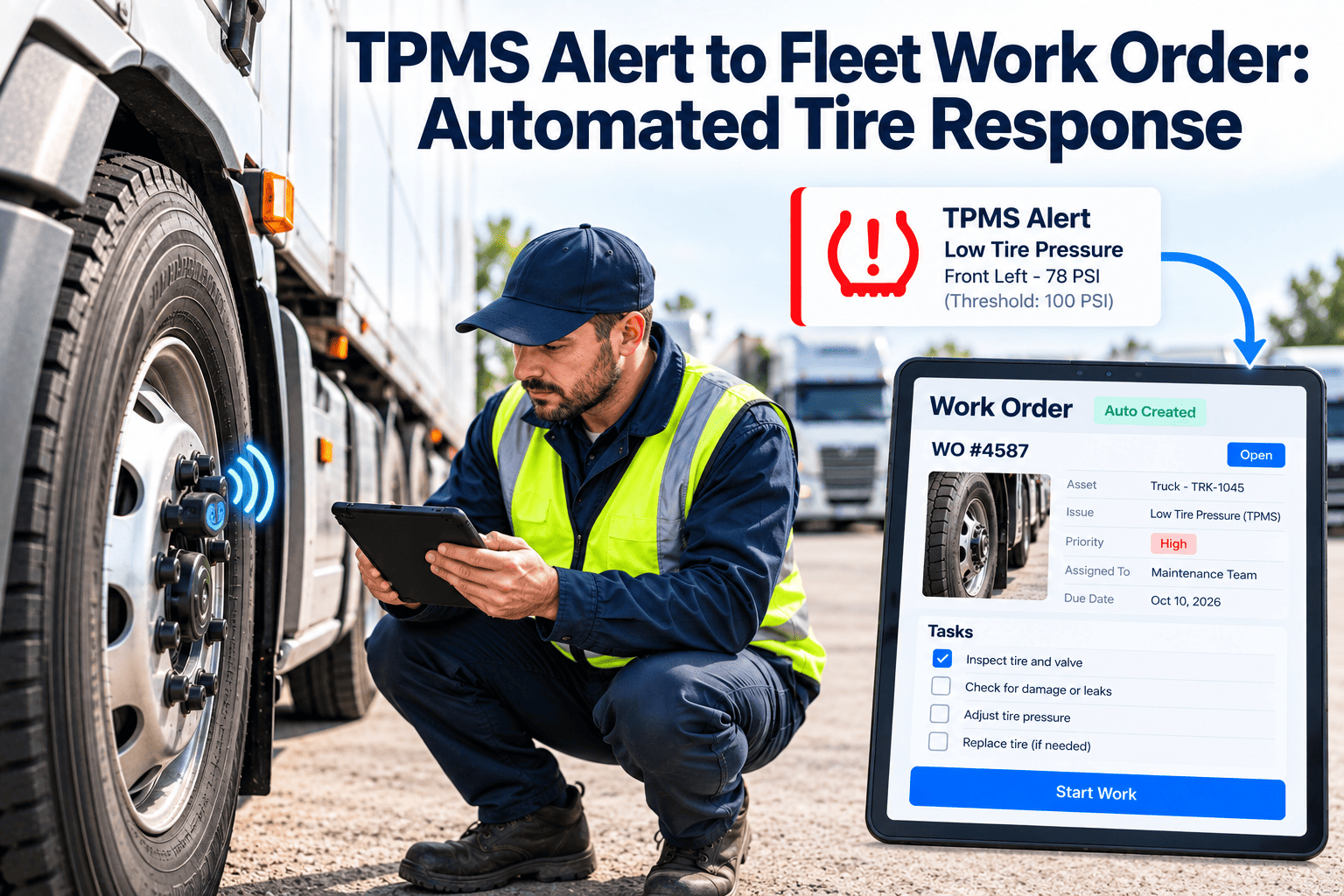
When AI telematics analysis flags a developing vehicle failure, OxMaint automatically creates a prioritized work order — populating vehicle ID, flagged system, AI confidence score, estimated failure window, and recommended action without dispatcher involvement. The work order exists before anyone manually reviews the alert, eliminating the 8–15 minute creation step and the risk of alerts aging in an inbox without action.
Manual equivalent: 8–15 min per work order creation event
Preventive Maintenance Scheduling
OxMaint generates PM work orders automatically when vehicles reach their configured service triggers — mileage, engine hours, calendar intervals, or AI condition thresholds. Multiple trigger types can be configured per vehicle type, with AI condition monitoring overriding fixed schedules when condition data indicates earlier or later service is appropriate. Zero manual scheduling required for routine PM at fleet scale.
Manual equivalent: 20–40 min/week for fleet-wide PM schedule management
Technician Assignment and Load Balancing
AI work assignment evaluates technician skill certifications, current open work order count, shift schedule, and specialization against each incoming work order — auto-assigning to the optimal technician and sending a mobile notification. When a technician's capacity is reached, the system automatically re-routes to the next qualified available resource. Manual job board management for a 6-technician shop typically consumes 30–45 minutes daily — automated to zero.
Manual equivalent: 30–45 min/day for shop scheduling and assignment
Parts Availability Checking and Reorder
When a work order is created, OxMaint automatically checks parts inventory against the recommended parts list and flags any items below the required quantity. If parts are insufficient, the system generates a purchase order or reorder alert automatically — based on preferred supplier, part number, and lead time stored in the parts registry. Parts procurement lead time is built into work order scheduling automatically.
Manual equivalent: 15–30 min per emergency parts research event
Vehicle Service History Retrieval
Every work order in OxMaint opens with the complete vehicle service history — prior related repairs, parts replaced, labor performed, and AI health alerts — displayed in reverse chronological order. Technicians see the context they need to perform the repair correctly without manual history retrieval. Repeat failures on the same component are immediately visible, enabling root cause diagnosis rather than component replacement without investigation.
Manual equivalent: 10–20 min per work order for paper-based history retrieval
Digital DVIR and Inspection Processing
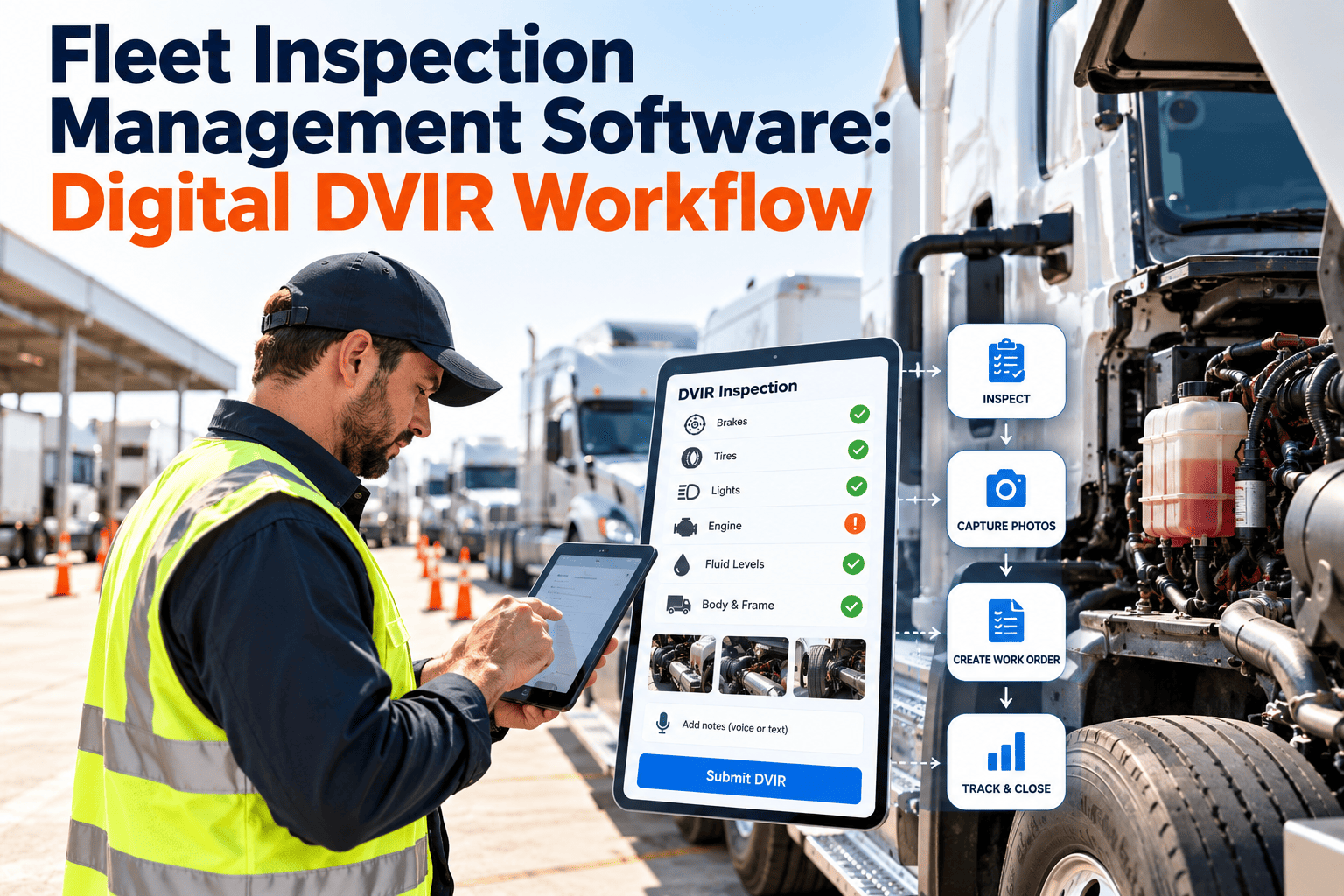
Drivers complete daily vehicle inspection reports on the OxMaint mobile app — guided through standardized checklists with required photo capture for defect items. Any failed inspection item automatically generates a maintenance work order and flags the vehicle status on the dispatcher's dashboard. Inspection completion, defect logging, and work order creation — all automated from a single driver action with no paper or secondary data entry.
Manual equivalent: 15–25 min/day for DVIR paperwork processing and defect work order creation
Compliance Documentation Generation
Every work order completion in OxMaint automatically generates the documentation that regulatory compliance and warranty claims require: timestamped service record, technician attribution, specification compliance data, parts used with part numbers, and labor time. DOT inspection history, FMCSA records, and OEM warranty documentation are built continuously as a byproduct of work order execution — not assembled separately under audit pressure.
Manual equivalent: 4–8 hours per audit event for manual record assembly
Fleet-Wide Status Reporting
OxMaint generates real-time fleet maintenance status dashboards automatically from work order data — open work orders by vehicle, technician utilization, PM compliance rate, parts spend by category, and maintenance cost per mile per vehicle. Reports that previously required manual data aggregation from multiple sources and took 2–4 hours to prepare weekly are available in real time from a single dashboard without any manual data entry or aggregation.
Manual equivalent: 2–4 hours/week for manual status reporting and metrics compilation
How OxMaint's AI Maintenance Software Closes the Work Order Automation Loop
The reason 70% of fleet AI projects fail to scale is not model accuracy — it is the missing automation between AI prediction and executed maintenance action. OxMaint is built to close this loop at every stage, from initial condition signal to completed work order to updated compliance record.
AI-to-Work-Order Automation
OxMaint's AI health monitoring connects directly to the work order engine — not through a separate alert dashboard that requires human review. When the AI flags a developing failure, a prioritized work order is created automatically, populated with all available diagnostic context, and queued for technician assignment. The loop from AI prediction to actionable maintenance task closes in under 90 seconds without any manual step.
Mobile-First Technician Interface
OxMaint's technician mobile app puts everything needed for a work order on one screen: vehicle profile, AI health flag details, service history, parts on order, manufacturer procedure reference, and a simple completion form. Technicians scan QR codes on vehicles and parts, dictate notes, capture photos, and close work orders without returning to a desktop. Every field interaction updates the central system in real time — no sync delays, no data loss.
Parts Inventory Integration
OxMaint's parts inventory module connects to work orders bidirectionally — work orders check inventory at creation, and work order completions deduct used parts automatically. Minimum stock thresholds trigger reorder alerts before parts shortfalls create repair delays. For fleets running OxMaint's procurement module, purchase orders generate automatically from reorder alerts — creating a fully automated parts procurement cycle from predicted maintenance demand to purchase order to inventory receipt.
Multi-Site Work Order Visibility
For fleets operating across multiple locations, OxMaint's work order management provides a unified view across all sites — open work orders, technician utilization, PM compliance rates, and cost per vehicle visible from portfolio-level down to individual work order. Vehicles that travel between sites generate work orders against their asset record regardless of location. No siloed systems, no inter-site coordination calls, no delayed reporting from remote depots.
CapEx Intelligence From Work Order Data
Every work order completion enriches each vehicle's condition score and maintenance cost record in OxMaint. The accumulated repair history, parts cost, labor hours, and AI health scores feed the rolling CapEx forecasting model — generating replacement priority rankings and 5–10 year fleet capital projections from work order data that already exists rather than from separately conducted assessments. The work order is the data collection event; the CapEx forecast is the automated output.
Rapid Deployment — No IT Project Required
OxMaint deploys as a cloud-native platform — no server installation, no IT infrastructure setup, no hardware procurement for core functionality. Most fleets are creating AI-generated digital work orders within their first week of deployment. Vehicle data import, PM schedule configuration, telematics connection, and technician app setup are guided by OxMaint's implementation team with typical full-fleet deployment completing within 1–3 weeks depending on fleet size.
Stop Paying Technicians to Create Work Orders. Let AI Create Them.
OxMaint's AI fleet maintenance software automates the complete work order lifecycle — from telematics condition alert to work order creation, parts checking, technician assignment, mobile execution, and documentation update. Zero manual administration. Free to start. Deploys in days.
Manual Fleet Maintenance Software vs. AI-Automated Platform: The Productivity Gap
95%
Reduction in work order administrative time with AI automation
From 63–122 minutes per manual work order to 2–4 minutes for AI-automated work orders — technician time redirected entirely to maintenance execution
15–25%
Improvement in technician productivity within 90 days of deployment
Documented across fleet implementations — administrative overhead elimination converts directly to additional vehicles serviced per technician per shift
$64K
Annual administrative overhead eliminated for a 4-technician shop
Labor cost of 22% administrative overhead eliminated by AI automation — equivalent to recovering 0.88 FTE technician capacity without adding headcount
60%
Fewer emergency repairs in fleets with full AI maintenance automation
AI-generated work orders from condition signals catch developing failures before breakdown — converting emergency repair spend to planned maintenance at 4.8× lower cost
Frequently Asked Questions
How does AI in fleet maintenance software actually generate a work order — and what triggers it?
AI work order generation in OxMaint is triggered by three distinct event types, each producing a work order without manual intervention. The first trigger is AI condition monitoring: when OxMaint's telematics analysis flags a developing vehicle failure — a temperature trend deviation, vibration frequency change, efficiency decline, or fault code escalation — the AI engine evaluates the signal against that vehicle's behavioral baseline and, when the pattern meets the threshold for a genuine developing failure, creates a work order automatically. The work order is pre-populated with the vehicle ID, flagged system, AI confidence score, estimated failure window, recommended repair action, and vehicle service history. The second trigger is PM schedule expiration: when a vehicle reaches its configured service trigger (mileage, engine hours, calendar date, or AI-adjusted condition threshold), OxMaint generates a PM work order automatically with the full PM checklist, specification requirements, and estimated parts needs. The third trigger is DVIR defect logging: when a driver submits a digital inspection report and flags a defect, OxMaint immediately creates a maintenance work order, notifies the assigned technician, and updates the vehicle availability status on the dispatcher dashboard — all from the driver's single inspection submission action. All three work order types are created without any dispatcher, manager, or administrator involvement.
Sign up free to see automated work order generation configured for your fleet.
How does OxMaint's automated work order system handle parts inventory — and what happens when parts are not on hand?
OxMaint's parts inventory module connects bidirectionally to the work order system — work orders check inventory at creation, and work order completions deduct consumed parts automatically. When a work order is created (by AI alert, PM schedule, or DVIR defect), OxMaint checks the parts registry against the recommended parts list for that repair type and vehicle specification. If all parts are available, the work order is scheduled normally. If parts are below required quantity, the work order is created with a parts-pending flag, an automatic reorder alert or purchase order is generated based on the preferred supplier and part number stored in the registry, and the work order scheduling takes estimated parts delivery time into account. For AI-generated predictive maintenance work orders — which are generated 10–14 days before the repair is urgently needed — this lead time typically allows standard planned procurement rather than emergency sourcing. This planned procurement vs. emergency sourcing differential saves 15–30% on parts cost for every AI-predicted repair event. OxMaint also tracks minimum stock thresholds per part and generates reorder alerts before stock shortfalls occur — keeping the most-used maintenance parts on hand without manual inventory auditing.
Book a demo to see OxMaint's parts integration configured for your parts inventory volume.
How does automated work order management improve compliance documentation — and what records does OxMaint generate automatically?
Manual compliance documentation assembly is consistently the most time-consuming non-maintenance activity in fleet operations — and the one most likely to have gaps, inconsistencies, and missing records that create liability exposure at audit time. OxMaint eliminates this problem by generating compliance documentation automatically as a byproduct of work order execution. Every work order close event generates: a timestamped service record with vehicle ID, odometer, date, and work performed; technician attribution with digital sign-off; specification compliance data showing the oil grade, filter part number, and torque specifications applied; parts used with part numbers and quantities; labor time; and any AI health flag that triggered the work order. This documentation is stored in the vehicle's permanent asset record in OxMaint and is retrievable by vehicle, date range, work order type, or technician in under 60 seconds. For DOT compliance, FMCSA inspection records, OEM warranty claims, and insurance investigations, this means the documentation that previously required 4–8 hours of manual assembly is available immediately. OxMaint also generates automated reports for PM compliance rates per vehicle, overdue maintenance alerts, and fleet-wide maintenance activity summaries — satisfying the reporting requirements that corporate operations, investors, and regulatory bodies typically request.
Sign up free to start building your compliance documentation record from day one.
How long does OxMaint take to deploy — and how disruptive is the transition from a manual or legacy system?
OxMaint is designed to deploy without disruption to ongoing maintenance operations — because the platform runs alongside existing workflows during the transition period rather than requiring a full cutover on day one. The deployment sequence follows three phases. Phase 1 (Days 1–3): vehicle registry setup, PM schedule import, and telematics connection. Vehicles are imported from existing records (OxMaint accepts CSV, Excel, and direct API imports from major fleet management systems) and PM schedules are configured based on existing service intervals. Telematics integration is configured against your existing GPS or telematics provider through open API connection. Phase 2 (Days 4–7): technician mobile app setup, parts inventory input, and live work order creation. Technicians receive mobile app credentials and complete a guided orientation. The first AI-generated and PM work orders begin flowing. Phase 3 (Days 8–21): full operational deployment with monitoring support. OxMaint's implementation team reviews the first 2 weeks of work order flow, alert accuracy, and technician adoption — adjusting thresholds, notification settings, and scheduling configurations based on observed performance. Most fleets are fully operational within 2 weeks. The transition does not require taking vehicles offline, halting maintenance operations, or dedicating IT resources. Because OxMaint is cloud-native, there is no server installation, no hardware procurement, and no IT infrastructure setup required.
Book a demo to see a deployment walkthrough for your fleet size and current system configuration.
Your Technicians Should Fix Vehicles — Not Create Work Orders. OxMaint Handles the Rest.
OxMaint's AI fleet maintenance software automates the complete work order lifecycle from telematics alert to compliance documentation — eliminating the 22% administrative overhead that currently consumes technician time without generating maintenance value. Free to start. Deploys in 1–3 weeks. First recovered technician hour pays for the month. Join 1,000+ organizations running AI-automated fleet maintenance with OxMaint.