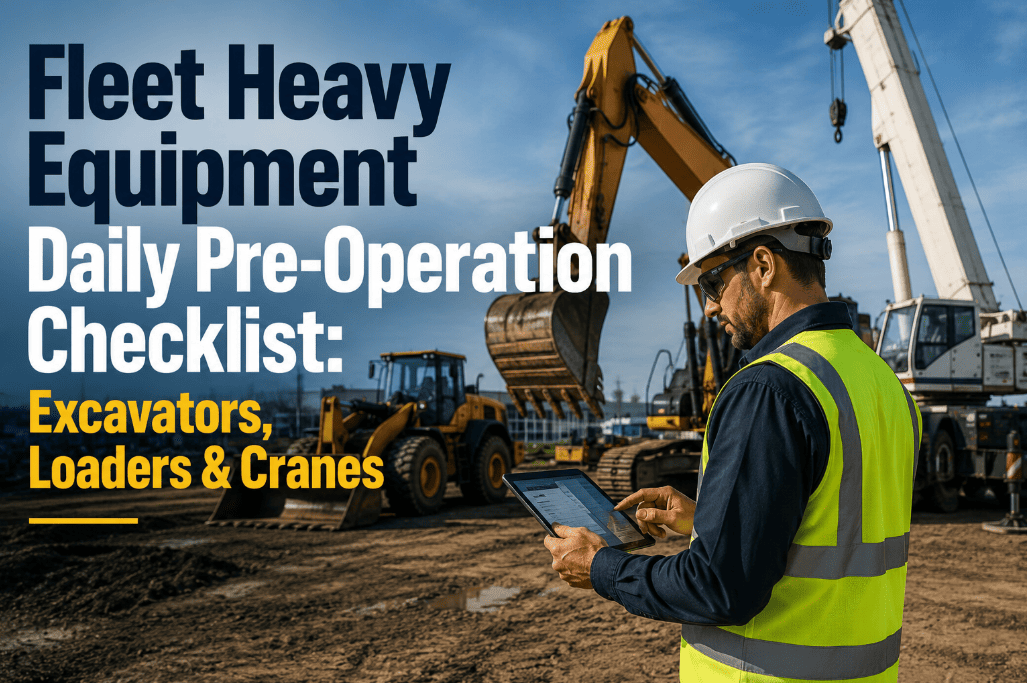
Every crane or lift equipment deployment without a structured pre-operation inspection is an unacceptable safety and compliance risk. OSHA 1926.1412 mandates documented pre-shift inspections for all crane types — yet fleet operators routinely discover hydraulic failures, wire rope defects, and outrigger faults that should have been caught before the hook was ever loaded. Crane-related incidents account for a disproportionate share of construction fatalities, and the majority are traceable to skipped or undocumented pre-operation checks. Sign Up Free on Oxmaint to digitise your fleet crane inspection workflow, capture findings per zone, and generate OSHA-compliant pre-operation records linked to each asset's history.
Fleet Crane Pre-Operation Safety Checklist — 4-Step Process
A compliant pre-operation inspection is not a casual walk-around — it is a structured four-phase process that must be completed before every shift. Compressing or skipping any phase creates documentation gaps that expose the fleet to regulatory penalties and, more critically, puts operators and ground crews at risk. Book a Demo to see how Oxmaint runs all four phases on mobile — no paper, no missed steps.
1. Wire Rope, Hook, and Load Block Checklist
Wire rope is the single most safety-critical component on any crane — and the most frequently under-inspected. ASME B30.2 and OSHA 1926.1413 specify exact removal-from-service criteria that require measurement and counting, not visual estimation. Sign Up Free to log wire rope measurements per layer and position in Oxmaint.
Wire rope condition — broken wires, kinks, and corrosion
Count broken wires in any rope lay and in any strand per ASME B30.2 removal criteria. Inspect for kinks, bird-caging, crushing, and corrosion pitting. Remove from service immediately if broken wire count exceeds the standard's limit per lay length. A kinked rope that appears to hoist normally has internal structural damage that fails without visible warning under dynamic loading. OOS — exceeds broken wire limit
Hook condition — cracks, throat opening, and latch operation
Inspect the hook body for cracks using dye penetrant or magnetic particle method at each periodic inspection. Measure throat opening — any hook deformed more than 15% from original throat width is OOS per OSHA 1926.1416. Test safety latch for positive closure and retention. A hook with a non-functioning latch is an OOS condition regardless of hook body condition. OOS — throat 15%+ deformed
Load block sheaves — groove wear and bearing condition
Inspect all load block sheaves for groove wear that reduces the sheave diameter at the rope contact point. Worn grooves allow rope to contact sheave flanges, accelerating rope degradation at a rate far greater than normal use. Check sheave bearing for roughness by rotating by hand — a bearing that drags or rattles under no load will fail under dynamic load cycling. Defect — groove out of gauge
Anti-two-block device — function test at each shift
Test the anti-two-block (ATB) device by manually actuating the weight ring and confirming hoist motion stops immediately. An ATB device that passes static testing but fails under dynamic hoist conditions is the leading cause of two-block events. If the ATB does not stop hoist motion within the prescribed distance, the crane is OOS until the device is repaired and retested. OOS — device fails to stop hoist
Wire rope lubrication and end termination condition
Check rope lubrication at the drum and over the entire reeving path. Dry rope significantly reduces fatigue life and accelerates internal corrosion invisible from the outside. Inspect all swaged, speltered, and wedge socket end terminations for cracking, corrosion, and security. A wedge socket with the wedge not fully seated or a castellated nut missing its cotter pin is an OOS rigging condition. Defect — dry rope / loose termination
2. Hydraulic System and Outrigger Checklist
Hydraulic system failures and outrigger setup errors are the two most common causes of crane tip-overs in fleet operations. Both are entirely preventable with a structured pre-operation check. Outrigger ground bearing pressure calculations must match site soil conditions — and that match must be documented before the first lift. Book a Demo to see Oxmaint's site-specific outrigger setup verification workflow.
Hydraulic oil level, hose condition, and leak inspection
Check hydraulic reservoir level with all cylinders retracted. Inspect all hydraulic hoses for chafing, cracking at fittings, and heat damage near exhaust routing. A hydraulic hose failure under pressure creates both a fire risk and an immediate loss of boom or outrigger control. Any seeping fitting or pinhole leak in a high-pressure circuit is an OOS condition — not a "monitor until next service" item. OOS — active hydraulic leak
Outrigger extension — full deployment and pad condition
Extend all outriggers to the configuration specified in the load chart for the planned lift. Inspect all outrigger pads for cracking and deformation. Verify each pad is fully seated and level indicators confirm the crane is within the manufacturer's levelling tolerance. A crane operating 1° outside level tolerance loses a significant percentage of its rated lifting capacity at every load chart configuration. OOS — outside level tolerance
Outrigger structural condition — beam cracks and cylinder seals
Inspect all outrigger beam welds for cracking at the header plate junction points. Check outrigger cylinder rod seals for weeping — a cylinder that slowly retracts under load will allow the crane to settle and tilt progressively during a lift, potentially shifting the load radius beyond the rated capacity line. Any outrigger that does not hold position under load is an OOS condition. OOS — cylinder does not hold
Boom hydraulic cylinders — extend/retract and drift test
Cycle boom to maximum extension and minimum boom angle per the day's planned operations. Verify smooth extension and retraction without cavitation or sudden movement. Test for hydraulic drift — hold boom at a specified angle under no load for two minutes and confirm it does not drop beyond the manufacturer's allowable drift rate. Boom drift under load is a tip-over precursor condition. Defect — drift exceeds spec
Load moment indicator — function test and calibration check
Test the load moment indicator (LMI) system by entering the planned lift configuration and verifying the display shows the correct load chart data. Confirm alarm set points trigger at 75%, 85%, and 100% of rated capacity per the unit's specification. An LMI that displays incorrect capacity data or fails to alarm at the rated threshold is an OOS condition under OSHA 1926.1415 — the crane cannot perform regulated lifts without a functional rated capacity indicator. OOS — LMI fails alarm test
3. Boom Structure, Load Chart, and Electrical Checklist
Boom structural defects are the hardest to detect visually and the most catastrophic when missed. Chord cracks, web buckles, and lacing failures accumulate over thousands of cycles and become critical long before they are visible without deliberate close-range inspection. Sign Up Free to capture boom section condition ratings and track structural trend data across your fleet in Oxmaint.
Boom chord and lacing inspection — cracks, buckles, and impact damage
Inspect all boom chord members and lacing bars for cracks at weld toes, lateral buckles, and impact damage from contact with loads or structures. Any chord crack longer than 1/2" requires non-destructive testing before the crane returns to service. Impact damage that appears cosmetic frequently produces internal chord deformation that reduces boom capacity far beyond what the visible dent suggests. OOS — any chord crack
Load chart availability and legibility — correct chart for configuration
Confirm the correct load chart for the crane's current configuration is present in the cab, legible, and matches the equipment's serial number and boom configuration. Verify the operator uses the correct chart section for the planned outrigger setting, boom length, and radius. Operating with the wrong chart section — even inadvertently — can result in a lift that exceeds actual rated capacity while appearing compliant. OOS — chart missing or illegible
Boom pins and retention devices — all sections
Inspect all boom section connection pins for wear, corrosion, and security of cotter pins or snap rings. A boom pin that is worn beyond the manufacturer's wear tolerance creates clearance that allows boom sections to shift under dynamic load — producing lateral boom deflection and asymmetric loading that the load chart does not account for. Missing cotter pins on boom section connections is an OOS condition. OOS — missing pin retention
Electrical system — cab controls, limit switches, and emergency stop
Test all cab control functions for correct response, correct speed range, and smooth operation. Verify all upper limit switches for hoist and boom stop functions. Test emergency stop — all crane motion must cease immediately and hold position. A limit switch that bypasses due to a corroded contact allows the hoist or boom to travel beyond its safe range, creating an anti-two-block event or a structural overload condition. OOS — emergency stop fails
Swing and travel brakes — holding capacity test
Test swing brake by applying a load, engaging the brake, and verifying the load does not drift when swing is released. Test travel brakes on a slope appropriate for the site. A swing brake that holds under static conditions but releases under dynamic load or wind pressure creates an uncontrolled swing event that cannot be arrested by operator input alone. OOS — brake does not hold
We were running 22 cranes across multiple sites and pre-operation checks were being done on paper — or not at all on short-notice lifts. After deploying Oxmaint's crane inspection module, we found 9 OOS conditions in the first week that had been operating undetected, including two load moment indicators with failed alarm thresholds. Our OSHA inspection 90 days later found zero documentation deficiencies for the first time in three years.
4. Engine, Fluids, and Travel System Checklist
Crane prime mover and travel system failures during a lift or while travelling on site create hazards that compound rapidly. Engine shutdowns under load, steering failures, and brake failures on grades are all preventable with a complete pre-operation check of the carrier and engine systems. Book a Demo to see Oxmaint's integrated engine and carrier pre-operation workflow for fleet crane assets.
Engine oil, coolant, and fuel — levels and condition
Check engine oil level and condition — milky oil indicates coolant contamination requiring immediate shutdown. Verify coolant level and inspect for oil contamination. Confirm adequate fuel for the planned shift including travel to and from the lift site. A crane that shuts down from fuel exhaustion during a suspended load is a life-safety event, not a refuelling inconvenience. OOS — milky oil / low coolant
Carrier brakes — service and parking brake function
Test service brakes at slow travel speed on the flattest available surface. Apply parking brake and verify it holds on the maximum grade the crane will encounter during site travel. A parking brake that holds the crane on level ground but releases on a 3% grade will allow an uncontrolled rollaway when the operator exits the cab for rigging — a common pattern in carrier brake incident reports. OOS — parking brake fails grade
Tyres and crawler tracks — inflation, wear, and tension
For rubber-tyred carriers: check all tyre inflation pressures at the correct crane-rated values, not standard truck pressures. For crawler cranes: inspect track tension, track pad condition, and sprocket tooth wear. Inspect for cracks between lugs on rubber track pads — a pad separation at travel speed creates an immediate loss of steering and braking. Defect — under-inflated / cracked pad
Counterweight configuration — matches planned lift chart
Verify counterweight configuration matches the load chart section being used for the planned lift. Confirm all counterweight sections are secured with correct pins and retention hardware. Operating with less counterweight than the load chart assumes reduces actual rated capacity below the chart value without any warning indicator — the LMI will show acceptable load percentages based on a counterweight assumption that does not match reality. OOS — counterweight mismatch
Fire suppression system and cab egress — function check
Verify cab-mounted fire extinguisher is present, fully charged, and in date. Check cab door operation — both doors must open and close freely from inside and outside. Test cab emergency egress path. A cab door that jams or requires unusual force to open from the inside is an egress hazard that becomes life-critical in a tip-over or fire event when the operator must exit under adverse conditions. Defect — extinguisher expired
Frequently Asked Questions
The most common questions from fleet maintenance managers and crane operators about pre-operation inspection requirements, OSHA compliance, and digital inspection management.
OSHA 1926.1412 requires a documented pre-shift inspection before each shift the crane is used. Monthly and annual inspections are also required on separate schedules. Pre-shift inspections must be documented and retained — verbal check confirmations do not satisfy the regulation.
In order of frequency: missing or incomplete pre-operation inspection documentation, load chart not present in the cab, anti-two-block device not tested, outrigger deployment not verified for the lift configuration, and wire rope with broken wires exceeding removal criteria.
Yes. OSHA 1926.1412 designates the operator as responsible for the pre-shift inspection. However, monthly and annual inspections must be performed by a qualified person or competent person as defined by OSHA. Operators must be trained on inspection criteria and removal-from-service standards specific to their equipment type.
Classify the defect per severity. OOS conditions must be tagged, the crane removed from service, and a work order generated before operations resume. Non-OOS defects must be logged and a repair schedule established. The key requirement is documentation — unrecorded findings do not satisfy OSHA and will not drive repairs.
Yes. Oxmaint creates a separate asset profile for each crane with its own inspection templates, defect history, work order log, and certification dates. Fleet managers see all cranes on one dashboard with condition ratings, upcoming inspection due dates, and open defect counts. Sign Up Free to configure your fleet in minutes.
Digital inspection records provide time-stamped, asset-linked evidence of every inspection event — something paper logs cannot reliably prove. Oxmaint generates inspection records that include technician ID, GPS location, findings per zone, and linked work orders, satisfying the documentation standard that most paper-based fleets fail during OSHA compliance reviews. Book a Demo to see the audit report format.