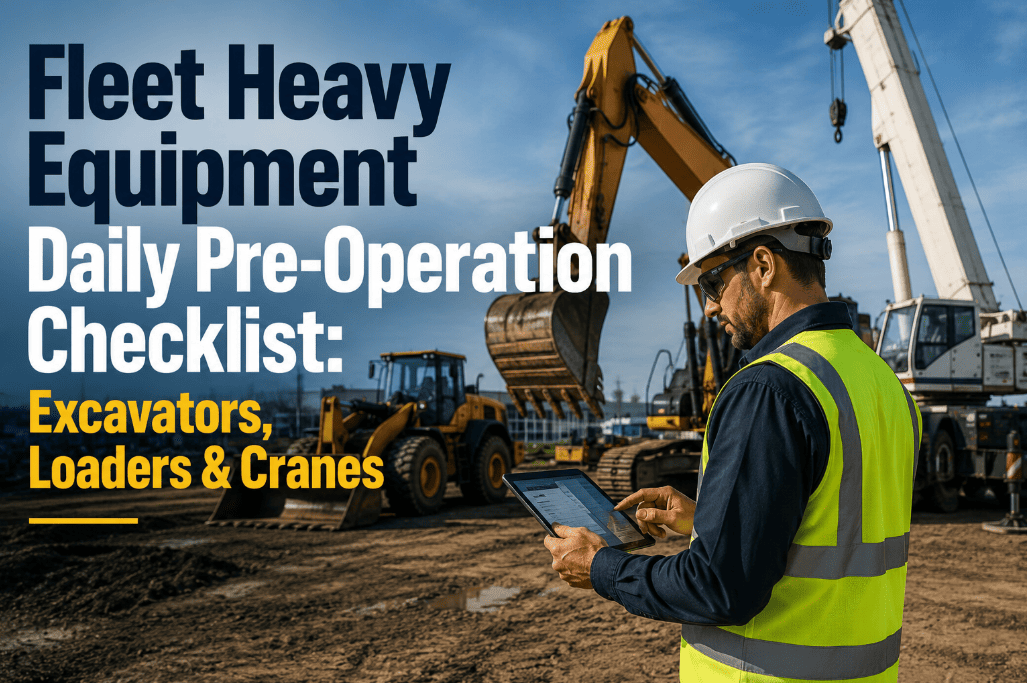
A missed fluid check before an excavator enters service. A crane operator who skips the load chart review. A loader with a cracked hydraulic line that nobody caught at shift start. These are the events that ground fleets, trigger OSHA citations, and turn a profitable project day into a six-figure liability. Fleet heavy equipment daily pre-operation inspections are not a formality — they are the single most effective control against unplanned downtime and site incidents. Sign Up Free to run guided pre-operation inspections on every piece of heavy equipment in your fleet, with findings recorded per asset and non-conformances escalated to work orders before the machine leaves the yard. Oxmaint's equipment inspection module covers excavators, wheel loaders, crawler cranes, and all allied plant — giving fleet managers real-time pre-shift compliance visibility across every site. Book a Demo to see how construction fleets use Oxmaint to close the gap between a paper pre-start form and a maintenance action. Every defect found at pre-op costs a fraction of the repair it prevents — and every defect missed compounds into the category of failures that stop machines mid-shift and eliminate paper pre-start forms across your entire heavy equipment fleet today.
Symptom → Likely Equipment Root Cause
Pre-operation findings are routinely dismissed because operators do not connect the symptom to the failure it precedes. Slow hydraulic response is not an operator feel issue — it is a pump cavitation warning. Using this identifier before releasing equipment from the yard prevents dispatching machines already on the failure curve.
1. Excavator Daily Pre-Operation Checklist
Excavators operate under continuous hydraulic load cycles — each hour of dig operation generates more wear events than most other construction plant. Pre-operation inspection must verify fluid condition, hydraulic integrity, undercarriage wear, and operator safety systems before the machine enters a dig face. Sign Up Free to record excavator pre-op findings in Oxmaint and auto-generate work orders for any defect found.
Engine oil level — dipstick check, correct grade, no contamination
Low engine oil at pre-op means the engine ran low during the previous shift. Check for leaks before topping up. OOS — below minimum mark
Hydraulic fluid level and condition — no milky colour or metal contamination
Milky hydraulic fluid indicates water ingress from a failed cooler or breather — do not operate until source is identified. OOS — milky or contaminated fluid
Hydraulic hoses and fittings — no weeping, cracking, or abrasion contact
Any hose in contact with a sharp edge or hot surface will fail under load. Reroute or shield before dispatch. Defect — any active weeping or abrasion
Undercarriage — track tension, roller condition, no missing track pads
Loose tracks de-shoe under side load. Check tension with a straight edge at the undercarriage midpoint per OEM spec. Defect — excessive sag or missing pads
Boom, arm, and bucket pins — grease purge at each pin seal, no visible play
Dry pins cause fretting corrosion that accelerates bush wear 10x. Grease to purge — three pumps is not confirmation. Defect — no grease purge or visible play
Bucket teeth and cutting edge — all teeth present, no cracked adapters
A lost tooth becomes an untracked ground obstacle or equipment damage event at the next pass. Replace before dispatch. Defect — missing tooth or cracked adapter
Cab safety — ROPS condition, seatbelt functional, door latch secure
Any ROPS crack or seat belt retractor failure is an immediate OOS — operator protection is compromised. OOS — ROPS damage or seatbelt failure
Engine start — no warning lights, normal oil pressure and temperature rise
Any active warning light at start requires fault code retrieval before the machine is released from pre-op. OOS — any active warning light
Travel and swing function — smooth operation, no drift, no unusual noise
Swing drift under hold indicates a control valve or brake issue — do not use near excavation edges until resolved. Defect — drift or abnormal noise
2. Wheel Loader Daily Pre-Operation Checklist
Wheel loaders operate in high-cycle, high-dust environments where air filter blockage, tyre wear, and articulation joint wear progress rapidly between service intervals. Book a Demo to see how Oxmaint's loader pre-op module tracks tyre pressure readings, fluid findings, and articulation joint condition per unit across your fleet.
Tyre pressure — all four tyres at OEM cold inflation spec
Over-inflated tyres on hard surfaces fracture carcass cords. Under-inflated tyres overheat under load cycle — both cause rapid failures. Defect — more than 10% outside OEM spec
Air filter restriction indicator — green zone confirmed before start
A restricted air filter in red zone causes black smoke, increased fuel consumption, and accelerated engine wear. Replace before dispatch. OOS — indicator in red zone
Articulation joint — grease purge at all pins, no visible cracking in steering stops
Articulation joint failure at speed causes immediate loss of steering. Inspect steering stop condition and centre pivot play. OOS — cracked stops or excessive joint play
Lift arms and bucket — cylinder seals, tilt linkage pins, bucket edge condition
Bucket tilt linkage pin wear causes intermittent dump control loss — inspect for play before material handling operations begin. Defect — cylinder weeping or linkage play
Transmission and axle fluid — correct levels, no external leaks on axle seals
Wet axle flanges indicate a differential breather blockage or axle seal failure — check breather before replacing seals. Defect — wet axle flanges
Braking function — service brake, secondary brake, and park brake tested
Park brake must hold on the steepest grade the machine will encounter. Test on an incline, not flat ground. OOS — park brake slips on grade
Backup alarm and proximity warning — functional test before leaving yard
Non-functional backup alarm is an OSHA violation and an immediate dispatch hold. Replace before releasing the machine. OOS — alarm non-functional
3. Crane Daily Pre-Operation Checklist (OSHA 29 CFR 1926.1412)
Crane pre-shift inspections are federally mandated under OSHA 29 CFR 1926.1412 — documented findings are a legal requirement, not an option. Every shift a crane lifts without a completed pre-op inspection record is an employer liability. Sign Up Free to generate compliant, timestamped crane pre-op inspection records in Oxmaint with operator and date capture on every item.
Load chart — present in cab, legible, correct for current configuration
Operating without the correct load chart for the rigging configuration is an OSHA violation and a lifting failure risk. OOS — chart absent or incorrect config
Wire rope — condition inspection, no kinking, broken wires, or bird-caging
Broken wire count per rope lay length triggers mandatory removal under ASME B30.2. Count and record at every pre-op. OOS — broken wires exceed ASME B30.2 limit
Hook block — swivel bearing, latch spring, and hook throat deformation check
A hook throat opened more than 15% of nominal dimension requires immediate removal from service per ASME B30.10. OOS — deformed throat or failed latch
Anti-two-block device — functional test, not bypassed or disconnected
A bypassed ATB device is an immediate OOS — two-blocking a crane is one of the most common catastrophic lifting failures. OOS — device bypassed or non-functional
Boom — visible structural inspection, all pins present, no cracks at welds
Lattice boom chord cracks at weld intersections are not visible from the cab — walk the boom before each shift. OOS — any crack at chord or weld
Outrigger pads and floats — all deployed, bearing on solid ground, no settlement
Outrigger settlement during a lift shifts the crane's centre of gravity beyond the rated load chart — recheck mid-shift on soft ground. OOS — settlement detected or float absent
Operator documentation — current licence, site induction, and medical fit-for-duty
An operator without a current licence certificate operating the crane creates employer liability regardless of operator competency. Verify before key handover. OOS — expired licence or missing induction
Swing, hoist, and travel functions — low-load functional test before lift operations
Test all crane functions under low load before approaching rated capacity — unusual response under low load predicts failure under full load. Defect — sluggish or abnormal response
Technology Improving Fleet Pre-Operation Compliance
Paper pre-start forms fail because defects are recorded but never acted on — findings sit on a clipboard while the machine enters service. Four technologies close the gap between a pre-op finding and a maintenance response. Book a Demo to see how Oxmaint integrates all four into one connected fleet inspection workflow.
Frequently Asked Questions
The most common questions from fleet managers and site supervisors about heavy equipment pre-operation inspection requirements, OSHA compliance, and digital inspection implementation.
Yes. OSHA 29 CFR 1926.1412 mandates a documented pre-shift inspection before each crane use. Most heavy equipment OEMs also specify daily pre-op inspection as a warranty and safe-use requirement. Oxmaint generates timestamped, operator-attributed inspection records that satisfy these documentation requirements.
The machine must be tagged out of service until the defect is assessed and cleared by a qualified technician. Oxmaint records the defect finding, triggers a maintenance work order, and holds the asset in a defect-pending status on the fleet dashboard until the work order is closed and the asset is re-released.
A thorough excavator or loader pre-op takes 10–15 minutes. A crane pre-shift inspection under OSHA requirements takes 20–30 minutes. Oxmaint's guided mobile workflow reduces inspection time by removing paper form completion while improving defect capture accuracy.
Yes. Oxmaint supports asset-specific inspection templates — excavator, loader, crane, and any other plant category each has its own guided checklist tailored to the asset type. Fleet managers see all pre-op results across all asset categories in a single compliance dashboard.
Oxmaint stores each crane pre-shift inspection with operator name, time stamp, asset ID, and a complete finding record — producing the documented inspection trail required by OSHA 29 CFR 1926.1412. Records are exportable for site audits and incident investigation on demand.
Hydraulic hose condition and undercarriage pin greasing are the two most consistently skipped items on paper-based pre-ops. Both are high-consequence failure precursors. Oxmaint's guided checklist requires a pass or fail entry on every item — operators cannot skip checklist steps and submit a complete form.