Fleet oil management sounds like a solved problem — change the oil every 5,000 miles, use the right grade, keep records. In practice, oil management is where the gap between what maintenance should cost and what it actually costs is created and sustained. A national 120-vehicle logistics fleet conducted an audit of their oil management program in 2025 and found four simultaneous problems that had been running invisibly for years: 23 vehicles receiving oil changes every 5,000 miles on urban routes where degradation occurs 40% faster — all chronically under-protected. 31 vehicles receiving the same 5,000-mile interval on highway routes where synthetic oil was still fully effective at 8,500 miles — generating $14,000 annually in unnecessary oil changes. 7 vehicles running the wrong viscosity grade because three different shops were sourcing from different suppliers without a centralized specification registry. And 11 high-mileage vehicles past 95,000 miles still receiving standard formulation while consuming oil at double the baseline rate — accumulating accelerated wear that would shorten engine life by 40,000 miles. Four problems. One universal fix: AI-powered oil management that monitors actual oil condition per vehicle, enforces specification compliance at every service event, flags consumption anomalies automatically, and converts oil management from a fixed-interval cost to a condition-optimized investment that reduces total spend while actually protecting more engines. Sign up for OxMaint and build a precision oil management program across your fleet today.
Fleet Operations · Guide · 2026
AI for Fleet Oil Management: Improving Efficiency and Reducing Costs
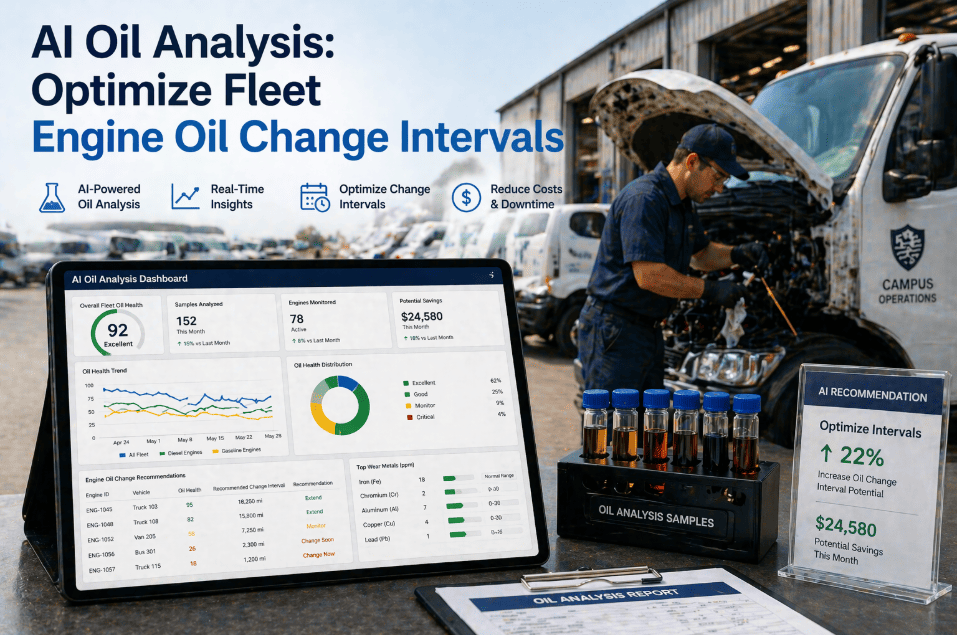
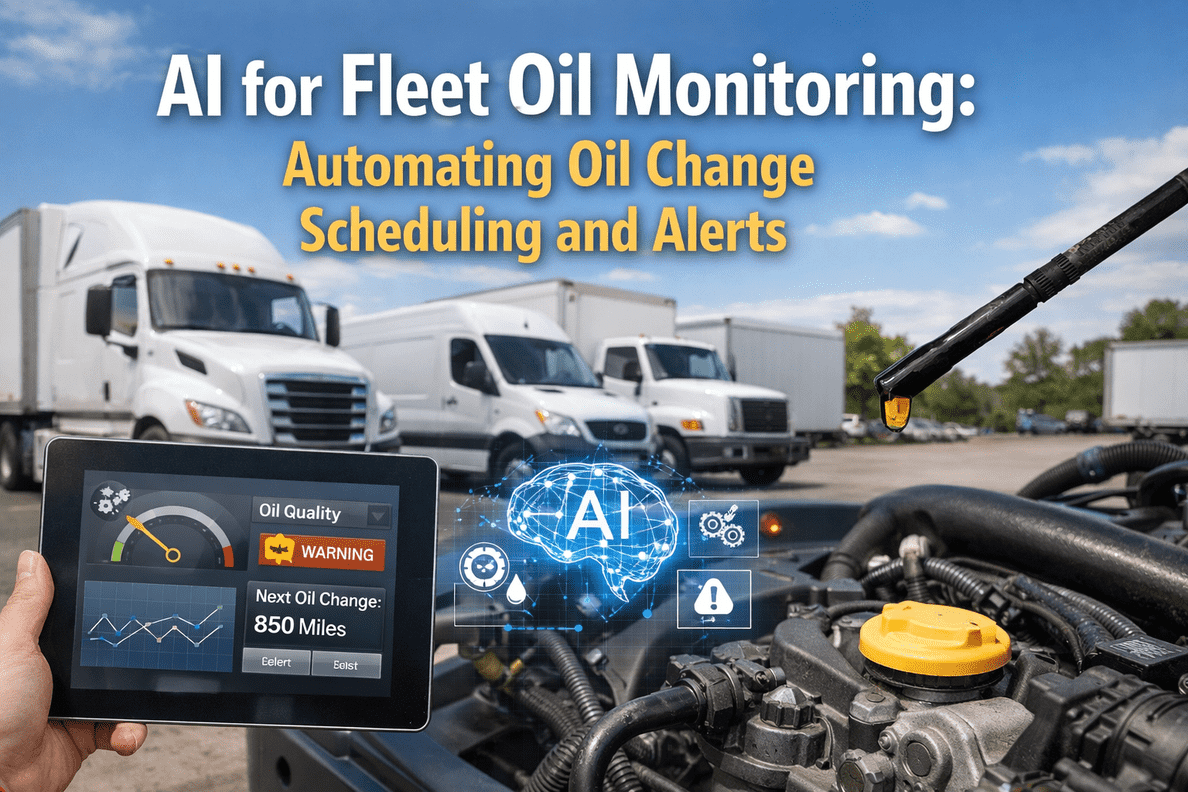
AI oil management eliminates the twin wastes of conventional fleet oil programs — over-servicing highway vehicles and under-protecting extreme-duty ones — by calibrating every oil change to actual vehicle condition, enforcing specification compliance automatically, and generating the consumption tracking that catches engine failure 6–8 weeks before the damage stage.
20–35%
Reduction in total fleet oil maintenance spend from AI condition-based scheduling vs. fixed universal intervals
40%
Faster synthetic oil degradation in extreme-duty vehicles vs. what manufacturer's standard drain interval assumes
30%
Engine life extension from correct high-mileage formulation transition at 75,000–100,000 miles with AI milestone tracking
$14K
Annual waste from unnecessary oil changes on 31 highway-cycle vehicles — eliminated by per-vehicle AI condition monitoring
The True Economics of Fleet Oil Management in 2026
Fleet oil management has two cost problems that work in opposite directions but share the same root cause — a universal interval schedule that ignores each vehicle's actual operating conditions. The first problem is visible on the P&L but often accepted as normal: unnecessary oil changes on over-serviced vehicles. The second problem is invisible until it generates a major repair bill: under-protection on extreme-duty vehicles whose oil degrades faster than the schedule assumes.
The Over-Service Problem
Highway vehicles, light-duty commuters, and infrequent-use assets receive oil changes at the same mileage intervals as heavy-duty, extreme-temperature, and high-load vehicles. Full synthetic oil in highway-dominant operation maintains effective protection well beyond 5,000-mile intervals — often to 7,500–10,000 miles. Every unnecessary change on these vehicles costs $35–$65 in parts and labor plus technician time — with zero benefit to engine protection.
Typical fleet waste: $14,000–$22,000/year on 30 over-serviced vehicles
The Under-Protection Problem
Urban stop-and-go vehicles, heavy-tow assets, and extreme-temperature operations degrade oil 30–50% faster than the standard interval assumes. Serving these vehicles at the same 5,000-mile interval as a highway vehicle is systematically late. The result is 2,000–3,000 miles of operation on oil past its effective protection threshold — accumulating bearing wear, piston ring wear, and deposit buildup that shortens engine life and increases future repair costs.
Long-term cost: 30,000–50,000 miles of accelerated engine wear per vehicle
The AI Solution
AI oil management monitors each vehicle's actual oil degradation indicators — thermal accumulation, cold-start frequency, load-weighted mileage, efficiency trends — and generates change alerts calibrated to that specific vehicle's condition. Over-serviced vehicles extend their intervals to the point of actual need. Under-protected vehicles trigger earlier service when condition data indicates the oil has crossed the protection threshold. Both problems solved simultaneously from one platform.
Result: 20–35% lower total oil spend + zero under-protected engines
The Specification Problem
In a multi-site fleet where vehicles are serviced by different shops, at different locations, or by rotating technician staff, the correct viscosity grade and oil type is subject to substitution — especially when purchasing decisions are made at the shop level rather than specified at the vehicle level. Wrong viscosity in a 5W-30 specified engine operating at severe service reduces oil film thickness by 45% at operating temperature — accumulating damage that is invisible until a major failure occurs.
Risk: 40,000 miles of accelerated wear from specification drift — invisible on paper logs
4 AI Oil Management Capabilities That Reduce Costs and Protect Engines
OxMaint's AI oil management platform addresses each of the four fleet oil management problems through distinct technical capabilities — each one delivering measurable, independent value and compounding together across the full fleet oil program.
01
Condition-Based Change Interval Optimization
OxMaint's AI processes telematics data — thermal load accumulation, cold-start frequency, load-weighted mileage, fuel efficiency trends — against each vehicle's oil condition model to determine the actual degradation state. Change alerts trigger when condition indicators reach the protection threshold for that specific vehicle under its actual operating profile. The result: over-serviced vehicles extend intervals by 25–50%, reducing oil change frequency and cost. Under-protected vehicles trigger earlier service before protection fails.
Savings: 25–50% interval extension on highway-cycle vehicles
02
Specification Enforcement at Point of Service
OxMaint stores the manufacturer-specified viscosity grade, API service category, OEM approval standard, and oil type in each vehicle's asset record. When a work order is generated for an oil change — whether triggered by AI condition alert, PM schedule, or DVIR defect — the specification is displayed on the technician's mobile work order screen. The correct grade is visible before the technician opens the hood. Specification compliance is recorded with the work order, creating an auditable specification history per vehicle.
Protection: eliminates the 45% film-strength loss from wrong-viscosity servicing
03
Consumption Rate Monitoring and Anomaly Detection
OxMaint calculates each vehicle's oil consumption rate in quarts per 1,000 miles from technician-logged top-up quantities at each service event. When a vehicle's consumption rate doubles from its established baseline — from 0.3 quarts to 0.7+ quarts per 1,000 miles — OxMaint flags the anomaly automatically. This consumption signal indicates early seal or ring wear at the $400–$800 intervention stage, providing 4–8 weeks of advance warning before the condition escalates to $5,000–$15,000 engine damage.
ROI: $400 intervention vs. $15,000 engine repair — per prevented escalation
04
High-Mileage Transition Management
OxMaint tracks each vehicle's odometer against configurable high-mileage transition thresholds — typically 75,000–100,000 miles depending on vehicle type and manufacturer recommendation. When a vehicle approaches the threshold, OxMaint generates a formulation transition alert alongside the next oil change work order — specifying the high-mileage grade, the rationale for transition, and the expected performance improvements. OxMaint's consumption monitoring validates the transition impact at the individual vehicle level.
Life extension: 30,000–50,000 additional miles from correct formulation transition
The AI Oil Management Cost Reduction Framework
Fleet oil management cost reduction from AI operates through six independent channels — each delivering value that stands alone and compounds with the others across the full fleet oil program.
Channel 1
Interval Optimization — Eliminate Unnecessary Changes
Highway-cycle vehicles extended from 5,000 to 7,500–10,000 mile intervals where condition data supports it. At $45/change average, 20 vehicles saving 3 changes per year each = $2,700 annually. 30 vehicles saving 4 changes per year each = $5,400 annually. These savings compound across every vehicle in the fleet whose actual operating profile supports extended intervals.
$2,700–$5,400/yr per 20–30 vehicles
Channel 2
Engine Damage Prevention — Early Consumption Detection
Consumption anomaly detection catches seal and ring wear at the $400–$800 intervention stage. Each prevented engine repair ($5,000–$15,000) represents a savings event that typically covers 12–24 months of platform subscription cost at per-vehicle pricing. For a 50-vehicle fleet experiencing 2–3 consumption anomalies per year, prevention is worth $10,000–$45,000 annually.
$10,000–$45,000/yr on 50 vehicles
Channel 3
Planned Procurement — 15–30% Parts Cost Reduction
AI condition alerts generate 10–14 days of advance warning before required service. Parts procurement at planned rates — oil, filter, gaskets — costs 15–30% less than emergency or ad-hoc sourcing. For a fleet executing 200 oil changes per year at $45 average parts cost, a 20% procurement savings represents $1,800 annually — before counting emergency sources that this lead time eliminates.
$1,800–$2,700/yr on 200 annual changes
Channel 4
Engine Life Extension — High-Mileage Formulation
Vehicles transitioning to high-mileage formulation at the correct threshold extend reliable service life by 30,000–50,000 miles. On a commercial vehicle with $120,000 replacement cost, extending service life by 40,000 miles defers replacement by 1.5–2 years — representing $15,000–$20,000 in annualized capital cost avoidance per vehicle.
$15,000–$20,000/vehicle life extension
Channel 5
Specification Compliance — Prevent Silent Wear Accumulation
Ensuring the correct viscosity grade is applied at every service event prevents the 40,000-mile accelerated wear that wrong-viscosity servicing accumulates invisibly. On a 10-vehicle subset regularly serviced with incorrect specification, compliance enforcement extends engine life by an equivalent of $4,000–$8,000 per vehicle in avoided repair costs and extended service life value.
$4,000–$8,000/vehicle over service life
Channel 6
Documentation — Warranty Claims and Compliance Value
Complete, specification-compliant oil service records per vehicle satisfy OEM warranty requirements that paper-based records fail to meet. A single recovered warranty claim (engine, drivetrain, or turbocharger) is worth $3,000–$12,000 in covered repair costs. For multi-site fleets subject to regulatory audit, complete oil records retrievable in 60 seconds eliminate hours of assembly labor per audit event.
$3,000–$12,000/claim + audit labor savings
How OxMaint Builds a Complete AI Oil Management Program
OxMaint's oil management capabilities are built into the core CMMS platform — not a separate add-on requiring a second system, second login, or second data entry workflow. Everything connects from one platform.
Vehicle Oil Specification Registry
Every vehicle in OxMaint's asset registry stores its manufacturer-specified viscosity grade, API category, OEM approval, and service type in the permanent asset record. When an oil change work order opens — from any trigger type — the specification is displayed on the technician's mobile screen before service begins. Specification is recorded in the work order, building a specification compliance history per vehicle without any additional data entry effort.
AI Condition-Based Alert Engine
OxMaint's AI processes telematics data continuously — thermal load, cold-start frequency, efficiency trends, load-weighted mileage — against each vehicle's oil condition model. Change alerts generate 10–14 days before the required service window, providing parts procurement lead time at planned rates. Alerts trigger automatically and generate work orders without dispatcher intervention.
Consumption Rate Tracking
Technicians log oil top-up quantities at each service event in OxMaint's mobile work order form — typically a 10-second step alongside existing parts logging. OxMaint calculates per-vehicle consumption rate automatically and flags rate acceleration from baseline. The anomaly alert includes the baseline rate, current rate, trend chart, and recommended inspection action — no analyst required to identify the signal.
High-Mileage Milestone Alerts
OxMaint's asset records include configurable high-mileage transition thresholds per vehicle type. When a vehicle approaches the transition milestone, OxMaint generates a formulation transition alert alongside the next scheduled oil change — with the recommended high-mileage grade, rationale, and supplier reference pre-populated in the work order. Transition compliance is recorded in the vehicle history automatically.
Fleet-Wide Oil Analytics
Fleet managers see the complete fleet oil picture from a single dashboard: vehicles approaching their condition-based change threshold, vehicles with consumption anomalies flagged, specification compliance gaps by site or vehicle type, total lubricant cost per vehicle per mile, and high-mileage transition queue. This portfolio-level oil intelligence replaces the per-vehicle spreadsheet tracking that most fleet managers maintain manually and inconsistently.
Complete Oil Service Documentation
Every oil change event — brand, grade, quantity, technician, odometer, timestamp, and specification compliance confirmation — is stored in the vehicle's permanent asset record. Complete oil service history is retrievable in under 60 seconds for warranty claims, DOT audits, insurance investigations, and resale documentation. The documentation that paper logs routinely fail to produce is generated automatically as a byproduct of OxMaint's work order execution workflow.
Stop Paying for Oil Changes Your Fleet Does Not Need — and Protect the Engines That Do
OxMaint's AI oil management stores per-vehicle specifications, monitors condition signals, generates calibrated change alerts, tracks consumption anomalies, and documents every service in the permanent asset record. Free to start. No new hardware required. ROI visible in the first quarter.
Fixed-Schedule Oil Management vs. AI-Optimized Program: Cost Comparison
20–35%
Reduction in total fleet oil spend with AI condition-based management
Interval optimization on over-serviced vehicles + planned procurement savings + eliminated unnecessary changes at fleet scale
$15K
Average engine repair cost prevented by early consumption anomaly detection
Ring/seal degradation caught at $400–$800 intervention vs. $5,000–$15,000 engine damage stage — per prevented escalation event
30%
Engine life extension from AI-managed high-mileage formulation transition
30,000–50,000 additional reliable miles per vehicle from correct transition timing — deferring $120,000+ replacement cost
Q1
Typical payback period — first prevented engine repair usually covers annual subscription
One consumption anomaly catch at $400 vs. $15,000 engine repair typically covers 12–18 months of OxMaint per-vehicle subscription
Frequently Asked Questions
How does OxMaint's AI determine the right oil change interval for each vehicle — and what data does it use?
OxMaint's AI oil condition model calculates a change alert for each vehicle by processing four data streams from existing telematics. Thermal accumulation: cumulative operating hours above the oil's thermal stability threshold — tracked as a running total rather than peak temperature. A vehicle running at 235°F for 3 hours per day accumulates degradation faster than one that briefly spikes to 260°F and returns to normal. Cold-start frequency: each cold start contributes fuel dilution contamination to the oil. Urban vehicles with 15–20 daily cold starts accumulate contamination that shortens effective protection intervals by 20–30%. Load-weighted mileage: standard odometer miles multiplied by a load factor derived from towing and payload telematics — converting raw miles to effective degradation equivalent miles. A vehicle towing heavy freight for 40% of its cycle has accumulated the degradation of significantly more unloaded miles. Efficiency degradation index: route-normalized fuel efficiency decline isolating vehicle-attributable efficiency loss from driver and route variation — a 4–6% decline on consistent route profiles indicates combustion degradation that affects oil contamination rate. All four streams are ingested from existing telematics through OxMaint's open API connections — no new hardware required.
Sign up free to connect your telematics to OxMaint's oil condition model today.
What is the ROI of AI oil management compared to a standard fixed-interval program — and how quickly does it pay back?
AI oil management ROI operates through six independent channels that each deliver value separately and compound together. Interval optimization savings for over-serviced vehicles: a 30-vehicle subset of highway-cycle vehicles extending from 5,000 to 8,000-mile intervals generates $1,350–$2,700 in annual oil change cost reduction. Engine damage prevention from consumption monitoring: one prevented engine repair typically covers 12–18 months of OxMaint subscription at per-vehicle pricing — making the first anomaly catch the primary payback event for most fleets. Planned procurement savings: AI alerts 10–14 days ahead enable parts purchasing at planned rates 15–30% below ad-hoc sourcing. Engine life extension from high-mileage transition: 30,000–50,000 additional reliable miles per vehicle defers $60,000–$180,000 in replacement capital. Specification compliance protection: eliminating wrong-viscosity servicing prevents 40,000 miles of accelerated engine wear per affected vehicle. Warranty claim recovery: complete specification-compliant records support OEM warranty claims worth $3,000–$12,000 per covered repair. Full payback is typically achieved in Q1 for fleets where even one early consumption detection or warranty claim occurs. For larger fleets (50+ vehicles), annual savings from interval optimization alone often exceed full-year subscription cost before counting damage prevention events.
Book a demo to calculate the oil management ROI for your specific fleet composition.
How does OxMaint enforce oil specification compliance across a multi-site fleet — and what happens when the wrong grade is applied?
Specification drift — applying available oil rather than the manufacturer-specified grade — is the most common and most invisible quality failure in multi-site fleet oil management. OxMaint enforces specification compliance through three mechanisms operating together. Storage in the asset record: the correct viscosity grade, API service category, and OEM approval for each vehicle is stored in OxMaint's asset registry — entered once during vehicle onboarding and applied to every subsequent work order. Display at point of service: when a technician opens any oil change work order on OxMaint's mobile app, the specification is the first field displayed — before they select parts, before they begin the work. The technician cannot close the work order without logging the oil brand and grade applied. Documentation and compliance tracking: the brand and grade actually applied is recorded in every completed work order — enabling fleet managers to identify specification compliance gaps through the work order history and filter by site, technician, or vehicle type to find where drift is occurring. The long-term engine protection value of specification enforcement is significant: using a 10W-40 in an engine specified for 5W-30 under severe service conditions reduces oil film thickness by 45% at peak operating temperature — damage that accumulates invisibly over 20,000–40,000 miles before manifesting as bearing wear or early oil consumption. For multi-site fleets where vehicles travel between locations and are serviced by different depot technicians, OxMaint's centralized specification registry is the only mechanism that consistently enforces the correct grade at every service event across every location.
Sign up free to configure your fleet's oil specification registry.
When should a fleet transition from standard to high-mileage oil formulation — and how does OxMaint manage this transition?
The high-mileage formulation transition is one of the highest-ROI, lowest-cost interventions in fleet oil management — and one of the most consistently missed because no standard PM schedule tracks it automatically. Standard synthetic oil does not contain the seal conditioners, viscosity stabilizers, and detergent packages that high-mileage formulations add for engines with increased bearing clearances, aging rubber seals, and piston ring wear that develop past 75,000–100,000 miles. Without transition, engines in this mileage range typically show 30–40% higher oil consumption, accelerated seal degradation, and reduced viscosity stability between changes — each condition shortening reliable service life by 10,000–20,000 miles. OxMaint manages the high-mileage transition through configurable milestone alerts in the vehicle's asset record. When a vehicle approaches the configured threshold (fleet managers set this per vehicle type — typically 75,000 miles for light commercial, 90,000–100,000 for heavy-duty), OxMaint generates a formulation transition alert alongside the next oil change work order. The work order specifies the recommended high-mileage grade, the reason for transition, and the improvement expected. Post-transition, OxMaint's consumption monitoring tracks the impact: vehicles typically show 20–35% reduction in consumption rate within 2–3 service cycles after high-mileage formulation adoption, which OxMaint records in the vehicle's condition history. This before/after consumption data validates the transition ROI at the individual vehicle level and provides documentation for service life extension decisions.
Book a demo to see the high-mileage transition workflow configured for your fleet's age profile.
Your Fleet's Oil Program Is Costing More Than It Should and Protecting Less Than It Could. OxMaint Fixes Both.
OxMaint's AI oil management stores per-vehicle specifications, monitors condition signals from existing telematics, generates interval-optimized change alerts, tracks consumption anomalies, manages high-mileage transitions, and documents every service event completely. 20–35% lower oil spend. Zero under-protected engines. First prevented repair pays for the system. Join 1,000+ organizations running precision fleet oil management with OxMaint.