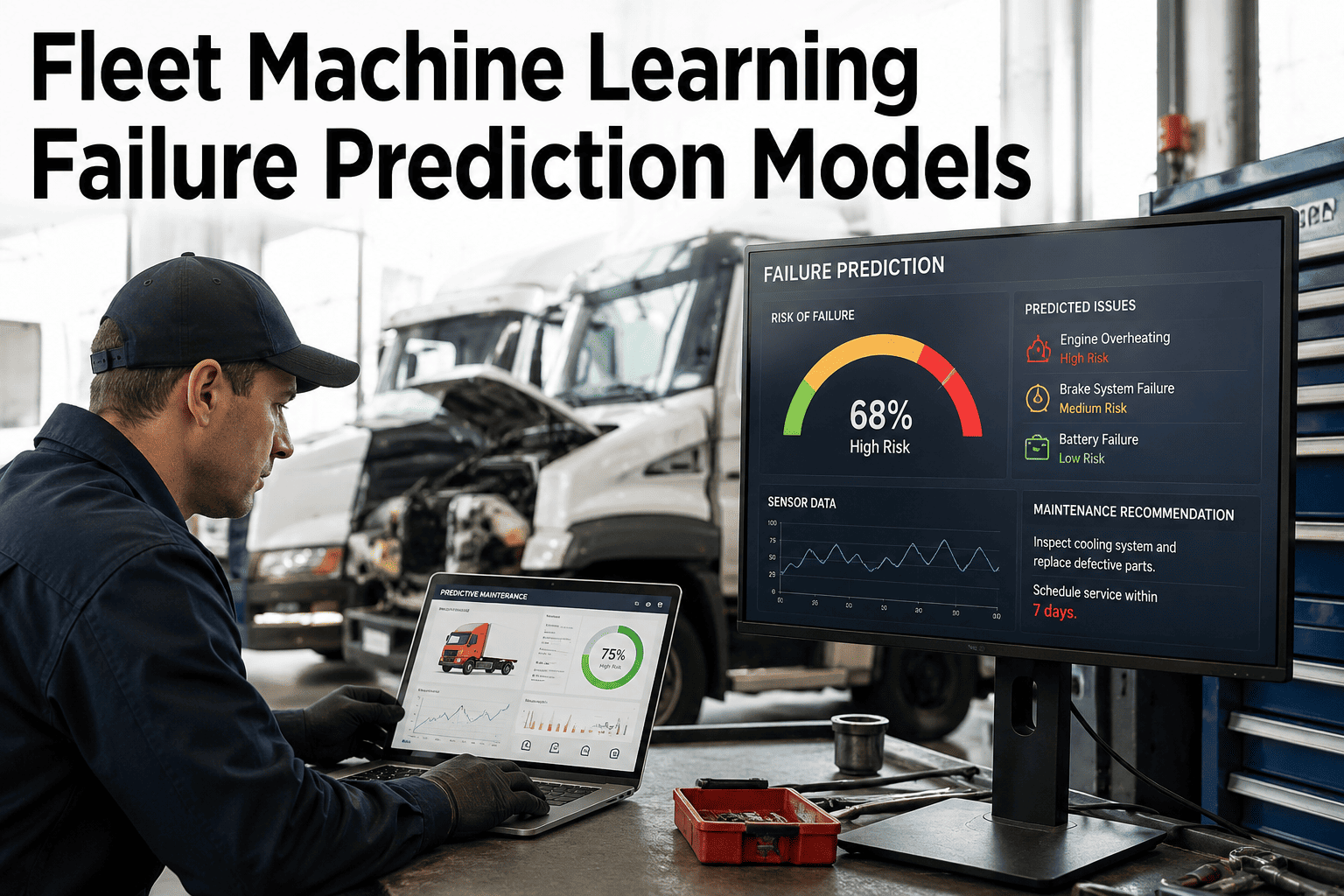
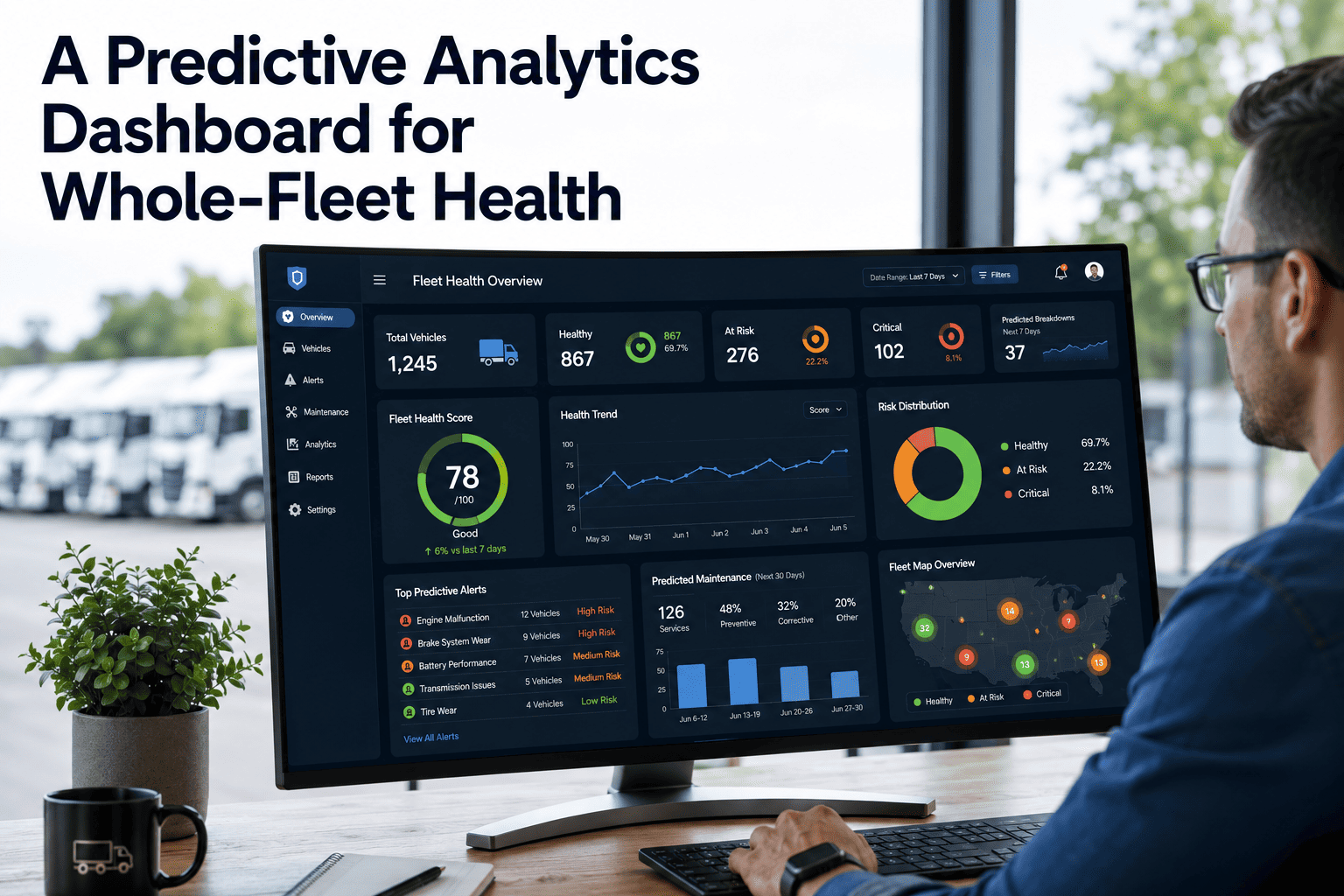
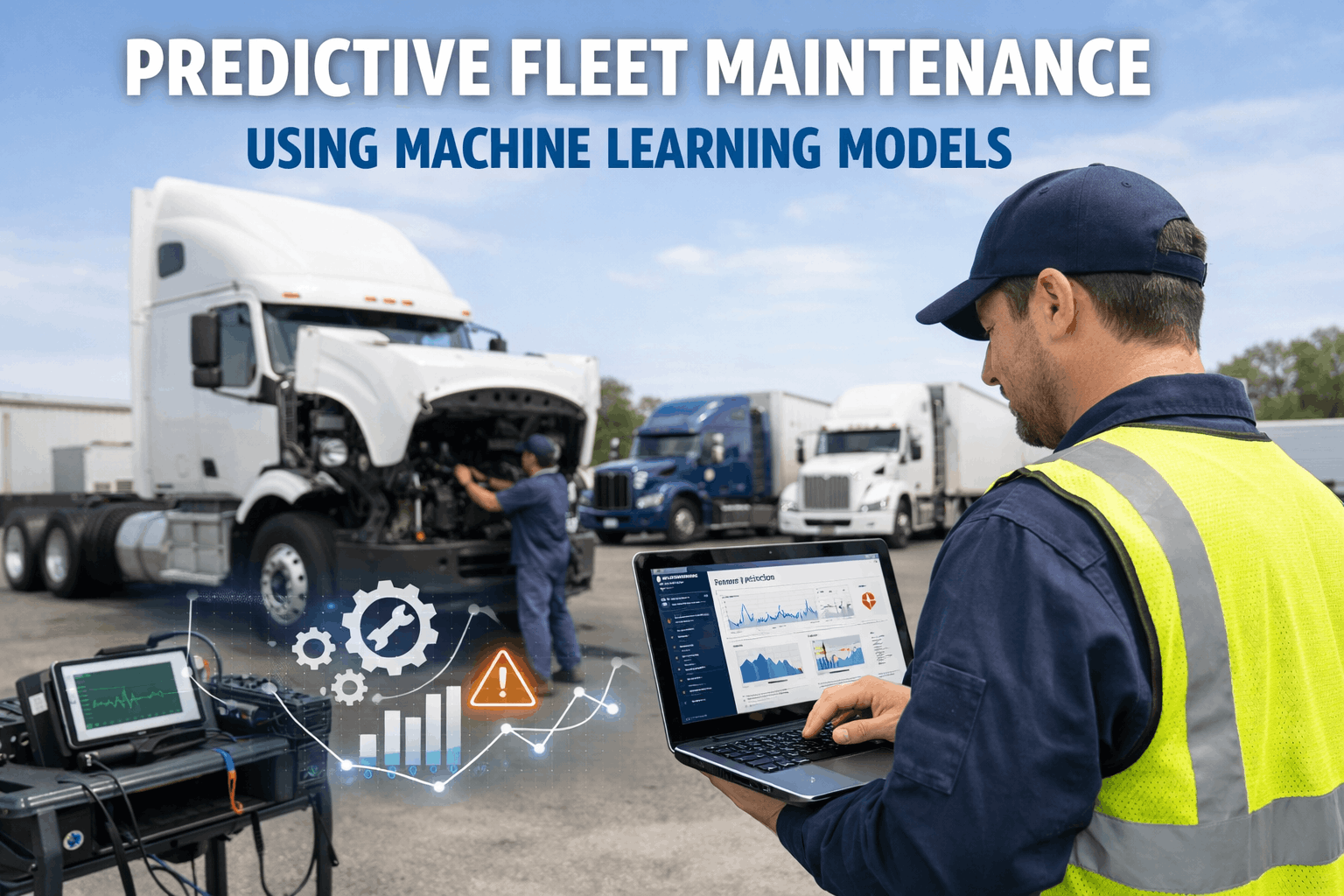
In late 2025, a 400-vehicle refrigerated logistics fleet deployed an AI-powered CMMS that ingested telematics data from every truck in real time — engine diagnostics, reefer unit temperatures, brake wear patterns, tire pressure trends, and driver behavior signals. Within its first 72 hours online, the system flagged a pattern no human analyst had spotted: three trucks on the same corridor were showing simultaneous coolant temperature spikes, alternator voltage drops, and increased idle time — a compound signal the AI correlated with imminent water pump failure based on training data from 50,000 similar vehicles. All three trucks were pulled for preventive service. The repair cost $2,400 total. The roadside breakdown, spoiled cargo, and missed delivery penalties those failures would have caused were projected at $187,000. That single prediction — made possible by machine learning models processing data streams that no spreadsheet or human dispatcher could synthesize — paid for the platform's annual license in one weekend. This is not a future scenario. This is fleet AI in 2026: operational, measurable, and compounding in value with every mile driven. Start your free trial and deploy AI-powered maintenance intelligence across your fleet today.
Of fleets have adopted at least some AI solutions (up from 53% in 2024)
Reduction in unplanned downtime achievable through predictive ML models
Of logistics leaders say AI will improve resiliency and future growth
The Seven AI/ML Applications Reshaping Fleet Operations
AI in fleet management is no longer a single tool — it is a constellation of machine learning models operating across every layer of the operation, from the engine control unit inside each vehicle to the cloud analytics platform synthesizing fleet-wide patterns. The seven application domains below represent where AI delivers measurable, proven ROI in 2026. Each domain maps to specific ML techniques, data requirements, and outcome metrics that fleet managers can benchmark against. Schedule a demo to see how OxMaint deploys these capabilities.
OxMaint AI EngineIngest · Predict · Automate
Predictive Maintenance
Failure forecasting, condition-based PM, anomaly detection
Computer Vision Safety
Distraction, drowsiness, following distance, lane departure
Route Optimization
Dynamic rerouting, fuel-optimal paths, delivery clustering
Driver Behavior Analytics
Scoring, coaching, eco-driving, risk prediction
GenAI Fleet Copilots
Natural language queries, auto-reports, agentic workflows
Edge AI Diagnostics
On-vehicle inference, real-time alerts, OBD-II ML models
AI Maturity: Where Does Your Fleet Stand?
The gap between fleets that treat AI as a strategic operating system and those still running on spreadsheets is widening every quarter. The maturity matrix below helps fleet managers assess their current position and chart a realistic path toward AI-driven operations. Most fleets in 2026 sit somewhere between Level 2 and Level 3 — the opportunity is moving to Level 4 where AI becomes the central nervous system of fleet operations.
HIGHAI Integration DepthLOW
LEVEL 4: AUTONOMOUS FLEET AI
Agentic AI workflows across safety, maintenance, dispatchMulti-model orchestration with self-correctionAI generates and executes maintenance decisionsContinuous learning from fleet-wide data lake
AI is the operating system — humans handle exceptions
LEVEL 3: PREDICTIVE + PRESCRIPTIVE
ML predicts failures 2-4 weeks aheadAI-driven driver coaching with real-time alertsDynamic route optimization using live dataAutomated compliance and reporting
AI recommends — humans approve and execute
LEVEL 2: ANALYTICS + DASHBOARDS
Telematics data visualised in dashboardsHistorical trend analysis for maintenanceGPS tracking and basic driver scoringManual interpretation of data patterns
Data visible — but decisions still human-driven
LEVEL 1: MANUAL + REACTIVE
Paper or spreadsheet-based maintenanceTime-based PM schedules onlyNo telematics or sensor integrationFix-it-when-it-breaks culture
No data — every decision is manual guesswork
LOWAutomation LevelHIGH
Implementation Roadmap: From First ML Model to Fleet-Wide AI
Deploying AI across a fleet is not a single software installation — it is a phased transformation that builds data foundations first, proves ROI with targeted use cases, and then scales intelligence across every operational domain. The roadmap below reflects the implementation patterns that deliver measurable results fastest, based on industry benchmarks showing payback within 6-12 weeks for safety improvements and 2-3 months for maintenance cost reductions.
Weeks 1-4
Connect telematics + OBD-II data to CMMS
Build digital asset registry for all vehicles
Establish baseline KPIs: MPG, idle time, MTBF
Data Foundation
Months 2-3
Deploy predictive maintenance ML models
Launch AI driver safety scoring
Activate automated work order generation
First AI Use Cases
Months 4-6
Add route optimisation + fuel analytics AI
Deploy computer vision safety cameras
Integrate parts inventory prediction
Validate ROI and refine models
Expand + Validate
Months 7-12
Deploy GenAI fleet copilot for managers
Enable agentic workflows across operations
Fleet-wide predictive + prescriptive analytics
Continuous model retraining on fleet data
Full AI Operating System
Year 2+
Digital twin fleet modelling
Multi-fleet AI benchmarking
Autonomous scheduling + dispatch AI
Insurance AI integration for risk pricing
Compound Intelligence
Start Your Fleet AI Deployment Today
OxMaint's AI engine connects to your existing telematics, ingests vehicle sensor data, and deploys predictive maintenance, driver safety scoring, and automated work order generation within weeks — not months. Well-designed pilots show measurable results within 6-12 weeks.
AI/ML Performance Dashboard: What to Measure
The fleets achieving the highest returns from AI track six core performance indicators that map directly to the ML models running beneath them. These are not vanity metrics — they are the operational KPIs that justify continued AI investment, demonstrate ROI to leadership, and provide feedback loops that improve model accuracy over time. In 2026, industry leaders agree that benchmarking with real-time data is vital for navigating economic volatility.
Percentage of predicted failures confirmed within 14-day window
AI-driven predictive scheduling vs. reactive baseline year
Fleet-wide driver safety score from AI dashcam analysis
ML route optimization vs. static routing fuel consumption
Maintenance tasks triggered automatically by AI alerts
Combined maintenance, fuel, and safety cost reduction vs. baseline
2026 AI Fleet Technology: What Is New This Year
The AI fleet landscape in 2026 has shifted from experimentation to execution. Three technology waves are converging: agentic AI systems that plan, execute, and self-correct across fleet workflows; factory-embedded OEM telematics that ship in over 90% of new vehicles, eliminating aftermarket hardware costs; and edge AI processing that delivers real-time inference inside the vehicle without cloud latency. Together, these advances are transforming AI from a supplementary analytics tool into the central operating system for fleet management.
AI agents handle end-to-end exception management: read delay, query driver status, update TMS, notify customer, adjust scheduling — then ask humans for approval only when needed.
Factory-installed telematics provide engine diagnostics, battery health, tire signals, and fuel data at deeper levels than aftermarket — with zero hardware cost or installation downtime.
AI models running on-vehicle for instant alerts: drowsiness detection, collision warning, diagnostic anomalies — processed in milliseconds without cloud dependency.
Natural language querying of fleet data — managers ask conversational questions and receive instant answers from years of telematics, maintenance, and compliance records.
Computer vision models detect close-following, phone use, drowsiness, and lane departures with weekly model updates improving accuracy continuously.
Maintenance AI agents that predict failures also pre-authorize parts purchases based on predicted needs — ensuring inventory availability when repairs begin.
Expert Perspective: AI as the Central Nervous System
"
We started with one AI use case — predictive maintenance — and the results were so compelling that within six months, every department wanted in. Safety wanted computer vision. Operations wanted route optimization. Finance wanted automated reporting. What we discovered is that fleet AI is not a collection of point solutions — it is a platform that gets smarter the more data you feed it. Our predictive models now catch failures three weeks out with over 90% accuracy. Our AI dashcams reduced at-fault accidents by 34%. And our GenAI assistant answers questions that used to require a data analyst and a two-week turnaround — in seconds. The ROI conversation is over. The only question now is how fast we can deploy the next capability.
— VP of Fleet Technology, 600-Vehicle National Logistics Carrier
34%
Reduction in at-fault accidents with AI dashcams
3 Weeks
Average failure prediction lead time
90%+
Predictive maintenance model accuracy
The fleet management industry crossed a decisive threshold in 2025-2026. AI is no longer experimental — it is operational infrastructure. The fleets that treat machine learning as their central operating system will compound their advantages every quarter through better predictions, lower costs, safer operations, and smarter decision-making. Those that wait will find the gap widening as AI-equipped competitors outperform them on every metric. The technology exists today. The data is already flowing from your telematics. The only missing piece is the platform that turns that data into intelligence. Start your free trial and connect your fleet to AI-powered maintenance, safety, and operational intelligence.
Deploy Fleet AI That Delivers Measurable ROI
OxMaint connects to your telematics, deploys predictive maintenance ML models, automates work orders from sensor alerts, scores driver behavior with computer vision, and gives you a GenAI assistant that answers fleet questions in natural language. Results within weeks — not quarters.
Frequently Asked Questions
What types of AI and ML are most impactful for fleet management in 2026?
The highest-impact AI applications in 2026 are predictive maintenance (ML models forecasting component failures from telematics data), computer vision safety (AI dashcams detecting distraction, drowsiness, and following distance), dynamic route optimization (ML evaluating traffic, weather, and delivery windows in real time), driver behavior analytics (scoring and coaching from telematics patterns), and GenAI fleet assistants (natural language querying of fleet data and automated reporting). Each application uses different ML techniques but all share a common requirement: high-quality telematics data flowing into a unified CMMS platform that can act on the predictions.
How quickly can we see ROI from deploying AI in our fleet?
Well-designed AI pilots typically show measurable results within 6-12 weeks. Safety improvements — reduced harsh braking, speeding, and distraction events — often appear within days of deploying AI dashcams. Maintenance cost reductions and downtime improvements typically require 2-3 months to validate as predictive models build baseline patterns. Fuel savings from route optimization emerge within weeks of activation. Most fleets demonstrate full payback within 12-18 months through maintenance cost reduction alone.
Start free and begin building your AI data foundation today.
Does OxMaint require replacing our existing telematics hardware?
No. OxMaint integrates with your existing telematics providers via standard APIs, MQTT, and cloud-to-cloud connections. Whether you use Geotab, Samsara, Verizon Connect, or factory-embedded OEM telematics, OxMaint ingests your data streams and layers AI analytics on top. In 2026, over 90% of new vehicles ship with factory-installed telematics, providing engine diagnostics, battery health, and tire data at deeper levels than aftermarket devices — all accessible through OxMaint's integration layer with zero additional hardware cost.
What is edge AI and why does it matter for fleet operations?
Edge AI processes data directly on the vehicle rather than sending it to the cloud for analysis. This eliminates network latency, enabling real-time alerts for safety-critical events like drowsiness detection, collision warnings, and diagnostic anomalies — where milliseconds matter. Modern AI dashcams and diagnostic systems use edge computing to deliver immediate in-cab feedback while simultaneously streaming data to the cloud for fleet-wide pattern analysis. The combination of edge inference for speed and cloud analytics for depth creates a comprehensive AI layer across the fleet.
What are agentic AI workflows in fleet management?
Agentic AI represents the next evolution beyond AI assistants. Instead of only recommending actions, agentic systems plan, execute multi-step workflows, and self-correct. In fleet management, an AI agent can read an incoming delay notification, query driver status, update the transport management system, notify the customer, adjust downstream scheduling, and only escalate to a human for approval if needed. Similarly, maintenance agents predict failures, check parts inventory, pre-authorize purchases, and schedule technicians — all without manual intervention. This level of automation saves hundreds of hours monthly in large fleets.
Book a demo to see agentic capabilities in action.