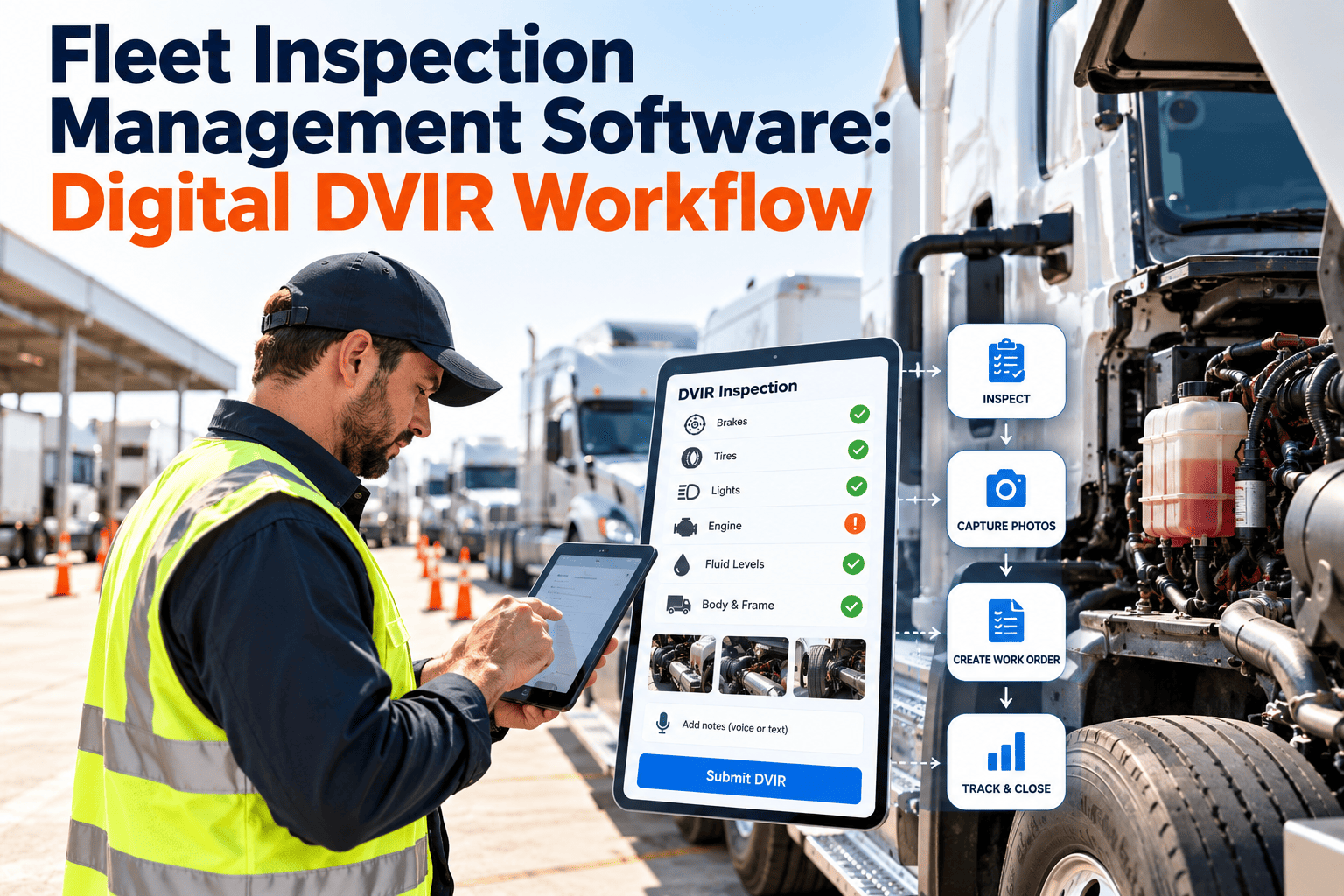
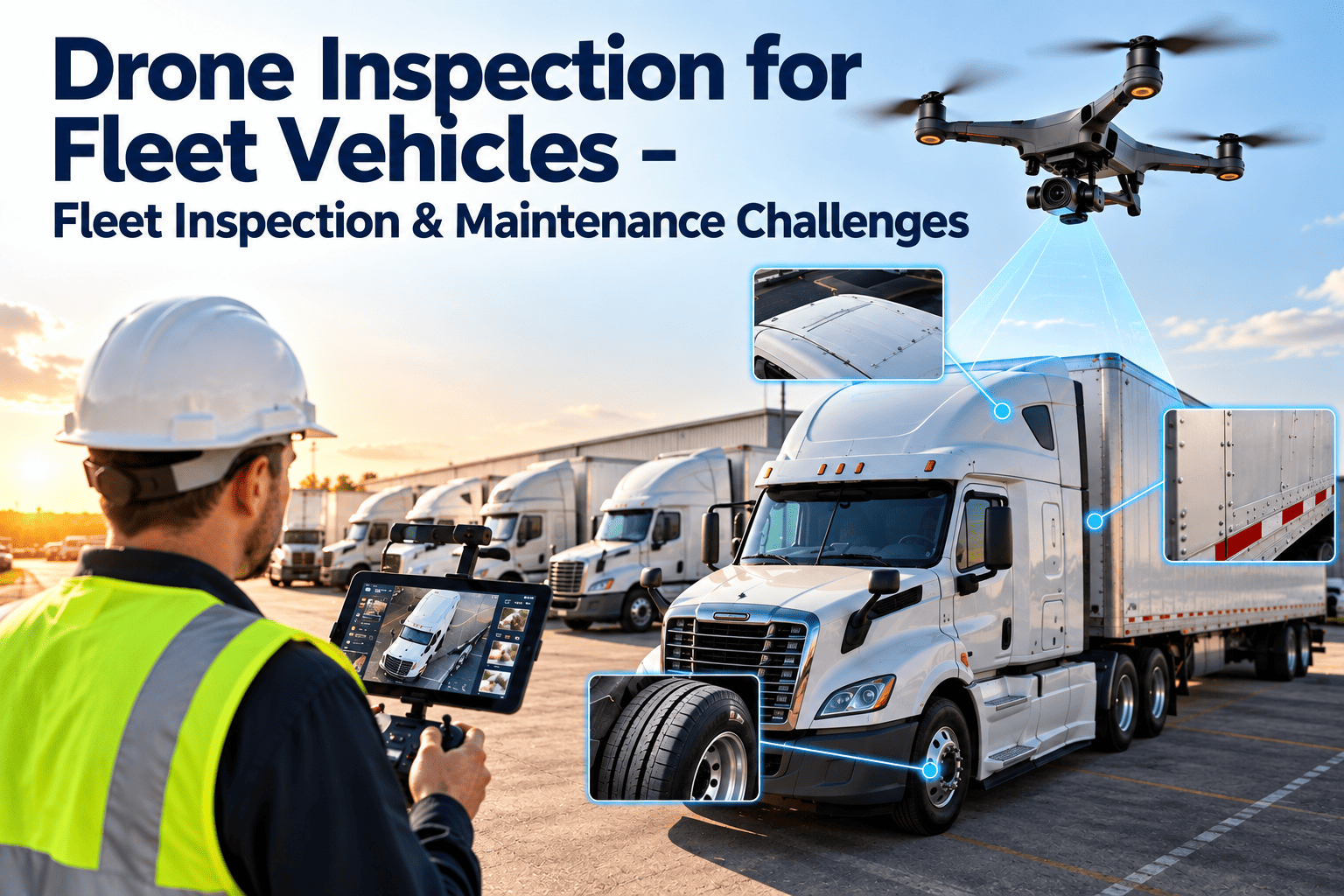
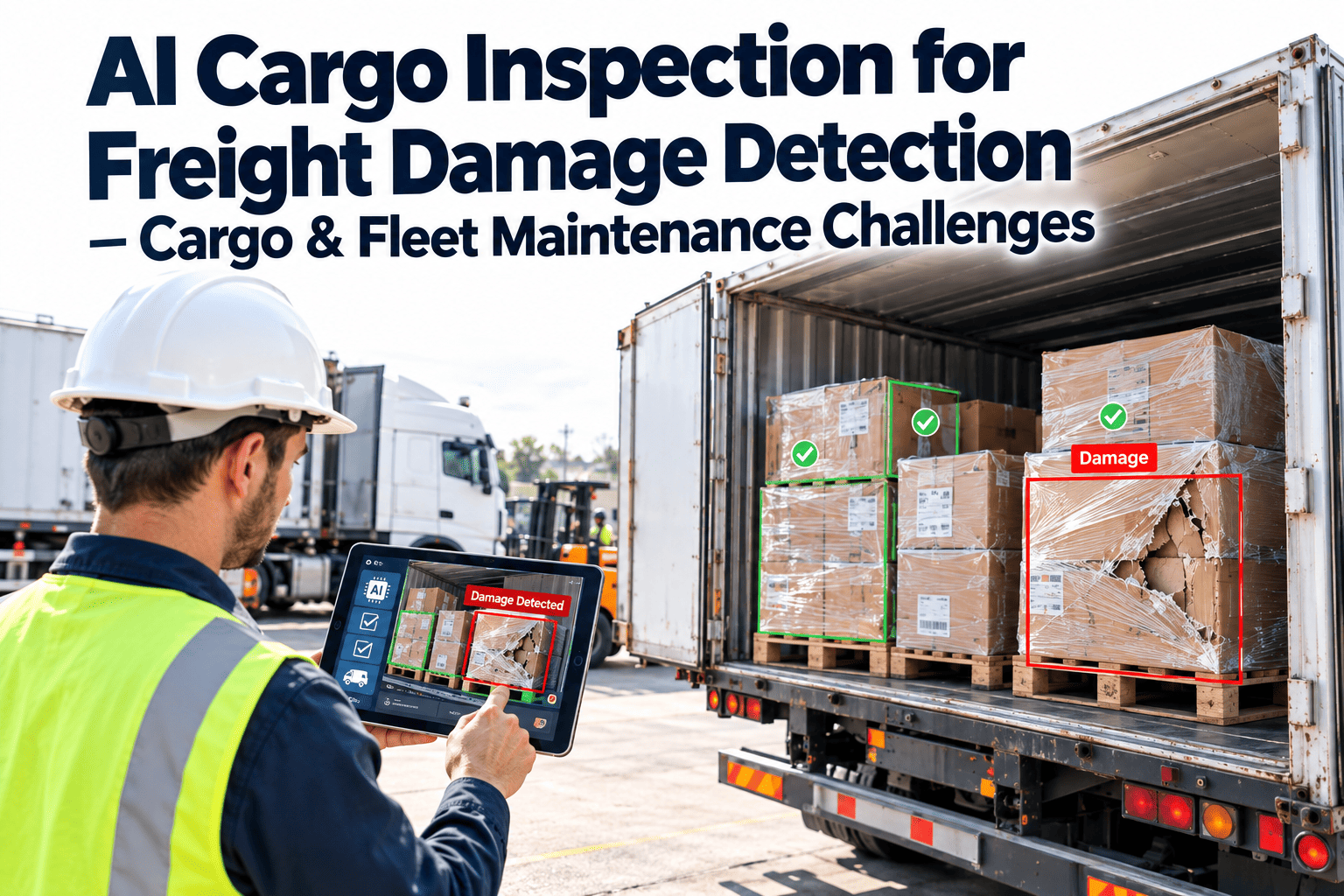
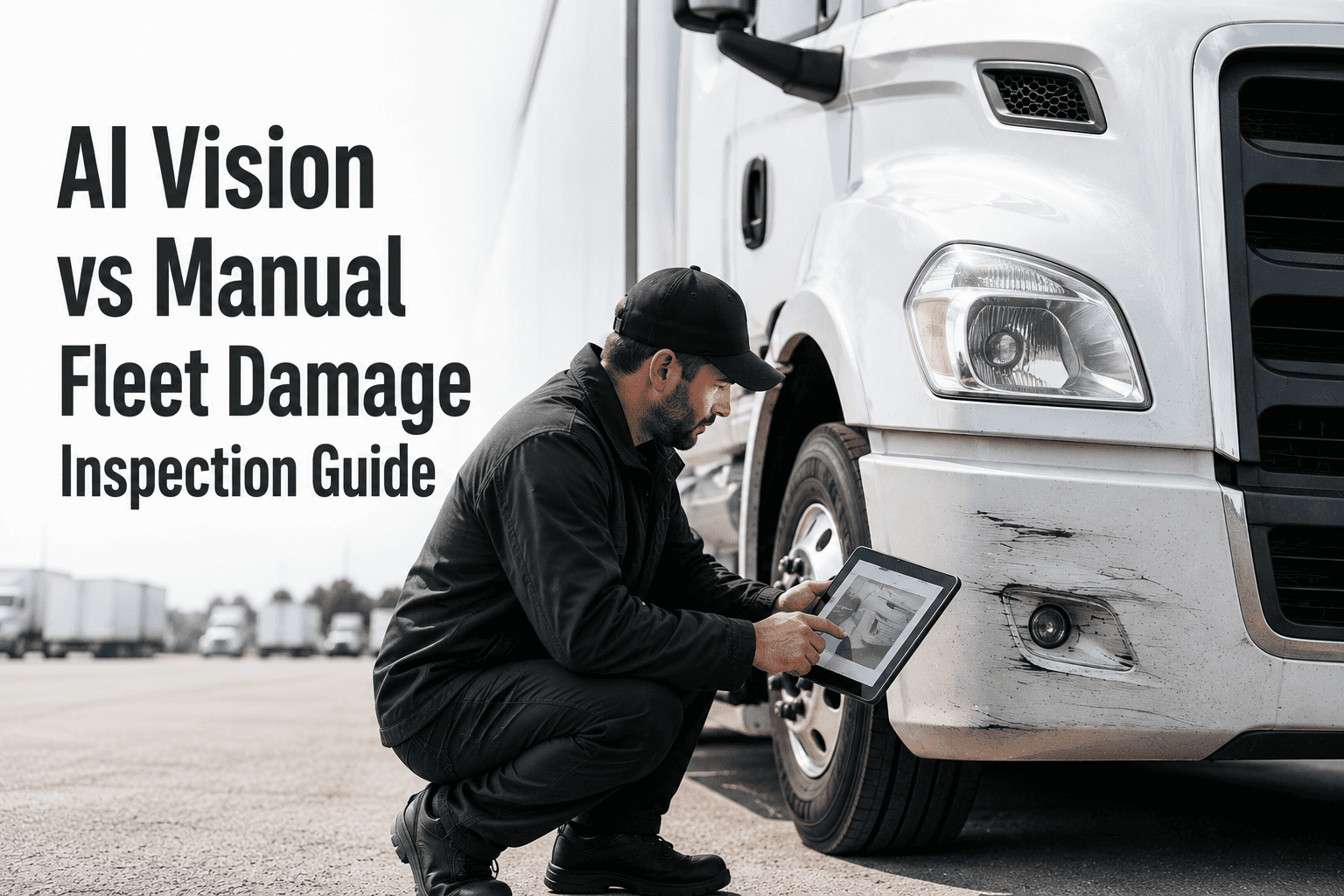
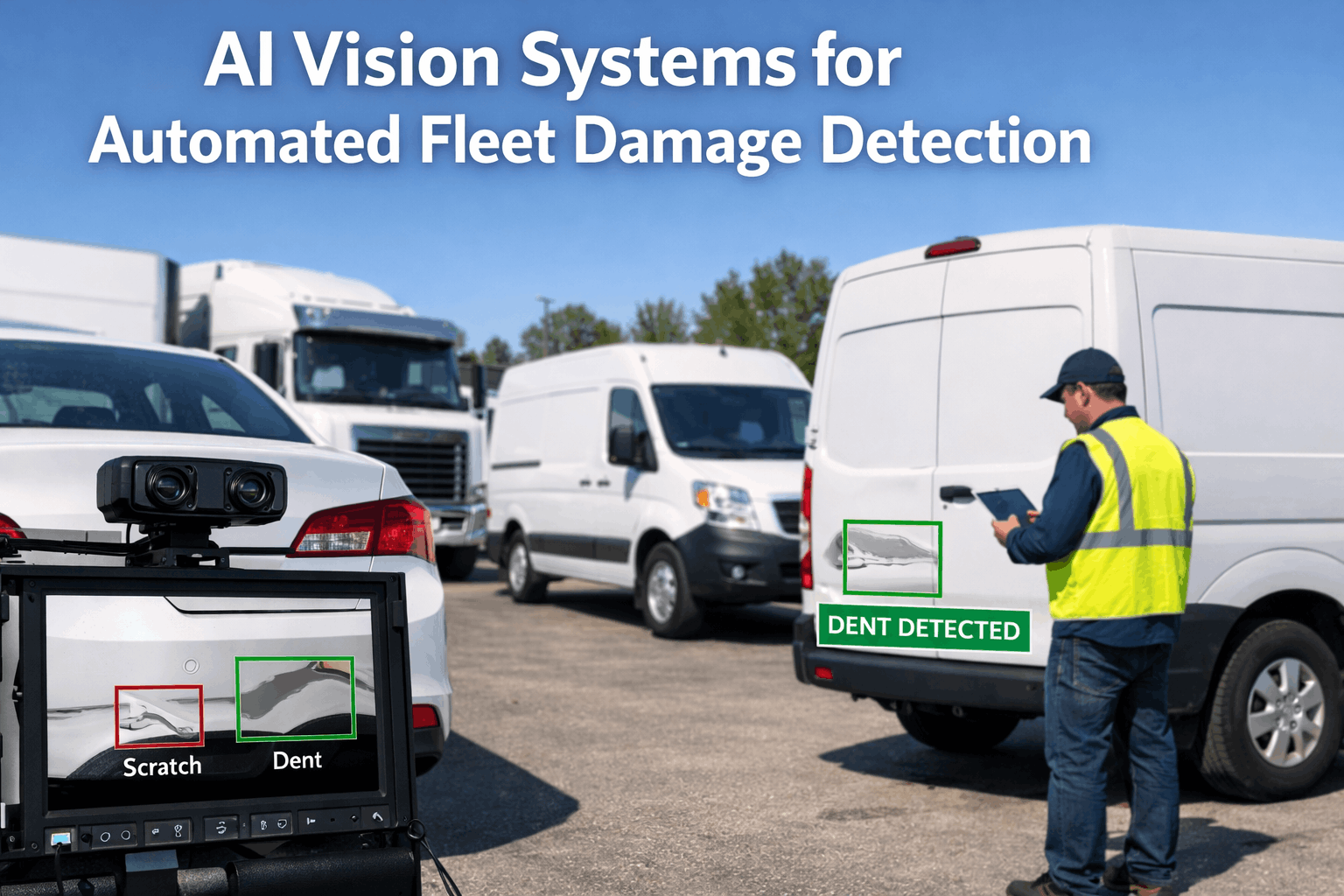
Every fleet vehicle that pulls out of the yard carries risk a two-minute walkaround rarely catches. Hairline cracks in brake hardware, early corrosion along a frame rail, and sidewall damage on a tire all develop long before they show up as a roadside breakdown. A traditional pre-trip inspection depends entirely on how alert, rushed, or thorough one driver happens to be on one given morning, which means the same vehicle can pass inspection Monday and strand a route Wednesday. AI vision damage detection removes that variability by scanning every vehicle the same way, every time, and feeding what it finds directly into a maintenance workflow rather than a clipboard. Fleet teams building this into a connected maintenance management platform are pairing computer vision cameras with automated work order triggers so a flagged defect becomes a scheduled repair in seconds instead of a note that waits in a drop box until someone gets around to reading it.
Fleet Maintenance Technology · AI & Automation
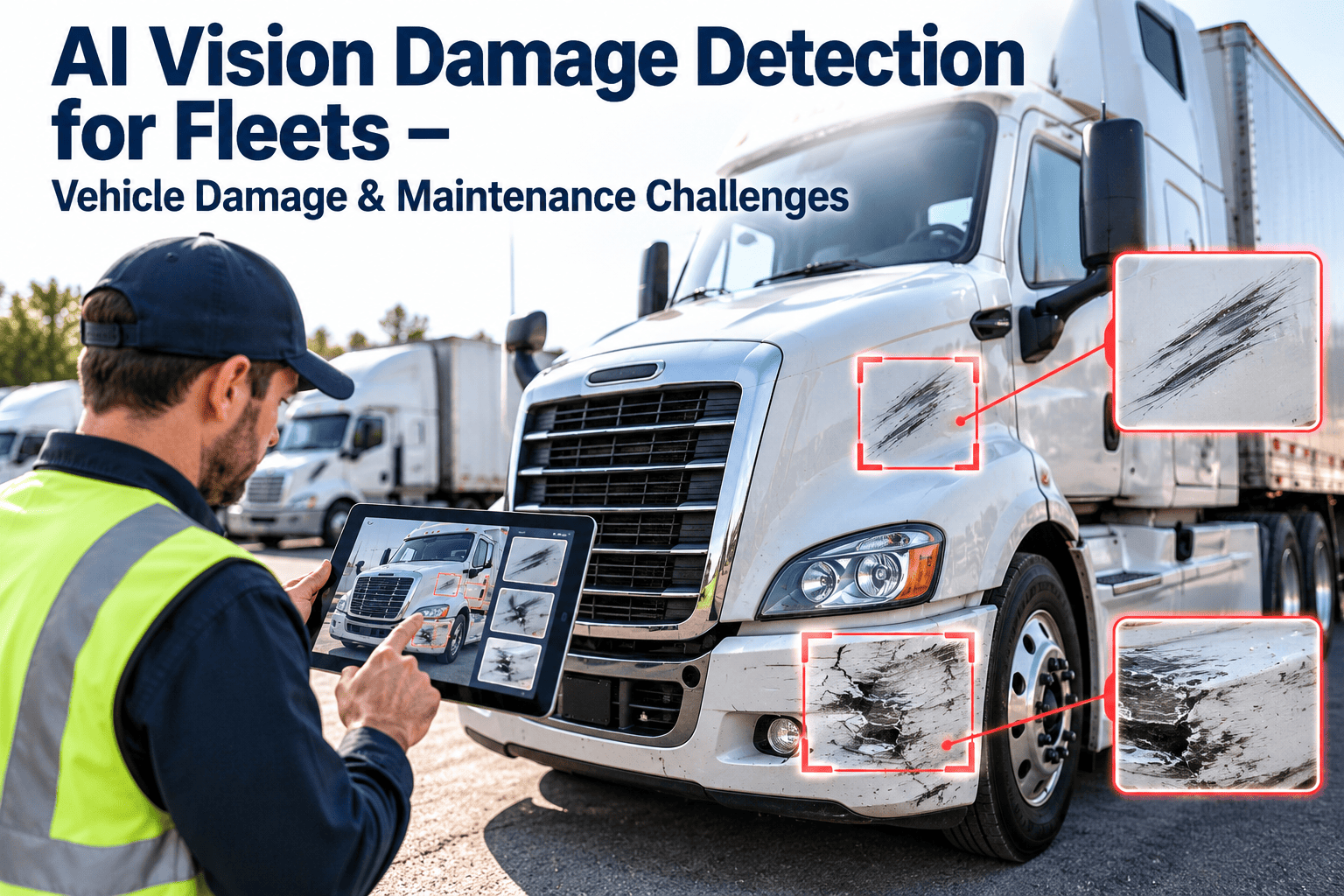
AI Vision Damage Detection for Fleets: Vehicle Damage & Maintenance Challenges
Computer vision cameras now identify dents, cracks, corrosion, and tire wear in seconds — logging photo evidence and routing every finding into a maintenance work order before the driver reaches the gate. Here is how the technology works, what it changes about fleet maintenance, and how to roll it out without disrupting operations.
95%+
Detection accuracy of trained vision models
20-30%
Defects missed by manual walkarounds
163+
Vehicle components covered by AI models
seconds
Time from scan to work order trigger
Why Manual Damage Inspections Keep Failing Fleets
A driver walkaround takes eight to fifteen minutes and produces a subjective, paper-based judgment call. That is not a discipline problem — it is a human limitation. Fatigue, poor yard lighting, and time pressure at dispatch all work against the kind of consistent, pixel-level attention that early-stage damage requires.
Inconsistent Attention
The same vehicle inspected by two different drivers, or by the same driver on two different days, can produce two different outcomes. Nothing about a paper checklist enforces a consistent standard.
No Persistent Evidence
A checked box on a DVIR proves a driver looked, not what they actually saw. Without photo evidence, damage disputes and insurance claims default to whoever argues loudest.
Delayed Defect Handoff
A defect noted on paper sits until someone in maintenance reads it. That gap — often hours, sometimes days — is exactly when a minor issue becomes a roadside failure.
Undetected Micro-Damage
Hairline cracks, early corrosion, and sub-surface tire wear are frequently below the threshold the human eye reliably catches, especially under time pressure or low light.
What Undetected Damage Actually Costs a Fleet
The financial gap between catching damage early and catching it on the road is not incremental — it is exponential. A cracked brake chamber caught during inspection is a parts-and-labor repair measured in hours. The same failure discovered on a highway shoulder involves towing, emergency repair, a missed delivery window, and in the worst case, a collision investigation and liability exposure that dwarfs the original repair cost many times over.
A brake chamber caught at inspection is a parts-and-labor repair measured in hours — the same failure on the shoulder of a highway is measured in tow trucks, missed deliveries, and liability review.
Beyond the immediate repair bill, undocumented pre-existing damage creates disputes at vehicle handback, lease return, and insurance claims — arguments that a time-stamped, photo-verified inspection record settles before they start. Fleets that treat inspection as a compliance formality rather than an early-warning system are effectively choosing to find out about component failure at the least convenient and most expensive possible moment.
Undetected damage does not just cost more to repair — it costs scheduling flexibility too, turning a planned maintenance window into an emergency response.
There is also a scheduling dimension to the cost that gets overlooked. A vehicle pulled from service unexpectedly mid-route disrupts every delivery or job scheduled behind it that day, and the replacement vehicle assigned to cover the gap often is not the right size or configuration for the load. Early detection through a consistent scan lets maintenance planners schedule the repair during a normal downtime window instead of reacting to a breakdown call.
How AI Vision Damage Detection Actually Works
AI damage detection is not a single algorithm — it is a pipeline of models working together, most built on deep learning architectures such as convolutional neural networks trained on millions of labeled vehicle images across lighting conditions, weather, and viewing angles. The steps below describe the general pipeline used by production systems today.
01
Capture
A driver's phone or a fixed yard camera captures a guided sequence of images or short video around the vehicle, following a set path so every panel, tire, and component gets consistent coverage.
02
Detect
A component-recognition model identifies what each frame shows — bumper, wheel well, brake chamber, mirror — then a damage-detection layer scans that region at the pixel level for anomalies.
03
Classify
Each finding is categorized by damage type — dent, crack, corrosion, wear, leak — and assigned a severity level based on size, depth, and location relative to safety-critical components.
04
Route
Severity determines the outcome: a minor cosmetic note logs to asset history, a moderate defect opens a work order, and a safety-critical finding can trigger an immediate out-of-service flag.
What the Models Actually Detect
Coverage varies by vendor and vehicle class, but mature systems recognize dozens of distinct damage categories across well over a hundred vehicle components, each with its own severity scale rather than a simple pass-or-fail label.
| Damage Category | Typical Examples | Common Routing |
|---|
| Body damage | Dents, panel deformation, bumper misalignment | Asset history note or work order |
| Surface defects | Scratches, paint chips, decal wear | Logged, low priority |
| Structural cracks | Frame rails, cross members, mounting brackets | Work order, elevated priority |
| Corrosion | Surface rust, penetrating corrosion, undercarriage | Preventive work order |
| Tire condition | Tread depth, sidewall bulge, uneven wear | Work order or out-of-service |
| Brake components | Chamber cracks, slack adjuster wear, lining thickness | Out-of-service flag |
| Fluid leaks | Drip, active leak, running leak under the chassis | Immediate work order |
| Glass and mirrors | Chips, cracks that impair visibility, loose mounts | Work order |
Detection to Work Order, Automatically
Stop Losing Defects Between the Yard and the Shop
Oxmaint connects AI vision inspection findings directly to work order creation, asset history, and parts availability — so a flagged defect never waits for someone to read a paper form.
Manual Inspection vs AI Vision Inspection
Placed side by side, the operational gap is not subtle. It shows up in detection accuracy, in how long an inspection actually takes, and in whether the record produced would survive an audit or a claims dispute.
Manual Walkaround
Detection accuracy typically 70-80%, dependent on the individual inspector
8-15 minutes per vehicle, often compressed under dispatch pressure
Paper or checkbox record with no photographic proof
No way to verify the inspector was actually at the vehicle
Defect reports depend on someone reading and re-keying them
AI Vision Inspection
Detection accuracy of 95% or higher across trained damage categories
Scan completes in seconds to a couple of minutes, guided step by step
Every finding logged with a timestamped photo and vehicle ID
GPS and image metadata confirm the scan happened at the vehicle
Findings route straight into work orders without manual re-entry
Connecting Damage Detection to Maintenance Operations
A camera that finds a crack is only useful if that finding turns into a scheduled repair. This is where AI vision inspection has to plug into a maintenance management system rather than operate as an isolated reporting tool.
Automated Work Orders
A moderate or critical finding generates a work order automatically, pre-populated with the vehicle, the component, the photo evidence, and a suggested priority — no dispatcher re-typing a paper note.
Asset Condition History
Every scan adds to a running condition record per vehicle, so a maintenance planner can see whether a corrosion spot is new or has been tracked and monitored for months.
Parts and Inventory Alignment
When a detection maps to a known component — a brake chamber, a mirror assembly — the system can check parts availability immediately, shortening the gap between defect and repair.
Mobile Technician Workflows
Technicians receive the work order with photo evidence already attached on their phone, cutting the diagnostic guesswork that normally happens at vehicle drop-off.
Compliance-Ready Reporting
Because every scan is timestamped and archived, fleet managers can produce a full inspection and repair trail for an audit in minutes rather than reconstructing it from paper files.
Fleet-Wide Dashboards
Rather than reviewing vehicles one at a time, a maintenance director can see completion rates, open defects, and recurring damage patterns across the entire fleet on one screen.
Rolling Out AI Vision Inspection Without Disrupting Operations
Fleets that succeed with AI vision inspection treat it as a phased operational change, not a one-time software install. A staged rollout keeps dispatch running while the system proves itself.
1
Pilot at a single yard
Run AI vision inspection alongside the existing manual process at one location first, so results can be compared directly before wider rollout.
2
Integrate with the CMMS
Connect detection findings to work order creation and asset history from day one, rather than letting scan results sit in a separate app.
3
Set severity thresholds
Agree with the maintenance team on what triggers a logged note, what opens a work order, and what stops a vehicle from dispatching.
4
Train drivers on the guided scan
A short walkthrough on how to complete the camera sequence correctly avoids the false negatives that come from an incomplete capture.
5
Expand fleet-wide
Once thresholds and workflows are validated, extend the same configuration across every yard so every vehicle gets the identical standard.
The fleets that get the most value from this rollout sequence are the ones that resist the urge to skip the pilot stage. Configuring severity thresholds against real fleet data, rather than a vendor's default settings, is usually what separates a system that reduces false alerts from one that maintenance teams quietly start ignoring after the first few weeks.
Where AI Vision Inspection Delivers the Most Value
Not every fleet needs the same configuration, but the operational logic holds across sectors: the more a vehicle changes hands, the more valuable an objective, timestamped condition record becomes.
Logistics and Distribution
High daily mileage and frequent driver rotation make consistent inspection difficult to sustain manually, which is exactly where an automated scan holds a fixed standard across every route and every driver.
Vehicle Rental and Leasing
Condition at check-out and check-in determines who pays for damage. A photo-verified scan at both points removes the guesswork that normally turns into a billing dispute.
Utilities and Field Service
Service vehicles operate off-road and in tight job sites where body and undercarriage damage accumulates gradually, making a regular scan the only practical way to catch it early.
The common thread is not the vehicle type but the volume of inspection cycles a fleet has to sustain. Once a fleet passes a few dozen vehicles, manual review simply cannot keep the same standard on every unit every day — which is the gap AI vision inspection is built to close.
Frequently Asked Questions
How accurate is AI vision damage detection compared to a human inspector?+
Trained computer vision models typically reach detection accuracy in the 95 to 99 percent range under normal lighting and camera conditions, compared with roughly 70 to 80 percent for manual walkarounds, largely because the model applies the same standard on every scan regardless of fatigue or time pressure.
Does AI damage detection replace the driver pre-trip inspection?+
No. It supplements the driver inspection by adding a consistent, photo-verified layer of detection, particularly for micro-damage the eye tends to miss. Safety-critical judgment calls, and the final decision on whether a vehicle is fit to dispatch, still route through the driver and maintenance team rather than being handed off entirely to the model.
How does a detected defect turn into an actual repair?+
When AI vision inspection is connected to a maintenance platform like
Oxmaint, a defect above the configured severity threshold automatically generates a work order with the photo evidence attached, removing the manual step of someone reading and re-entering a paper note.
What does it take to roll out AI vision inspection across a fleet?+
Most fleets start with a single-yard pilot, connect the detection output to their maintenance system, agree on severity thresholds with the maintenance team, and then expand once the workflow is validated — typically a matter of weeks rather than months, provided the maintenance team is involved in setting thresholds from the start rather than being handed a finished system after the fact.
Can AI vision inspection help with insurance and damage disputes?+
Yes. Because every scan is timestamped, photo-verified, and tied to a specific vehicle, it creates evidence of condition at a specific point in time, which is far stronger in a claims or handback dispute than a checked box on a paper form, and it tends to shorten how long a dispute takes to resolve.
AI Vision Damage Detection · Oxmaint
Catch Damage Before It Becomes a Breakdown
AI vision inspection only pays off when what it finds turns into action. Oxmaint connects computer vision scans to automated work orders, asset history, and fleet-wide dashboards, so every defect gets tracked from detection to repair without a single paper form.