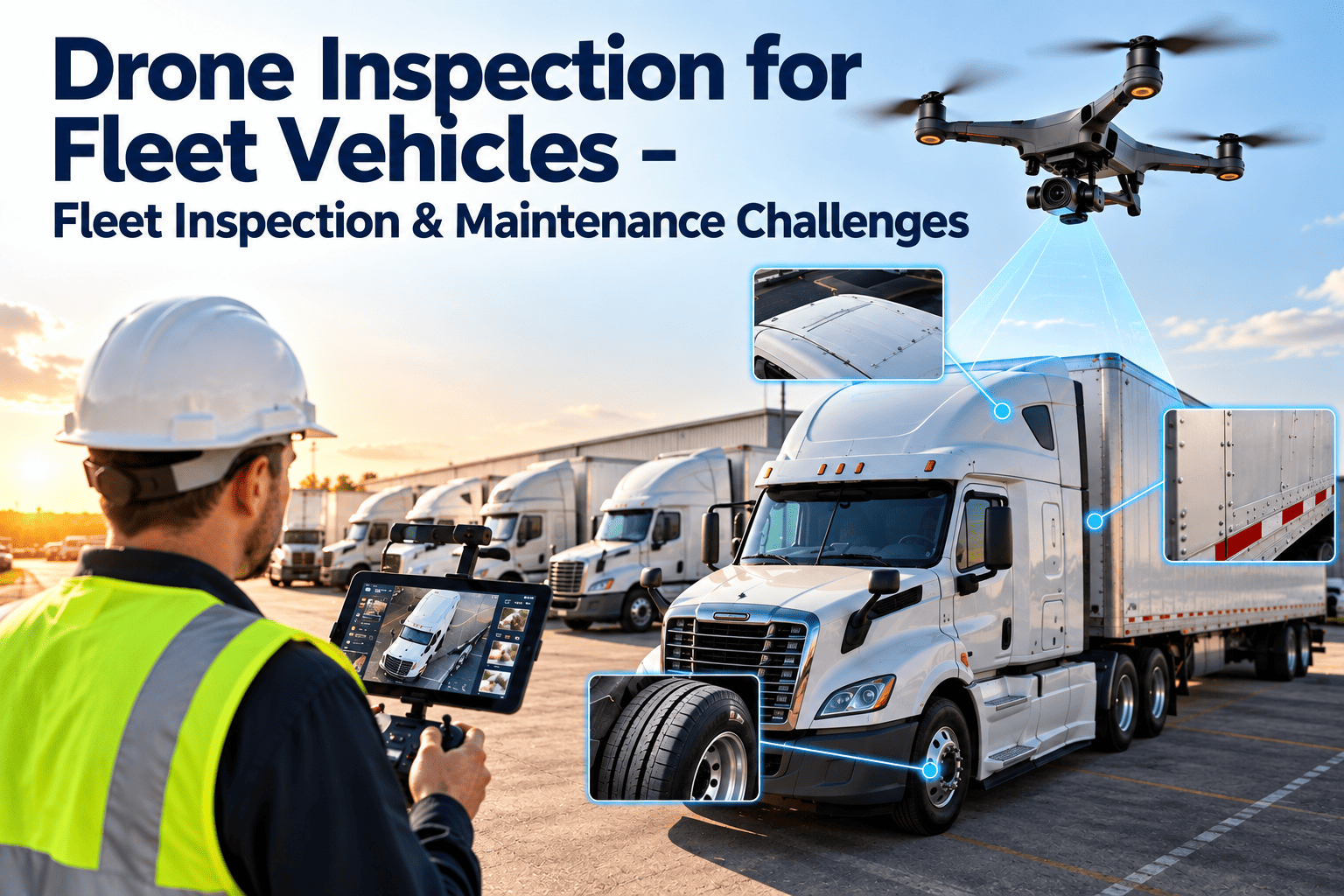
Walking a two-hundred-vehicle yard with a clipboard used to be the only way a fleet manager could know what shape the trucks were actually in. Someone climbed onto trailer roofs, crouched under chassis, and photographed dents on a phone that nobody ever looked at again. Drone inspection has quietly rewritten that routine — small aircraft now fly a fixed pattern over an entire yard, capture high-resolution and thermal imagery of every unit, and hand a maintenance team a prioritized list of what actually needs attention before the vehicle leaves the gate. The technology is not experimental anymore; it is showing up in trucking, construction, and transit fleets that got tired of inspection backlogs eating into uptime.
Drone Inspection for Fleet Vehicles: Solving the Yard Inspection Bottleneck
Large fleet yards outgrow manual inspection long before anyone admits it. Trailer roofs go unchecked for months, tire wear on the far row gets missed, and a rooftop refrigeration leak is invisible from the ground. Camera- and thermal-equipped drones scan a full yard in hours instead of days, and feed every finding straight into a maintenance workflow as a ranked work order.
Why manual fleet inspections stop scaling past a certain yard size
A ten-vehicle yard is manageable with a clipboard. A two-hundred-vehicle yard is a different problem entirely, and most fleets never redesign the process — they just add more inspectors and hope coverage keeps up.
What breaks down first
- Trailer and vehicle rooftops go unchecked because reaching them safely requires a ladder, a harness, and time nobody budgets.
- Inspectors default to the vehicles parked near the gate, so units at the back of a large yard get inspected less often than they should.
- A single inspector can realistically cover a few dozen vehicles a shift, which turns a full-fleet check into a multi-day event.
- Hand-written or photo-only findings rarely make it into a work order the same day, so defects sit unaddressed.
What it costs the operation
- Rooftop refrigeration units on reefer trailers fail without warning because nobody inspects the compressor deck regularly.
- Slow tire wear and sidewall damage on rarely-inspected units surfaces as a roadside blowout instead of a scheduled swap.
- Inspection gaps become compliance gaps, and a DOT or insurance audit exposes months without a documented check.
- Technicians spend more time chasing paper defect reports than actually repairing flagged vehicles.
From drone flight to a technician's work order queue
A drone inspection program is not just hardware in the sky — it is a five-step loop that starts with a flight plan and ends with a completed repair.
Mission planning
A fixed flight path is mapped across the yard using GPS waypoints and geofencing, so every parked unit falls inside the route.
Autonomous flight
The drone launches from a charging dock, follows the route automatically, and captures high-resolution and thermal imagery of each vehicle in turn.
Computer vision analysis
Image models scan the captured footage for body damage, tire wear, fluid staining, and thermal anomalies that suggest a leak or overheating part.
Work order creation
Findings above a confidence threshold are pushed into the CMMS as ranked work orders, tagged to the specific asset and defect type.
Technician action
A technician receives the assignment with photo evidence attached, completes the repair, and the record closes out with a timestamp and sign-off.
What changes when the walk-around becomes a flight path
The comparison is not just speed. Coverage, consistency, and how quickly a finding turns into a scheduled repair all shift once inspection is no longer bound to how many inspectors are on shift.
| Factor | Manual walk-around | Drone inspection |
|---|---|---|
| Time per full yard scan | Multiple days for a large fleet | A few hours, often overnight |
| Rooftop and upper-body access | Requires ladders or lifts, often skipped | Standard part of every pass |
| Consistency across vehicles | Varies by inspector and fatigue | Identical flight path and criteria every time |
| Thermal fault detection | Not practical without added equipment | Built into the standard scan |
| Time from finding to work order | Hours to days, depending on paperwork | Minutes, generated automatically |
See your yard's inspection backlog disappear.
Connect drone-detected defects directly to work orders, technician assignments, and audit-ready compliance records.
Drone inspection earns its keep fastest on these fleet segments
Not every fleet needs a drone program on day one. It pays off quickest where manual inspection is hardest — tall vehicles, wide yards, and rooftop equipment that people avoid climbing to check.
Tall trucks and trailers
Roof panels, marker lights, and structural seams on double-decker or high-cube units are difficult and risky for a person to reach on foot.
Refrigerated trailer fleets
Reefer units mount their compressor and condenser on the trailer roof, exactly where routine ground-level checks never look closely.
Heavy construction equipment
Large upper-body surfaces on loaders and haul trucks take a fraction of the time to scan from the air than from a ladder.
High-density distribution yards
Where hundreds of vehicles sit overnight, a drone can cover the entire lot before the first shift ever clocks in.
A drone finds the defect. A CMMS is what turns it into a repair.
Imagery and AI flags are only half the equation. Without a maintenance platform connecting a finding to an assigned technician, a defect is just a photo sitting in a folder.
Automated work orders
Every flagged defect creates a work order tied to the exact asset, with severity and photo evidence attached automatically.
Asset-level history
Each vehicle builds a running record of every inspection pass, repair, and part replaced, searchable from a single asset profile.
Mobile technician workflows
Technicians see assignments, close them out from a phone or tablet in the yard, and log parts used against the work order.
Compliance-ready records
Every inspection, finding, and repair timestamp is stored for audit purposes, replacing scattered paper defect sheets.
Fleet managers running a structured inspection-to-work-order workflow typically see the biggest gains not from the drone hardware itself, but from how consistently findings actually get closed out afterward. Dashboards that show open findings by age and severity make it obvious when a defect has been sitting untouched, which is exactly the gap that manual inspection programs tend to hide until an audit or a breakdown exposes it.
Why inspection records matter as much as the inspection itself
A DOT audit, an insurance review, or an internal safety investigation does not ask whether a vehicle was inspected — it asks for proof, with a date, a finding, and a resolution attached.
Every drone pass timestamps the exact vehicle, location, and imagery captured, removing any ambiguity about whether an inspection actually happened.
Findings link directly to the work order that resolved them, so a reviewer can trace a defect from detection to repair in one record.
Technician sign-off on each closed work order creates the accountability chain that paper inspection sheets routinely lose.
Historical scans give an auditor a full pattern of inspection frequency, not just a single spot-check pulled at random.
Drone inspection for fleet vehicles — answered
How long does it take a drone to inspect a full fleet yard?
A yard of a few hundred vehicles typically takes a few hours to a single overnight cycle, depending on drone count and yard layout, compared to several days for a manual pass.
What kinds of defects can a drone actually detect?
Body damage, tire wear, fluid leaks, and thermal anomalies such as overheating components or refrigeration faults are the most common findings from combined visual and thermal scans.
Does drone inspection replace manual inspections entirely?
Most fleets treat it as a complement rather than a replacement — drones handle broad, frequent coverage while technicians still perform hands-on checks for items a camera cannot assess, like brake feel or fluid levels.
How do drone findings turn into repairs?
Findings above a confidence threshold are pushed automatically into a CMMS as a work order tagged to the asset, so a technician is assigned without anyone re-typing a paper report. Get Started to see this workflow configured for your fleet.
Is drone inspection worth it for a smaller fleet?
The payoff scales with yard size and vehicle height — smaller flat-yard fleets may get more value from a structured mobile inspection workflow first. Book a Demo to talk through what fits your fleet's size.
Stop letting rooftop and rear-row defects go unnoticed.
Turn every inspection finding — drone-captured or technician-logged — into a tracked work order with a full audit trail.
Free 14-day trial · No credit card