A DEF system failure does not announce itself politely. It flags a truck at a roadside inspection, drops the engine into derate, and strands a load hundreds of miles from the nearest shop. Across a multi-location fleet, the risk multiplies because DEF quality, refill discipline, and sensor health vary by yard, and a single contaminated tank can damage an entire SCR system. With FMCSA now splitting Vehicle Maintenance into two separate scoring categories, even one DEF violation can nudge your fleet toward an audit trigger. Standardizing the practice is the fix, and you can see how with a free trial or a demo.
Best Practices for DEF System Maintenance in Multi-Location Fleet Operations
DEF problems scale faster than any other emissions issue across a distributed fleet. Standardize fluid quality, refill discipline, and sensor monitoring at every yard, and turn surprise derates into scheduled, audit-ready maintenance.
What Makes DEF The Highest-Risk Emissions System To Manage Across Sites
DEF is not a fluid you can treat casually. It is corrosive to common metals, sensitive to contamination from dirt, coolant, or the wrong fluid, and prone to crystallizing and clogging injectors. A single bad refill at one terminal can cause faulty readings and costly SCR damage, and because the symptoms show up as derate or limp mode, the truck stops earning the moment the system faults.
DEF is corrosive to steel, aluminum, copper, and more. Contamination from dirt, chemicals, coolant, or engine oil ruins the fluid and damages the system it is meant to protect.
Crystallized fluid clogs injectors, while freezing at low temperatures and poor-quality DEF trigger faulty readings that put the engine into de-rate or limp mode.
A single sensor or quality fault can take a truck off the road, derail a delivery, and trigger cascading costs across the network, far beyond the part itself.
DEF systems are federally mandated emissions components. With Vehicle Maintenance now split into two FMCSA scoring categories, one DEF violation can move you toward an audit trigger.
Catch DEF Faults Before The Roadside Does
Oxmaint schedules DEF inspections, refill checks, and sensor monitoring as recurring work orders across every terminal, logs fluid quality per site, and flags overdue service before a derate strands a load. The same standard runs at every yard, so DEF stops being the system that surprises you.
Ad-Hoc DEF Handling vs Standardized Multi-Site Practice
DEF reliability is mostly a discipline problem, not a technology problem. The fleets that avoid derates run the same fluid-handling and inspection standard at every location instead of letting each yard improvise.
| Practice Area | Ad-Hoc Per-Site Handling | Standardized Fleet Practice |
|---|---|---|
| Fluid quality | Whatever each yard buys | Spec'd, sealed DEF with contamination controls |
| Refill discipline | Informal, no contamination check | Clean-fill procedure logged per refill |
| Inspections | Reactive, after a fault | Recurring 6-12 month inspection work orders |
| Sensor health | Noticed at derate | Monitored and flagged before failure |
| Records | Scattered across terminals | One audit-ready history per vehicle |
| Cold weather | No freeze plan | Storage and warm-up procedures standardized |
Six DEF Best Practices That Hold At Every Terminal
Standardize on quality DEF and protect it from dirt, coolant, oil, and chemical contamination. Bad fluid is the root of most injector clogging and SCR damage.
Use a contamination-free refill procedure at every yard. A single dirty fill can produce faulty readings and damage the system across the whole truck.
Check the DEF system every 6 to 12 months depending on usage, inspecting for leaks, blockages, and sensor function before they escalate into breakdowns.
Frequent regens and a drop in fuel economy are early DEF and aftertreatment warning signs. A clogged filter alone can cut fuel efficiency by around 5 percent.
Replace sensors and filters at recommended intervals and act on minor alerts. Ignored DEF warnings escalate into derate, limp mode, and far larger repairs.
Maintain one inspection and service history per vehicle so a DEF violation never becomes an audit finding under the split Vehicle Maintenance scoring.
DEF Maintenance Standardized Across Every Yard
Oxmaint turns DEF best practice into recurring work orders, logged fluid checks, and sensor monitoring that run identically at every terminal, with one audit-ready history per vehicle. Inspections trigger on schedule, alerts surface early, and corporate sees fleet-wide DEF status while each yard manages its own units. Keep your fleet compliant and out of derate with a free trial or a demo.
DEF system checks generate as recurring work orders on a 6-12 month cycle per vehicle, so inspections happen on time at every location.
Log fluid checks and clean-fill procedures per site, building a contamination-control trail that protects the SCR system fleet-wide.
Frequent-regen and warning-light patterns surface early so sensors and filters get replaced before a derate strands a load.
Every DEF inspection and repair lands in one searchable record, keeping the fleet audit-ready under split Vehicle Maintenance scoring.
The Early DEF Symptoms Every Yard Should Catch
DEF failures rarely happen without warning; the warnings just go unnoticed when no one is watching for them. Training every terminal to recognize these early symptoms turns a future derate into a scheduled inspection. Each sign below points to a specific developing problem in the DEF or SCR system.
A rising regen count signals a clogging aftertreatment system. Caught early, it is a cleaning; ignored, it becomes a derate and a stranded load.
A clogged filter can cut fuel efficiency by around 5 percent. A per-unit economy dip is often the first measurable sign of DEF trouble.
DEF and SCR fault codes precede de-rate. Acting on a minor alert is far cheaper than the limp-mode recovery that follows ignoring it.
White crystalline buildup around injectors or caps points to crystallization that clogs the system and signals fluid-quality or seal issues.
A Clean-DEF Standard That Protects The SCR At Every Site
Most expensive DEF repairs trace back to a handling failure, not a hardware defect. Because DEF is corrosive and contamination-sensitive, the same disciplined fluid standard has to run at every yard. These are the handling rules that keep one bad tank from damaging an entire SCR system.
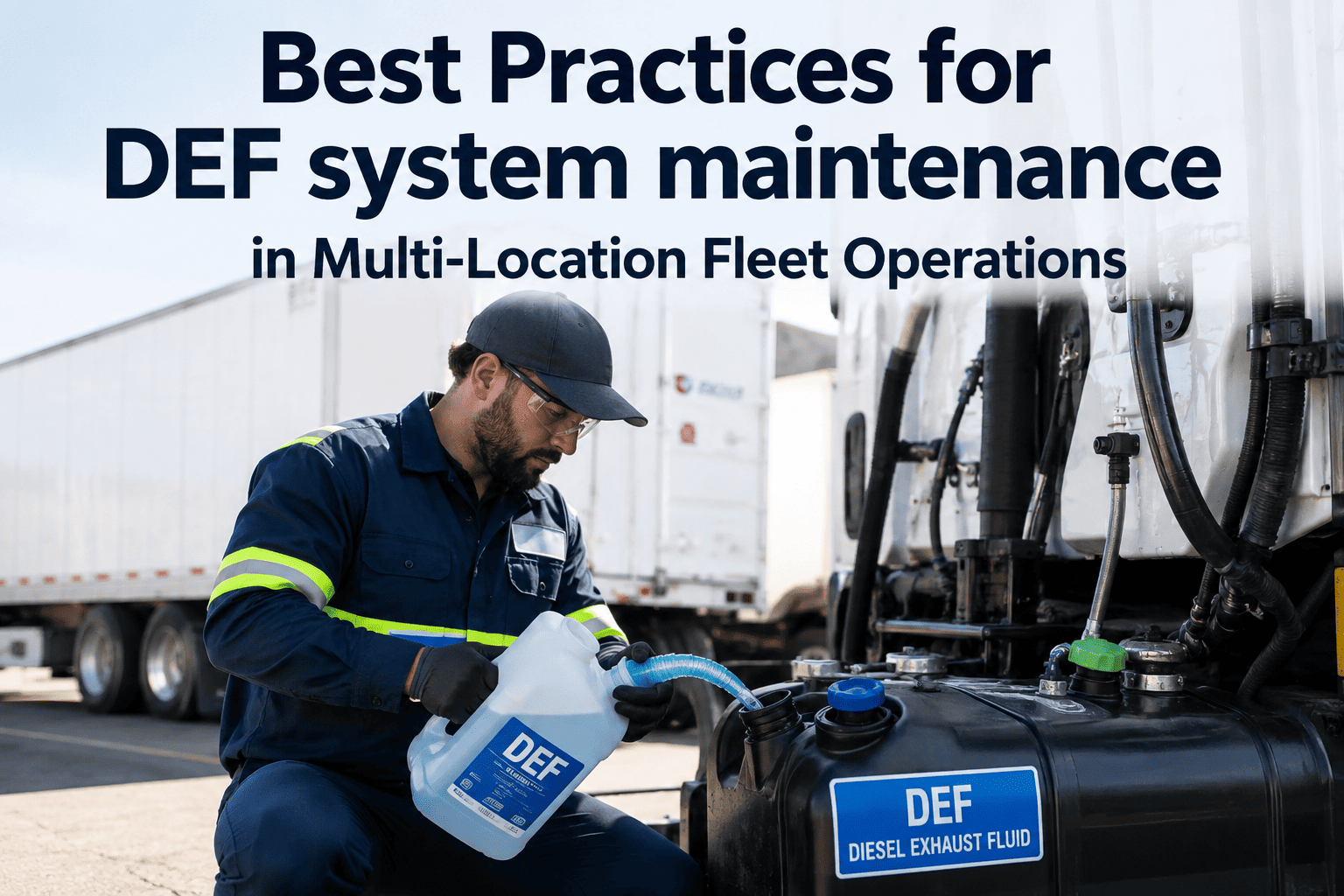
Use DEF-only pumps, funnels, and containers. DEF is corrosive to common metals and picks up contamination from any shared or unclean equipment.
Keep fluid sealed and protected from dirt, coolant, oil, and chemicals. Contamination from any of these ruins the fluid and damages the SCR system.
Store within recommended temperatures and plan for freezing in cold climates, since frozen or degraded fluid produces faulty readings and faults.
Rotate stock and respect shelf life. Old or off-spec DEF is a leading cause of crystallization, injector clogging, and costly downtime.
Record each clean-fill so contamination can be traced to a source. The log is the audit trail that protects both the fleet and the SCR.
Spot-check fluid quality at delivery and before fill. Catching off-spec DEF at the tank is far cheaper than catching it at a roadside derate.
Frequently Asked Questions
How often should a DEF system be inspected?+
What causes most DEF system failures?+
What happens if I ignore DEF warning lights?+
Why is DEF a compliance risk now?+
How does Oxmaint standardize DEF across sites?+
Stop Letting DEF Surprise You At The Roadside
Every contaminated tank, ignored warning light, and missed inspection is a derate and an audit finding waiting to happen. Run one DEF standard across every yard, schedule the inspections, and monitor the sensors, so compliance stays continuous and loads keep moving.