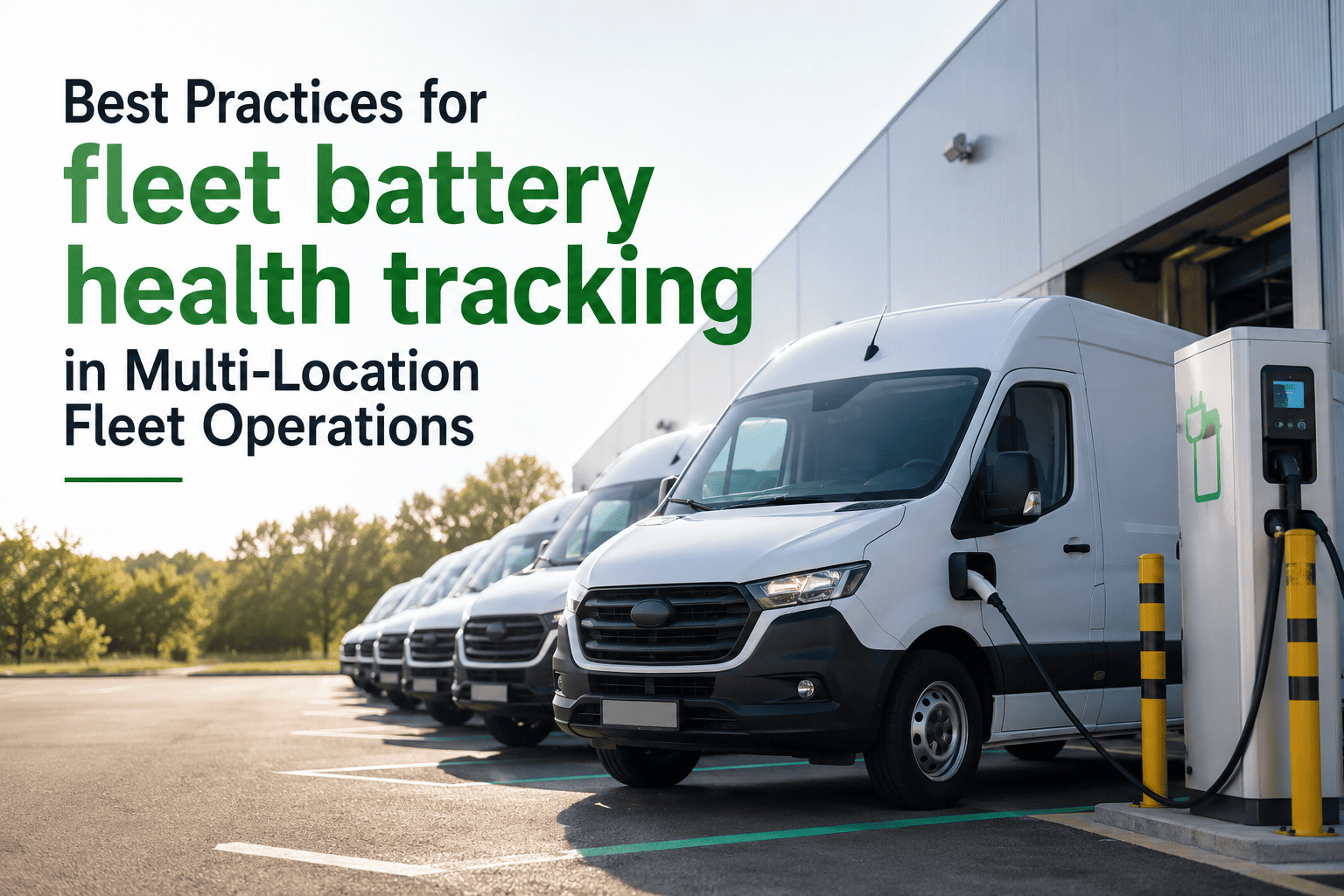
A fleet spread across multiple yards rarely has one clear picture of battery health until a vehicle won't start on a cold morning at a location nobody was watching closely. Battery failures cause roadside calls more often than most fleets expect, and the cost of a reactive jump-start or tow is far higher than a planned replacement. Multi-location operations make this worse because each yard tends to track batteries differently, if at all. Start a free trial to centralize battery health across every location, or book a demo to see the tracking dashboard.
Best Practices for Fleet Battery Health Tracking Across Multiple Locations
When battery data lives separately at every yard, failures look random. Centralized tracking turns battery health into a predictable, schedulable maintenance line item instead of a surprise.
Battery failure is one of the most predictable mechanical events in a fleet, yet it remains one of the most common roadside calls because the data needed to predict it rarely makes it past the yard where it was collected.
Why Battery Health Is Harder to Track Across Multiple Yards
Each location tests batteries differently, with no shared standard for voltage or load testing.
Records stay on paper or local spreadsheets, invisible to the central maintenance team.
A battery near end of life at one yard never triggers a fleet-wide pattern check.
The vehicle fails to start during a route, creating a roadside call and a missed delivery.
Without a centralized record, the same failure pattern repeats at another yard with no one connecting the dots.
This chain breaks the moment one piece of it becomes centralized. Even just pulling voltage readings into a shared vehicle record removes most of the blind spots that let battery failures repeat across locations unnoticed.
Bring Every Yard's Battery Data Into One View
Oxmaint logs battery voltage readings against every vehicle's service history, so a technician at any location sees the same health record and replacement timeline.
Five Best Practices for Multi-Location Battery Tracking
Set the same voltage and load test schedule for every yard so readings are comparable across the fleet, not just within one location.
Attach battery data to the vehicle record so the history travels with the truck even if it moves between locations.
Flag batteries trending downward before they fail outright, giving the team a planned replacement window instead of a roadside scramble.
Locations in colder climates see faster battery degradation, so replacement intervals should be benchmarked by yard, not fleet-wide average.
A monthly cross-location report surfaces whether failures cluster around a specific battery brand, vehicle model, or yard, pointing to a root cause.
Keep battery purchase dates and warranty terms in one system so no location pays out of pocket for a battery that should still be covered.
Running fewer battery brands across the fleet makes voltage comparisons more reliable and simplifies bulk purchasing and warranty negotiation.
Designate one person per region responsible for reviewing battery health reports, rather than leaving it as an unassigned task that falls through the cracks.
These practices work best together rather than in isolation. A standard test interval means little if the readings never reach a shared dashboard, and a dashboard means little if no one owns the responsibility of acting on it.
What Centralized Tracking Looks Like in Practice
| Without Centralized Tracking | With Oxmaint Battery Tracking |
|---|---|
| Each yard tracks batteries on its own paper log | One dashboard shows battery health across every location |
| Failures discovered only at the roadside | Voltage decline alerts trigger before failure |
| No visibility into brand or model failure patterns | Monthly pattern reports highlight root causes |
| Warranty claims missed due to scattered records | Warranty dates tracked centrally per battery |
| No way to compare battery brand performance | Brand-level failure data visible across the fleet |
| Cold-climate yards treated the same as warm-climate yards | Replacement intervals benchmarked by climate zone |
The difference is not just fewer roadside calls, it is the ability to make a data-backed decision about which battery brand, supplier, or replacement interval actually performs best across your specific operating conditions.
Frequently Asked Questions
How often should batteries be tested across a multi-location fleet?
Can battery data sync automatically from diagnostic tools?
How does centralized tracking help with warranty claims?
What if different locations use different battery brands?
Who should own battery tracking across a multi-location fleet?
Give Every Yard the Same Battery Health Visibility
Replace scattered paper logs with one centralized battery tracking view across your entire fleet.