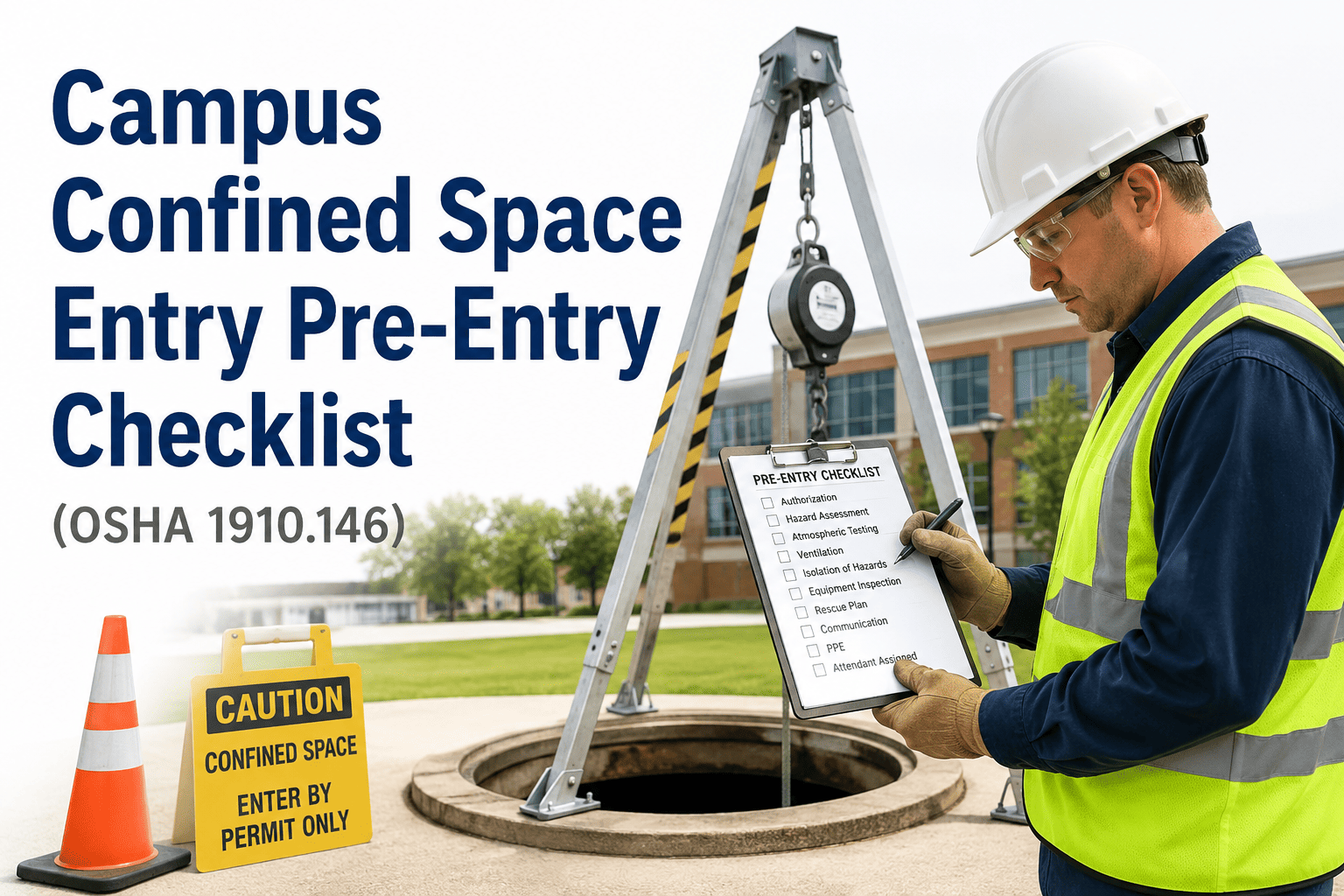
Campus facilities teams face a critical compliance challenge every time a technician enters a boiler room, utility vault, storm drain, or mechanical pit. OSHA 1910.146 governs permit-required confined space entry in higher education settings just as strictly as it does in industrial plants — and the stakes are the same: preventable fatalities, OSHA citations averaging $15,625 per serious violation, and institutional liability. A rigorous campus confined space entry pre-entry checklist is the operational foundation that keeps university maintenance workers safe, keeps facilities directors compliant, and keeps auditors satisfied. Oxmaint helps campus facilities teams build, deploy, and document OSHA 1910.146 confined space programs end-to-end — Sign Up Free to deploy digital confined space permits, or Book a Demo to see campus compliance workflows in action.
Automate Campus Confined Space Permits and OSHA 1910.146 Compliance
Deploy digital pre-entry checklists, atmospheric testing logs, and rescue plan documentation across every campus building — no paper permits, no missing signatures.
OSHA 1910.146 on Campus: The Compliance Stakes for Universities and Colleges
University campuses are dense with permit-required confined spaces — underground utility tunnels, steam vaults, water storage tanks, elevator pits, rooftop mechanical units, and crawl spaces that meet the OSHA definition of spaces large enough to bodily enter, with limited means of egress, and not designed for continuous occupancy. OSHA 1910.146 requires a written permit program, trained attendants and entry supervisors, atmospheric testing before and during entry, and a documented rescue plan. Facilities departments that rely on paper binders and verbal briefings create documentation gaps that cost institutions in both safety incidents and OSHA inspection outcomes. Oxmaint digitizes the full pre-entry process — Sign Up Free to build your campus CSE program, or Book a Demo to see the permit workflow.
Campus Confined Space Entry Pre-Entry Checklist — OSHA 1910.146
| Checklist Item | Responsible Party | OSHA 1910.146 Reference | Verification Method |
|---|---|---|---|
| Space identified and classified as permit-required | Entry Supervisor | §1910.146(c)(1) | Campus CSE inventory map |
| Written entry permit issued and signed | Entry Supervisor | §1910.146(f) | Permit form with date/time/signatures |
| Atmospheric testing — O₂, LEL, toxic gases | Authorized Entrant / Attendant | §1910.146(d)(5) | Calibrated 4-gas monitor; log readings |
| Continuous monitoring plan confirmed | Attendant | §1910.146(d)(5)(ii) | Monitor assigned and operational |
| Energy isolation / lockout-tagout complete | Entry Supervisor | §1910.146(d)(3) | LOTO log; verification test |
| Purging, inerting, or ventilation completed | Entry Supervisor | §1910.146(d)(4) | Pre-entry atmospheric test confirmation |
| PPE issued: harness, retrieval line, respirator if required | Attendant | §1910.146(d)(4)(iv) | Visual inspection; equipment log |
| Rescue plan documented and rescue team notified | Entry Supervisor | §1910.146(d)(9) | Written rescue procedure on permit |
| Communication system tested between entrant and attendant | Attendant | §1910.146(i)(5) | Radio or voice check before entry |
| Entrant and attendant training records current | Facilities Manager | §1910.146(g) | Training log verified against roster |
| Entry point barricaded and warning signage posted | Attendant | §1910.146(d)(1) | Physical barrier + posted permit copy |
| Permit posted at entry point for duration of work | Entry Supervisor | §1910.146(f)(7) | Visible permit; removed on exit |
6 Pre-Entry Phases That Determine Campus CSE Safety and Compliance
Every campus confined space must be classified as permit-required or non-permit. A written permit must be issued before any entry — listing the space, hazards, authorized entrants, attendant, supervisor, and permit validity window. Unsigned or incomplete permits are the most common citation trigger during OSHA inspections.
Test oxygen (acceptable range 19.5%–23.5%), lower explosive limit (below 10% LEL), and toxic gases (CO, H₂S) before entry and continuously during work. Calibrated 4-gas monitors must be used by trained personnel. Test results must be logged on the permit — verbal confirmation is not sufficient for OSHA 1910.146 compliance.
All energy sources — electrical, mechanical, hydraulic, thermal — must be locked out and tagged before entry. OSHA 1910.146(d)(3) requires physical isolation of lines that could introduce hazardous substances. Lockout completion must be documented on the permit and verified by the entry supervisor, not assumed.
OSHA 1910.146 requires a written rescue procedure before any permit entry begins. For university campuses, this means identifying whether campus EHS, local fire department, or a contracted rescue team provides retrieval — and confirming they have been notified and are on-call for the duration of entry. Generic rescue references are not acceptable.
A trained attendant must remain outside the confined space for the entire duration of entry, maintain continuous communication with the entrant, track entrant count, and have authority to order immediate evacuation. Attendants may not perform other tasks that distract from monitoring — a common gap in campus maintenance operations.
OSHA 1910.146(g) requires documented training for all authorized entrants, attendants, and entry supervisors — refreshed whenever procedures change or a near-miss occurs. Campus facilities teams must maintain accessible training records per technician, verified before each entry season.
Paper-Based vs. Digital Campus CSE Program
How Oxmaint Supports Campus Confined Space Entry Programs
Build OSHA 1910.146-aligned entry permit forms with required fields, mandatory atmospheric test entries, and supervisor e-signature. Incomplete permits cannot be submitted — eliminating the most common compliance gap before entry begins. Sign Up Free to configure permit templates.
Map every permit-required confined space by building, floor, and access point. Attach hazard classifications, historical entry logs, and rescue plan documents directly to each space record — accessible from mobile before entry begins.
Technicians enter O₂, LEL, CO, and H₂S readings directly in the mobile permit form. Readings outside acceptable ranges trigger automatic alerts and block permit approval — preventing entries into atmospheres that are immediately dangerous to life or health (IDLH).
Track OSHA 1910.146 training completion, expiry dates, and recertification requirements per technician. Expired certifications block assignment to confined space work orders — keeping only qualified personnel on permit entry tasks. Book a Demo to see certification enforcement.
Generate campus-wide CSE activity reports, open permit summaries, and training compliance dashboards on demand. OSHA inspection readiness goes from days of record-gathering to a single report export — covering every entry across every building.
Deploy recurring confined space inspection checklists that verify signage, cover integrity, and hazard condition before seasonal entry periods. Findings generate work orders automatically — ensuring pre-season hazard remediation before student and staff populations return.
Outcomes from a Digital Campus CSE Compliance Program
Replace Paper CSE Permits with Audit-Ready Digital Workflows
Oxmaint digitizes confined space permits, atmospheric test logs, rescue documentation, and training records — giving campus facilities teams OSHA 1910.146 compliance that holds up under inspection.
Frequently Asked Questions
What spaces on a university campus are classified as permit-required confined spaces under OSHA 1910.146?
Common campus permit-required spaces include underground utility tunnels, steam vaults, electrical manholes, elevator pits, water storage tanks, crawlspaces with mechanical hazards, and rooftop mechanical enclosures. Any space that is large enough to enter, has limited egress, and contains or has potential for hazardous atmospheres or engulfment hazards requires a permit program.
What atmospheric testing is required before a campus confined space entry?
OSHA 1910.146 requires testing for oxygen content (19.5–23.5% acceptable), flammable gases (below 10% LEL), and toxic contaminants including carbon monoxide and hydrogen sulfide before entry. Testing must be performed with a calibrated instrument by a trained person, results logged on the permit, and continuous monitoring maintained during entry.
Does Oxmaint support OSHA 1910.146 permit documentation and record retention?
Yes. Oxmaint generates digital confined space entry permits with mandatory atmospheric test fields, supervisor sign-off, and entrant tracking. All permit records are stored and searchable by space, date, and technician — meeting OSHA's requirement to retain canceled permits for at least one year for annual program review.
How should a university handle confined space rescue planning under OSHA 1910.146?
A written rescue procedure must be established before any permit entry, identifying who performs rescue (campus team, local fire department, or contractor), how retrieval equipment is deployed, and how rescuers are notified. Oxmaint allows rescue plans to be attached to individual space records and reviewed as part of each permit issuance workflow.
Can Oxmaint track confined space training compliance for campus facilities staff?
Yes. Oxmaint tracks OSHA 1910.146 training completion and expiry per technician, role, and department. Expired training blocks assignment to confined space work orders automatically — ensuring only currently certified authorized entrants, attendants, and supervisors are permitted to perform or oversee campus CSE operations.
How often should campus confined spaces be inspected under an OSHA-compliant program?
OSHA requires an annual review of the confined space entry program and canceled permits. Beyond that, physical space inspections — cover integrity, signage, hazard condition — should occur at least seasonally, and whenever physical conditions near the space change. Oxmaint schedules recurring inspection checklists and auto-generates work orders for any deficiencies found.
Protect Campus Workers and Meet OSHA 1910.146 — Deploy Digital CSE Permits Today
Oxmaint automates confined space permits, atmospheric logging, rescue documentation, and training compliance for university and college facilities teams. Sign Up Free — no credit card required. Or Book a Demo for a guided walkthrough of campus safety compliance workflows.