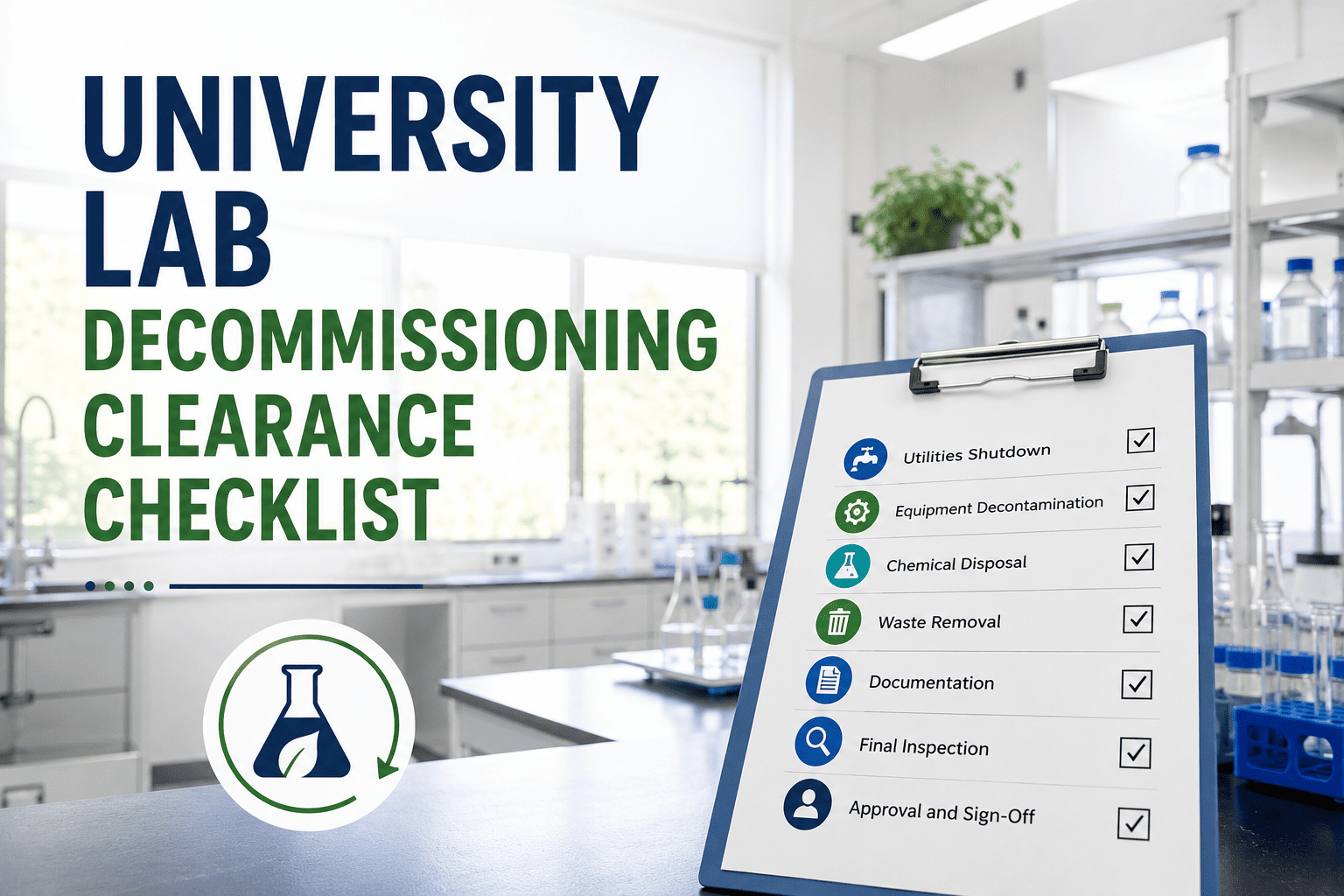
University lab decommissioning is one of the highest-risk closeout events in institutional facilities management — involving chemical inventory disposal, biological clearance, radiation survey sign-off, equipment disposition, and regulatory documentation across multiple departments simultaneously. A missed clearance step can delay a PI's departure, trigger an EHS violation, or leave hazardous materials unaccounted for in a vacated space. Sign Up Free to digitize your lab decommissioning workflow in Oxmaint and eliminate paper-based closeout gaps. Book a Demo to see how university facilities teams use Oxmaint to manage lab closeouts end-to-end.
Manage Lab Decommissioning Clearance in Oxmaint
Oxmaint gives university EHS and facilities teams a guided lab decommissioning workflow covering chemical disposal, biological clearance, equipment disposition, radiation survey, and final space sign-off — with every step recorded, assigned, and auditable per lab location.
University Lab Decommissioning — Phase Clearance Chain
Lab decommissioning clearance proceeds through five sequential phases. Each phase must reach sign-off status before the next can be initiated — skipping ahead creates compliance exposure and blocks the EHS final clearance certificate required for space reassignment.
1. PI Notification and Chemical Inventory Checklist
The chemical inventory freeze is the first mandatory action in any university lab decommissioning. A PI who removes or transfers materials before EHS notification creates untracked hazardous waste — a 40 CFR violation that can generate institutional fines. Sign Up Free to assign PI notification tasks and lock inventory records in Oxmaint the moment a decommissioning request is raised.
EHS decommissioning request submitted — lab number and PI identified
Submit the institutional decommissioning request form minimum 30 days before PI departure. Late notification compresses chemical disposal timelines below regulatory minimums.
Required — 30-day minimum noticeChemical inventory reconciled against institutional ChemTracker or EHS system
Every container in the lab must be accounted for — open containers with degraded labels are a disposal classification problem. Unknown material requires TCLP testing before disposal classification.
Required — 100% reconciliationControlled substances inventory verified with DEA schedule documentation
Schedule I–V substances require DEA Form 41 for disposal — institutional DEA registrant must be notified before any controlled substance is moved or destroyed.
Defect — undocumented controlled substanceSurplus chemicals identified for transfer to another PI or departmental stockroom
Unopened reagents in good condition may be transferred rather than disposed — reducing hazardous waste generation volume and disposal cost.
Note — transfer before disposal classificationFlammable storage cabinet inventoried and removal scheduled with EHS
Flammable and oxidizer storage must be cleared in separate collection events — do not consolidate incompatible material classes into a single waste container.
Required — segregated collection only2. Biological and Radiological Clearance Checklist
Biological and radiological clearance are the highest-liability phases of a university lab decommissioning — requiring sign-off from the Institutional Biosafety Committee (IBC) and Radiation Safety Officer (RSO) respectively before any other party can access the space. Book a Demo to see how Oxmaint routes biological and radiation clearance tasks to the correct authority and holds space release until both sign-offs are recorded.
All biological agents autoclaved, inactivated, or disposed via EHS-approved protocol
BSL-2 and above labs require documented decontamination by autoclave with cycle verification tape — verbal confirmation of decon is not acceptable for IBC sign-off.
Required — documented decon cycleBiosafety cabinet (BSC) decontaminated and NSF 49 recertification or decommission documented
A BSC that has not been formaldehyde-decontaminated or HEPA-inactivated cannot be moved by facilities staff — moving contaminated BSCs is an OSHA bloodborne pathogen exposure risk.
Required before relocationRadioactive material inventory surrendered to RSO and disposal manifest generated
All radioactive material transfers — including waste — require a signed radiation material transfer form filed with the RSO before physical movement.
Required — RSO manifest requiredRadiation surface wipe survey completed — all counts at or below release threshold
Wipe test results must fall below the institutional release limit (typically 200 dpm/100cm²) before the RSO will issue a space clearance certificate.
Hold — retest required if above thresholdIBC protocol closed and any remaining select agents reported to USDA/CDC
Labs registered for select agents must submit a termination report to the Federal Select Agent Program within seven days of the last working day of the PI.
Required — federal reporting deadline3. Equipment Disposition and Asset CMMS Checklist
Equipment disposition during lab decommissioning generates the most interdepartmental friction — assets may be claimed by multiple PIs, carry grant-funded ownership restrictions, or require decontamination certificates before surplus can accept them. Sign Up Free to track every lab asset through disposition in Oxmaint. Book a Demo to see Oxmaint's equipment transfer workflow integrated with your university's asset management system.
All lab equipment matched to asset register — tag numbers verified
Equipment without asset tags must be identified and added to the institution's property management system before disposition — untagged capital equipment is an audit finding.
Defect — untagged equipment foundFederally funded equipment reviewed for grant ownership restrictions
NIH, NSF, and DOD-funded equipment above $5,000 may require agency notification or transfer approval before institutional surplus — review award terms before any disposition action.
Required — grant compliance checkEquipment decontamination certificate issued for all items containing biological or chemical residue
Surplus and moving staff cannot accept equipment that has not been certified clean — a decon cert from the PI lab or EHS is required for every item leaving the lab.
Required before surplus pickupCryogenic and pressurized vessel inventory — gas cylinders returned to vendor
Compressed gas cylinders must be returned to the vendor account holder — abandoned cylinders in a vacated lab are a facilities safety hazard and a lease liability.
Defect — abandoned cylinders foundIT equipment data wiped and submitted to IT asset management for redeployment or e-waste
Lab computers, servers, and storage devices must be data-wiped per institutional data governance policy — hard drives with research data are a FERPA/HIPAA risk if disposed without certification.
Required — data wipe certificateAll assets updated to "disposed", "transferred", or "surplus" status in CMMS
CMMS records for decommissioned lab equipment must be closed out — open maintenance work orders on disposed assets generate false PM schedules and inflate future maintenance backlog.
Defect — open PM on disposed assetTechnology Streamlining University Lab Decommissioning
University lab decommissioning spans EHS, facilities, procurement, IT, and the PI's home department — four to six stakeholders who each require documented sign-off before the space can be released. Manual paper-based workflows create gaps when sign-off documents are lost, tasks are not assigned, or clearance phases proceed out of sequence.
Digitize Your Lab Decommissioning Clearance Workflow
Oxmaint gives university EHS and facilities teams a single platform for chemical clearance, biological sign-off, equipment disposition, radiation survey, and final space release — with every phase tracked, assigned, and auditable.
Frequently Asked Questions
Common questions from university facilities managers, EHS coordinators, and PI administrators about lab decommissioning clearance, CMMS closeout, and regulatory compliance requirements.
Most institutions require 30–60 days minimum notice before a PI's last working day. Chemical disposal scheduling, biological clearance, and radiation surveys each require lead time that cannot be compressed below regulatory minimum handling windows.
EHS issues the final clearance certificate, but sign-off is required from the PI, IBC (if BSL-2+), RSO (if radioactive materials), facilities, and surplus/procurement. All department sign-offs must be recorded before space reassignment.
Equipment purchased on federal grants above $5,000 is subject to the Uniform Guidance (2 CFR 200) — the funding agency may retain title or require prior approval for transfer or disposal. Review the award terms and notify your sponsored programs office before any disposition action.
No. NSF 49 requires that any BSC be decontaminated before relocation — facilities and moving staff cannot legally accept a BSC without a written decon certification. Formaldehyde fumigation or HEPA filter inactivation must be documented.
Oxmaint provides phase-gated decommissioning checklists assigned to each responsible party, equipment disposition tracking with CMMS record closure, hazmat audit documentation, and automated work order routing to EHS, RSO, and facilities — all recorded per lab location.
The RSO must conduct a surface wipe survey with results at or below the institutional release threshold. All radioactive material must be inventoried, transferred on a signed manifest, and disposed per NRC license conditions before the RSO will issue a clearance certificate.
We were managing lab decommissioning across 14 PI moves per year with paper checklists and email chains — sign-off documents were routinely lost, EHS clearance was issued before radiation surveys were complete, and space releases averaged 16 weeks. After deploying Oxmaint's decommissioning workflow, every phase is gated, every sign-off is timestamped, and our average space release time is down to nine weeks.
— Facilities Operations Director, R1 Research University, North America
Every Lab Clearance. Every Sign-Off. Fully Documented.
Oxmaint tracks chemical disposal, biological decon, radiation survey, equipment disposition, and final EHS sign-off in one place — so no clearance phase is skipped and no lab space is released prematurely.