In early 2023, the fleet operations manager for a mid-size U.S. city government stood in front of a filing cabinet holding four years of handwritten vehicle logs, paper inspection sheets, and maintenance receipts. The fleet: 1,200 vehicles spanning police cruisers, sanitation trucks, fire apparatus support units, and parks department equipment. Compliance audit result: 68% DOT documentation completeness. Unplanned vehicle downtime: averaging 9.4 days per incident. PM completion rate: 41%. The city was operating the way most municipal fleets operate — reactively, manually, and invisibly. After deploying Oxmaint's municipal fleet CMMS, the city achieved 100% DOT compliance documentation, cut vehicle downtime by 60%, and brought PM completion to 97% within 12 months. This is how a city government fleet went fully digital — and what that transformation cost, saved, and changed. Book a Demo to see how Oxmaint works for government fleets. The platform supports fleets of any size, with Sign Up Free onboarding and no upfront licence commitment for initial evaluation.
Municipal Fleet Case Study — Oxmaint
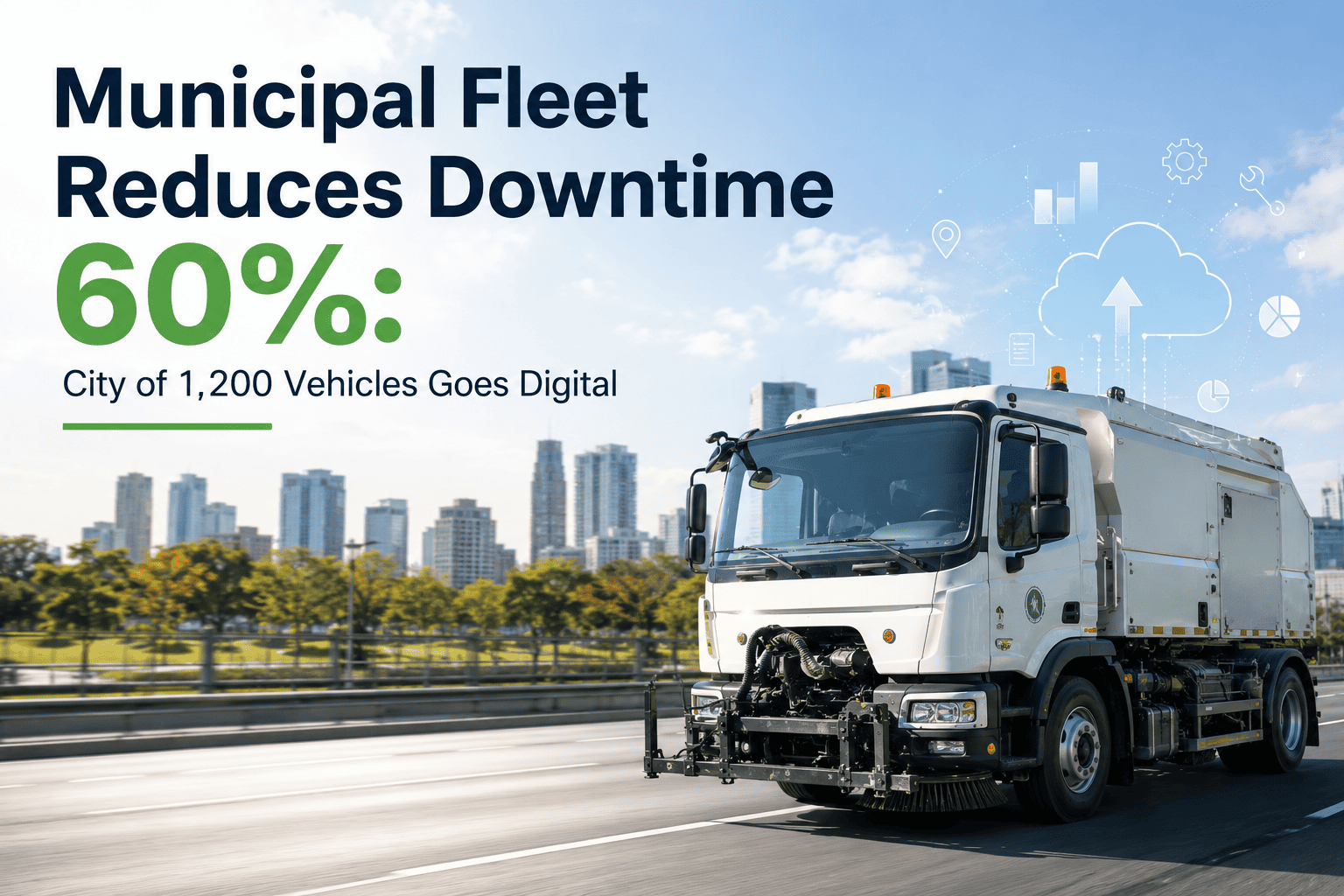
1,200 Vehicles. 60% Less Downtime. 100% DOT Compliance.
A city government fleet eliminated paper, automated compliance, and transformed reactive maintenance into a scheduled, data-driven operation — in 12 months.
60%
Reduction in average vehicle downtime per incident — from 9.4 days to 3.7 days
100%
DOT compliance documentation completeness — up from 68% at baseline audit
97%
PM work order completion rate at month 12 — up from 41% on paper scheduling
The Municipal Fleet Before Oxmaint — Operational Baseline
Paper-based fleet operations in government environments create four compounding problems that no amount of staff effort resolves: documentation gaps that create audit liability, scheduling blind spots that make PM compliance impossible to enforce, reactive repair cycles that inflate parts and labour costs, and no per-vehicle cost visibility to support replacement decisions. The city fleet had all four. Book a Demo to see how Oxmaint addresses each problem simultaneously from day one of deployment.
68%
DOT Documentation Rate
Pre-trip inspection records, repair histories, and certification documents were on paper — incomplete, misfiled, or missing at audit time. Every compliance gap was a liability exposure for the city.
41%
PM Completion Rate
Maintenance schedules were maintained in spreadsheets with no automated alerts. Technicians had no mobile work order access — tasks were assigned verbally or on printed sheets and frequently missed or undocumented.
9.4 days
Avg Downtime Per Incident
Breakdowns triggered manual parts sourcing, supervisor approvals via email, and no priority routing for critical-service vehicles like sanitation and emergency support units.
$0
Per-Vehicle Cost Visibility
Maintenance spend was tracked as a single department budget line. The 80 highest-cost vehicles in the fleet were invisible — their repair patterns undetected until they reached catastrophic failure.
The Solution — Oxmaint Municipal Fleet CMMS Deployment
Oxmaint was deployed across all 1,200 city vehicles in a phased 90-day programme. The platform replaced paper logs with digital work orders, automated PM scheduling per vehicle class, connected OBD telematics for fault detection, and introduced a mobile inspection workflow for pre-trip and post-trip documentation. For government fleet operations, Oxmaint's compliance module provided the audit-ready documentation trail that paper processes cannot deliver. All vehicle histories, inspection records, and work orders became searchable, exportable, and timestamp-verified from day one. Sign Up Free to explore the platform's government fleet configuration before committing to full deployment.
Digital Work Orders & Mobile Technician App
All maintenance tasks issued digitally through the Oxmaint mobile app. Technicians received, accepted, and closed work orders on mobile — capturing labour hours, parts used, and findings per job. Eliminated verbal task assignment and undocumented repairs across all 12 city maintenance facilities.
Automated PM Scheduling by Vehicle Class
PM intervals configured per vehicle type — police cruisers, refuse trucks, light-duty parks equipment, and heavy apparatus support vehicles each received class-specific schedules. OBD mileage and engine-hour triggers replaced fixed calendar intervals, aligning service with actual usage.
DOT-Compliant Digital Inspection Workflows
Pre-trip and post-trip inspections digitalised via Oxmaint's configurable inspection module. Drivers completed DVIR-equivalent checklists on mobile — defects automatically generated work orders. Every inspection timestamped, geo-tagged, and stored for audit retrieval in under 30 seconds.
OBD Telematics & Real-Time Fault Detection
Telematics integration connected Oxmaint to vehicle OBD ports across the fleet. Every DTC triggered an automatic work order within 2 minutes of fault detection — eliminating the manual driver-to-dispatch-to-shop chain that averaged 6.1 hours for critical vehicles before deployment.
Fleet Analytics & Lifecycle Cost Dashboard
Per-vehicle cost dashboards gave fleet management weekly visibility into the highest-cost units for the first time. Lifecycle analytics identified 27 vehicles past economic replacement threshold — disposals executed at optimal timing, recovering residual value before further depreciation.
Implementation Timeline — 90-Day Deployment
Days 1–30
Asset Onboarding & Historical Data Import
All 1,200 vehicles loaded with VIN, class, department assignment, and maintenance history. 3,200+ historical work orders imported from paper records and spreadsheets to establish per-vehicle cost baselines. PM schedules configured per vehicle class across all departments.
First overdue PM alerts fired on day 6 — 214 vehicles with outstanding tasks made immediately visible
Days 31–60
Technician Onboarding & Digital Inspection Launch
All 94 city fleet technicians onboarded to Oxmaint mobile in under 2 hours per person. Digital pre-trip inspection workflows activated for all driver-facing departments. DOT documentation completeness rose from 68% to 91% within 30 days of digital inspection deployment.
PM completion rate rose from 41% to 76% within the first 30 days of digital work orders
Days 61–90
OBD Integration & Priority Dispatch Activation
Telematics connected across 900 OBD-equipped vehicles. Priority dispatch rules activated — critical service vehicles (sanitation, emergency support) routed to highest-priority technician queues automatically. Average fault-to-response time dropped from 6.1 hours to 31 minutes for priority classes.
Unplanned breakdown repairs dropped 38% in month 3 as early fault detection took effect
Months 4–12
Full Results — 60% Downtime Reduction & 100% Compliance
PM compliance stabilised at 97%. DOT documentation completeness reached 100% at month 7 — the first clean audit in the department's recorded history. Vehicle downtime per incident reduced from 9.4 days to 3.7 days. Lifecycle analytics triggered replacement of 27 end-of-life units at the right economic moment.
Full 60% downtime reduction measurable by month 12 — unplanned repair rate dropped from 59% to 11%
Results by Category — Where the Improvements Came From
60%
Vehicle downtime reduction per incident
100%
DOT compliance documentation — first clean audit in department history
97%
PM completion rate at month 12 — up from 41%
81%
Reduction in unplanned maintenance as share of total spend
For years our compliance audit prep took three weeks of staff pulling paper files. Last year it took four hours — we exported everything from Oxmaint. That alone justified the entire deployment. The downtime reduction was the operational win; the documentation completeness was the legal win. We got both.
— Fleet Operations Manager, Municipal Government Fleet, 1,200 Vehicles · Oxmaint customer since 2023
Government Fleet CMMS — Oxmaint
Built for Municipal Fleets. Compliant by Default.
Oxmaint gives city fleet operations digital work orders, DOT-ready inspection records, automated PM scheduling, and per-vehicle cost dashboards — without paper, without compliance gaps, without reactive downtime.
Frequently Asked Questions
Start Your Fleet Transformation — Oxmaint
Your Municipal Fleet. Digital. Compliant. Efficient.
Join city government fleets that have eliminated paper logs, achieved DOT compliance, and cut vehicle downtime with Oxmaint's purpose-built fleet CMMS. No upfront commitment. No disruption to active operations.