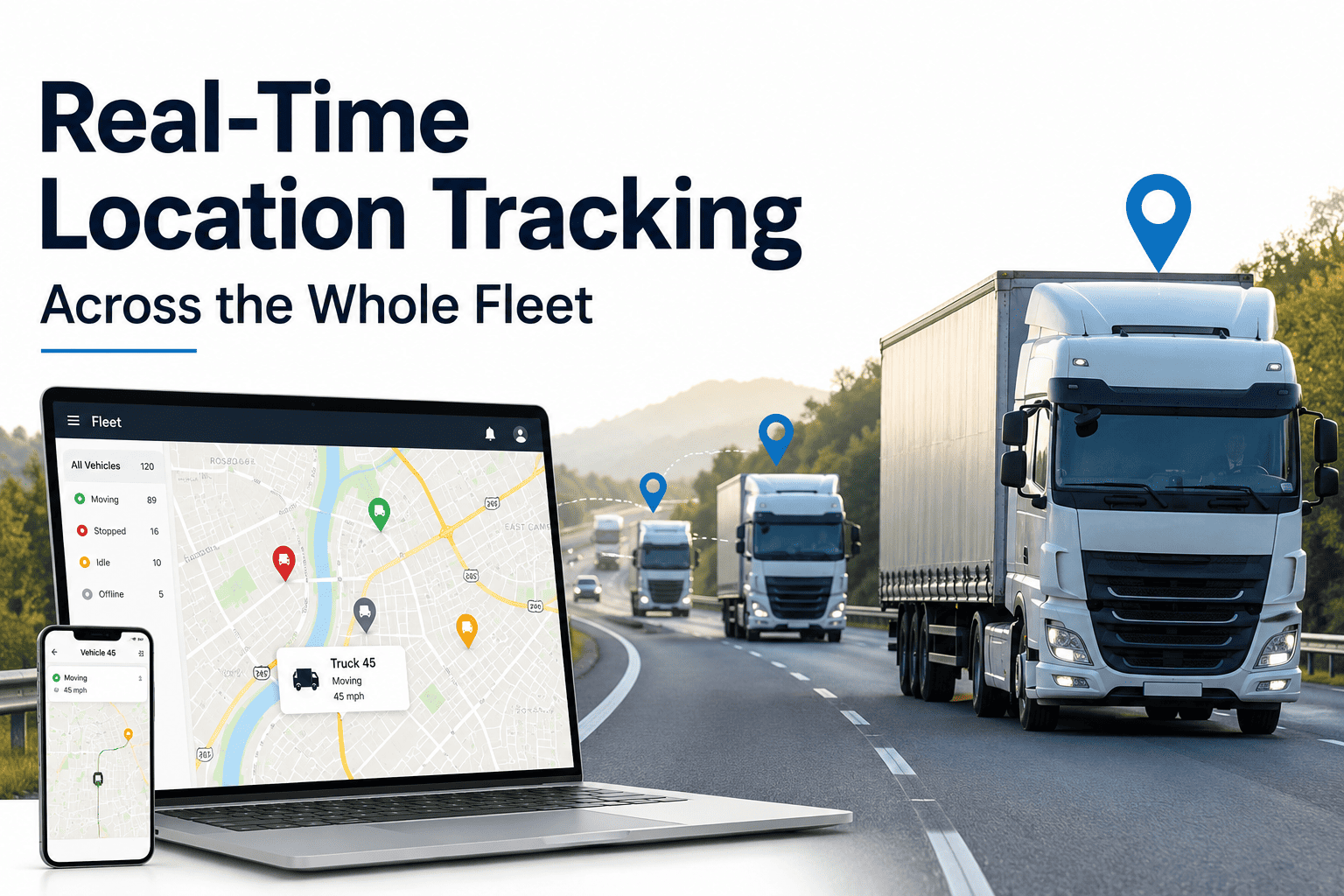
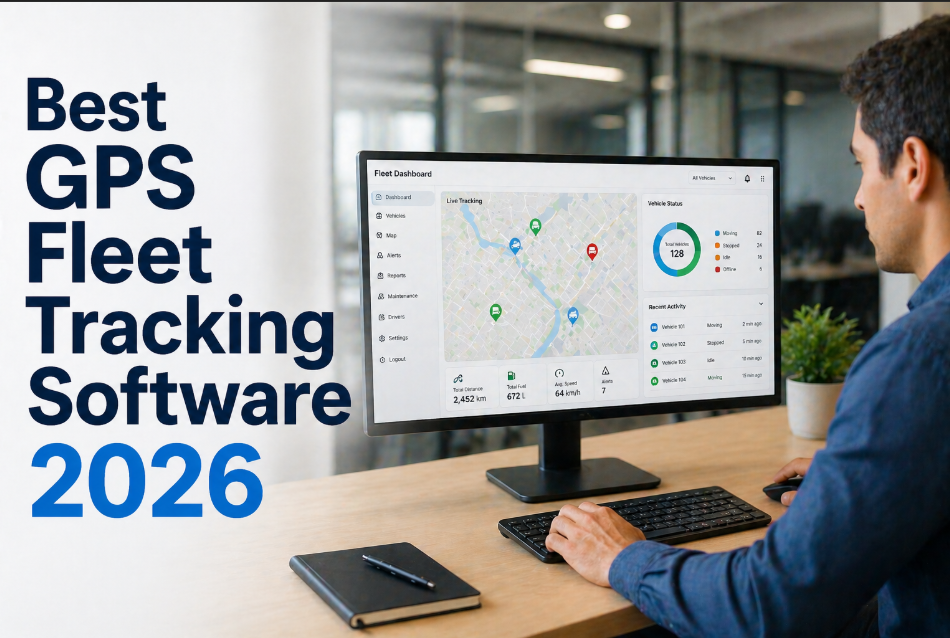
Commercial truck GPS trackers have become the baseline infrastructure of professional trucking operations — but the gap between a $30 OBD-II plug-in and a purpose-built hardwired commercial telematics device is the difference between knowing a truck moved and knowing why it stopped, what the engine reported, whether the driver braked hard on the I-40 descent, and whether the next oil change is 200 miles overdue. In 2026, 91% of trucking fleets with five or more vehicles use some form of GPS tracking — yet fleet managers consistently report that hardware quality and integration depth, not software features, determine whether a tracking investment delivers ROI or collects dust after the free trial. A poorly chosen GPS device fails in extreme temperatures, loses signal in mountain corridors, drains the vehicle battery during extended stops, and captures engine data at 60-second intervals when the fault code that caused a $14,000 breakdown fired and cleared in 45 seconds. This guide ranks the best commercial truck GPS trackers of 2026 by the criteria that matter to professional fleet operations — accuracy, durability, engine data depth, installation reliability, and how well the device connects to your fleet maintenance system. If you want to see how OxMaint connects GPS tracker data directly to preventive maintenance workflows and audit-ready compliance documentation, start a free trial or book a demo today.
Commercial Truck GPS · Hardware Rankings · 2026 Guide
Best Commercial Truck GPS Trackers in 2026 — Ranked by Accuracy, Durability, and Fleet Integration
Hardwired and OBD-II options compared across signal accuracy, engine data depth, temperature tolerance, battery impact, geofencing capability, and maintenance system integration — for professional trucking fleets that cannot afford tracking hardware that fails in the field.
91%
of trucking fleets with 5+ vehicles use GPS tracking in 2026
$14,000
Average cost of a breakdown caused by an undetected engine fault code
2.5m
GPS accuracy achievable with commercial-grade hardwired trackers in 2026
38%
of fleet GPS devices fail to capture fault codes that caused the breakdown they were present for
Hardware Decision Framework
Hardwired vs OBD-II GPS Trackers — Which Is Right for Commercial Trucks
The OBD-II vs hardwired decision is the most consequential hardware choice in commercial truck GPS tracking — and the one most frequently made on price alone. Here is what each installation type delivers operationally, and where each one fails under real commercial trucking conditions.
OBD-II Plug-In Trackers
Advantages
Self-install in under 2 minutes — no technician required
Transferable between vehicles when reassigning devices
Lower upfront hardware cost — typically $60–$120 per device
Reads basic OBD-II engine diagnostics and VIN automatically
Limitations in Commercial Use
OBD-II port exposed — can be unplugged by drivers in seconds
Power draws from OBD-II port drain battery during extended stops
Limited access to J1939/J1708 truck-specific engine data protocols
Physical vibration in heavy trucks loosens OBD-II connection over time
Best for: Light commercial vehicles, vans, pickup fleets under 10 vehicles
Hardwired Commercial Trackers
Advantages
Cannot be removed without tools — tamper-evident installation
Connects directly to J1939 CAN bus for full heavy-duty engine data
Ignition-controlled power — zero battery drain during vehicle stops
Captures trailer data, axle load, PTO status, and refrigeration units
Considerations
Professional installation required — typically $80–$150 per vehicle
Higher upfront hardware cost — $150–$350 per device
Not easily transferred between vehicles — best for dedicated assignments
Requires scheduling installation downtime per vehicle
Best for: Class 6–8 trucks, long-haul, refrigerated transport, high-value fleets
2026 Device Rankings
Top Commercial Truck GPS Trackers — Ranked and Compared
Evaluated across eight criteria that determine real-world performance in commercial trucking operations: GPS accuracy, update frequency, engine data protocol support, temperature operating range, battery impact, geofencing capability, maintenance system integration, and total cost of ownership over 36 months. The devices that rank highest are the ones that still perform reliably in the conditions where tracking matters most. Want to see how OxMaint connects these devices to a complete maintenance management platform? Start a free trial or book a demo.
#1
Hardwired · Best Overall
Samsara VG34
Update Rate2.5 sec real-time
Engine ProtocolJ1939 + J1708
Temp Range-40°C to +85°C
GPS Accuracy2.5m CEP
Hardware Cost~$199 per unit
Full J1939 engine data with AI-assisted fault code analysis. Dashcam integration available. Best-in-class signal reliability in mountain corridors.
#2
Hardwired · Best for Open API
Geotab GO9
Update RateConfigurable (1–30 sec)
Engine ProtocolJ1939 + OBD-II
Temp Range-40°C to +80°C
GPS Accuracy3m CEP
Hardware Cost~$175 per unit
Industry-leading open API ecosystem with 200+ marketplace integrations. Ideal for fleets with existing CMMS platforms needing GPS data feeds.
#3
Hardwired · Best for ELD Fleets
Motive Vehicle Gateway
Update RateReal-time
Engine ProtocolJ1939 + J1708
Temp Range-30°C to +70°C
GPS Accuracy3m CEP
Hardware Cost~$150 per unit
Tightly integrated with Motive ELD platform. AI dashcam optional. Strong driver behavior scoring. Weaker third-party integration than Geotab.
#4
OBD-II · Best Plug-In Option
Verizon Connect Reveal OBD
Update Rate30 sec intervals
Engine ProtocolOBD-II only
Temp Range-20°C to +60°C
GPS Accuracy5m CEP
Hardware Cost~$99 per unit
Best OBD-II option for light commercial fleets. 30-second update rate is a limitation for real-time dispatch. No J1939 heavy-truck engine data.
#5
OBD-II · Best Budget Option
GPS Trackit GL300
Update Rate10 sec intervals
Engine ProtocolOBD-II basic
Temp Range-20°C to +55°C
GPS Accuracy5–8m CEP
Hardware Cost~$65 per unit
Lowest hardware cost in the ranking. Acceptable for basic location tracking on light vehicles. Not recommended for heavy trucks or maintenance-triggered workflows.
#6
Hardwired · Best for Refrigerated
CalAmp LMU-4200
Update RateConfigurable
Engine ProtocolJ1939 + reefer data
Temp Range-40°C to +85°C
GPS Accuracy2.5m CEP
Hardware Cost~$280 per unit
Purpose-built for refrigerated transport. Monitors reefer unit temperature, fuel consumption, and alarm status alongside vehicle GPS and engine data.
The Integration Gap
Why GPS Hardware Is Only Half the Investment — and What the Other Half Delivers
A commercial truck GPS tracker is a data collection device. Its value is determined entirely by what the connected platform does with that data. Here is the operational difference between GPS data that feeds a live map and GPS data that connects to a full fleet management and maintenance system.
GPS Tracker Alone
Engine fault code detected by device
Alert email sent to fleet manager inbox
Email buried in inbox — no action taken
Vehicle breaks down 11 days later — $14,000 repair
GPS Tracker + OxMaint
Engine fault code detected by device
Work order auto-generated and assigned to technician
Technician repairs fault — completion documented with photo
Vehicle runs — breakdown prevented — $14,000 saved
Selection Checklist
Eight Questions to Ask Before Choosing a Commercial Truck GPS Tracker
01
Does it support J1939?
Class 6–8 trucks use J1939 CAN bus for engine data. OBD-II-only devices miss RPM, torque, aftertreatment status, and most fault codes that matter for heavy-duty maintenance.
02
What is the update frequency?
30-second updates mean a vehicle traveling at 65 mph moves over 900 feet between data points. For dispatch accuracy and fault code capture, sub-10-second updates are the commercial standard.
03
What is the operating temperature range?
Commercial trucks operate from -40°C in northern Canada and Alaska to +55°C in desert Southwest summer conditions. Consumer-grade devices fail at both extremes. Commercial spec: -40°C to +85°C minimum.
04
How is it powered and what is battery impact?
OBD-II devices draw continuous power even when the vehicle is off. For trucks parked 48–72 hours, battery drain causes no-start events. Hardwired devices with ignition control eliminate this entirely.
05
Can it be removed by drivers?
OBD-II devices are removed by drivers avoiding monitoring in under 3 seconds. Hardwired installations require tools and are tamper-evident. For accountability programs, tamper resistance is non-negotiable.
06
Does it integrate with your CMMS?
Mileage data from GPS should trigger PM work orders automatically. Fault codes should create repair tasks without manual transfer. Without this integration, tracking data generates awareness — not action.
07
What is the total 36-month cost?
Hardware + installation + monthly data subscription + replacement rate. A $65 OBD-II device on a $20/month plan costs $785 over 36 months. A $200 hardwired device on a $15/month plan costs $740 — and delivers 4x the data.
08
Does it support geofencing for your use case?
Polygon geofencing around customer sites, restricted zones, and overnight parking locations requires sub-5-meter accuracy. Devices with 8–10 meter accuracy trigger false alerts at fence boundaries and miss real violations.
GPS Hardware + Fleet CMMS · Complete Solution
The Right GPS Tracker Collects the Data. OxMaint Turns That Data Into Maintenance Actions, Compliance Records, and Prevented Breakdowns.
OxMaint connects commercial truck GPS hardware — including Samsara, Geotab, Motive, and CalAmp devices — directly to preventive maintenance scheduling, fault-code-triggered work orders, digital DVIR inspections, driver credential management, and audit-ready compliance documentation. The GPS tracker tells you what happened. OxMaint makes sure it never happens again.
ROI Numbers
What Commercial Trucking Fleets Report After Deploying Quality GPS + Integrated Maintenance
41%
Fewer Roadside Breakdowns
Fault-code-triggered maintenance workflows catch engine issues before failure — reducing roadside events by 41% in the first year.
$8,900
Annual Saving Per Vehicle
Combined breakdown avoidance, fuel efficiency gains, and insurance premium reductions across integrated GPS and maintenance platforms.
76%
Drop in Unauthorized Use
Hardwired tamper-resistant trackers with geofencing eliminate after-hours vehicle use within the first week of deployment.
52 days
Average Payback Period
Hardware, installation, and subscription costs recovered in under 8 weeks from the first prevented breakdown and fuel savings alone.
Buyer Questions
Commercial Truck GPS Trackers — What Fleet Managers Ask Before Deploying
What is the difference between J1939 and OBD-II engine data access, and why does it matter for commercial trucks?
+
OBD-II is the standardized diagnostic protocol used in light-duty vehicles — passenger cars, pickups, and vans under 8,500 lbs GVWR. It provides access to generic engine fault codes, basic sensor readings, and emissions-related data. J1939 is the heavy-duty vehicle communication standard used in Class 6–8 commercial trucks — governing data exchange between the engine control module, transmission, ABS system, aftertreatment systems, and body controllers. J1939 provides dramatically more operational data: engine RPM and torque curves, transmission gear and oil temperature, brake system pressure, aftertreatment regeneration status, axle load, PTO engagement, and hundreds of manufacturer-specific fault codes that OBD-II never captures. For commercial trucking maintenance management, J1939 access is not optional — the fault codes that predict the most expensive failures in Class 8 trucks are transmitted exclusively on J1939. A GPS device that only reads OBD-II on a Class 8 truck is missing 60–70% of the engine data that matters for predictive maintenance. OxMaint processes J1939 data from supported devices and converts fault codes into actionable work orders automatically.
Start a free trial to see the fault-to-work-order workflow.
How many GPS trackers should a fleet deploy — one per tractor, or one per trailer as well?
+
For owner-operators and dedicated fleet assignments where tractors and trailers move together, one hardwired tractor tracker with J1939 access captures the operational data that matters most. For drop-and-hook operations — where tractors are regularly swapped between trailers — trailer tracking becomes critical for two reasons: knowing where your trailers are when they are parked at customer docks, and monitoring refrigeration unit status and cargo temperature on reefer trailers. Trailer GPS devices are typically simpler and lower cost than tractor units — they do not need engine data access, only location, door status, temperature sensors if applicable, and cargo security monitoring. For fleets running mixed operations, the practical rule is: hardwired J1939 device on every tractor, battery-powered or solar asset tracker on every trailer with a value over $25,000. OxMaint manages both asset types in the same platform — tractor and trailer records linked, maintenance tracked separately.
Book a demo to discuss your tractor-trailer ratio and tracking strategy.
How does GPS tracker data feed into preventive maintenance scheduling?
+
The connection between GPS mileage data and preventive maintenance scheduling is the most valuable and most underutilized integration in commercial fleet management. Here is how it works in OxMaint: the GPS device transmits odometer readings from the vehicle ECU in real time. OxMaint compares that odometer reading against the PM schedule configured for each vehicle — oil change at 15,000 miles, transmission service at 50,000 miles, brake inspection at 25,000 miles, and so on. When the vehicle reaches 90% of the interval, OxMaint generates a warning alert to the fleet manager. At 100% of the interval, a work order is automatically created, assigned to the designated technician, and tracked through completion. The vehicle's PM record updates automatically when the work order is closed. No manual odometer checks. No spreadsheet updates. No missed intervals because a driver forgot to mention the service light came on. Fleets using this integrated workflow report 41% fewer unplanned breakdowns in the first year compared to manual PM scheduling.
Start a free trial to configure your first mileage-triggered PM schedule.
What is the realistic total cost of commercial truck GPS tracking over three years?
+
The three-year total cost of ownership for commercial truck GPS tracking breaks into four components: hardware, installation, monthly data subscription, and replacement or upgrade costs. For a hardwired J1939 device like the Samsara VG34 or Geotab GO9: hardware runs $150–$200 per unit, professional installation $80–$150 per vehicle, monthly data subscription $15–$25 per vehicle, and replacement rate approximately 8% of devices annually due to vehicle turnover or hardware failure. For a 20-vehicle fleet over 36 months: hardware $3,500, installation $2,600, subscription $10,800–$18,000, replacements $840. Total range: $17,740–$24,940 for the tracking hardware and connectivity alone — not including the fleet management platform. When OxMaint is the connected platform, the maintenance management subscription replaces a separate CMMS that most fleets are already paying $20–$40 per vehicle per month for. The net cost of adding OxMaint to an existing GPS investment is often zero or negative against the eliminated CMMS subscription — while delivering the fault-to-work-order integration that the standalone GPS platform never could.
Book a demo and we will build a specific cost model for your fleet size and hardware mix.
OxMaint · GPS Integration · Fleet Maintenance Platform
Track Every Truck. Catch Every Fault. Schedule Every Service. Document Everything.
OxMaint integrates with leading commercial truck GPS trackers — Samsara, Geotab, Motive, CalAmp — to convert real-time vehicle data into preventive maintenance work orders, fault-code repair tasks, mileage-triggered service schedules, and audit-ready compliance records. The GPS tracker tells you what the truck is doing. OxMaint makes sure the truck stays on the road.