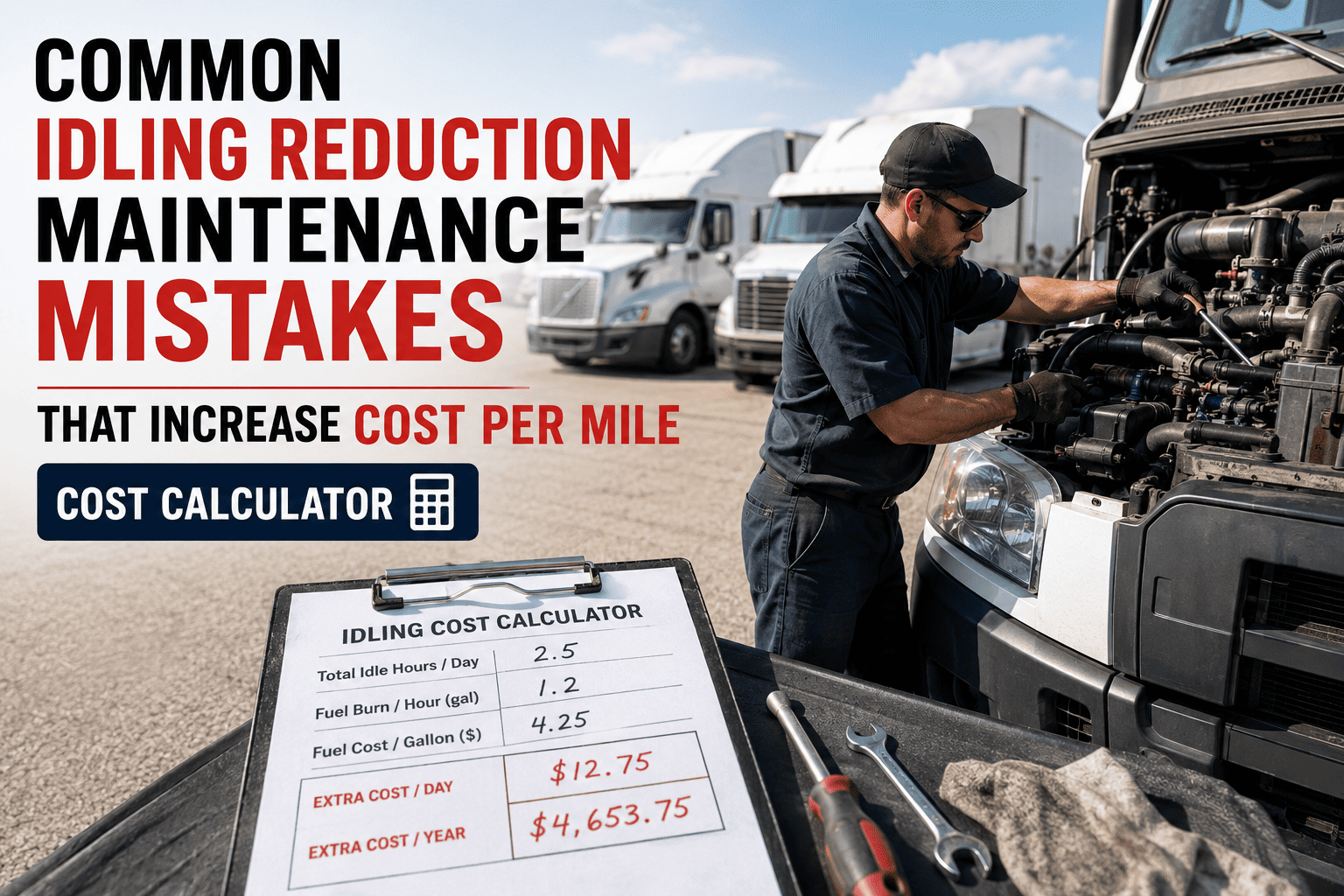
Cost per mile is the number every fleet lives and dies by, and idling quietly inflates it without ever touching the odometer. The mistakes that drive it up are not dramatic, they are routine: a warm-up that runs too long, a timer switched off, a maintenance interval set on miles instead of hours. A single truck idling eight hours a day, three hundred days a year, wastes around $6,000 in fuel for zero productive miles, and that cost lands straight on every mile you bill. Before you accept a higher cost per mile, see exactly where it leaks with a free trial or a demo.
Common Idling Reduction Maintenance Mistakes That Increase Cost Per Mile
Idle hours never show on the odometer, but they show up in every cost-per-mile calculation. Find the five routine mistakes inflating your number, and the math behind what fixing them returns.
Why Idle Never Shows On The Odometer But Always Shows On Cost
Cost per mile divides total operating cost by miles driven. Idling adds fuel, maintenance, and engine wear to the top of that fraction while adding zero to the bottom. Every idle gallon and every idle-driven repair makes the number worse, and because one idle hour ages an engine like three to six highway hours, the maintenance side compounds quietly until a rebuild arrives early.
Routine Habits Quietly Inflating Your Cost Per Mile
Engines run far longer than needed to warm up, especially in winter with no policy limit set. Minutes per truck per cold morning compound into thousands of idle gallons a season.
Trucks stay running through long loading and delivery waits instead of shutting down. Idling beyond 10 seconds already burns more fuel than a restart would.
Without a timer, the decision to shut off is left entirely to the driver every time, so idle accumulates differently on every unit with no guardrail.
Drivers leave the engine running for heat or AC during breaks instead of using cab power options, a leading reason trucks idle during off-duty hours.
Oil and filter intervals set on mileage ignore that a high-idle truck ages like a higher-mileage one, so emissions-system failures arrive unscheduled and expensive.
Put A Dollar Figure On Every Idle Mistake
Oxmaint converts idle hours into a cost figure per vehicle, route, and driver, separating avoidable idle from necessary idle and adjusting maintenance intervals on engine hours so emissions repairs stop landing early. The mistakes inflating your cost per mile become a line item you can see and fix.
What Fixing Idle Returns To Your Cost Per Mile
Idle reduction is one of the fastest paths to lower cost per mile because the savings are immediate and the investment is mostly behavioral. These are the levers and the numbers behind them.
| Idle Fix | What It Targets | Cost-Per-Mile Effect |
|---|---|---|
| Idle monitoring + coaching | Avoidable driver idle | Cuts idle time 30-50%, lowering fuel per mile |
| Warm-up policy limit | Winter over-idling | Removes seasonal fuel spikes from the cost base |
| Hour-based PM intervals | Emissions-system wear | Prevents early DPF, injector, turbo repairs |
| Shutdown timer enforcement | Idle during waits | Caps idle gallons with no driver decision needed |
| Cause tagging | Necessary vs avoidable | Targets only the waste, protecting operations |
From Idle Mistake To Lower Cost Per Mile
Oxmaint tracks idle hours by vehicle and driver, flags emissions-system wear early, and turns idle data into a maintenance plan you can act on, so the routine mistakes inflating your cost per mile become visible and correctable. Most fleets see measurable fuel savings within the first 30 days. See your own idle cost with a free trial or a demo.
Idle hours convert into a dollar figure per vehicle, route, and driver, so the cost behind every mistake is never hidden in a lump fuel total.
Maintenance intervals adjust for high-idle units, scheduling service ahead of the emissions-system failures that idle drives into your repair line.
Idle events tag by cause so policy targets only avoidable idling, protecting cost per mile without disrupting necessary operations.
Idle data turns into a maintenance plan you can act on, closing the loop from a flagged mistake to a scheduled fix.
How One Idle Hour Per Day Scales Across A Fleet
A single idle hour sounds harmless. Multiplied by every truck and every operating day, it becomes one of the largest controllable line items on your cost sheet. This is what one avoidable idle hour per truck per day compounds into as the fleet grows, at roughly a gallon per hour and typical diesel pricing.
One idle hour each per day across 300 operating days adds up to roughly 3,000 wasted gallons a year, spread invisibly across every mile billed.
The same single idle hour scales to about 15,000 gallons a year, a five-figure fuel cost that never moved a single load down the road.
At fleet scale, one idle hour per truck per day reaches roughly 30,000 gallons a year, directly inflating cost per mile across the operation.
Every one of those idle hours ages engines like three to six highway hours, stacking early repair cost on top of the fuel already lost.
The Cost-Per-Mile Mistakes That Hide The Longest
Some idle costs announce themselves; others stay buried for months because nothing on a standard report points to them. These are the quiet ones, the mistakes that keep inflating cost per mile precisely because no one is looking at the number that would reveal them.
| Hidden Mistake | Why It Stays Invisible | What Surfaces It |
|---|---|---|
| Effective engine age | Odometer reads low, hours read high | Tracking idle hours, not just miles |
| Lane-specific idle | Fleet average masks one bad route | Idle cost broken out per route |
| Seasonal warm-up creep | Blamed on weather, not policy | Cold-start idle tracked separately |
| Early emissions repairs | Filed as unrelated breakdowns | Linking high-idle units to repair history |
| Defeated shutoff timers | Assumed to be working | Override events flagged per unit |
Frequently Asked Questions
How does idling raise cost per mile if it adds no miles?+
Which idle mistake costs the most?+
Does idling really cause early engine repairs?+
How fast does fixing idle show in cost per mile?+
Will cutting idle hurt necessary operations?+
Lower The Number Every Mile Is Measured By
Every idle mistake is fuel and wear added to a cost per mile that never moved an inch. Make idle visible, price it per truck, and schedule maintenance on real engine hours, and the routine habits inflating your number start coming back out in week one.