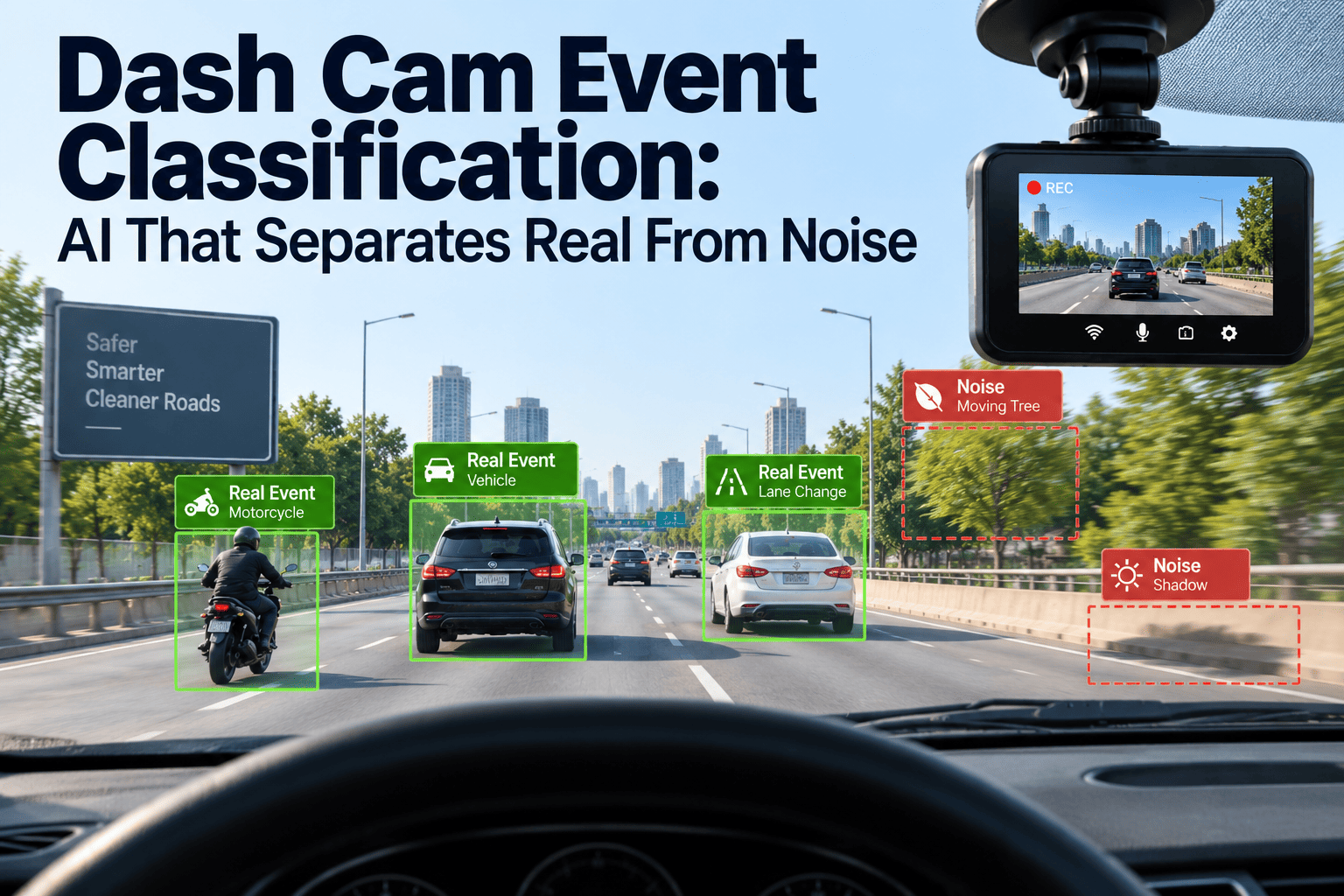
A hard-braking alert fires. A following-distance warning fires. A phone-use flag fires — except the driver was reaching for a water bottle. Multiply that by every vehicle in a fleet and safety managers end up buried under hundreds of clips a week, most of which never should have been sent in the first place. Event classification is the layer of a dash cam system that decides which of those clips actually matter, separating a genuine near-miss from sun glare, a pothole, or a passenger reaching across the seat. Fleets that get this layer right cut wasted review time dramatically and keep drivers trusting the technology instead of ignoring it. See how classified dash cam events turn into maintenance work orders inside Oxmaint and stop treating video data as a separate system from the rest of your fleet operation.
Dash Cam Event Classification: AI That Separates Real From Noise
How modern classification models tell a genuine safety event apart from sun glare, road noise, and driver-neutral moments — and why that accuracy decides whether your team trusts the alerts or starts ignoring them.
Why Unclassified Dash Cam Alerts Quietly Break Fleet Safety Programs
A camera that flags everything is not actually protecting anyone — it is training your team to stop looking. Early dash cam deployments learned this the hard way: a single g-sensor trigger or a basic distraction algorithm generates dozens of alerts a day per vehicle, and the overwhelming majority are not real risk. Sunlight hitting the windshield reads as a distraction event. A driver adjusting the mirror reads as phone use. A following-distance rule tuned for open highway fires constantly during stop-and-go city delivery routes. None of that is a safety event, but without classification, all of it lands in the same inbox as a genuine near-miss.
The cost shows up in two places. Safety managers burn time they do not have sifting through clips that never needed a human eye, and drivers — who see every false flag as an accusation — start disengaging from a program meant to protect them. Fleet turnover is already a pressure point in commercial transport, and a camera system that feels punitive rather than fair accelerates it. Classification is what turns a raw video stream into a safety program people actually trust.
There is a second, quieter cost that rarely makes it into a vendor pitch: signal loss. When dispatch stops opening alerts because most of them are noise, the fleet also loses the handful of alerts that were genuinely useful — the ones that would have caught a fatigued driver before a shift ended badly, or flagged a brake pattern worth a look before it became a breakdown on the highway. A classification layer that is tuned poorly does not just waste time; it actively hides the events that matter most inside a pile of ones that do not.
This is also where classification becomes a maintenance question and not just a safety one. Video evidence that repeatedly shows a driver braking hard on the same route, at the same intersection, in the same vehicle, is rarely a coaching issue alone — it can be worn brake pads, a suspension fault, or a tire that is no longer gripping the way it should. A classification system tuned only to police driver behavior misses this signal entirely, while one designed to route vehicle-linked patterns to maintenance catches it before it becomes a roadside failure.
How AI Event Classification Actually Works, Step By Step
Classification is not a single check — it is a layered pipeline that runs partly on the camera and partly in the cloud. Understanding the stages makes it clear why some vendors report near-perfect accuracy while others still flood inboxes with noise.
The gap between vendors usually comes down to how many of these five stages a system actually runs. A basic dash cam stops after stage one — it captures video and fires a threshold alert, full stop. A system built for a commercial fleet runs all five, which is the difference between an alert that says "something happened" and one that says exactly what happened, how confident the model is, and what should happen next.
Classified events are only useful once they trigger the right action
Oxmaint takes a confirmed dash cam event — hard braking pattern, repeated collision-warning cluster, a camera flag tied to a specific vehicle — and turns it straight into a scheduled inspection or repair work order, with the footage attached as evidence. No spreadsheet in between, no event sitting unread in a dashboard.
The Three Event Families Every Fleet Dash Cam Needs to Tell Apart
Not every event is a driver-behavior problem. A well-built classification model sorts video into distinct families before anyone reviews it, because a coaching conversation, an exoneration file, and a maintenance ticket all start from a different kind of clip. Treating all three the same way is exactly what buries useful signal — a repeated hard-braking pattern deserves a mechanic's attention, not a driver write-up, and a genuine near-miss deserves a coaching conversation, not a spot on a vehicle inspection list.
What Separates a Reliable Classification Model From a Noisy One
Vendor accuracy claims vary widely because they are testing different things. A camera advertising strong overall accuracy can still perform poorly on a specific behavior — texting detection alone has been measured anywhere from roughly one in eight events caught correctly to near-perfect, depending on the vendor and the lighting conditions tested. The table below breaks down what to actually check before trusting a number.
Ask any vendor for accuracy broken down by behavior type and by lighting condition, not a single blended figure. A system that scores well overall because it excels at simple hard-braking detection can still miss the harder calls — drowsiness, subtle lane drift, or phone use held low in the lap — that matter most for preventing the incidents that cost a fleet the most money.
| What To Check | Weak Classification System | Strong Classification System |
|---|---|---|
| Overall event accuracy | Below 80%, heavy on false triggers | 95% or higher across common event types |
| Low-light and glare handling | Accuracy drops sharply at dawn, dusk, or bright sun | Consistent detection across lighting conditions |
| Review workload after rollout | Dozens of clips per vehicle per day | Small, high-confidence queue of confirmed events |
| Model updates | Fixed logic on the camera's onboard chip | Cloud-trained models improve over time without new hardware |
Scroll horizontally on smaller screens to view the full comparison
What Fleets Report After Moving to Classified Event Alerts
These figures reflect outcomes reported across commercial fleets after moving from raw alert feeds to AI-classified, validated dash cam events connected to a maintenance and coaching workflow.
Insurers are also paying closer attention to how fleets use this data, not just whether cameras are installed. Renewal conversations increasingly ask for evidence of declining event frequency, documented coaching follow-through, and a track record of exoneration cases — all of which depend on classification working well enough that the underlying data is trustworthy in the first place.
Four Steps to Get From Raw Alerts to a Trusted Classification Workflow
Fleets that succeed with dash cam AI do not flip on every alert type on day one. They calibrate, connect the data downstream, and expand coverage once drivers see the system is fair. Book a demo to walk through how this plan maps onto your current fleet setup.
The order matters as much as the steps themselves. Fleets that try to connect every alert type to every workflow in week one tend to overwhelm both drivers and dispatch before the classification model has had a chance to learn the fleet's actual driving patterns. A staged rollout gives the system time to earn trust before it earns full authority over coaching and maintenance decisions.
Frequently Asked Questions on Dash Cam Event Classification
Turn classified dash cam events into completed work, not just clips in a dashboard
Oxmaint connects confirmed dash cam events to maintenance work orders, driver coaching records, and inspection schedules — so a real safety signal never sits unread waiting for someone to notice it.