The DOT inspector just pulled into your yard—unannounced. Your dispatcher is scrambling through filing cabinets for DVIR records while a driver searches his truck for the ELD printout from last Tuesday. Meanwhile, your IFTA quarter-end is three days away, and mileage logs from two trucks don't reconcile. The inspector is waiting. Your reputation is on the line.
Regional delivery fleets operate under a compliance microscope that intensifies every year. DOT roadside inspections, IFTA fuel tax audits, ELD mandate enforcement—each carries penalties that extend far beyond fines. A single out-of-service violation can cascade into increased insurance premiums, lost customer contracts, and CSA scores that haunt your operation for years.
This guide delivers the framework for building DOT/IFTA/ELD readiness through CMMS integration—transforming compliance from a quarterly panic into a continuous, automated process. Fleets implementing structured compliance programs report 85% reduction in audit preparation time and 60% fewer violations. Ready to make compliance automatic? Start your free compliance tracking with Oxmaint CMMS.
What if every inspection, every fuel receipt, and every driver log was automatically organized, audit-ready, and accessible in seconds?
DOT/IFTA/ELD Readiness via CMMS: Vendor Performance Scorecard for Regional Delivery
The Compliance Penalty Matrix
Understanding what's at stake clarifies why systematic compliance matters. These aren't theoretical risks—they're the actual costs fleets face when compliance gaps appear during audits or roadside inspections.
| Violation Category | First Offense | Repeat Offense | Hidden Costs |
|---|---|---|---|
| DOT Annual Inspection Lapse | $1,000-$5,000 | $5,000-$16,000 | Vehicle OOS, delayed deliveries, customer penalties |
| DVIR Not Current/Available | $500-$1,500 | $2,500-$5,000 | CSA points, insurance premium increase |
| ELD Violation (No Device) | $1,000-$2,500 | $5,000-$16,000 | Driver OOS 10 hours, missed delivery windows |
| HOS Violation (ELD Logged) | $1,500-$3,000 | $5,000-$11,000 | Driver disqualification risk, liability exposure |
| IFTA License Not Current | $300-$500/state | Operating authority suspension | Cannot cross state lines legally |
| IFTA Audit Discrepancy | Back taxes + 10% penalty | Back taxes + 25% penalty + interest | Audit flag for 3-5 years, increased scrutiny |
| Cumulative Annual Risk | $15,000-$75,000+ in potential fines, plus operational disruption and reputation damage | ||
Boost Fleet Management Safety with Connected Sensors
Connected sensors transform compliance from paperwork exercise to real-time safety assurance. When condition monitoring feeds directly into your CMMS, you're not just meeting DOT requirements—you're exceeding them with data-driven vehicle health management.
Cutting Downtime with Foresight — A Fleet Management Architecture with IoT
IoT-enabled compliance isn't just about avoiding fines—it's about preventing the downtime that compliance failures create. When sensors detect a brake issue before it becomes a DOT violation, you schedule repair on your terms, not the inspector's.
The Three Pillars of Fleet Compliance
DOT, IFTA, and ELD compliance each have distinct requirements, timelines, and documentation needs. Understanding how they interconnect—and how CMMS integration addresses each—is the foundation of sustainable compliance.
- Annual vehicle inspections (FMCSA 396.17)
- Pre-trip/post-trip DVIR completion
- Brake adjustment documentation
- Lighting and reflector compliance
- Tire condition and inflation records
- Automatic annual inspection scheduling
- Digital DVIR with photo documentation
- Defect tracking through resolution
- Inspection history by vehicle
- Vendor certification tracking
- Quarterly fuel tax reporting
- Mileage by jurisdiction tracking
- Fuel purchase documentation
- 4-year record retention
- Audit-ready reconciliation
- GPS-based jurisdiction mileage
- Fuel card integration
- Automatic MPG calculations
- Variance detection and alerts
- One-click quarterly reports
- FMCSA-registered ELD device
- Automatic duty status recording
- Driver log availability (current + 7 days)
- Data transfer capability
- Malfunction reporting procedures
- ELD data integration
- HOS violation alerts
- Driver scorecard generation
- Unidentified driving resolution
- Compliance trend analysis
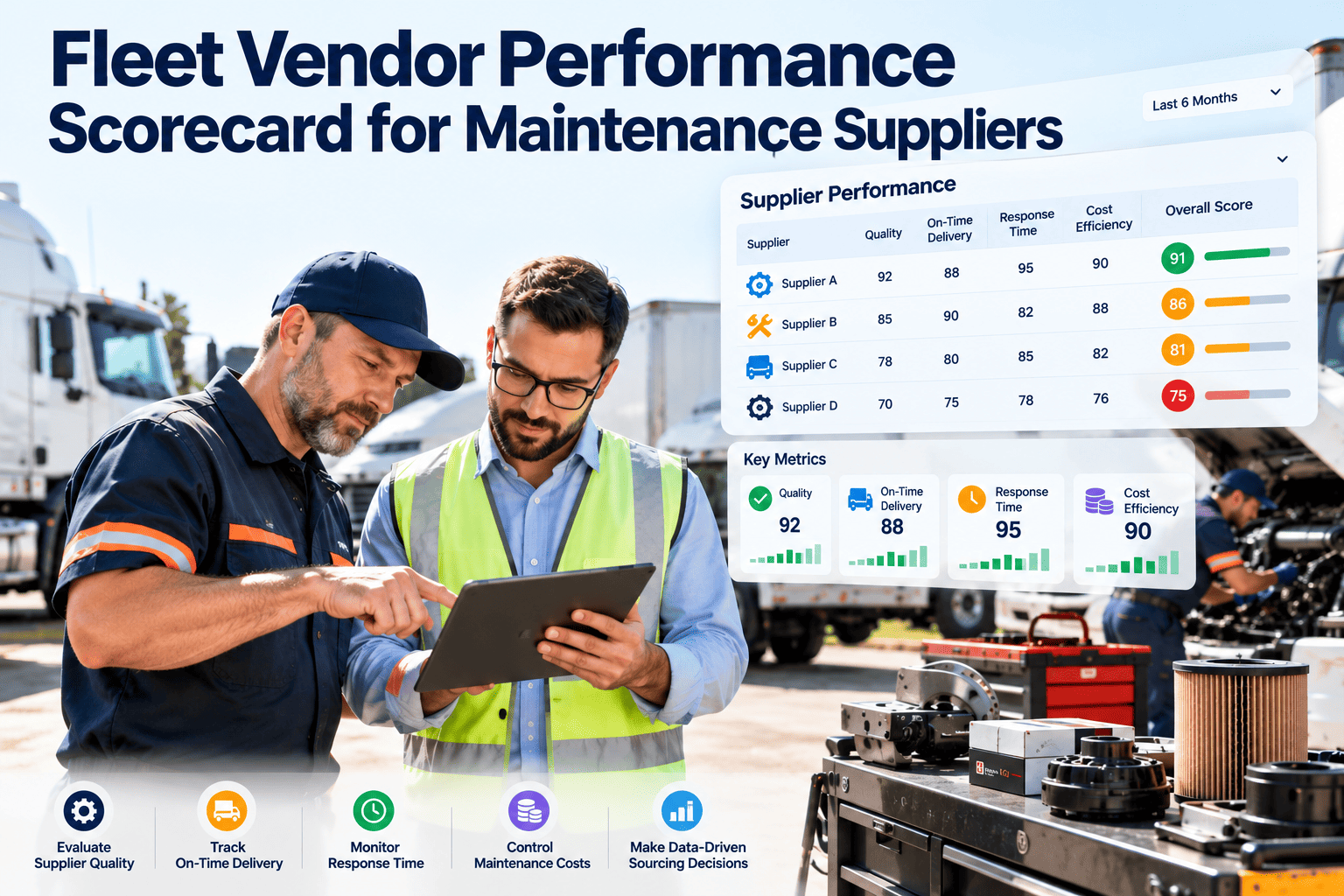
Vendor Performance Scorecard for Compliance Partners
Your compliance is only as strong as your weakest vendor. Inspection stations, ELD providers, fuel card companies, and maintenance vendors all impact your audit readiness. Structured scorecards ensure accountability across your compliance ecosystem.
| Performance Metric | Weight | Excellent (5) | Good (4) | Acceptable (3) | Poor (1-2) |
|---|---|---|---|---|---|
| Documentation Quality | 25% | Complete, legible, timestamped | Complete with minor gaps | Requires follow-up clarification | Incomplete or illegible |
| Turnaround Time | 20% | Same-day completion | Next business day | 2-3 business days | Greater than 3 business days |
| Defect Communication | 20% | Immediate call + written | Same-day written notice | Noted on paperwork only | No proactive communication |
| Pricing Accuracy | 15% | 100% match to quote | Within 5% variance | Within 10% variance | Greater than 10% variance |
| Scheduling Flexibility | 10% | Same-day availability | Next-day availability | Within 1 week | Greater than 1 week wait |
| Digital Integration | 10% | API to CMMS | Digital file delivery | Email/portal access | Paper only |
| Performance Metric | Weight | Excellent (5) | Good (4) | Acceptable (3) | Poor (1-2) |
|---|---|---|---|---|---|
| System Uptime | 30% | 99.9%+ | 99.5-99.8% | 99.0-99.4% | Less than 99.0% |
| Data Accuracy | 25% | GPS within 50ft, time synced | GPS within 100ft | Occasional drift/errors | Frequent inaccuracies |
| Support Response | 20% | 24/7 live, under 5 min response | 24/7 live, under 15 min | Business hours only | Slow/unresponsive |
| CMMS Integration | 15% | Real-time API sync | Hourly batch sync | Daily file export | Manual export only |
| Compliance Updates | 10% | Automatic, pre-deadline | Timely with notice | Reactive to regulations | Delayed updates |
Track every vendor, measure every interaction, ensure every compliance partner meets your standards.
Mobile Inspections: The Digital DVIR Revolution
Paper DVIRs are compliance time bombs—illegible entries, lost forms, undocumented defect resolution. Mobile inspections fleet management tools transform driver vehicle inspection reports into audit-proof digital records with timestamps, photos, and automatic defect tracking.
- Illegible handwriting
- Missing signatures
- Lost or damaged forms
- No defect follow-up trail
- Days-old data entry
- 100% legible, complete records
- Automatic defect escalation
- Photo evidence of conditions
- Real-time fleet visibility
- Instant audit response
AI Analytics for Compliance Intelligence
AI analytics transforms compliance data from historical records into predictive intelligence. Pattern recognition identifies compliance risks before they become violations, while anomaly detection catches documentation gaps in real-time.
Machine learning analyzes historical violation patterns, vehicle age, driver behavior, and route characteristics to predict which units face highest compliance risk in the coming 30 days.
AI continuously scans compliance logs for missing signatures, incomplete inspections, overdue certifications, and documentation inconsistencies that would fail audit scrutiny.
Algorithms compare fuel consumption against mileage patterns, flagging discrepancies that indicate data errors, fuel theft, or documentation gaps before quarterly filing.
Real-time analysis of driver hours, route distances, and delivery windows predicts HOS conflicts before they occur, enabling proactive route adjustments.
SLA Reporting for Compliance Stakeholders
Different stakeholders need different compliance views. SLA reporting transforms raw compliance data into actionable intelligence tailored for executives, operations managers, and safety directors.
Multi-Site Rollouts: Scaling Compliance
Regional delivery fleets often operate from multiple terminals, each with local compliance nuances. Multi-site rollouts with standardized processes ensure consistent compliance across your entire operation while accommodating regional requirements.
Fleet Management CMMS Best Practices for Compliance
Never rely on manual calendar tracking for DOT annuals. CMMS should automatically schedule inspections 30 days before expiration with escalating reminders.
ELD information should flow to CMMS automatically. Manual data entry creates gaps that auditors exploit and delays violation response.
Every DVIR defect needs a documented resolution path—work order created, repair completed, supervisor sign-off, vehicle returned to service.
Don't wait for quarter-end to discover mileage discrepancies. Weekly reconciliation catches errors while drivers still remember routes.
Inspection stations, ELD providers, and fuel card companies all impact your compliance. Track their performance with the same rigor as parts vendors.
Test your audit readiness before regulators do. Pull random vehicle files and verify every required document is accessible within 2 minutes.
Expert Review
Highest ROI compliance improvement—eliminates most common audit findings
Connect ELD, fuel cards, and GPS first—automation without integration creates silos
Compliance completion rates jump 40% when drivers understand violation consequences
Poor inspection vendors cause more violations than poor maintenance practices
Conclusion
DOT, IFTA, and ELD compliance aren't separate challenges—they're interconnected systems that either reinforce each other or create cascading failures. When your CMMS integrates vehicle safety data, fuel consumption records, and driver hours into a unified platform, compliance transforms from quarterly panic into continuous assurance.
Connected sensors catch safety issues before inspectors do. AI analytics predict violations before they occur. Digital DVIRs create audit-proof documentation automatically. Vendor scorecards ensure every compliance partner meets your standards.
The inspector will show up eventually. The question is whether you'll be scrambling through filing cabinets or handing them a tablet with everything they need.