
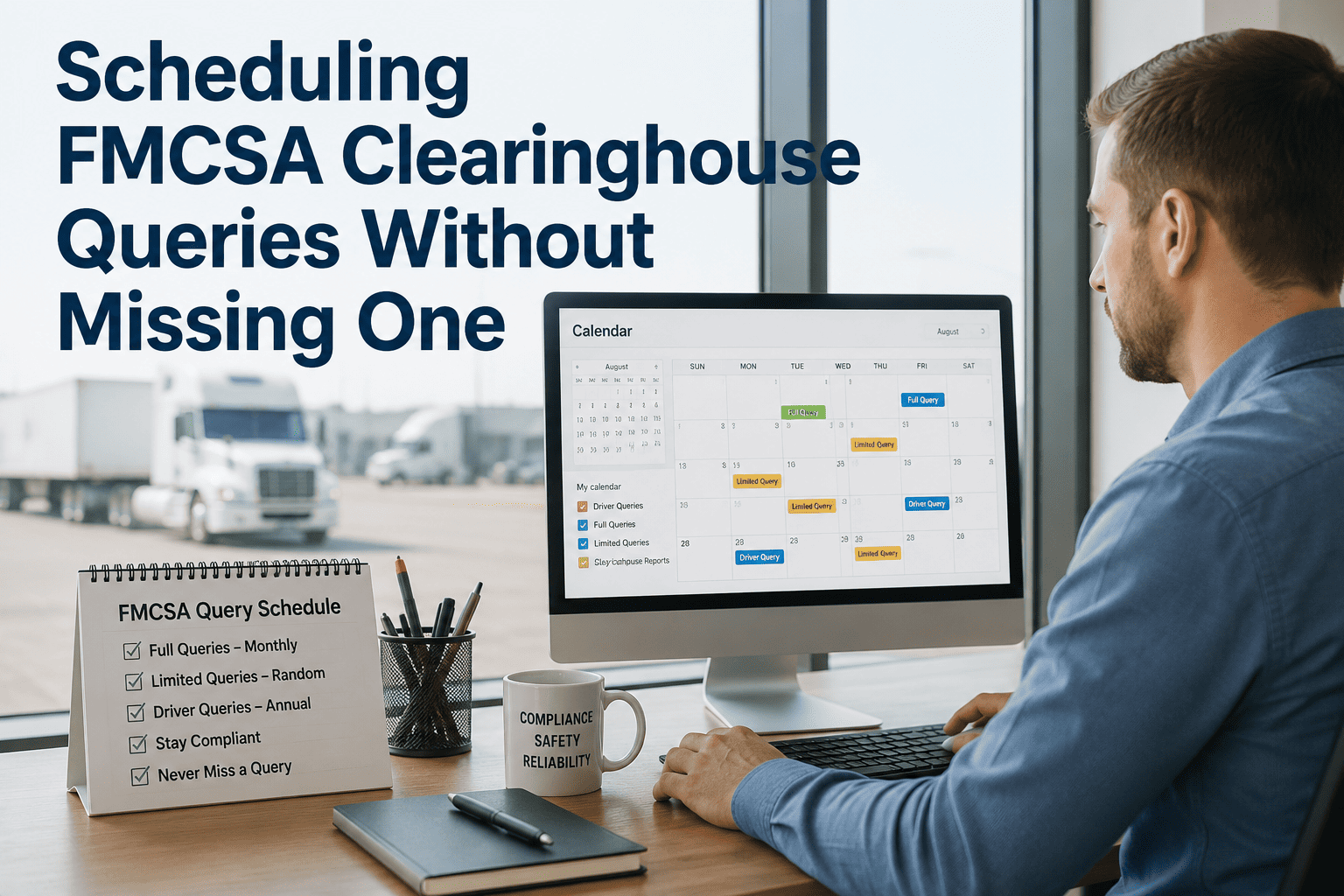
The FMCSA Drug and Alcohol Clearinghouse became mandatory for all commercial motor vehicle operators in January 2020, and enforcement actions for non-compliance have accelerated significantly since then. The Clearinghouse is a federal database that tracks drug and alcohol programme violations for CDL holders — and it changed three decades of industry practice in one fundamental way: a driver who fails a drug test with one carrier can no longer simply move to another carrier and start fresh. Every carrier must query the Clearinghouse before a CDL driver begins safety-sensitive functions, and must run annual limited queries on every current CDL driver. Failure to do either is itself a violation — separate from any underlying drug test result. OxMaint's driver qualification module tracks Clearinghouse query due dates per driver, generates alerts before annual query deadlines, and maintains the consent and query records that FMCSA auditors require.
Drug and Alcohol Clearinghouse Compliance for Fleet Operators
Pre-employment queries, annual checks, reporting obligations, return-to-duty process, and CMMS-integrated driver qualification file management — the complete compliance guide for fleet HR and compliance directors.
What the Clearinghouse Requires: The 4 Core Obligations
Clearinghouse compliance breaks down into four distinct obligations, each with its own trigger condition, deadline, and consequences for non-compliance. Most enforcement findings against carriers involve not the underlying substance violation — but a failure to run a required query before allowing the driver to operate. OxMaint tracks all four obligation types per driver and alerts compliance directors before deadlines pass.
Full Query vs Limited Query: What Each Covers
The two query types serve different purposes and have different consent requirements — a common source of audit findings is carriers who run the wrong query type or fail to obtain the correct consent documentation. OxMaint's driver records module stores consent forms and query results per driver, with the correct document type flagged for each query event.
What Must Be Reported to the Clearinghouse
Carriers are not passive users of the Clearinghouse — they are active reporters. Six categories of events must be reported within 3 business days. Missing a reporting deadline is an independent violation, separate from the underlying event. Many fleet operators focus on query obligations but overlook reporting obligations for non-positive outcomes like refusals and actual knowledge violations. OxMaint's compliance module generates Clearinghouse reporting reminders for each event type, with a 24-hour warning before the 3-day deadline expires.
The Return-to-Duty Process: Step by Step
When a CDL driver violates the drug and alcohol programme, they cannot return to safety-sensitive functions until completing a mandated process supervised by a Substance Abuse Professional (SAP). This process has strict sequence requirements — each step must be completed before the next can begin. The carrier's role is to verify Clearinghouse status and maintain documentation at each transition point. Many carriers make the error of allowing a driver to return before all steps are complete or before running the required return-to-duty query. OxMaint's driver qualification tracker records each RTD step completion with date and signatory — creating the audit trail FMCSA requires if the return is questioned.
We had 47 drivers to query annually and were tracking deadlines on a spreadsheet. After two near-misses where queries ran past the 365-day window, we moved to OxMaint. Now each driver's annual query date is in the system with a 30-day and 7-day alert. We haven't missed a query in 18 months.
Annual Query Tracking for Every CDL Driver — Automated.
OxMaint tracks query due dates per driver, sends 30-day and 7-day alerts, and stores consent forms and query results in the driver's digital qualification file. Free to start.
Technology Integration: How CMMS Supports Clearinghouse Compliance
The Clearinghouse is a documentation and deadline management problem as much as a testing problem. A fleet with 80 CDL drivers has 80 annual query deadlines — each on a different date, each requiring consent documentation, each subject to $16,000/day penalties for non-compliance. Manual tracking at scale is inherently unreliable. OBD and telematics data integration lets CMMS flag when a driver is operating — triggering a cross-check that the annual query is current before that shift. AI digital twin driver profiles track qualification status across DQF, Clearinghouse, medical certificates, and MVR in a single compliance record. OxMaint integrates Clearinghouse query tracking within the driver qualification module — so compliance directors see one dashboard covering all DQF requirements, not separate systems for each obligation type. SAP integration means the Clearinghouse record feeds directly into the enterprise HR record, eliminating dual-system maintenance.
Tracks all 4 Clearinghouse obligations per driver — pre-employment query date, annual query due date, consent form on file, and any violation status. Automated alerts before each deadline. Single qualification record per driver across all DQF requirements.
AI driver qualification profile combines Clearinghouse status, medical certificate expiry, MVR review date, and CDL class into a single compliance risk score per driver. Flags compliance gaps 60 days ahead — before they become violations.
When OBD data shows a driver is operating a CMV, the system cross-checks that their annual Clearinghouse query is current. Drivers whose query is approaching expiry generate an alert before they go on shift — not after a violation is already in progress.
Clearinghouse query records, consent forms, and violation events sync to SAP HR automatically — eliminating dual-system maintenance. Finance and HR have the same compliance record as operations, with no manual reconciliation required.
Frequently Asked Questions
Does the annual query requirement apply to part-time CDL drivers?
Yes. Any driver who holds a CDL and performs safety-sensitive functions for your company — full-time, part-time, or occasional — must be queried annually within 365 days. There is no minimum hours threshold. A seasonal driver who works 30 days per year still requires an annual query. OxMaint tracks query due dates regardless of employment type.
What happens if a pre-employment full query returns "violation found"?
If a pre-employment full query returns "violation found," the driver may not begin safety-sensitive functions. The carrier must review the full violation record. If the violation is unresolved, the driver cannot be hired for CDL roles. If the violation shows a completed return-to-duty process, the carrier may proceed — but must verify all steps are recorded as complete in the Clearinghouse.
Can a carrier use a TPA to manage Clearinghouse compliance?
Yes. Carriers can designate a Third Party Administrator to conduct queries and manage reporting on their behalf — but the carrier retains full legal responsibility for compliance. If the TPA misses a query or reporting deadline, the carrier is the responsible party. CMMS tracking of TPA-managed queries provides the audit trail needed to verify TPA performance. Book a demo to see OxMaint's TPA management integration.
How long must Clearinghouse query records be retained?
Clearinghouse records — query results, consent forms, and any violation documentation — must be retained for 3 years. They are subject to FMCSA audit at any time within that window. Digital storage in a CMMS produces the instantly retrievable records that paper-based systems struggle to produce under the 72-hour audit production timeline. OxMaint retains all query records with full audit metadata.
Clearinghouse Compliance — Tracked Per Driver, Automated.
OxMaint tracks annual query due dates, consent forms, and violation status per driver. Free to start.

-compliance-checklist.png)