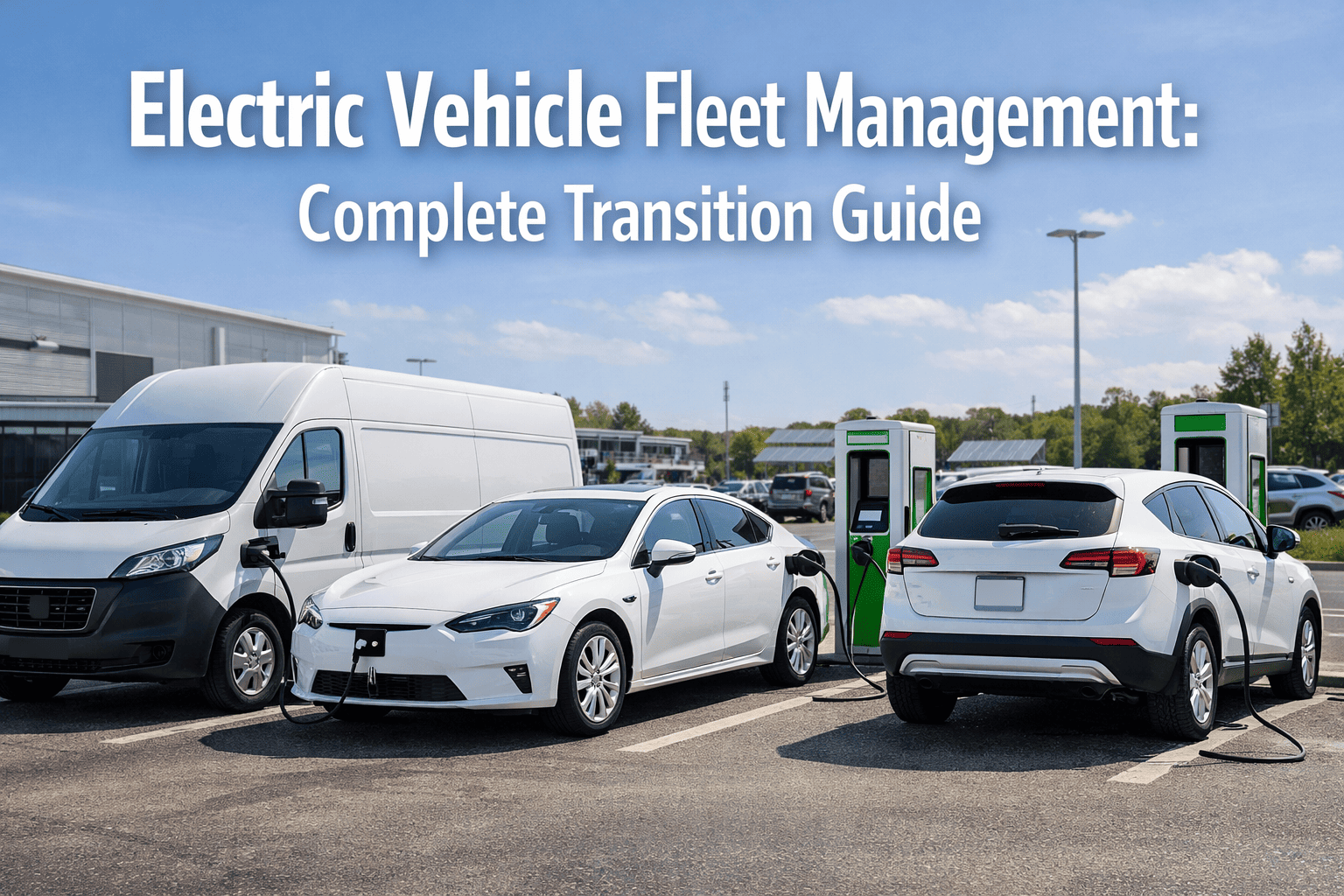
Over 38,000 medium- and heavy-duty electric trucks are now operating across 386 fleets in the U.S. — a figure that stood at just 219 in 2020. In 2026, the transition from diesel to electric is no longer a pilot project. It's a commercial reality reshaping how fleet managers think about maintenance, range, charging, compliance, and total cost of ownership. The EV fleet management market is projected to surge from $9.10 billion in 2025 to $32.25 billion by 2030 at a 22.7% annual growth rate. Major fleets — including Walmart, UPS, and the U.S. Postal Service — have already committed to six-figure electric vehicle deployments. And 87% of fleet owners expect to add electric vehicles within four years. The question is no longer whether to electrify. It's how to manage electric truck fleets efficiently, cost-effectively, and in compliance with tightening regulations — without replacing what works in your existing operation. This guide shows you exactly how. Book a demo to see how OxMaint supports your fleet's EV transition.
Manage Your EV Fleet and ICE Fleet in One Platform
OxMaint is the cloud-native CMMS that handles EV battery health, charging documentation, preventive maintenance, compliance, and work orders — all in one place. Free to start.
38,000+
Medium and heavy-duty electric trucks now on U.S. roads
22.7%
Annual growth rate — EV fleet management market through 2030
87%
Of fleet owners expect to add electric vehicles within 4 years
$32.25B
EV fleet management market size by 2030
Why 2026 Is the Inflection Point for Electric Truck Fleets
The industry crossed a critical threshold. For the first time, early-scale EV deployments — not just pilots — are the norm. In 2025, 61% of fleets announcing electric truck deployments were doing so for the first time. Nearly half already had existing electric orders in place, showing that early adopters are doubling down. Several converging forces are making electric truck fleets a strategic imperative in 2026, not just an environmental aspiration.
Regulatory Pressure
33% of new cars + 24% of new vans must be zero-emission in 2026 (ZEV mandate)
Cost Trajectory
U.S. Dept. of Energy: by 2035, zero-emission heavy trucks will be cheaper to buy, run, and maintain than diesel
Market Commitment
Major fleets committing to 30%+ zero-emission trucks by 2030 — setting precedent for all operators
Sustainability Reporting
In 2026, emissions metrics are tied to daily operations — idling, route efficiency, maintenance health, energy mix
E-Commerce Demand
Last-mile delivery growth driving electric van and truck adoption across urban low-emission zones
Electric Trucks vs. Diesel: The Real 2026 Comparison
Fleet managers evaluating EV adoption need a realistic picture — not just headline savings figures or headline concerns. Here's where the numbers actually stand for commercial fleet operations in 2026.
The 5 New Management Challenges Electric Truck Fleets Introduce
Electric trucks reduce mechanical complexity — but they introduce an entirely new layer of operational management that most fleet software wasn't designed to handle. Fleets that treat EV adoption as a procurement decision rather than an operations transformation run into these five challenges within the first 90 days.
01
Charging as a Dispatch Function
A fleet that doesn't manage charging well loses the operational benefits of EVs to "charging chaos." Charge windows must be scheduled around route commitments, avoiding peak demand hours that spike energy costs. Charger utilization needs to be tracked like bay utilization. Without active management, you end up with trucks that aren't ready when routes need them.
Poor charging management eliminates EV operating cost advantage within weeks
02
Battery Health Monitoring
Battery degradation is the primary financial risk in an EV fleet. Intensive utilization and frequent rapid charging accelerate cell wear — reducing range and creating fiscal uncertainty about asset residual value. Battery health must be tracked per vehicle, per cycle, with temperature, depth of discharge, and charge rate all logged to support warranty claims and replacement forecasting.
Battery degradation creates fiscal uncertainty — secondary market for EV trucks still maturing
03
EV-Aware Route Planning
EV range is not static. Temperature drops 15–20% range efficiency in cold climates. Heavy payloads cut range further. Routes that work for diesel don't automatically work for electric. Fleet managers need EV-aware routing that factors in charge state, range with load, temperature impact, and available charging infrastructure — not just distance and delivery windows.
Cold weather reduces EV range by 15–20% — route planning must account for conditions
04
Mixed Fleet Complexity
No fleet is electrifying overnight. The transition period — running diesel, hybrid, and electric units simultaneously — creates management complexity when different platforms handle each type. EV maintenance schedules, inspection checklists, and PM intervals look completely different from ICE vehicles. Managing them in the same system without mixing up protocols requires configurable vehicle profiles.
87% of fleets will run mixed EV/diesel operations for at least 5 years during transition
05
New Compliance Documentation
EV fleets face a different compliance landscape: charging session logs, battery certification records, regenerative braking inspection requirements, high-voltage system service documentation, and DOT inspection templates that don't yet have a universal standard across jurisdictions. Documentation gaps during the EV transition create audit exposure that most fleets don't anticipate.
EV compliance documentation requirements differ from diesel — most paper systems can't adapt
OxMaint Manages EVs and Diesel Vehicles in the Same Platform
Battery health tracking, charging documentation, EV-specific PM schedules, and mixed fleet analytics — all in one cloud-native CMMS. No switching between systems during your transition.
How to Build a Smart Electric Truck Fleet Strategy in 4 Phases
A successful EV fleet transition isn't a purchase decision — it's an operational transformation that takes 18–36 months for most mid-size fleets. Here's the phased approach that leading fleets are using to move from diesel-dominant to EV-capable without operational disruption.
Phase 1
Assessment and Route Matching (Months 1–3)
Analyze your current fleet's route data — daily mileage distribution, load types, dwell times, and depot return patterns. Identify the 20–30% of routes that are best suited for EV operation: short-haul, predictable, depot-returning within range. This data profile determines your initial EV vehicle count and charging infrastructure requirements before a single vehicle is ordered. Fleets that skip this step buy too many EVs for their actual route structure or too few chargers for their operating schedule.
Phase 2
Infrastructure Before Trucks (Months 2–6)
Charging infrastructure leads vehicle acquisition — not the reverse. Depot charging installation takes 2–4 months including grid capacity assessment, permit approval, and installation. Installing 10 Level 2 chargers costs $80,000–$200,000 plus grid upgrade costs that can exceed the charger cost itself for older depots. Federal incentives under the IRA can offset 30% of infrastructure costs through the Alternative Fuel Vehicle Refueling Property Credit. Lock infrastructure timelines before confirming vehicle delivery dates.
Phase 3
Initial Deployment and Data Collection (Months 4–12)
Deploy 5–15% of your target EV count first. Use this cohort to validate range performance against your route model, calibrate battery degradation curves for your duty cycle, train technicians on EV-specific maintenance, and establish your charging management workflow. The data from your first deployment cohort is operationally more valuable than any manufacturer spec sheet — it reflects your actual loads, your actual routes, and your actual driver behavior patterns.
Phase 4
Scale and Optimize (Month 12 Onward)
Armed with real performance data, scale your EV acquisition in line with your fleet replacement cycle. Retire highest-mileage diesel vehicles first. Continuously optimize charging schedules based on demand-charge patterns. Integrate EV performance data into your CMMS for predictive maintenance scheduling and total cost of ownership reporting. By Year 3, your EV fleet should be delivering documented fuel, maintenance, and compliance savings that feed your sustainability reporting and insurance premium negotiations.
How OxMaint Supports Electric Truck Fleet Operations
OxMaint is built for mixed-fleet environments where diesel, hybrid, and electric vehicles operate side by side. Every EV-specific management requirement is handled natively — without the workarounds and manual processes that generic fleet software requires when EV units are added.
40%
Fewer moving parts in EVs — significantly lower routine maintenance cost vs. diesel
$0.08/mi
Average energy cost for electric trucks vs. $0.28–$0.45/mi for diesel
1,000+
Metric tons CO₂/year eliminated — 50 electric vs. 50 diesel yard trucks
22.7%
Annual growth — EV fleet management market CAGR through 2030
Frequently Asked Questions
Questions fleet managers ask when planning their electric truck fleet transition — from total cost of ownership to maintenance differences and management software requirements.
Are electric trucks actually cheaper to operate than diesel in 2026?
For the right routes and use cases, yes — significantly so. Energy costs for electric trucks average $0.08–$0.14 per mile vs. $0.28–$0.45 per mile for diesel at current fuel prices. Routine maintenance costs are meaningfully lower due to 40% fewer moving parts — no oil changes, fewer brake services from regenerative braking, and no transmission fluid or belt replacements. However, the total cost calculation must include higher upfront vehicle cost ($250,000–$450,000+ vs. $130,000–$180,000 for diesel Class 8), depot charging infrastructure ($15,000–$80,000 per charger plus potential grid upgrade costs), and battery replacement risk over the vehicle life. The U.S. Department of Energy projects that by 2035, zero-emission heavy trucks will be cheaper on a total cost basis than diesel. For fleets in urban delivery, yard operations, and short-haul routes today, the economics are already favorable.
Sign up free to use OxMaint's cost-per-mile analytics to compare EV vs. diesel across your specific fleet.
How is EV fleet maintenance different from diesel fleet maintenance?
Electric trucks require fundamentally different maintenance protocols. The good news: far fewer scheduled service items — no oil changes, no transmission fluid, fewer brake replacements due to regenerative braking. The new requirements: high-voltage system inspections requiring certified technicians, battery thermal management system checks, software/firmware update management, charging equipment maintenance, cooling system monitoring for battery pack temperature, and regenerative braking system assessments. Tire wear and suspension maintenance remain comparable — and in fact may require more attention since EV torque delivery is more aggressive at low speeds. Your maintenance platform must be able to configure EV-specific PM schedules that don't conflict with your diesel PM templates. OxMaint handles this natively with per-vehicle-type schedule configuration.
Book a demo to see EV maintenance scheduling in action.
What fleet management software features do electric truck fleets specifically need?
EV fleets need four capabilities that most standard fleet management software doesn't natively support. First: battery health monitoring — tracking state of health, charge cycles, depth of discharge, and thermal history per vehicle with trend analysis and degradation alerts. Second: charging session management — logging each charge event with energy consumed, duration, and cost, with scheduling tools that avoid peak demand charges. Third: EV-specific PM templates — maintenance schedules that reflect electric drivetrain service requirements, configurable separately from diesel PM schedules in a mixed fleet. Fourth: cost-per-mile analytics that compare EV vs. diesel total operating costs in real time — the data leadership needs to validate the electrification investment and that insurers and ESG reporters increasingly require. OxMaint supports all four alongside its core CMMS capabilities.
Sign up free or
book a demo to configure your EV fleet setup.
Which types of routes are best suited for electric truck fleets right now?
In 2026, electric trucks excel in four route categories. Yard and depot operations: yard trucks running 50–150 miles per shift in controlled environments are the highest-ROI EV application — the $370,000 annual fuel savings from replacing 50 diesel yard trucks is well-documented. Urban last-mile delivery: delivery vans and light-duty trucks on urban routes with multiple stops, low daily mileage, and overnight depot charging. Regional distribution: routes under 200 miles daily with predictable schedules and depot return. Refrigerated urban delivery: where zero-emission zone regulations require electric regardless of economics. Long-haul routes remain predominantly diesel in 2026 — range, charging time, and infrastructure density still favor diesel for runs exceeding 400 miles. The most successful electrification strategies start with the EV-ready portion of the fleet and expand systematically as range, infrastructure, and economics improve.
Book a demo to analyze your route data for EV suitability.
How do electric truck fleets handle DOT compliance documentation differently?
DOT compliance for EV fleets introduces documentation requirements that don't exist for diesel vehicles. Pre-trip DVIRs must include EV-specific inspection points: high-voltage system indicator status, charging port condition, battery range display, and regenerative braking system function — in addition to standard DVIR items. Service records must document high-voltage system work with certified technician credentials. Charging session logs may be requested as evidence of proper battery management during audits. Software update records for vehicle control systems are increasingly expected as part of the vehicle maintenance history. OxMaint's digital DVIR templates are fully customizable — you can add EV-specific inspection points to pre-trip and post-trip checklists while keeping the standard DOT requirements intact. Every record is stored with GPS timestamp and driver signature for instant audit export.
Sign up free to configure your EV compliance documentation.
Your Electric Fleet Transition Starts With the Right Management Platform
OxMaint gives you battery health tracking, charging documentation, EV-specific PM scheduling, mixed fleet management, DOT compliance, and cost-per-mile analytics — all in one cloud-native platform built for real fleet operations. Join 1,000+ fleets already running smarter.
40%Lower Maintenance Costs
22.7%Market CAGR Through 2030
38K+Electric Trucks Deployed
100%DOT Compliance Ready