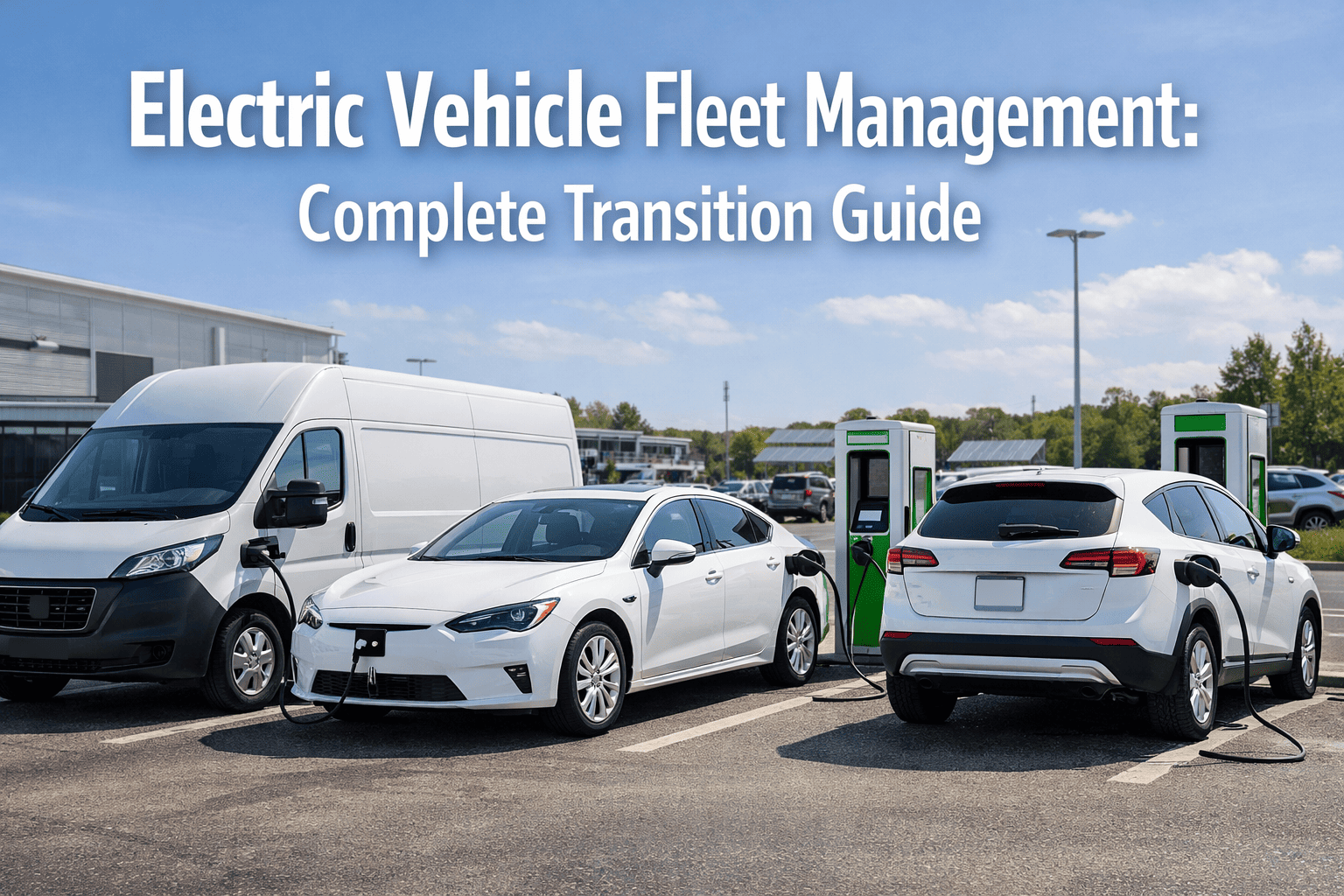
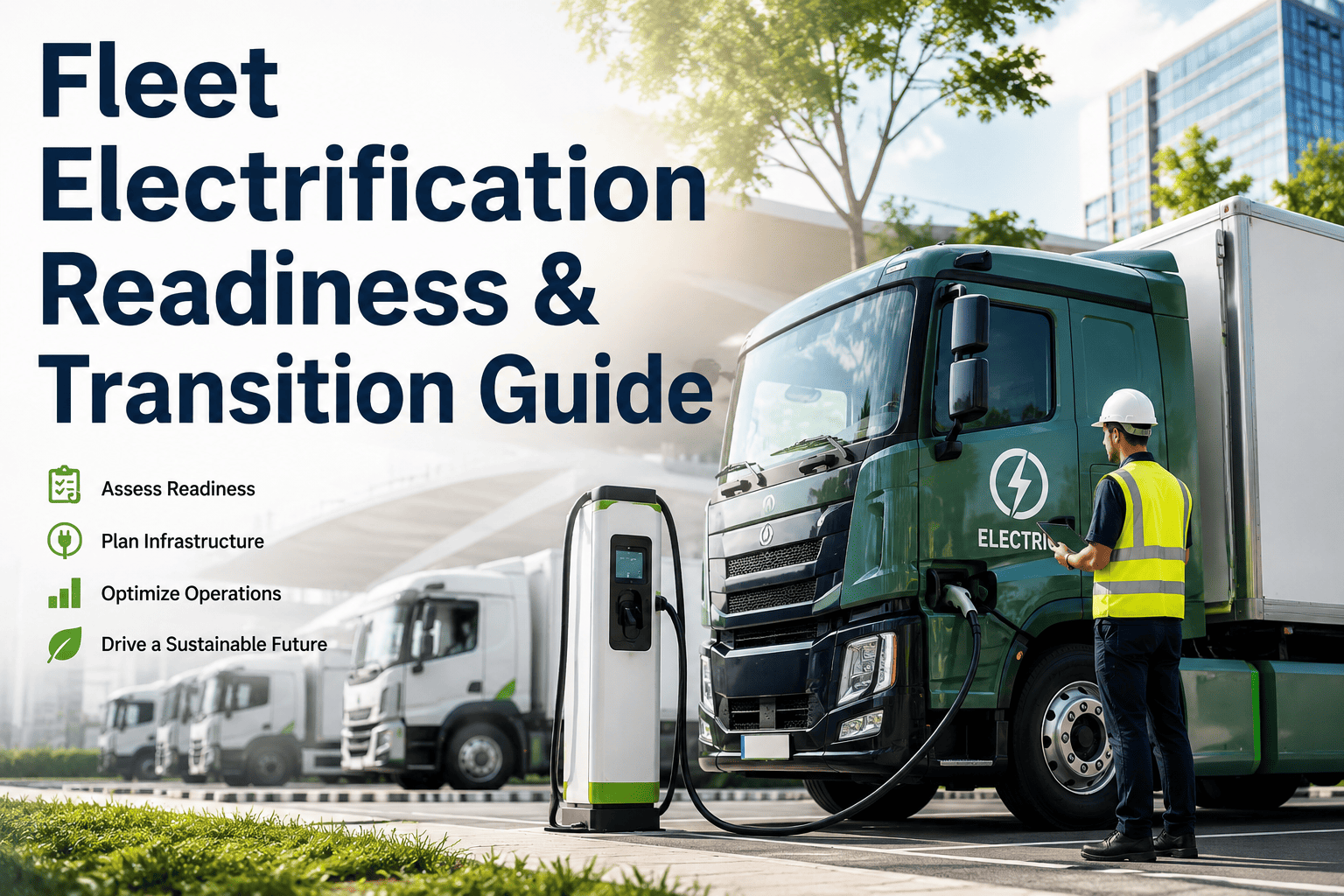
Electric Vehicle Fleet Management: Complete Transition Guide
By Jack Miller on April 8, 2026
A regional food distribution company in California decided to electrify 40% of its 180-vehicle delivery fleet by the end of 2025 — not because of ideology, but because diesel fuel costs had hit $6.20 per gallon in their operating region and the total cost of ownership math finally favored EVs for their urban delivery routes. The transition planning took six months. The execution exposed every gap in their existing fleet management infrastructure: their CMMS had no concept of state of charge, their dispatch system didn't understand range constraints, their maintenance programme was built entirely around ICE service intervals, and they had no way to track charging costs by vehicle or by route. Within eight months they had 72 EVs in service and were managing them alongside 108 diesel vehicles from a single OxMaint dashboard. Charging cost per mile: tracked. Battery health per vehicle: monitored. Range-appropriate route assignment: automated. OxMaint's EV fleet management module is built for mixed fleets in transition — not for fleets that have already completed electrification. Book a demo to see how your current fleet maps to an EV transition plan.
Manage ICE and EV Fleets Together — One Platform, One Dashboard
Battery health monitoring · charging infrastructure · range optimization · mixed fleet operations
Average EV energy cost per mile vs $0.19/mi for diesel at current US fuel prices — the TCO inflection point driving fleet electrification
40%
Lower scheduled maintenance cost for EVs vs equivalent diesel vehicles — no oil changes, DPF service, or transmission fluid — ATRI fleet benchmark data
8,100
Monthly searches for "electric vehicle fleet management" — the fastest-growing category in fleet management software as electrification accelerates across US industries
The 6 Operational Gaps That Appear When ICE Fleets Add EVs
Most fleet management platforms were built for ICE vehicles. Adding EVs to an ICE fleet exposes every assumption that went into that design — and creates operational gaps that cost money and productivity until they're resolved. OxMaint is built from the ground up for mixed ICE/EV fleets — without forcing you to run two systems or accept ICE assumptions applied to EVs.
1
Range Anxiety in Dispatch
Most common EV fleet failure — route assignment ignoring state of charge
Dispatching an EV with 180-mile range to a 220-mile route is an immediate service failure. OxMaint integrates state of charge data from every EV in real time — dispatch only assigns routes that the vehicle can complete on current charge, with configurable buffer margins per vehicle type and season.
2
Battery Health Degradation — Invisible Until It's Too Late
State of health below 80% meaningfully reduces usable range and vehicle value
Battery state of health (SoH) degrades with cycles, temperature extremes, and charging behaviour. OxMaint monitors SoH per vehicle using BMS data — flagging vehicles approaching the 80% SoH threshold that triggers warranty claims, affects resale value, and requires route reassignment before drivers report range shortfalls.
3
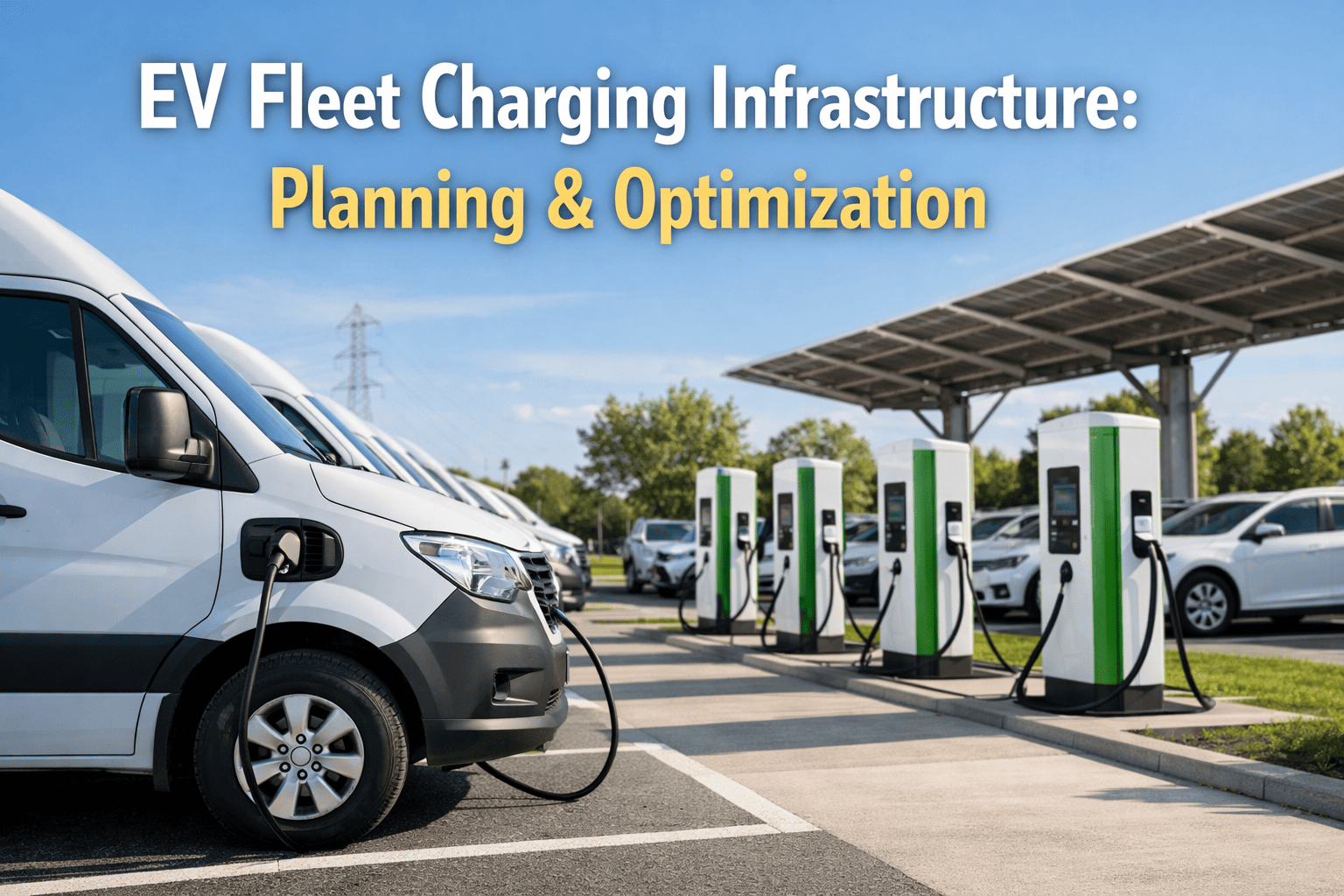
Charging Infrastructure Management
EVSE uptime directly equals fleet availability — an offline charger is an offline vehicle
A Level 2 charger that fails overnight means a vehicle starts its shift with 60% charge instead of 100%. OxMaint monitors EVSE health and generates PM work orders for charger maintenance — treating charging infrastructure with the same PM discipline as the vehicles it powers. Charger uptime tracked per station and per depot.
4
Charging Cost Allocation
The fleet finance problem nobody solved before OxMaint
When a driver charges at a public DCFC, at the depot, and at home — on three different billing systems — the cost-per-mile for that vehicle becomes impossible to calculate without a unified data layer. OxMaint aggregates charging events from all sources — depot EVSE, public network, and driver reimbursement — into a single cost-per-mile calculation per vehicle.
5
EV-Specific Maintenance Programme
Different service intervals, different failure modes, different technician requirements
EVs don't need oil changes, but they need thermal management system inspections, cabin air filter replacements, brake fluid changes (less frequent, but critical), tyre rotations (more frequent — due to regenerative braking load distribution), and high-voltage battery connector inspections. OxMaint configures EV-specific PM templates per model — separate from ICE schedules.
6
Mixed Fleet TCO Comparison
The business case for continued electrification requires per-vehicle comparison
Is your Class 6 EV box truck actually cheaper to operate than the diesel it replaced — or did the higher acquisition cost, charging infrastructure investment, and range limitations erode the fuel savings? OxMaint calculates actual TCO per vehicle for every EV and ICE vehicle in your fleet — giving you the real data behind the electrification business case, not the vendor's modeled projection.
EV Fleet Management — OxMaint
ICE and EV — One Fleet, One Platform, One Dashboard.
OxMaint manages battery health, charging infrastructure, range-aware dispatch, EV maintenance schedules, and mixed-fleet TCO — giving you the operational data your electrification transition actually requires.
EV Fleet Transition — From Planning to Full Operations
A successful EV fleet transition is not a vehicle procurement project — it is an operational transformation. The six phases below reflect what happens when fleets manage this with discipline versus when they improvise. OxMaint supports every phase from pilot to full deployment.
Phase 1
Route Suitability Analysis
OxMaint analyses existing route data — daily mileage distribution, dwell times, stop counts, and seasonal patterns — to identify which routes are EV-suitable on Day 1 vs which require charging infrastructure investment first
Phase 2
Charging Infrastructure Planning
OxMaint models charging demand per depot shift — calculating EVSE quantity, power level mix (L2 vs DCFC), and utility demand charge exposure for each charging configuration before capital is committed
Phase 3
EV Asset Configuration
Each EV configured in OxMaint with its BMS integration, battery capacity, degradation curve parameters, EV-specific PM template, and charging cost allocation rules — separate from the ICE fleet configuration
Phase 4
Mixed Fleet Operations Launch
ICE and EV vehicles dispatched from the same OxMaint interface — range-aware dispatch for EVs, standard dispatch for ICE, and EVSE monitoring running in parallel in the same maintenance dashboard
Phase 5
TCO Monitoring and Validation
Actual EV cost-per-mile compared against ICE equivalent monthly — showing real electrification savings, identifying routes where EV performance differs from projection, and generating data for the next procurement cycle
Phase 6
Electrification Reporting
EV penetration rate, Scope 1 emission reduction vs ICE baseline, charging energy consumption, and projected full-fleet electrification timeline reported to stakeholders — from the same OxMaint sustainability dashboard
EV vs ICE Maintenance — What Changes and What Stays the Same
The maintenance programme for an EV fleet is not simply a stripped-down version of an ICE programme — it has different intervals, different failure modes, and different technician qualification requirements. OxMaint configures separate PM templates for each vehicle type while tracking compliance on a single dashboard.
EV Transition Economics — By Fleet Type and Route Profile
EV fleet economics depend heavily on route type, duty cycle, and depot charging access. The comparisons below show actual operating cost ranges for real US fleets — not manufacturer projections.
Urban Delivery
Vans · Class 3–5 · 60–150 mi/day
ICE fuel cost per mile
$0.18–$0.24
EV energy cost per mile
$0.06–$0.10
ICE maintenance per mile
$0.09–$0.14
EV maintenance per mile
$0.04–$0.07
Annual saving per vehicle
$8,500–$18,000
Regional Distribution
Class 6–7 · 150–250 mi/day
ICE fuel cost per mile
$0.20–$0.28
EV energy cost per mile
$0.07–$0.12
ICE maintenance per mile
$0.11–$0.16
EV maintenance per mile
$0.05–$0.09
Annual saving per vehicle
$14,000–$28,000
OTR / Long Haul
Class 8 · 300–500+ mi/day
ICE fuel cost per mile
$0.22–$0.32
EV energy cost per mile
$0.10–$0.17 (DCFC charging)
ICE maintenance per mile
$0.14–$0.20
EV maintenance per mile
$0.06–$0.10
TCO break-even timeline
3–5 years at current pricing
We added 72 EVs to a diesel fleet and the hardest part wasn't the vehicles — it was the data. Which chargers were working? Which vehicles had enough charge for which routes? Which EV was actually cheaper to operate than the diesel it replaced? OxMaint answered all three from the same screen. Our dispatcher learned the EV workflow in two days. Charging cost per mile is now a daily metric. Battery health alerts have caught two degrading packs before they affected range.
— Fleet Director, 180-vehicle food distribution company, California, OxMaint user since 2023
Technology Stack — What Powers EV Fleet Management
OxMaint's EV fleet management integrates five technology layers — BMS data, telematics, charging network APIs, AI digital twin modeling, and maintenance records — into a unified operational platform. Connect your EV fleet technology through OxMaint.
BMS Integration
Battery Management System data — state of charge, state of health, temperature, cycle count, and fault codes — feeds OxMaint in real time for every EV in your fleet. Compatible with Ford Pro, GM BrightDrop, Rivian Commercial, Mercedes eSprinter, and major OEM BMS platforms.
AI Digital Twin
Each EV battery has a digital twin in OxMaint — modelling degradation curves against usage patterns, temperature exposure, and charging behavior. The twin predicts SoH trajectory 12 months ahead — enabling proactive warranty claims before degradation visibly affects operations.
Charging Network Integration
OxMaint integrates with ChargePoint, Blink, EVgo, and Electrify Commercial APIs — aggregating public charging sessions alongside depot charging data into a unified cost-per-mile calculation per vehicle. Driver home charging reimbursement tracked through OBD mileage attribution.
SAP / ERP Integration
EV charging costs, infrastructure maintenance records, and vehicle TCO data from OxMaint feeds SAP for consolidated fleet cost accounting — EV cost centres tracked separately from ICE, with full allocation transparency for finance teams building the electrification business case.
Frequently Asked Questions
Can OxMaint manage ICE and EV vehicles in the same fleet without separate systems?
Yes — OxMaint is built for mixed fleets. ICE vehicles run their standard PM templates; EVs run EV-specific templates with battery health monitoring, charging tracking, and range-aware dispatch — all visible in the same dashboard. No separate system or login required for the EV portion of your fleet.
How does OxMaint monitor battery health across different EV makes and models?
OxMaint integrates with OEM BMS platforms via API and telematics — pulling state of charge, state of health, cycle count, and temperature data per vehicle. Fleet managers see a battery health dashboard per vehicle with degradation trend lines and alerts when SoH approaches the 80% warranty threshold.
How does OxMaint track charging costs when drivers charge at multiple locations?
OxMaint aggregates charging session data from depot EVSE, public charging network APIs, and driver reimbursement records — calculating a single cost-per-mile per vehicle that captures all energy costs regardless of where the vehicle charged. Monthly charging cost reports are available by vehicle, driver, depot, and route.
Does OxMaint support EVSE charger preventive maintenance?
Yes — charging stations are registered as assets in OxMaint with their own PM schedules — annual inspection, connector cleaning, firmware verification, and cable condition checks. EVSE uptime is tracked per station, and offline charger events generate work orders automatically from the charger network integration.
How do we use OxMaint to build the business case for continued EV expansion?
OxMaint generates an EV vs ICE TCO comparison report per vehicle and per route — showing actual energy cost, maintenance cost, and downtime cost for each EV against the ICE vehicle it replaced. This report, updated monthly with real operating data, is the evidence base for the next procurement cycle and for board-level electrification investment decisions.
EV Fleet Management — OxMaint
Electrify Your Fleet. Manage the Transition. Prove the Savings.