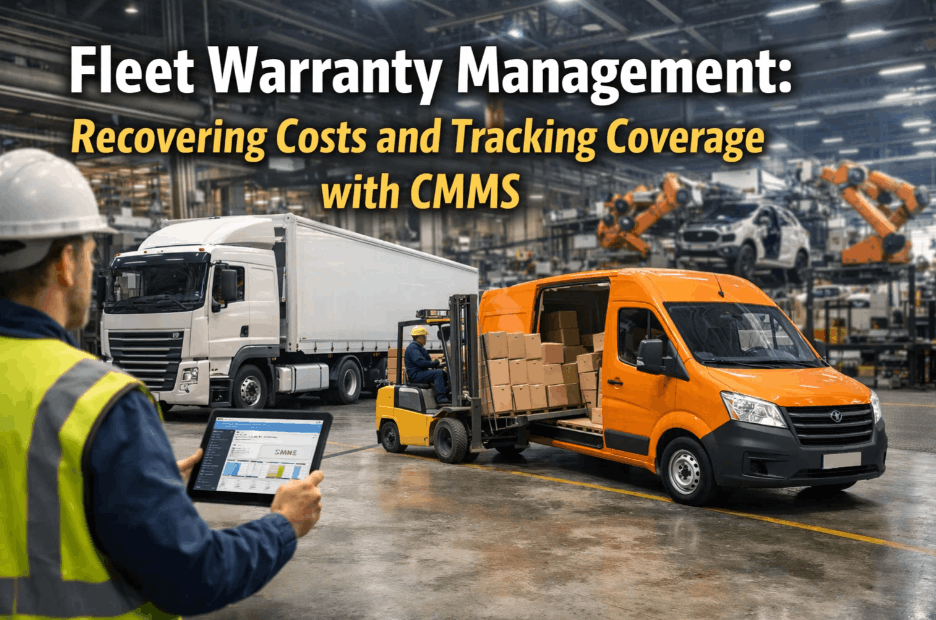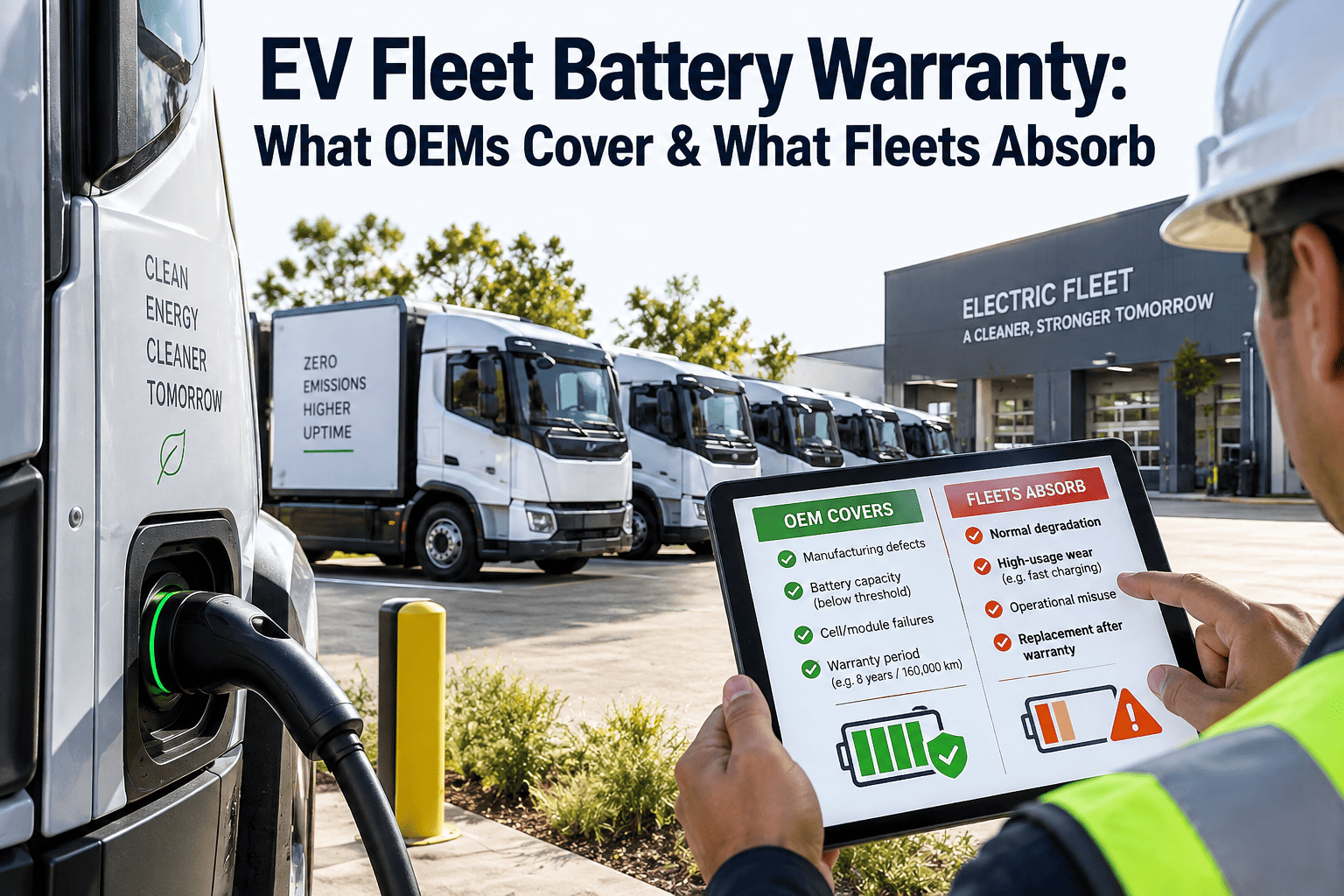
Every EV fleet buyer reads the warranty sticker and hears the same reassuring number: eight years. What that number hides is more important than what it promises — capacity floors, storage clauses, commercial-use carve-outs, and duty-cycle exclusions that were written with a suburban commuter in mind, not a van running three shifts a day. Fleets that assume "8-year battery warranty" means the same thing across Ford, GM, Freightliner, Rivian, and BYD end up paying full price for packs they thought were still covered. OxMaint helps maintenance teams track every asset's warranty window, capacity trend, and exclusion risk automatically, so a claim never gets missed because nobody was watching the odometer. Start your free OxMaint trial to see warranty tracking on your own fleet, or book a 30-minute specialist demo to walk through a real warranty audit workflow.
EV Fleet Battery Warranty: What OEMs Cover & What Fleets Absorb
Ford, GM, Freightliner, Rivian, and BYD all advertise generous EV battery coverage. The exclusions decide who actually pays when a pack degrades early — and most fleets find out the hard way.
What "Battery Warranty" Actually Promises
No OEM warranty promises a pack will perform on year eight exactly as it did on day one. What they promise is narrower — protection against manufacturing defects and against capacity loss beyond a defined floor, and nothing more. Understanding the four things a warranty actually covers is the difference between a valid claim and a denied one, and it is worth reading closely before a fleet builds its purchasing decision around a headline number alone.
Cell-level defects, faulty welds, or workmanship errors that surface as a fault code are covered by every major OEM for the full term, regardless of mileage or duty cycle, as long as the fault is not traced to misuse.
If usable capacity drops below the OEM's stated floor within the warranty window, the pack qualifies for repair or replacement. Gradual degradation that stays above that floor is treated as normal wear, not a defect.
Inverters, DC-DC converters, and the eDrive unit typically ride on the same coverage term as the battery pack itself, since a failure in any of these can mimic or accelerate battery degradation.
Impact damage, improper storage at extreme states of charge, unauthorized high-voltage modifications, and continued operation after a warning fault are excluded by every OEM in this comparison, without exception.
How Ford, GM, Freightliner, Rivian, and BYD Compare
The table below summarizes publicly stated battery coverage terms for vehicles commonly deployed in commercial fleets. Fleet-specific contracts and regional dealer programs can adjust these baseline terms, so always confirm against the in-service documentation for your own units. Legacy passenger-derived platforms tend to publish the clearest, most standardized language, while newer commercial-specific entrants are still catching up on documentation consistency across dealer networks.
| OEM / Platform | Battery Coverage Term | Capacity Floor | Fleet-Relevant Caveat |
|---|---|---|---|
| Ford F-150 Lightning | 8 years / 100,000 miles | 70% minimum | BEV production ended late 2025; existing units keep full coverage and long-term parts support |
| GM / BrightDrop Zevo | 8 years / 100,000 miles | 70% minimum | Commercial duty-cycle clauses can narrow coverage versus consumer GM EV terms |
| Freightliner eCascadia | Shorter, program-specific term | Varies by contract | Class 8 duty cycles and DC fast-charge reliance push OEMs toward conservative, dealer-negotiated terms |
| Rivian Commercial Van | Up to 8 years / 175,000 miles | 70% minimum | Mileage cap depends on pack size and motor configuration ordered |
| BYD Commercial | Varies by importer/dealer | Varies by market | Newer to North American fleet channels; terms are less standardized than legacy OEMs |
OxMaint logs every EV asset's in-service date, mileage, and battery health trend automatically, then flags units approaching their capacity floor or coverage window so your team files the claim before it expires, not after.
Five Ways Fleets Accidentally Void Their Own Coverage
Most denied claims are not disputes over degradation math — they are denials triggered by documented operating behavior that falls outside the warranty's normal-use definition. Fleet operators run vehicles harder than the warranty language was written for, and that gap is where claims get rejected. Understanding these five patterns ahead of time turns them from unavoidable risks into operational habits a maintenance team can actively manage around.
Parking a spare or seasonal unit at 0% or 100% for weeks accelerates cell stress and is explicitly excluded by every OEM in this comparison as improper storage, regardless of how the degradation actually occurred.
Dispatching a vehicle that threw a battery warning fault, because the route could not wait, is treated as owner-caused aggravation of the defect rather than a covered failure.
Running a passenger-derived platform on a commercial route it was never rated for, sustained overloading, or routing patterns well outside the OEM's stated use case can be cited as misuse during a claim review.
Aftermarket taps, non-OEM diagnostic tools connected to the high-voltage bus, or repairs performed outside the authorized network void coverage instantly, even on an otherwise healthy pack.
When a dispute happens, the fleet with dated service logs, charging records, and inspection history wins the argument. Fleets without that paper trail are asked to prove normal use after the fact, and often cannot.
How OxMaint Keeps Fleets Inside the Warranty Lines
A warranty is only as good as the records that support a claim. OxMaint builds that record automatically as part of everyday maintenance management, so a claim is a five-minute export instead of a two-week scramble through spreadsheets and paper logs.
In-service date, mileage, and battery health readings are logged against each vehicle automatically, building the exact timeline an OEM warranty desk needs to validate a claim.
When a pack's capacity trend approaches an OEM's stated floor, OxMaint generates a work order automatically, well before the vehicle drops out of coverage entirely.
Idle units sitting at risky states of charge are flagged so a technician can intervene before storage-related exclusions become the reason a claim gets denied.
Every reading, work order, and technician note is stored against the asset record permanently, ready to export the moment an OEM warranty reviewer asks for proof of normal use.
Why Fleet Duty Cycles Shrink Real-World Coverage
Every warranty term on the comparison table above was written against a baseline assumption: one driver, roughly 12,000 to 15,000 miles a year, mostly Level 2 home charging, and long idle periods overnight. A commercial route breaks nearly every one of those assumptions at once, and that gap is where fleet operators lose the most warranty value even though the printed term never changes.
A delivery van covering 40,000 to 60,000 miles a year hits a 100,000-mile mileage cap in under three years, well before the eight-year clock runs out. The term that looked generous on the brochure becomes the binding constraint almost immediately once the vehicle is actually working.
A home-charged commuter EV might see a handful of DC fast-charge sessions a month. A route vehicle topping off midday to finish a second shift can rely on fast charging dozens of times a month, a pattern the warranty language treats as occasional, not routine.
Rotating drivers across shifts means nobody owns the vehicle's charging discipline the way a single commuter would. Warning lights get ignored more often when the person driving today will not be the one dealing with the consequences next week.
Sustained heavy payload, frequent stop-and-go traffic, and towing all draw more current and generate more thermal stress than the light-duty driving patterns most consumer battery warranties were modeled against.
None of this voids a warranty by itself — normal commercial use is still normal use. The risk is that fleets without visibility into these patterns cannot tell the difference between ordinary degradation and a defect worth claiming, and often let a valid claim expire simply because nobody was tracking the trend closely enough to notice it crossing the line.
Extended Plans, Third-Party Coverage, and Self-Insuring the Gap
Once a fleet understands where factory coverage actually ends, the next question is how to handle the exposure that remains — mileage that outruns the term, capacity loss that stays just above the floor, or units that age out of coverage entirely while still on active routes.
Some manufacturers sell extended coverage for the rest of the vehicle, while explicitly carving the high-voltage battery back out, since it already carries the longest factory term. Confirm battery inclusion in writing before assuming an extended plan closes the gap.
Independent providers are beginning to offer battery-specific coverage sized for commercial mileage, but underwriting quality varies widely and few have long enough claims history on EV packs to prove they will pay out reliably.
Many fleets budget a per-vehicle reserve for pack replacement once factory coverage lapses, treating it the same way they would budget for a major engine overhaul on a combustion fleet nearing end of life.
Fleets tracking capacity trend lines can often predict, years in advance, roughly when a given unit will need a pack replacement or should simply be cycled out of the fleet before that cost hits.
Frequently Asked Questions
These are the questions fleet managers raise most often once they move past the headline warranty numbers and start planning how coverage actually applies to vehicles running real commercial routes rather than a single daily commute.
Does a used or transferred EV keep its original battery warranty?
Can fast-charging habits void a fleet EV's battery warranty?
Do extended service plans cover the high-voltage battery?
How is capacity loss actually measured during a claim?
What records should a fleet keep to protect a future claim?
Know Exactly What's Covered on Every EV in Your Fleet
OxMaint tracks in-service dates, capacity trends, and coverage windows across every EV in your fleet automatically, so warranty claims get filed on time and disputes get resolved with data instead of guesswork. Most fleets are fully set up within two weeks.